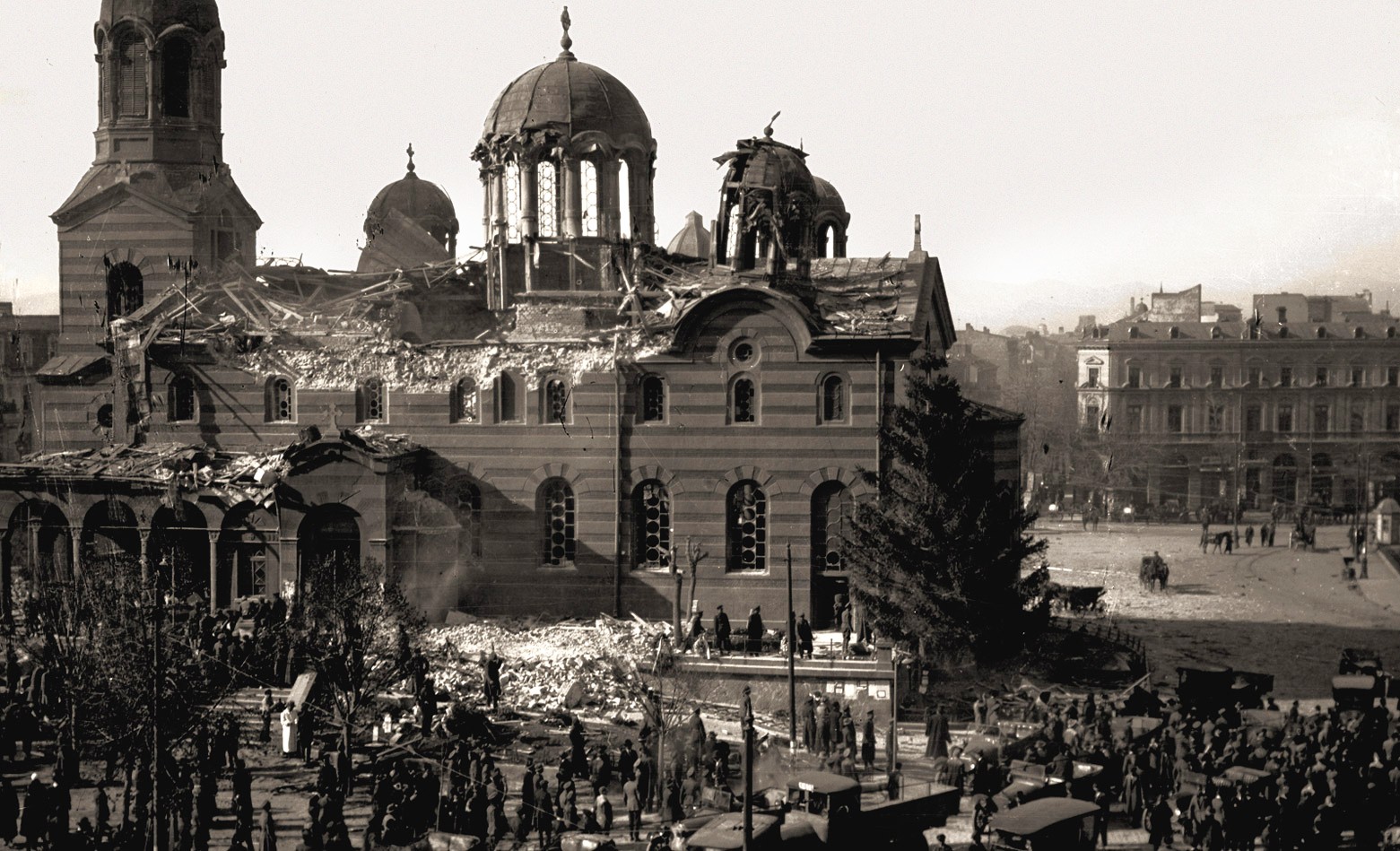
Bulgaria of the early 1920s was home to many White refugees from Soviet Russia and, with its substantial Communist and peasant movements, was the site of a ferocious campaign against the left that would, in many ways, be a precursor of the 1930s fascist regimes. Two years, and much blood, after Zankov’s 1923 military coup in Bulgaria, an April 16, 1925 assault on Sofia’s St. Nedelya Cathedral, during the funeral of the assassinated General Konstantin Georgievin, killed 200 people, mostly members of the country’s ruling class and its political, military, and religious elite. The backlash that followed was even more horrific than the events, some of which are described below, leading to it.
‘Why The Infernal Machine Exploded in Bulgaria’ by Al. Kolossov from The Daily Worker. Vol. 2 No. 121. June 3, 1925.
COMRADE STOYANOV, a Communist, member of the Bulgarian parliament, a comrade whose unrelenting and unwearied fight against the regime of bloody violence was brought to an end two months ago by his being shot down in the streets of Sofia, sent to the International Red Aid in the spring of last year the diary of one of Zankov’s hangmen, who had ended his prolonged and bloody “work” by suicide.
In the letter accompanying the diary Comrade Stoyanov wrote, that the number and the names of the victims of the Zankov terror cannot be ascertained, that this terror is indescribable, as human language lacks the words with which to describe the sufferings of the blood-soaked country and that, therefore, this task must be “left to the words of the hangman,” whose diary provides some sketches of the white terror carried on by the Bulgarian government.
THIS diary is the unique confession of a Bulgarian officer, a former social democrat, who at the end of 1923, was the leader of a punitive expedition which went from place to place carrying fire and bloodshed and practicing innumerable acts of violence.
At a time when the Zankov agents are fabricating “documents of the Comintern and of the Soviet government,” at a time when the capitalist press is endeavoring to demonstrate the hand of Moscow in the Bulgarian events, it is very opportune to turn over the gruesome pages of the confession of a hangman and to read the bloody records of an eyewitness of the acts of the white terror and to convince oneself that the avenging explosion of the infernal machine was an outbreak of desperation, which has seized the mercilessly tortured and plundered working masses of the country who have nothing to lose but prison walls, torturings, and death from starvation.
What is the peasant policy of the government of this land of peasants?
In the attached case of the writer of the diary there lay the “instructions” of the authorities in Sofia, which prescribe:
1. “When circumstances render it necessary, the entire population of the villages must be exterminated!”
2. “No prisoners must be taken!”
3. “Individual executions should be carried out with the cold steel!”
TO whom has the government entrusted the fate of the Bulgarian villages?
Below there is given the type of one of the dictators, an absolute ruler over the rural areas.
“One of my companions,” writes the author of the diary, “is a fat, under-sized person: his bloated cheeks are clean shaven, his black moustache, which is touched with grey, is curled upwards, his eyes are inflamed as a result of continual drinking; but the chief thing that impresses one’s memory, are his low forehead and the tousled hair hanging over it!” ‘I only need to look at a fellow who is going to be hanged, young man,’ said he, ‘and I can tell what convulsions he will have; his arms and legs will twist and turn, will now stretch out or will bend in the form of half a wheel, with convulsive movements at the sides. Thus, for example, I can tell from your neck that your limbs would be bent and that you would have long convulsions. I, however’…”
THE sadistic dictator could not finish his speech. There entered the room now glancing sideways, now looking on the ground, now fastening her eyes on one point, an old woman. She came up to the table, began to tremble, and her sobs filled the room. She bowed to the ground and began with groans to beg that the corpses of her two young sons who had been executed a week before might be given up.
One insufficiently acquainted with the exercise of the white terror by the Bulgarian government could easily assume that this is only directed with all its rigor against the Communist Party, against the working masses and against the revolutionary active peasants. The language of the documents tells a somewhat different story. Facts and figures bear witness that the terror in the country under the rule of Zankov has reached a point of blind, pitiless and bestial cruelty, where the hangmen can no longer distinguish the active opponents from the masses of the workers, and class hate knows no limits.
“Seven condemned,” states the writer of the diary, “are bound together. A living wall, a wall of human bodies.”
WHO are these people who are to be slaughtered, concerning whom it is prescribed, “they must not be hanged but finished off with the cold steel?”
“It is within my own knowledge,” writes the author, “that this man was arrested, as he was returning home after the burial of his son, that one as he was going into his little vineyard, and this one was simply fetched from his hay wagon.
Nevertheless, the leader of the punitive expedition, who was only recently a “member of the social democratic party,” in the “name of the government,” gave the order, and stabs were given which penetrated into the back and into the deck; crunching sounds of the breaking of bones; the dull sound of the bayonet which splits the bones…One has fallen into the grave…Another one, another and yet another. Still living they are thrown into the grave with its walls of damp black earth. Dozens of spadefuls of earth are thrown over them, and thru the noise of the falling clods there rises the faint groaning of men in their death agony: “Stop, I am still alive!…”
***
“Silence reigns over the country. And even the mothers, who on Saturday visit the graves of their sons who have been hung, shot or had the flesh torn off them, silently weep, without speaking a word, for the invisible, but all-seeing gendarme follows on their heels.”
THE above is from a letter from a Bulgarian student, who is neither a member of the Communist Party nor of the Young Communist League, to a colleague who is studying at the Berlin university.
“In September, 1923, all lights in the villages were out. A darkness and stillness as of the grave reigned over the fields of Bulgaria.
“Strike a light grandmother; Just a light so that I can see to change my clothes,” asks Comrade Torov, who has escaped from the prison of Stara Zagora, of an old peasant woman.
“Have you gone mad?” exclaims the old woman in reply, her whole body trembling. “And what about the guerilla? They will be here in a minute. They will sweep down like fierce vultures.”
THE guerilla is Zankov’s band for maintaining order. It Is the members of this band who fling peasants into the wells for being behind in paying their taxes, who rape young women, who, in an intoxicated condition, set fire to the peasants’ houses, hang the village school teacher, declare the last horse o$ the peasant to be “state property” and create that horror which lies upon the souls of the Bulgarian peasants and which was described by Comrade P. who has recently fled to Poland:
“The burning village lay before us seven or eight kilometers distant. The flames seized only a portion of the village, and to the left, half a kilometer from the burning houses there flared up three separate huge tongues of flame which lit up the few dozen houses which still remained untouched by the fire. One could hear the weeping, crying and sobbing of the women and children, the wild lowing of cows and oxen, the bleating of sheep and the crashing of the walls as they collapsed. This government of the bloody Zankov was settling accounts with the “disobedient” peasants. The air trembled, the first shot was followed by a second, then a third and a fourth, the punitive expedition was commencing artillery fire. Fresh sparks shot up to the heavens and lit up that portion of the village which lay between the main conflagration and the three sheets of flame.”
And here is the testimony of another eye witness.
“Below, a kilometer from the maple trees, there lay on the right bank of the brook a little village, and on the trees there hung three corpses, one of a youth, another of an old peasant and the third of a priest The morning breeze played with the wavy beard of the old peasant; a strange smile lay upon his face. Upon the bare breast of the priest there shone a cross that had been hacked with a sabre; the blood was dripping down and two yellow flies had crawled into the depths of the wound.”
Is there any need to ask why the infernal machine exploded?
The Daily Worker began in 1924 and was published in New York City by the Communist Party US and its predecessor organizations. Among the most long-lasting and important left publications in US history, it had a circulation of 35,000 at its peak. The Daily Worker came from The Ohio Socialist, published by the Left Wing-dominated Socialist Party of Ohio in Cleveland from 1917 to November 1919, when it became became The Toiler, paper of the Communist Labor Party. In December 1921 the above-ground Workers Party of America merged the Toiler with the paper Workers Council to found The Worker, which became The Daily Worker beginning January 13, 1924.
PDF of full issue: https://www.marxists.org/history/usa/pubs/dailyworker/1925/1925-ny/v02b-n121-NYE-jun-03-1925-DW-LOC.pdf

