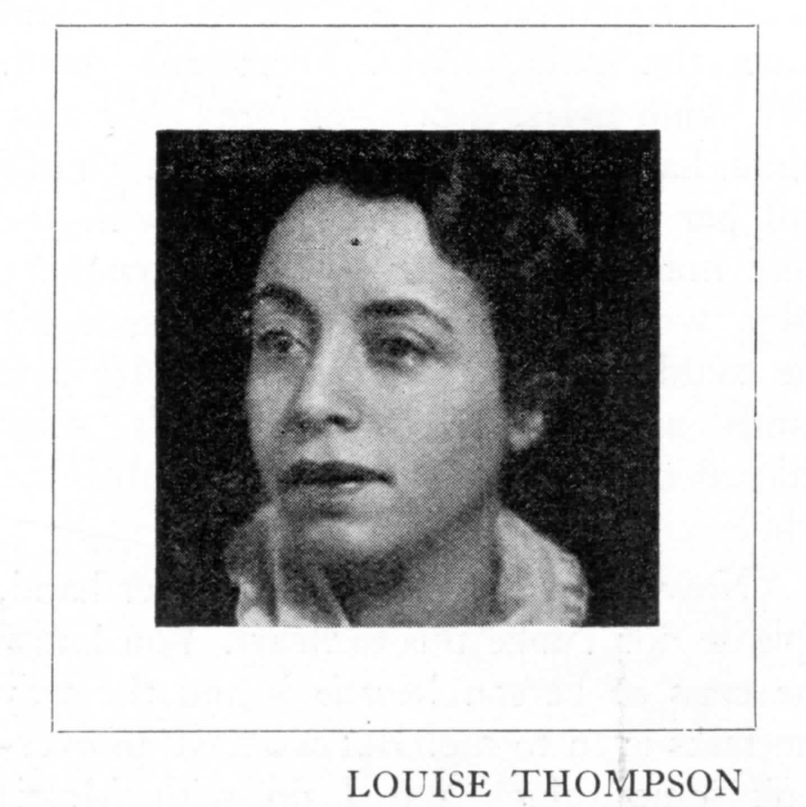
Louise Thompson was among the most important early Black women Communists in the U.S. and a leader of Scottsboro and Party work in Harlem during the 1930s. She would later marry William L. Patterson, Secretary of the International Labor Defense. Much of her national work in the 30s was with the I.L.D. and as vice-president of the International Workers Order.
‘Negro Women in Our Party’ by Louise Thompson from Party Organizer. Vol. 10 No. 8. August, 1937.
A CONFERENCE on Negro women was held in New York City a few weeks ago. This conference was considered historic, because it was the first such conference held. It was an historic one also so far as the composition of its delegates and the quality of the discussion that ensued there were concerned. It was held on June 6; there were 92 official delegates and 75 visitors. Fifteen of these delegates were Negroes; two non-Party women were invited and both joined the Party at the conference. One was the sister of Alonzo Watson, the first Negro to die in Spain. The topics of the conference were:
a. The Negro woman in industry.
b. Organizing the unorganized, and neighborhood and church work.
c. The role of the Negro woman in the Party.
Recruiting was discussed freely and during those seven and a half hours which the conference lasted, not a person left the hall until the conference was over, and it was one of those intensely hot days. There were 43 women and one or two men who participated in the discussion. They discussed very frankly and freely all the problems concerning Negro women.
The Promotion of Cadres
The main emphasis in the conference was on the promotion of cadres. It was proposed that special attention be given to Negro women on the basis of their special problems; that special classes be organized where necessary; that more women be brought into the trade unions, the peace movement, and the Party.
I want to speak about the sewing project, where some of our best Negro women comrades are working. There are some 3,700 women of all nationalities on this project, Negro and white. We found at the beginning that Negro: women were not given leading positions, were not given promotions. Through the work of our council we now have a number of Negro women who have the respect and are the leaders of all of these nearly 4,000 women. It is not insignificant to note that among these thousands of women, many of them are Italian women. The relationship that has developed between the Italian and Negro women on the sewing project is a splendid demonstration of what can be done by correct work.
A few remarks on building the Party among the Negro women. I think that if we examine our work we will see the necessity of finding special ways of recruiting Negro women in the Party. I know from experience—not personal, so much, but by observation—many times Negro women, because of extra special conditions that have kept them up to now out of the labor movement entirely, feel quite strange when they come into our movement. Perhaps we recruit some of them into the Party. Many of them feel strange. When they come to our meeting or affairs they do not feel that they fit in, they do not feel as much a part of it as even are Negro men comrades.
Perhaps this is not the basic point to consider when we talk about the recruiting of Negro women into the Party, but I think it is an important consideration in helping to keep them in the Party. I think, too, that Negro men comrades should place emphasis upon bringing Negro women men into the Party.
It seems to me it should be in a sort of personal way. Our women have been so cut off from the labor movement; I know they feel strange. Many times we have to win them in different ways—with some sort of human approach.
How to Recruit Negro Women
For example, I think that often, when we have affairs, dances, etc., if we went around we would find young Negro girls who would be glad to attend. If they got there and found they were given consideration, danced with–not made wallflowers–we would find that these are the things that count. These are the things that hold a lot of Negro women back from the Party. They are not so political, but they do mean a great deal.
As Comrade Browder said, as Bolsheviks we have to transform our lives in every way. It is true that political life and personal life tie up together. We have won over young Negro girls by bringing them into our personal circles, showing them that we are just like everybody else. It does a great deal to break down their antagonism and makes them interested.
Then there is the question of education. It is my opinion that even if we take such an example as we have of the development of the Party in Harlem, where our movement is cited always as an example, there are far too few Negro women in positions of leadership.
I think it will be necessary to take up as a special problem the ways to develop women cadres. When it can be seen that we have Negro women in our Party capable as leaders, as speakers, it is going to do a great deal for the Party.
I think that until we have a representative and large group of Negro women in the Party, our work in the Negro territories is going to be seriously hampered. Getting large sections of Negro women is going to root the Party among the Negroes. I think it is true–get the Negro women into the Party, and not only will the men follow, but we will see that we will have a Party among the Negro people that has its roots among them and is a very vital part of their lives. I think the important thing is for us to see that special attention is given to bring them in, hold them, train them. This is essential to our Negro work.
The Party Organizer was the internal bulletin of the Communist Party published by its Central Committee beginning in 1927. First published irregularly, than bi-monthly, and then monthly, the Organizer was primarily meant for the Party’s unit, district, and shop organizers. The Organizer offers a much different view of the CP than the Daily Worker, including a much higher proportion of women writers than almost any other CP publication. Its pages are often full of the mundane problems of Party organizing, complaints about resources, debates over policy and personalities, as well as official numbers and information on Party campaigns, locals, organizations, and periodicals making the Party Organizer an important resource for the study and understanding of the Party in its most important years.
PDF of full issue: https://www.marxists.org/history/usa/pubs/party-organizer/v10n08-aug-1937-Party%20Organizer.pdf

