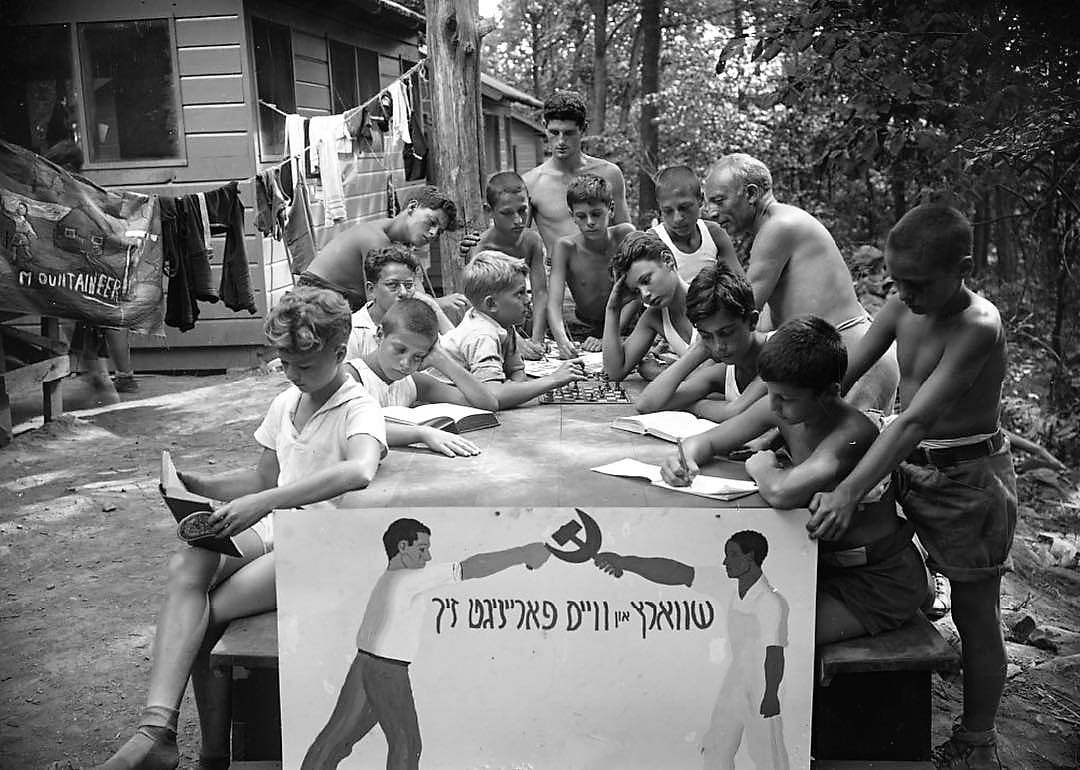
Edwin Hoernle of the Comintern’s Education Commission reminds comrades of the resolution presented by he and Krupskaya passed at the Fourth Comintern Congress on the centrality of Party education.
‘Political Enlightenment of the Communist Parties’ by Edwin Hörnle from International Press Correspondence. Vol. 2 No. 34. April 26, 1923.
It is necessary to draw the attention of the Communist Parties to a resolution passed by the IV World Congress, a resolution which is easily forgotten amidst the rush of conflicts and urgent duties of the present moment. The World Congress passed a resolution to the effect that the Communist Parties are to carry on systematic and organized educational work amongst their members and amongst the broad masses. For this purpose, they were to appoint a special secretariat with the central committee of the Party, and entrust at least one comrade with the responsible leadership and control of the work of political education. Was this resolution necessary?
The first duty of communist educational work is to keep all members of the Party systematically informed of the most important decisions of the world congresses, of the sessions of the enlarged executive, and of the party conferences of the section in question. Even to-day, there are thousands of members, in almost every Communist Party, who have at most merely cursorily read the important resolutions determining our fundamental attitude, our organization, our propaganda, in short, the whole of our daily tasks. Are there many sections, even today, in which newly admitted members are systematically informed on the principles, tactics, and history of the Party of which they are becoming members? Is a Communist Party capable of accomplishing work at all if it leaves the enlightenment of its members as to program and statutes to mere chance? The Communist Parties differ from the reformist precisely in being based entirely on the purposeful activity of their members, who have to perform the main work in the workshops, trade unions, and all proletarian organizations. A Communist Party whose policy is determined by a handful of leaders, and whose members have not really grasped the actual purport of the resolutions, or of the necessity of carrying them out, runs the risk of failing in moments of serious action, and of becoming the shuttle-cock of opportunist anarcho-syndicalist tendencies, The systematic arrangement of information evenings, in which all members of the party participate, whether to learn, to teach, or to stimulate, is one of the most important political tasks of every Communist Party.
But the Party must not content itself with well-informed members. To be informed upon, and to comprehend, the most important resolutions, no more than the political minimum constitutes below which the mass of members must not sink. Second this, every Communist Party must aim at giving at least its responsible party, workers a Marxist training. Evening classes must be arranged for this purpose, and the economic teachings of Karl Marx and the basic outlines of historical materialism thoroughly studied. But this instruction must by no means be given on lines of dry abstraction and pure theory. The work of communist enlightenment, even in its scientific phase, must maintain the closest relations with the requirements of the daily struggle. Marxist teachings must be applied to current events and daily problems, the students must be encouraged to relate their experiences in the workshops, in fraction work in the trade unions, in meeting activities, etc. The Marxist theories are then to be explained in relation to these.
The lack of teachers is of course a great disadvantage, as our parties are still young, and this lack is often used as an excuse for neglecting the work of education. This shortcoming will be met to a great extent by the publication by the central bureaus, of a number of useful instruction pamphlets for information evenings and discussion evenings. Where the instruction is carried on in the form of a vital discussion relating to daily work and daily struggle, the need of a perfectly theoretically trained teacher is felt much less; what is then much more required is a comrade possessing a certain amount of practical experience in party work, and having a sound revolutionary instinct, tactical insight, and the most important elementary knowledge. There are such tried and tested party comrades in every local group. These must come to the aid of the smaller groups.
Despite this, every party must naturally devote attention to the systematic training of a staff of schooled theorists, capable of taking up positions as teachers in the party schools and in scientific evening classes, or as chief editors or political secretaries. For this purpose the parties should establish central party schools wherever possible, in which a number of carefully selected students, chosen for their tested qualities and Marxist knowledge, receive instruction for a certain time, during which they are relieved from all other party work. Such a central party school is certainly somewhat expensive to keep up. The Parties will therefore maintain such schools, to the extent, and for the length of time rendered possible by their means. But it is not possible for any Communist Party to exist permanently unless the leading party functionaries can be replaced by members who have received such methodical instruction. At the present time a plan is under consideration for a socialist academy for advanced Party students, at the headquarters of the Executive.
Another important branch of education is the introduction of the responsible party workers into their special spheres of activity. The slogan: To the masses! forces the Communist Parties to penetrate into every labor organization, into municipal and state representative bodies. Hence the communist functionaries must not only be equipped with general politico-economic knowledge, but at the same time with a certain amount of technical knowledge; they must be well informed in their special line, for instance in the history and methods of the trade union movement, in the problems of municipal or agrarian politics, in the questions of instruction and education, cooperative work, etc. The Party functionaries must meet together for periodical consultations, according to their special lines of work; for courses of instruction, or instructive conferences. The instructive conferences are especially suitable as preparation for definite Party campaigns, or for the carrying out of important Party resolutions.
In many countries the proletariat has found sufficient resources to create certain educational institutions, proletarian schools for adults. The Communist Parties must try to influence these proletarian educational institutions, to give them really revolutionary Marxists as teachers, and thus to transform these schools info instruments of revolutionary class war. At the same time the Communist Parties must strive to influence the educational institutions belonging to proletarian trade unions and co-operative societies by continually criticizing the reformist teachings, by proposing revolutionary Marxists as teachers, and by advocating the treatment of political and economic problems in their relations to the fighting tasks of the proletariat. It is also possible to carry on work of systematic communist enlightenment in the labor organizations. The shallow and reformist lectures and entertainments are to be replaced by enlightenment on the tasks of the workmen’s sport clubs in the revolutionary class war, and, on their co-operation with the Party and trade unions, so that the interest of the working class sportsmen may be aroused for a profounder Marxist education.
This work goes far beyond educational work within the actual limits of the party; it is mass educational work. Mass educational work must adapt itself to masses ruled by primitive motives and feelings, it must employ means which possess a powerful suggestive effect on the senses and the will. Such mediums are that of song, of choral singing, recitations, speaking choruses, political dramas, photography, cinematograph, etc. In public meetings, at demonstrations, at proletarian festivals and revolutionary memorial celebrations, the Party has the opportunity of appealing to the broadest masses by means of suggestive and artistic mediums. Above all, much impression can be made by means of living and dramatic representation of proletarian experiences, of revolutionary fights; the treatment of political problems in the form of dialogues or trials. The work of mass education must never be separated from propaganda, it must lead directly into propaganda.
The ever-rising prices render it more and more difficult for the proletarian to buy any theoretical or historical books beyond the most ordinary daily reading matter. Systematic educational work therefore involves the establishment of Party circulating libraries, large or small according to the powers of the local group in question. Instructions as to the arrangement and administration of such lending libraries are issued by the central bureaus, as well or lists of books supplemented with an introduction for self-instruction. It is of the greatest importance to attempt to introduce Marxist and communist literature into the libraries of the trade unions and co-operative societies and into the municipal libraries and reading rooms. The Party publishers must be induced to sell books on the most advantageous possible terms to the workers’ libraries, and to the participators in communist courses of instruction.
The Communist Parties should lend energetic support to the special educational work of the Communist Youth organizations, and should put premises at their disposal, supply them with teachers, lend financial aid, permit the use of Party libraries, and endeavor to induce youthful workers to take part in all educational institutions belonging to the party. The importance of communist education among proletarian children should not be underestimated. Here our task does not consist merely of instructing and enlightening the children on the existence of classes, the class war, and the final aims of revolution, but in drawing the proletarian child into the actual struggle and work being carried on by the adults, as for instance, the Communist Children’s groups have most successfully done in their work for the proletarian famine relief, and in other work for the collection of funds. Proletarian children are also quite capable of raising protests against the national jingo agitation carried on in the schools, and of carrying on a lively work of propaganda among their school-fellows. Revolutionary educational work, wherever and whenever carried out, among old or young, must invariably be an intimate combination of teaching and fighting, theory and practice.
International Press Correspondence, widely known as”Inprecorr” was published by the Executive Committee of the Communist International (ECCI) regularly in German and English, occasionally in many other languages, beginning in 1921 and lasting in English until 1938. Inprecorr’s role was to supply translated articles to the English-speaking press of the International from the Comintern’s different sections, as well as news and statements from the ECCI. Many ‘Daily Worker’ and ‘Communist’ articles originated in Inprecorr, and it also published articles by American comrades for use in other countries. It was published at least weekly, and often thrice weekly. Inprecorr is an invaluable English-language source on the history of the Communist International and its sections.
PDF of issue: https://www.marxists.org/history/international/comintern/inprecor/1923/v03n34[16]-apr-26-1923-Inprecor-stan.pdf

