‘To that sorely betrayed and some what bedraggled goddess, “Liberty,” with whom, however, Puritanism has prevented the author’s personal acquaintance, this little book is affectionately inscribed.‘
The full text of Meily’s 1911 work begins with the first two chapters, What is Morality? and The Class Basis of Morality. In his book the Los Angeles Socialist, a lawyer and left journalist, Meily takes the long view in this materialist view of morality and the specific puritanical tradition in the United States.
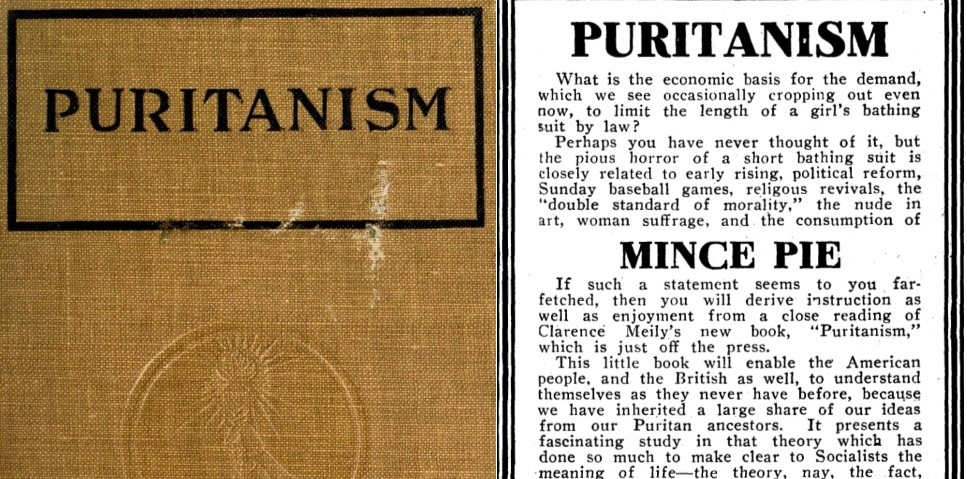
‘Puritanism, Part I’ by Clarence Meily. Charles H. Kerr Publishers, Chicago. 1911.
To that sorely betrayed and some what bedraggled goddess, “Liberty,” with whom, however, Puritanism has prevented the author’s personal acquaintance, this little book is affectionately inscribed.
CHAPTER I. WHAT IS MORALITY?
The association of living forms in groups or communities goes very far back in the annals of life on the earth. Among vegetable organisms association occurs mechanically, inexorably, from the fact of their inability to move from place to place. The offspring of the parent plant are of necessity confined to the same locality, and generation after generation is fixed in the same habitat. It is not apparent, however, that vegetation gains any advantage either of nutrition or defense from the fact of association. One of the chief practical differences between the vegetable and animal kingdoms is the power of free locomotion which belongs to animals. With the acquisition of this faculty, association assumes a voluntary character. The offspring of the parents may remain together in the primal and natural community of the family, or they may scatter in permanent separation. This alternative implies that if association continues it does so because of definite advantages which it affords in the struggle for existence. And, vice versa, the fact that practically all animal species, outside the prowling carnivora, are gregarious. is ample demonstration of the very real and supremely important nature of these advantages. With the strength given by numbers, defense becomes more successful, the procurement of food surer, shelter better, and the care of the young easier and better performed. The principle of association and mutual aid is, indeed, one of the great laws of life, the condition and cause of success in the contest waged against an adverse environment by the vast majority of sentient creatures.
That conjoint effort is more productive and efficient than individual labor is an economic truism, the practice of which is by no means confined to mankind. The hunting pack which unite in dragging down their quarry, the pair of birds which build their nest together, the herd which sends out scouts to discover the choicest and safest feeding places, all act in obedience to this general economic law. But it is reserved for man to rivet yet more firmly the bonds of his associations, to increase the interdependence of their membership one upon the other, by the discovery of the further economic principle of the division of labor, in the application of which one man cultivates and becomes adept in a particular art or labor for the benefit of the community. By this special adaptation of his powers his dependence upon the remainder of the group for necessities which he cannot produce is firmly fixed, just as, in turn, is fixed the dependence of the group upon him for his own product. The severance of association means, under these circumstances, the embarrassment of the group, and primeval hardship and probable destruction for the individual. From thence forward man is a social creature by the very terms of his existence.
Even voluntary association implies a sacrifice of personal freedom. Private caprice, wayward desire, selfish advantage must all be subordinated to the communal interest. Without this, the association cannot continue. The application of the principle of association thus engenders a conflict between the interests and desires of the individual, and the interests of the group as a whole. The desire, as well as the immediate interest, of the wolf who has made a kill is to gorge himself, but the interests of the pack demand that he should share his good fortune with his fellows. Unless he does so, one of the chief purposes of the association is defeated, and its bonds weakened accordingly. So, too, the instinctive desire of individuals between whom a cause of difference has arisen, is to settle the merits of the controversy by physical encounter. But as the group would be rapidly disintegrated by conflicts between its members, the group interest demands that private desire shall be subordinated to peaceable adjustment of the difficulty. “Thou shalt do no murder,” is, probably, the oldest law and moral maxim in existence, though it is not thereby meant that no life whatever shall be taken, but only that the cohesion of the group shall not be destroyed by the lawless slaying of its members by each other. In a thousand ways the private wish of the individual must bend to the larger purpose of the social organization.
The perception of the group interest, unlike the recognition of personal interest or desire, is not intuitive. Only the exceptional few of the community have wisdom and experience sufficient to anticipate the remote if far-reaching results of anti-social conduct. For the majority, the realization of public or community needs and obligations must be aided by their formal and explicit statement, while obedience to them is compelled either by direct coercion or by attaching to their violations penalties, the fear of which effectively supplements the vaguer motive of concern for the general good. Of the rules so formulated, three general classes may be distinguished. First, those which are of such obvious and vital importance that they receive the sanction of physical force exerted by the community for their observance. These constitute laws. Second, those which, though of serious import to the communal welfare, are nevertheless of such flexible application or of such hidden, remote or dubious consequence as to preclude a common consent to their enforcement by physical strength, leaving them to find their sanction merely in public opinion. These constitute morality. Third, those rules which, while having no definite public significance, yet lend grace and facility to personal intercourse and so aid in smoothly carrying forward the communal life. These are enforced by the opinion of intimates, and constitute manners. Morality is thus seen to occupy a middle ground between the institution of law on the one hand, and the institution of manners on the other. Like law, its formulas define and interpret the public good, the group interest; but, unlike law, it is denied the supreme sanction of enforcement by the sheer physical power of the community. Hence it fails to receive that exact and painstaking statement, that precise and elaborate interpretation and application, which are features of all systems of jurisprudence. Like manners, morality must depend upon the opinion and attitude of others for its coercive emphasis; but, unlike social convention, its importance is of public rather than of personal concern, and obedience to its precepts is induced by much severer reprobation visited upon their transgressor, than upon those guilty of mere ill-breeding. The line between morals and manners, however, remains indistinct, manners, in an effete society, tending to rise to the dignity of morals, while morals, grown obsolete, often persist as social conventions.
Immoral impulses are checked, in the first instance, by the fear of the dislike, aversion, ostracism and contempt which an injured or outraged public will manifest toward the offender. In exceptional instances, this motive may be supplemented by an honest and generous wish to conserve the welfare of the community as defined by moral precept, though usually the group interest affected is so remote or so disguised, or is to all appearances so slightly involved, or loyalty to the group is so tenuous, that the mere promotion of the general good does riot alone furnish adequate motive for moral conduct. Neither of these considerations, however, is commonly regarded, among people in the more primitive stages of culture, as sufficiently potent to insure moral observance, and accordingly it is deemed necessary to secure some additional sanction which shall restrain the wayward and rebellious from moral laxity. The realization of the communal necessities which are voiced in moral precepts, and the formulation of the precepts themselves, being matters requiring unusual intellectual power. foresight and wisdom, naturally fall into the hands of those in the association who possess superior mental attainments and who thus become, as it were, the custodians of morals, possessing not only the privilege of ethical enactment but the duty of exhortation to ethical conduct. Now, with all primitive peoples, these functionaries of superior intelligence are also the priests, the persons authorized to address the gods and to interpret the divine will to men. Very naturally, therefore. an additional and final sanction for the practice of virtue is declared by the custodians of morals to lie in the divine pleasure, which demands the service of righteousness from all those who would please the gods, and which will visit with condign punishment those who persist in evil doing. Morality thus becomes linked with religion, its precepts are represented as embodying the divine will, and their violation becomes sin, the transgression of the will of the gods, to be visited by the terrors of the divine wrath both in this life and in the life to come. The religious sanction, which morality thus acquires is enormously powerful, particularly amongst peoples in the lower stages of enlightenment, whose superstitious minds unquestioningly accept the instruction thus received. So important, indeed, is this religious sanction that it may be regarded almost as affording a distinguishing mark of morality as against mere manners and ceremonial conventions.
The prestige gained by morality when enunciated as a revelation of the divine will operates in two ways. First, it inspires a direct terror of the divine anger and of the punishments to be accordingly suffered, and so furnishes a new and fresh motive for the practice of righteous ness, the potency of which is but little impaired by the fact that the fears inspired are imaginary rather than actual. Second, the aversion which the public feels toward the person discovered to be guilty of immorality is, by the religious aspect of the case, intensified to such
horror, loathing and detestation as may fittingly be exhibited toward one who has incurred the wrath of deity and who is numbered amongst the enemies of the gods. The primary sanction of public opinion is thus stimulated, educated and directed until any deficiency which may have originally impaired its efficiency is removed, and it becomes a redoubtable agency in guiding the recalcitrant soul into the paths of virtue.
Morality always presents itself as a conflict between the private impulse and inclination of the individual, and the more remote and abstract but more important interests of the group, clan or class in its collective aspect. And because morality expresses the popular will and opinion, and because it has the sanction of religious teaching, disobedience to its injunctions assumes the guise of rebellion, transgression, sin. The sense of conflict and struggle which ever haunts the spirit of man, and which is primarily a subjective reflection of his contest with an adverse environment, with the buffetings, betrayals and parsimony of oblivious nature, receives an added emphasis from this secondary antagonism of his most rudimentary instincts by the prescribed duties and calculated restrictions of the communal life which is itself formed for the purpose of aiding in the general struggle for existence. This conception of the battle of good and evil finds expression in endless legends and traditions, from Michael, the archangel, triumphing over Satan, or St. George slaying the dragon, down to the latest civic-righteousness fiction of our popular magazines. And if the good must always prove eventually victorious, it is because the good is felt to be synonymous with the triumph of life, the furtherance of progress, the fulfillment of human destiny. For however irksome moral precept may be, or however fantastically it may be explained or enforced, it must be remembered that while the association continues homogeneous, that is, before the development of private property has given rise to different economic classes within the group having hostile interests and aims, both laws and moral codes really represent the true welfare of the species, and, in most instances, of the refractory individual as well. With the rise of private property, however, and the consequent formation of antagonistic economic classes, a collective common interest, uniform with all members of the group, ceases in large measure to exist, and both law and morality come rather to embody but the interest, prestige and welfare of the dominant, proprietary class. From this on, it is only in a secondary fashion, and when viewed in the perspective of a long historical evolution, that law and morality can be said to have also ministered to the general progress of the race.
CHAPTER II. CLASS SYSTEMS OF MORALITY
Notwithstanding the naive confidence in the realization of liberty, equality and fraternity which illuminated the beginning of the nineteenth century, he would be a hardy debater who would venture now to deny the existence of economic classes in modern society, or to question the fundamental and irreconcilable nature of their enmities. Still less would any one question the existence of such classes in the past, when the legalized status of master. and slave, of lord and serf, made cavil upon the subject impossible. In the slow progress achieved by our barbarian ancestors through the matching of their inventive powers against an adverse environment, tools were created and gradually improved until a point was reached, the most momentous thus far encountered in human history, where, with the aid of tools, a man might produce by his labor not only sufficient for his own needs but a surplus of which he could be despoiled without materially impairing his efficiency as a laborer. At this point a use was discovered for the captives taken in battle.
They became possible subjects of exploitation. In the picturesque language of a contemporary, “Mankind abandoned cannibalism just as soon as it was discovered that more meals could be got from a captive by keeping him alive and working him than by killing and eating him.” A profound alteration was thus wrought in the structure of the human association–from the homogeneity of barbarian communistic society to the heterogeneity of the class organization which ushers in the stage of development we know as civilization. Society became split into two hostile economic class–the master or proprietary class which owned the slaves as private property and lived by appropriating the surplus product of slave labor, and the slaves themselves whose labor sustained both them and their masters. The basic fact of this, as of all, class organization was that of exploitation–the fact that a portion of the fruit of one man’s labor is taken without recompense by another man under the safeguard of legal and moral protection and approval. And thus arise the radical and fundamental divergence of interests and the profound, implacable and unremitting class warfare, which constitute the key to the interpretation of all the annals and institutions of civilization.
In the new organization of society thus brought about, the “intellectuals,” to whose custody law and morality had been perforce committed and who were the priests, the wise men, the jurists, legislators and moral exhorters of the tribe, occupied a somewhat anomalous place. Exceptional wisdom or superior mental equipment is not commonly united with martial prowess, especially when prowess is synonymous with brute strength. The captives, and therefore slaves, falling to the lot of the intellectuals were accordingly few, and insufficient to give them place as members of the proprietary class. Nor were the intellectuals either fitted or accustomed to supply their own necessities directly by manual labor. For, after all, it is only manual labor which effects that modification of material substances which fits them to the satisfaction of bodily needs. Mere intellectual effort, however valuable and deserving, is not directly productive of material goods, and therefore it must always be bartered or exchanged before it yields a livelihood to him who performs it. But in a class society, the exploitation which feeds fat the proprietary class leaves it the only class possessed of the means of purchasing or of compensating intellectual labor, and it is to the proprietary or master class, therefore, that the intellectual must always turn for a supply of those material goods without which he cannot live. Hence it is that, with the creation of economic classes, the intellectuals, the trustees of law and morals, become of necessity the paid retainers of the master class.
The unity of interest which characterizes primitive communistic society necessarily pales before the internecine struggle which exploitation and the establishment of the class system engender. Even were no other circumstance operative to distort law and morality from their pristine function of enunciating the common interest, the very fact of the existence of a class warfare within the group would suffice to make it impossible that these institutions should continue to embody the true interests of all citizens irrespective of their class allegiance. To do this would require both law and morality to divide within themselves into antagonistic and contradictory codes, one set expressive of the masters’ interests. the other, of those of the slaves. But the receipt oi income by the intellectuals from the proprietary class which alone can yield it, speedily determines the fate of both law and morals. There need be no illusion about the position of a paid retainer. He must serve his employer’s will, he must promote his employer’s interest, or his pay stops. His continued existence, particularly upon the plane of luxury and ease to which he has become accustomed, depends directly upon his subserviency. Law and morals, therefore, promptly become but embodiments of the class concerns of the proprietary class alone, are made to sanctify and defend exploitation and class superiority and control, while for the working class they express but the antithesis and denial of all its true interests. Thus, the obedience of the workers is vital to the masters’ safety and welfare, while rebellion only can conserve their own welfare; yet law and morality must always enjoin and enforce obedience and condemn and punish rebellion. So, exploitation is the masters’ method of livelihood, while it represents a robbery of the worker; yet law and morality must require the servant to yield the surplus of his labor peaceably to his owner. It may be questioned whether in any class system of morality a residuum can be found which continues to represent the entire group interest independently of class considerations. Even the most elementary maxims take on a class color. Thus. ”Thou shalt not kill:” comes to forbid only the slaying of a member of the master class, and by no means prevents the master taking the life of the slave, as in Rome, where a slave might be killed and fed to the master’s eels without any violation of law. Nor can such power of life and death over the slave be attributed to his original position as a captive who held his life at the victor’s mercy, since the power persisted long after the slave’s character as a captive taken in battle had been merged and lost in the general body of slave property. It is explicable only on the theory that the slave, as such, was outside the bounds of class, and therefore of human, fellowship, and because the successful maintenance of the system required that no assuagement of terror should be afforded the slave by the legal safeguarding of his physical integrity. In later times, and in freer and more highly organized societies, indeed, the purely group interests in a measure reassert themselves, as in sanitary laws, and the like. The workers may even be so far recognized as members of the group as to be given a perfunctory protection, such concessions being either dictated by the exigencies of production, or inspired by fear of an insurrection of the laboring class. But in the main, under a class organization of society, the function of law is merely to crystallize into formal statement the dominance of the masters, and to adjust their private differences peaceably between themselves so that their position may not be imperiled by internal strife, while morality becomes in turn but the fainter yet even more faithful echo of purely class interests.
The business of the male citizen of a barbarian community is that of a hunter and fighter, while the women are employed in household drudgery and the exercise of those primitive arts which are the faint prototypes of the industries of civilization. But the thorough-going communism which marks this era in social evolution prevents the position of women being reduced to that of a true slavery. While their labors are more onerous and persistent than those of their male companions, they are less hazardous, and the universal right to share freely in the communal wealth frees even the female employment from any actual exploitation. The difference between male and female vocation is rather an instance of the primitive division of labor, than the mark of a real servile exploitation of women.
The normal attitude of barbarian communities towards each other is one of actual or at least potential warfare. The member of an alien tribe is perforce an enemy just as the beasts that prowl the jungle are also enemies. The barbarian is therefore a warrior. But he is also a hunter, a fisherman, and in later times, a herdsman and agriculturist. Peaceful industries find place among his pursuits. Though a warrior, he has not yet become a professional soldier. With the rise of chattel slavery, however, society crystallizes into a distinctively military mold. A fixed military establishment becomes imperative, both to hold the slave property in subjection, and to add to it by further conquest. At first all males of the master class bear arms. Later, the military becomes detached from the balance of the class as a special caste or occupation. Later still, the legionaries become, like the intellectuals, the mercenaries or paid retainers of the proprietors. But at all times the military organization and habit of life, together with the direct implications of the slave relation itself, determine the conventional morality of the slave society. As the slave property is, for the most part, alien in origin, being composed of the conquered members of foreign tribes and peoples, the support of the system demands first of all patriotism, or devotion to one’s own dominant tribe, city or commonwealth, as a supreme virtue. In the southern states of the American Republic before the Civil War, where the distinction between master and slave followed racial lines, this virtue took the form of pride of race, the denunciation of miscegenation, and the somewhat frantic outcry for the preservation of “racial integrity.” In classic antiquity, however, slaves and masters were of the same, or substantially the same, race, and the differentiation proceeded no further than membership in different tribes or citizenship in different commonwealths. Patriotism, therefore, became the characteristic and cardinal virtue of this era. To this were added the essentially military virtues of personal courage, obedience, truthfulness, and the like. As the weapons of that period required great bodily strength and skill for their effective use, athletics and the cultivation of physical prowess and endurance also assumed the role of virtues. With the creation of a master class founded upon the institution of private property came the need of preserving and transmitting this property, and the privileged status it conferred, from generation to generation; in other words, the need of class preservation. To accomplish this purpose it was necessary that the master have a restricted and definitely ascertained progeny in whom the right of inheritance might rest. To effect the first of these objects, that is restriction of progeny. the loose sexual relations of the barbarian period gave place to the monogamous form of marriage. To carry out the second, that is to insure the identity of the offspring selected to inherit, as indeed the children of the father, the virtue of female chastity, which Balzac mordantly described as “man’s greatest invention,” was evolved, to be enforced, at least in the beginning, by the cloistered seclusion of the wife. In this way the marriage relation, with its attendant moral conceptions, was fashioned into an effective agency for preserving the master class in assured dominance through successive generations. The conception of male chastity, however, had not yet been formed, that particular virtue being unnecessary for the accomplishment of the purpose in hand. Masters indulged in concubinage, or even more promiscuous relations, without thought of evil, it being, of course, enacted in the laws that the children of concubines should not inherit. Nor was chastity, or even an orderly marital relation, deemed applicable to slaves. The female slave held her person at her master’s pleasure, while the male slave was a mere breeding animal. Polygamy, which appeared later, was probably the result of an attempt to give to concubinage a more settled and legitimate character.
As the subjection of the workers under the chattel slave system is secured through the position of sheer physical force and terror and not through any restraint of moral suasion, morality under such a system is held not to concern the workers but to have significance for the masters only. Like the service of the gods, its observance is something too sacred to be contaminated by servile touch. But as the practice of morality was confined to the masters, so the protection of virtuous conduct in others, shielded the master class alone. The slave master of classic antiquity owed no moral obligation of any sort to his slaves. The notion of such an obligation was unthinkable. On the contrary, in order to inspire a subjugating terror in the slaves, unbridled license for cruelty toward them was given the masters, the exercise of which developed that strange and horrible appetite for scenes of physical anguish the tales of which incarnadine the period of Roman decadence. The spirit of cruelty permeated the whole of society, and a callous indifference to bodily suffering or even a monstrous enjoyment of torn flesh and scorching limbs testified to the detestable perversion of normal human feeling which the industrial system had wrought. Add to this the drunkenness, licentiousness, administrative corruption and moral degeneracy which resulted from the extreme concentration of wealth, which, in turn, is an inseparable incident of private property, and one may form a picture of that pagan world against which the Christian faith hurled itself as a revolutionary propaganda. The criticism which that brilliant philosophic charlatan, Friedrich Nietzsche, launched at Christianity, that it was the morality of slaves, is, in point of fact, as regards the early church, strictly accurate, though few would echo the contempt for it with which, on this account, that pseudo-aristocrat inflated himself. The basic tenet of Christianity, that of human brotherhood, is but the idealized moral phrasing of that principle of association which is ever the counterpoise by which the weak match themselves against the strong. The early Christian communism, reminiscent of its more primitive barbarian counterpart, was and ever has been the answer of the propertyless worker to the exploitation of the proprietor. The Christian detestation of war struck at the very foundation of the chattel slave system of antiquity. Coming as a reaction against the libertinism and debauchery of the time, Christianity saturated itself with the mystical asceticism of the East. Indeed, at every point early Christianity was the revolutionary antithesis of the existing social order, so that it is no real wonder that the Roman state, notoriously tolerant of alien religious faiths, yet greeted the gospel with the relentless and bloody persecutions which crowned with martyrdom this first of proletarian revolts. It is an economic maxim that productiveness increases in proportion as the freer constitution of society insures the workers an absolutely larger and more secure portion of the product of their labor. In other words, freer social forms have the direct effect of stimulating production. When, therefore, in process of time, the wasteful and inefficient methods of chattel slave cultivation had exhausted the lands of Southern Europe, and when, also, it became necessary to bring under cultivation the less fertile lands of the North, it grew imperative that chattel slavery should yield to a freer form of industrial organization. The resulting social revolution, being to the interest of the master class, was protracted through centuries of slow and frictionless mutation, became a component part of the dawning Celtic and Teutonic civilization, and, in itself, quite escaped the notice of the superficial historians who, until recently, when history was placed upon a scientific foundation, were the chroniclers of Western progress. The principal industry of the time, the one upon which the vast mass of the people depended for support, was agriculture. The restless migrations of the northern barbarians, our Celtic, Teutonic and Slavonic ancestors, seeking a permanent feeding ground upon the face of the earth, the decadence and dissolution of that mighty fabric of empire, the Roman state, and the disorganization and chaos which followed, all compelled the persistence of the military organization of society-made, indeed, of every freeman a soldier. The unique problem was thus presented of organizing the industry of agriculture upon a military basis, and in such fashion as to give to the workers an increased measure of liberty and security. To this difficult problem the feudal system furnished the ingenious and adequate answer. The slave was transmuted into the serf, the master became the lord. Surrendering his right of absolute property in the body of the worker, the proprietor nevertheless owned the land upon which the laborer was obliged to toil, the land to which he was legally bound and which he could not leave without the lord’s permission. But to a portion of this land the serf acquired a right of occupancy and use not unlike that of the modern tenant. For this right he paid certain rents and was subjected to certain exactions the only merit of which was that they were, for the most part, fairly well defined by custom. For a prescribed period, for instance, he labored upon the lands of his lord, but for the balance of the time he was free to cultivate his own small holding. The measure of his exploitation, therefore, while severe enough, had the very great advantage of definite limitation. Moreover, the serf began to have the semblance of personal rights. In exchange for his fealty, his lord engaged to preserve him from injurious violence. The integrity of his family relations was vaguely acknowledged. His tenure of his plot of ground became a conceded and permanent right which received legal protection and could be transmitted to his descendants. Though the relation of lord and serf partook largely of a paternal character, it was also one of reciprocal obligations, fixed by custom, which, on the whole, it was to the lord’s interest to recognize and fulfill. Personal liberty for the worker was, indeed, afar off, but security for person and property was slowly gained.
As society remained militant in respect of the proprietary class, that is, as the chief business of that class continued to be fighting, so the virtues of the feudal era remained those reflective of a military organization–physical courage and prowess, obedience, truthfulness, honor and so on. Loyalty to the king took the place of patriotism, but served the same purpose of conserving and increasing class cohesion. Trade, commerce and usury or the lending of money at interest, were despised; but war, pillage, piracy and enforced tribute were, as aforetime, highly esteemed. But in two particulars, at least, feudal morality deserves special discussion. First, in relation to marriage. Second, as to the part which came to be played by morality, through the instrumentality of the feudal church, in keeping the working class in restraint.
Chattel slaves had been personal property; and the fluid nature of this property, as well as the rapidity with which wealth accumulated under that system, made the matter of inheritance of relatively less importance than it was later to acquire under feudalism. Feudal property was landed property, and, as such, peculiarly adapted to transmission by inheritance. Besides, the meager wealth of the feudal period required strict conservation from generation to generation, and could not, if it were to sustain the social fabric, be periodically dissipated by distribution to numerous heirs. Again, the uninterrupted continuance of feudal rents and servitudes was essential to the military system, which was one of prescribed levies, and the concomitant status, property and privilege of the nobility must, of course, also be continuous. The hereditary principle therefore assumed a transcendent importance. Not only was class preservation dependent upon it, but the fate of the very system itself was bound up in it. The effect of these circumstances upon the institution of marriage was most profound. The feudal marriage was not only monogamous. but it was the severest monogamy, and the most inflexible and adamantine union, the world has ever known. Once contracted, it was, for all practical purposes, indissoluble. Only one authority existed, the Roman pontiff, who could dissolve it for any cause, and he would not. Side by side with this development of marriage went a corresponding emphasis upon the virtue of female chastity. This was the crowning, and, aside from domestic thrift, practically the only virtue recognized in women. The supreme duty of the married woman was to furnish a legitimate male heir to continue the family name and power. Fecundity to this extent was also a virtue. Aside from this, the woman’s life and identity were so completely merged in the husband that she became a negligible quantity. As the chastity of females of the proprietary class assumed so great an importance, the violation of this chastity, carrying with it the utter ruin of the woman’s marital prospects and leaving entrance into a nunnery her sole possible refuge, became a serious offense which her male relatives would not be slow to visit with drastic punishment. A sort of reflex chastity was thus imposed upon the males of the class, with respect to women of the aristocracy. And from this protective attitude toward ladies of the nobility, enhanced by the love of stately ceremonial which lingered as a legacy from a not very remote barbarism, was developed that chivalry and courtesy toward women of aristocratic rank, which constituted one of the finest and most charming traits of the feudal noble. But chivalry and courtesy were reserved for women of the proprietary class alone. Towards women of the working class, the correct noble attitude was one of contemptuous brutality, coupled with a quite unregulated sexual license. Nor has chivalry, in this regard, ever succeeded in rising above its traditional class limitations, as may easily be observed by noting the bearing of the modern gentleman toward the mistress, and toward the maid.
But monogamous marriage alone, even though indissoluble, did not furnish a sufficient restriction upon the number of heirs, to meet the exigencies of feudal inheritance. Not only were illegitimates debarred from the right to inherit, and, incidentally, visited by the most intense disgrace, but only one child of the legitimate progeny, the eldest male, was permitted to succeed to the title of nobility, the family properties, and the rank and power of the sire. The right of primogeniture completed the curious structure of class domination. Under these circumstances, the family relation assumed a social importance which it had not known since the barbarian period. Then it had furnished the basis of the tribal bond, the only form of social organization. But the family which was then important was a contemporaneous group. Under feudalism it was a line of descent. As feudal rank and privilege came from the ancestor, so the ancestor became of immense significance, and both the status and worth of men were determined not by what they were, but by what their forebears had been. Pride of family was added to the other distinctively feudal virtues. The vacuous remark sometimes heard from modern pulpits and professorial chairs, that the family is the foundation of the state, is the aimless ghost of this feudal conception of the class importance of that relation. It is almost needless to add that the super-sanctity of the feudal marriage, together with female chastity and all its other attendant virtues, was enforced with the utmost zeal and rigor by the feudal church.
Notwithstanding the sanguinary persecutions under which the early Christians had suffered, Roman ferocity proved powerless to stem the advance of their seditious doctrines. By the time of Constantine it was plain that a compromise must be effected, or the “kingdom of Goel,” that marvelous utopia of brotherhood, purity and peace which the ecstatic vision of the saints had pictured as replacing the welter of cruelty and licentiousness which enveloped them, would be dangerously near realization. Diplomatic cunning was called in to accomplish what mere bloodthirstiness had failed to do, Christianity was made the state religion, the church became the pensioner of the civil authority, and in return elected to forego its revolutionary character, to abandon its ideals of social regeneration, and to become a subservient prop to the imperial power. Scarcely had this compromise been reached, however, when the entire Roman polity, save in the extreme east of Europe, was whelmed and lost in the chaotic surge of barbarian invasion. In this crisis the church exhibited a fortitude, strength and mastery of events unparalleled in history. By a wonderful missionary effort it subdued to its own spiritual sway these new masters of the world. If the barbarians conquered Rome, it was only a matter of time until
Rome in turn conquered the barbarians. And by virtue of its triumph the church retained the place given it by Constantine, that of a state religion. Nay, more, it wove itself into the very warp and woof of the new feudal society. Its graded hierarchy was a replica of the successive ranks of the feudal aristocracy. Its fantastically splendid and imposing services were but a portion of that general ceremonial observance which adorned the life of the middle ages. In its hands were held from a third to a half of the lands of Western Europe. Of all feudatories it was the richest, the most powerful, the most arrogant.
But this prestige was not gained by the church without a full complement of service rendered. If the religious establishment enjoyed exceptional wealth and privilege, it was because it was in a position to lend exceptional assistance to the proprietary class. With the relaxing of the rigors of the slave relation, and the attainment of a measure of private right by the working class, the continued coercion of labor by the crude methods of sheer physical brutality was no longer feasible. For forcible physical bondage must be substituted the less tangible, yet none the less effective, bondage of superstitious terrors; for the shackle and the whip, the awful dread of uncomprehended evil, the horror of ghostly doom. To accomplish this became the peculiar office of the church. Its proletarian traditions still endeared it to the workers in Southern Europe, while its communistic reminiscences gave it a ready and trustful acceptance among the serfs of the North. Its hold upon the working class was consequently powerful. Moreover, the near remove of barbarian culture made the priestly traffic in superstition exceptionally safe and easy. Religion and morality, therefore, came to have significance not merely for the proprietors, but for the laborers as well. The serfs were received into the church–the poor had, indeed, the go pel preached to them, but to what an end! Morality now discharged a double function of service to the proprietors, first, by inculcating amongst themselves those virtues which buttressed the existing order, second, by persuading the workers to submit tamely to the exploitation and servitude which supported the social fabric. For this latter purpose, a whole new series of virtues was created, specially adapted to the workers, such as humility, reverence, obedience, patience, gratitude, meekness, and, above all, contentment, which has always been in the eyes of the proprietors, the crowning virtue of the slave. Failure to practice these virtues brought upon the devoted head of the recalcitrant serf the priestly anathema with all its ghostly train of imagined horrors, besides the very real horror of complete ostracism, while for the observance of the same the church held out a mythical reward in that promised “kingdom of God,” the locale of which had been cleverly shifted from this world to the next. Finally, the church afforded a way of escape to those more able amongst the workers in whom an enforced servitude would surely have bred rebellion. In return for vows of celibacy, and an undivided loyalty to the church, that institution gave to these the opportunity to achieve within its own hierarchy the power, place and luxury which men of exceptional talents have always demanded, but which, through the caste distinctions of feudalism, were reserved in the course of secular affairs for the nobility alone. It is doubtful if this last named service of the church to feudalism has ever been fully appreciated, though any class system, in order to insure its permanence, must provide in some way a vent of this kind, else the disaffection of the natural leaders of the laboring mass will soon engender insurrection.
In short, the church was the indispensable cement which held feudal society together. It furnished the intellectual sustenance, the moral suasion and stimulus, upon which the system drew for nurture and strength. Never before or since have religion and morality discharged such important social functions, and, it may be added. never before or since has any religion proven so utterly false to its pristine purposes and ideals. True, those purposes and ideals were ever impossible dreams, and whatever practical validity they may have originally had was lost in the barbarian conquest. But that the gospel of the Nazarene Carpenter should have become the chief sustaining power of a class system of exploitation is surely the greatest marvel, as it is the supremest irony, of history. Yet the proletarian, communistic and revolutionary traditions of the Christian faith were never entirely lost. They were continued through the middle ages by the Waldenses, the Anabaptists, the Lollards, and similar dissenting sects, and blossomed with renewed vigor in the Reformation and in the bourgeois political revolution which followed, reaching their full fruition in the international socialist movement of today which is historically, as it is sympathetically, the true descendant of the primitive church.
The Charles H Kerr publishing house was responsible for some of the earliest translations and editions of Marx, Engels, and other leaders of the socialist movement in the United States. Publisher of the Socialist Party aligned International Socialist Review, the Charles H Kerr Co. was an exponent of the Party’s left wing and the most important left publisher of the pre-Communist US workers movement.
PDF of original book: https://archive.org/download/puritanism00meiluoft/puritanism00meiluoft.pdf

