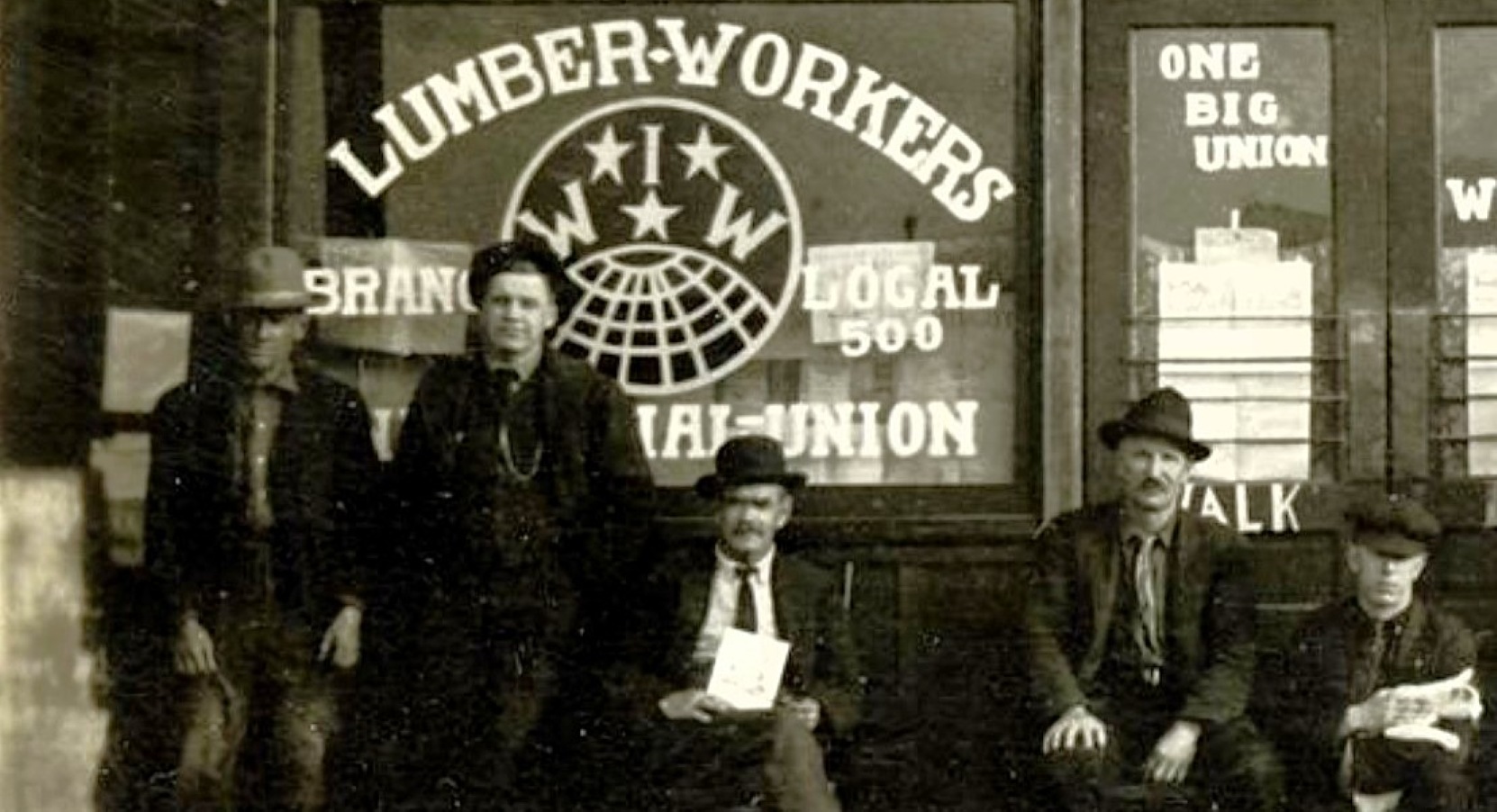
The massive war-time lumber strikes centered in the Pacific Northwest led by the I.W.W.’s Lumber Workers Industrial Union No. 500 was a highlight of that period’s class struggle, and won real improvements for the tens of thousands of workers.
‘How the I.W.W. Men Brought About the 8-Hour-Day in the Lumber Industry’ by A.H. from One Big Union Monthly. Vol. 1 No. 1. March, 1919.
I do not think there has been enough said about how the eight-hour day was brought about and about the struggle toward economic power. Being one of the strikers, I will write it as I have seen it, the best I can.
The Industrial Worker was started the first part of 1916, as an official organ of the I.W.W.
Through the Industrial Worker there was a call for a convention of Lumber Workers about the Ath of July, 1916, at Seattle. At that Convention Ways and means were arranged to organize the Lumber Workers Union of the I.W.W. The latter part of the summer, I.W.W. halls began to open up. Everett, one of the first halls to open up, was opened and closed several times, resulting in the killing of no less than five I.W.W.s, and the wounding of several more; also the arrest of seventy I.W.W.s., who were charged with murder, and after a long trial were found “not guilty.” There is a book on the Everett tragedy in circulation at this time, so it is not necessary to comment on it further. The autocratic stand that the lumber trust took in Everett against the Union men landing on the public wharf, and the sayings of Hy Gill through pressure brought to bear by organized labor against the Commercial Club of Everett in favor of the I.W.W., went a long way toward organizing the I.W.W. and the winning of the eight hour day; also in winning the trial of the defendants in the Everett tragedy. After the winning of the trial, loggers and mill workers joined the Lumber Workers Union of the I.W.W. by the thousands.
In the spring of 1917 strikes began among the river drivers in Montana, Idaho and the Eastern part of Washington, and the winning of some of them was encouraging to the loggers. By the middle of June, the lumber industry of Idaho, Montana and the Eastern part of Washington was tied up. By the 20th of July this strike had extended to the Pacific Coast and parts of Oregon.
The tricks of the Lumber Trusts.
The Lumber Trust seeing that we were preparing to spread this strike, their first act was to make use of the A.F. of L. by calling a strike before we were ready, for the purpose of creating a division. They also got the support of some of the shining lights of the Socialist party. This was at Aberdeen, Wash., but we beat them to it by shutting all the logging camps and saw mills down in that vicinity. The second day after the strike was called, one lumberman granted the nine-hour day, and the Timber Workers of the A.F. of L. went out and scabbed as an organization. When the strike was first called the Timber Workers Union had about 400 members; at this writing they hardly exist, with the exception of the places where the boss is using them to keep the slaves from joining the I.W.W.
The second act was to flash a court injunction in our face against picketing, but we had so much economic power and so many went on the picket line and in picket camps, that it was not enforced until toward the last when our economic power began to slip; and then they began to fill the jails. It was not a question of being against the law, or against right or wrong; it was a question of power.
The Third Act.
The officials of the A.F. of L. saw that they would be forced to quit for the want of lumber in the shipyards of Aberdeen, so they called a strike in the shipyards against using “scab lumber” for the purpose of swinging the loggers and mill workers in the Timber Workers Union.
The Fourth Act.
The Political State felt our economic power and saw that the Lumber Trust would be forced to grant the eight hour day sooner or later, so the Governor of the State of Washington and Secretary of War Baker declared themselves for an eight hour day, for the purpose of getting great honors and being heroes, and to make the slave think “George did it.” This ought to be a great lesson to the Workers. It proves that if we get enough economic
power, we can swing the politicians on our side or off. It makes no difference who or what they are, so let us waste no energy dabbling with politics.
The Fifth Act.
In Seattle several hundred carpenters were laid off for the want of lumber, so the labor fakirs and bosses instigated a strike in the Seattle shipyards against using “scab lumber” for the purpose of getting the loggers and mill workers to join the Timber Workers of the A. F. of L.—the Bosses’ Union. All this was for the purpose of defeating the I.W.W.
The Sixth Act.
In Aberdeen the soldiers were called out at the instigation of the Mayor, through the economic pressure brought to bear by the lumbermen, and drove the strikers off the picket line. This happened after the A.F. of L. had called off their strike in the shipyards at Aberdeen and the jail at Montesano began to fill up and men going broke and going back to work. Our economic power got weak and the Lumber Trust took advantage of the situation.
Act One by the Workers.
Seeing that we could accomplish nothing by staying off the job any longer, there was a resolution drawn up in the Montesano jail to the effect that we transfer the strike to the job and that it be left to the workers to do what they saw fit, individually or collectively, to enforce the eight-hour day. So back to the job we went. In the first camp I was in we loafed on the job three days.
The bull of the woods quit because we could not get the logs. The fourth day we all got fired and the camp shut down for a new crew; at other camps the whistle would blow when the eight hours were up, and we would all go to camp. There were instances where the job delegate would get fired and the whole crew would walk out. One lumberman gave $50,000 to the Lumbermen’s Association for the purpose of defeating the eight-hour day. This lumber camp was pulled five different times. In another instance a camp was being pulled and the owner was overheard to say, “I will spend every cent of money I have got to defeat that damnable organization.” In another instance one lumberman was overheard to say, “They will put me on the bum if they keep this up, striking on the job. Grant them the eight-hour day.” The “hoosier” act was played to a finish and the “loaf on the job” and other tactics not only hit the lumbermen’s pocketbooks, but it was those tactics that got the eight-hour day.
Four L Organized.
While all of this was going on, the lumber trust, seeing that they could not create a division with the A.F. of L. Timber Workers Union and that the loggers were joining the I.W.W. by the hundreds, the Lumber Trust attorney suggested an organization by the name of the Four Ls, meaning the Loyal Legion of Loggers and Lumbermen, and this was accepted by the Lumber Trust and turned over to one Col. Disque for execution. The next move was to send a “sky-pilot” into the logging camps and saw mills to work on the workers’ patriotism for the purpose of preparing them for the Four Ls.
The next move was to send men into the woods with uniform on and intimidate them into signing up with the Four Ls, and the great struggle was on for the control of the Lumber Workers. Hundreds signed up through intimidation and bulldozing and for the purpose of holding their jobs without being bothered. All men refusing to line up with this organization suffered all manner of abuse at the hands of the authorities by being called pro-German and traitors to their country.
A few of those who signed up with the Four Ls were sincere; the majority were not, but the Four Ls being controlled by the Lumber Trust did succeed in keeping wages down and kept many from thinking that the I.W.W. forced the Lumber Trust to grant the eight-hour day, and it also hindered organization.
The Lumber Trust held a meeting and decided to surrender the eight-hour day before the Four Ls held a meeting, and when they did call a meeting they tried to cut wages, but there were too many I.W.W.s on the job for them to make it stick
The lumbermen east of the Cascades were the first to decide to surrender, at a meeting held at Spokane, Wash., which represented the lumbermen in Montana, Idaho and Eastern Washington. At this meeting they passed a resolution calling on the government for the sake of industrial peace to establish an eight-hour day.
In numerous camps at this time the eight-hour day had already been taken by the I.W.W.s.
Slush Fund Lost.
The Lumber Trust also attempted to cover up under the government by making the people think that the government forced them to grant the eight-hour day, and the lost their $500,000 that they raised to defeat the eight-hour day and the I.W.W. After all this they did not stop the growth of the I.W.W. by using the A.F. of L., the Four Ls, jails, patriotic bunk, and their lying papers in big headlines.
The capitalist class in general seeing that the workers were not being “flimflammed” and that there were thousands of workers on the fence thinking of joining the I.W.W., including the rank and file of the A.F. of L. and the Socialists, so the last stand was “mob rule.” The next move was to make a raid on the printing plant where the Industrial Worker was being printed and about $10,000 damage was done to the Piggott Printing plant, but this did not stop the paper.
Some of the A.F. of L. officials who accepted government jobs were used as industrial police in Wenatchee and North Yakima. A resolution was signed calling on the soldiers, which resulted in the closing of the hall and the arrest of a great many I.W.W.s.
Governor Slides Out.
In the latter part of April there was a meeting of lumber men called at Spokane, to decide ways and means to stop the I.W.W. activities. At this meeting the Governor of the State was called on to cope with the situation. The Governor refused to act. The President of the Central Labor Council did. So back to Olympia the Governor went, and in a few days he was notified by the lumbermen that they could do the job without him.
After a few days I heard that the Governor had gone to Alaska on a visit. Whether he got cold feet or his trip paid for, I do not know. I will leave it for other people to decide. During his absence raiding of union halls began, smashing in the fronts and burning furniture, tarring and feathering job delegates and others, and there were many people put in jail on deportation and open charges and held for months, then turned loose without trial.
This was for the purpose of intimidating weak-kneed members and others who were thinking of joining. In Seattle I saw the biggest union raid on record. It lasted about four hours. There were 213 arrests and over $5000 found on them. All the time while this was going on there were thousands of people looking on.
All summer, during 1918, in some of the logging camps, antagonism was kept up between the foreman and the men; the foremen in order to hold their jobs would tell the men that the Four Ls got the eight-hour day, or that Col. Disque did it.
At the present writing they are losing their control with the Four Ls. What their next move will be remains to be seen. But watch developments. Federation Petted.
In the last eighteen months the capitalist class has petted the A.F. of L. and gave some of them government jobs in order to hold them down.

Just eighteen months ago I was working in Peterson’s shipyards at Aberdeen, as a common laborer. All we common laborers were members of the I.W.W. We called a meeting in the hall one night and decided to go on a strike the next morning at ten o’clock for fifty cents more a day. It was successful. In a few days our demands were granted, but the owner of the shipyards told us that in order to get our jobs back we would have to give him our red cards and take out a card in the shipyard union of the A.F. of L. There was nothing doing along these lines.
At the present writing there is some cunning diplomacy going on in Seattle. The A.F. of L. are taking some of the I.W.W. principles; the Socialist party of Portland is at present using some of the I.W.W. philosophy, also posing as the same people as the Bolsheviki in Russia. Their main idea seems to be to confuse the workers in order to hold them where they are.
The working class should learn a great lesson from the way the eight-hour day was brought about. In forcing the lumbermen to grant the eight-hour day we have demonstrated our propaganda. We do not have to tell them we can “put them on the bum,” they know it. The lesson to be learned is worth more than the eight-hour day.
What I.W.W. Gained for the Workers.
This is the greatest labor victory in the history of the country, and the first time that a big strike has ever been transferred to the job. There were no arbitration meetings with the bosses. They tried to get a meeting with us, and wanted to sign contracts, but there was nothing doing. There have been no less than 150,000 slaves who have profited by this labor victory.
The scissorbills of Oregon and British Columbia who have never done anything to better job conditions have profited well by getting the eight-hour day, but they have not yet received any better camp conditions from the boss. If a worker wishes to know what class of men work in a certain camp, all he has to do is to ascertain what camp conditions exist there to know whether the camp is organized or unorganized.
The lumber industry is the basic industry of the Northwest, and whatever the conditions are in the basic industry it helps you to determine what conditions exist on all the jobs. Every one who works for wages in the Northwest has profited by the great struggle for shorter hours and better conditions that was put up by Lumber Workers Industrial Union No. 500 of the Industrial Workers of the World.
One Big Union Monthly was a magazine published in Chicago by the General Executive Board of the Industrial Workers of the World from 1919 until 1938, with a break from February, 1921 until September, 1926 when Industrial Pioneer was produced. OBU was a large format, magazine publication with heavy use of images, cartoons and photos. OBU carried news, analysis, poetry, and art as well as I.W.W. local and national reports. OBU was also Mary E. Marcy’s writing platform after the suppression of International Socialist Review., she had joined the I.W.W. in 1918.
PDF of full issue: https://www.marxists.org/history/usa/pubs/one-big-union-monthly/v01n01-mar-1919_One%20Big%20Union.pdf

