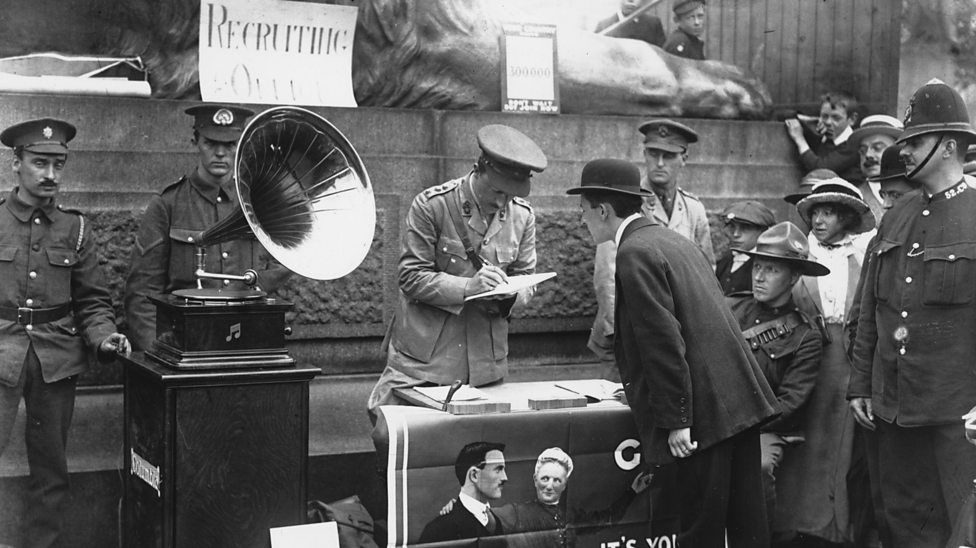
What Socialism is not. State intervention and control of the capitalist economy to marshal resources in a war effort.
‘The Socialism of the Sword’ by Louis C. Fraina from The New Review. Vol 3. No. 6. May 15, 1915.
THE military State Socialism imposed upon the belligerent nations by implacable necessity is not a new phenomenon in the scope of its purpose; it is a new phenomenon in its application and social consequences.
war. Now, however, these constructive changes occur in the midst of war itself. While the armies of the nations slaughter each other, the state organizes and transforms the internal social system. The Napoleonic wars destroyed the old order of things in
The theory of the older Socialism of the Sword Europe, but except in France the new order was lucidly stated by Benjamin Franklin.
“Property is the creature of society and society is entitled to the last farthing whenever society needs it.”
This is a recognition of the right of the state to protect itself and the power of the state to seize its citizens and their property as means of protection. The language of Franklin, “Society is entitled to the last farthing,” indicates the method,–taxation and expropriation. Property was taxed, destroyed, stolen by the state, but economic activity was not fundamentally altered by the decrees of the state. Socially, that was not State Socialism; it was an action of the state economically and socially destructive, and not constructive.
The ancient prerogative of a state to protect itself assumes the form of State Socialism only when the state denies the right of private property in industry; only when the state regulates economic activity thoroughly and arbitrarily and absorbs within itself the means of production of the nation. Formerly the state simply taxed property; now it REORGANIZES industry. The change is tremendous and fundamental. Previous wars while being waged were purely destructive; constructive economic and social changes usually followed after and not during the developed many years later. The Great War, however, is constructing the basis of the new order of things at the same time that it destroys the old. The work of destruction and construction proceeds simultaneously. In this new phenomenon lies one of the great hopes of progress as a consequence of the war.
The belligerent nations are instituting State Socialism by the absorption of economic activity within the control of the state. This was impossible in a society of isolated individual production; it is possible and practicable only in a society in which industry is highly developed. This presupposes economic unity within the state, the reality or illusion of common economic interests, national enthusiasm and solidarity; all of which presupposes or produces the war of peoples in place of simply the war of nations. States are no longer organized as competing military powers, but as basically competing economic groups. Out of this proceeds the implacable necessity of State Socialism during the war. In all the belligerent nations–in Germany most, in Russia least–the economic forces are mobilized for war, offensively and defensively.
In the fact that it is a war of peoples and a war of economics lies the dynamic social significance of the Great War. It is a war of peoples not alone because of universal military service and its huge armies, but because the people at home are fighting in a very real sense as much as those at the front and because they believe they have a stake in the country worth protecting–are a part of the nation. It is a war of economics not alone because industry is mobilized, but because all the forces of the nation, close-knit by economic unity, are brought within the scope of the war–utilized, affected, transformed. A war possessing these social characteristics must necessarily produce fundamental and permanent changes, economically, politically, culturally.
Considering its economic basis, the State Socialism of the belligerent nations, while an expedient of war, is not necessarily a temporary expedient. All the more does it possess the quality of permanency because the emergency acts of the governments strengthen a previously-existing and powerful State Socialist tendency. Internationally the war is bound to modify national individualism in favor of federation of nations; nationally the war strikes a powerful blow, perhaps the final blow, at the decrepit system of economic individualism.
The war does not produce new forces and a new line of progress, but caps the climax of the evolutionary developments proceeding in the bosom of pacific society. It destroys that which was on the verge of destruction and strengthens that which was ascending into power.
Those who still cling to the system of economic individualism imagine the compulsory collectivism of the war to be temporary because “this whole government regimentation has meant great sacrifices for many classes.” But these sacrifices are the sacrifices of war; part and parcel of the Socialism of the Sword, they are incidental and temporary in State Socialism itself.
The old argument of inefficiency is being revived. It is pointed out that graft and corruption and vicious speculation are actively at work. These triple evils, however, are nothing new; present in all wars, they were actively at work in the American Civil War and in the wars of the French Revolution. They were incidental to the social changes proceeding during those epochs, just as they are incidental to the social changes implied in military State Socialism. Besides, graft and corruption are a more or less normal phase of Capitalism.
Prejudices are more pertinacious than economics. While titanic events marking the birth of a new era are revolutionizing the economics of the world, immediately and potentially, the arguments and ideological conceptions of a moribund system of things still persist and will continue to persist. Ideological superstructures do not change as easily as their economic and social foundations.
The devotees of economic individualism desperately hope that labor will prevent permanent State Socialism. The New York Evening Post expresses this attitude beautifully:
“The man with the tools is to be regulated as minutely as the man with money. And there can be no doubt at all that Kitchener methods enforced upon British workmen after the war would lead to loud protests and a political revolt…It would be, to them, only one more oppressive display of the power of the capitalistic state.”
Exactly; but it has never been assumed by revolutionary Socialists that State Socialism meant anything else than the governmental regulation alike of labor and capital. American progressivism has made this clear.
The potential revolt of the workers and the capitalist fear of the proletariat would strengthen instead of weakening State Socialism.
The despotic control of industry exercised by a State Socialist regime would impress upon the workers the idea and necessity of industrial self-government. The class struggle, while transformed and simplified, would become more acute and pervasive. The unity of the heterogenous elements of the capitalist class implied in State Socialism would strengthen that class, and greater resistance provoked among the workers.
State Socialism strengthens the potentiality of proletarian revolt–in that lies the promise and social mission of State Socialism. But the proletariat would not revolt to reintroduce the economic individualism of the bourgeois; it would revolt to introduce industrial self-government, that is to say, Socialism.
The New Review: A Critical Survey of International Socialism was a New York-based, explicitly Marxist, sometimes weekly/sometimes monthly theoretical journal begun in 1913 and was an important vehicle for left discussion in the period before World War One. Bases in New York it declared in its aim the first issue: “The intellectual achievements of Marx and his successors have become the guiding star of the awakened, self-conscious proletariat on the toilsome road that leads to its emancipation. And it will be one of the principal tasks of The NEW REVIEW to make known these achievements,to the Socialists of America, so that we may attain to that fundamental unity of thought without which unity of action is impossible.” In the world of the East Coast Socialist Party, it included Max Eastman, Floyd Dell, Herman Simpson, Louis Boudin, William English Walling, Moses Oppenheimer, Robert Rives La Monte, Walter Lippmann, William Bohn, Frank Bohn, John Spargo, Austin Lewis, WEB DuBois, Arturo Giovannitti, Harry W. Laidler, Austin Lewis, and Isaac Hourwich as editors. Louis Fraina played an increasing role from 1914 and lead the journal in a leftward direction as New Review addressed many of the leading international questions facing Marxists. International writers in New Review included Rosa Luxemburg, James Connolly, Karl Kautsky, Anton Pannekoek, Lajpat Rai, Alexandra Kollontai, Tom Quelch, S.J. Rutgers, Edward Bernstein, and H.M. Hyndman, The journal folded in June, 1916 for financial reasons. Its issues are a formidable and invaluable archive of Marxist and Socialist discussion of the time.
PDF of full issue: https://www.marxists.org/history/usa/pubs/newreview/1915/v3n06-may-15-1915.pdf

