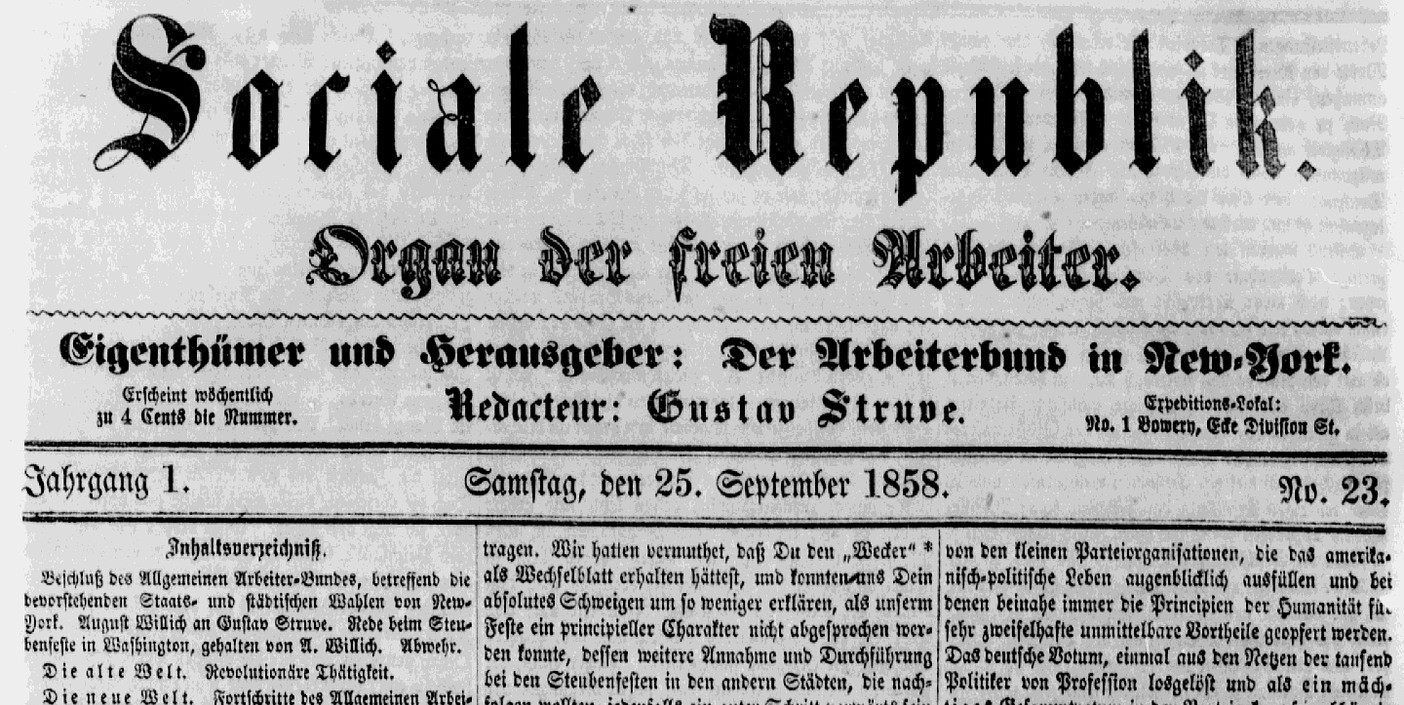
German-speaking workers, the exiled ’48ers, were absolutely central to the beginnings and development of the U.S. Socialist movement. Two generations before the country had a single daily English-language Socialist newspaper it had seven in German at one time. A brief history of the essential contribution of the German comrades.
‘Germans Were Pioneers in U.S. Socialist Work’ from The Chicago Daily Socialist. Vol. 6 No. 58. December 30, 1911.
In the Days of Karl Marx They Raised the Workers’ Banner Here.
“Let them all get into the English branches of the Socialist party.”
This was the sentiment voiced by Victor L. Berger, Socialist congressman, when the question of national foreign language organizations came before the 1910 congress of the Socialist party.
“That is the way the Germans are doing,” continued Berger, and he is correct, no serious attempt having thus far been made by the German Socialists of the United States to start national organization similar to the sections of the Finnish, Polish, Italian, South Slavic, Scandinavian, Bohemian, Russian and French Socialists.
It seems also that the Germans will be in the lead among the foreign speaking people to show that the foreign language organizations must only be a means to an end; the taking care of the foreign speaking people until they can learn the English language and become active members in the regular English organizations.
The Germans, too, were the pioneers in the American Socialist movement over half a century ago, and they are now loth to isolate themselves in a foreign section, although they have their foreign local branches in every part of the land; these, however, working directly with the local English central bodies.
The Volkzeitung, the German daily of New York City, some time ago tried to learn the number of German Socialist branches in the United States, and the number of German Socialists in the American Socialist movement, but it developed that the German movement was so interwoven with the English that it was difficult to secure any satisfactory statistics.
Began at Close of War
Perhaps the best central organization of the Germans at the present time is the German state agitation committee of New York. The German Socialists of Illinois had a similar organization in mind, but were unable to get it under way, the Germans down state seeming to be more attracted to St. Louis than they are to Chicago.
In many of the larger cities there are German central committees: These are affiliated with the central committees of the English branches.
The Germans were prominent in the early rise of Socialist sentiment in this country. The Socialist movement in the United States during the period Immediately following the end of the Civil war was closely linked with the career of the European International Workingmen’s Association, for which Karl Marx and Frederick Engels were largely responsible.
The active career of the International embraced a period of about eight years, from 1864 to 1872, and the zenith of its power and influence was reached toward the end of the sixties.
It was largely through the efforts of Germans and other Socialists of foreign birth that the international exerted an influence on the labor movement of the United States.
The first organizations directly affiliated with the international appeared in the United States around the year 1868. They were small societies in New York. Chicago, and San Francisco, composed almost exclusively of German Socialists, and styled “sections” of the International.
Organized on the Bowery
In New York the movement was inaugurated by a call issued in December. 1867, for a mass meeting to be held in the Germania Assembly rooms, on the Bowery in January, 1868.
The call was signed by C. Carl, E. Ellenberg, A. Kamp, F. Krahlinger and C.A. Petersen, all of whom were men of influence in German labor circles, and the meeting was well attended. After a thorough discussion of the political situation, it was decided to organize an independent political labor party, and the Social Labor party of New York and vicinity was accordingly formed.
The party adopted a platform which was a sort of compromise between the declaration of principles of the international of Europe and the platform of the national labor union of the United States, and appointed two executive boards, one English speaking and the other German speaking, who together formed the political campaign committee of the party. The Social party nominated an independent ticket at the elections of 1868, but its vote was very insignificant.
Immediately after this, its first and last campaign, the party dissolved, and some of its most active and intelligent members organized the “General German Labor Association.”
This was the first strictly Marxian) organization of some strength and influence on American soil, and the present Socialist movement in this country may be said to date from the organization of that party.
“The members,” relates F.A. Sorge, in his book on “The Labor Movement in the United States,” “almost exclusively wage-earners of every possible trade, vied with each other in the study of the most difficult economic and political problems.
All Members Close Students
“Among the hundreds of members who belonged to the society from 1869 to 1874, there was hardly one who had not read his Marx (Capital), and more than a dozen of them had mastered the most involved passages and definitions, and were armed against any attacks of the capitalist, middle class, radical or reform schools.”
In February, 1869, the General German Workingmen’s Association was admitted to the National Labor Union. In the fall of 1869 the society joined the International Workingmen’s Association, and all through the career of the international It remained its strongest and most reliable branch in the country.
A new impetus was given to the American labor movement at about this time by the transfer of the seat of the international from London to New York. The council was headed by F.A. Sorge as general secretary. Sorge was well qualified for the duties of this responsible and delicate position. A veteran of the German revolution of 1848, and a personal friend and co-worker of Marx and Engels, he arrived in this country in 1852, and by dint of his tact, abilities and intimate knowledge of the labor question, he soon acquired a position in the front ranks, of the early Socialist movement in this country.
This is sufficient to show the part that the Germans played in the early history of the United States Socialist movement. Between 1876 and 1877 the German press, which was either directly or indirectly supporting the Socialist Labor party, the Socialist party of that day, was represented by fourteen newspapers, of which no less than seven were dailies–the Chicago Socialist and Chicago Volkszeitung In Chicago; Volksstimme des Westens in St. Louis; Die Neue Zeit in Louisville, Ky.; the Philadelphia Tageblatt, in Philadelphia; the Vorwaerts in Newark and the Ohio Volkszeitung in Cincinnati; one, the Chicagoer Arbeiter Zeitung, appeared three times a week; and six–the Arbeiterstimme of New York, Arbeiter von Ohio and Freiheitsbanner of Cincinnati, Neue Zeit and Verbote of Chicago, and Vorwaerts of Milwaukee, appeared weekly.
Papers Went Down
Of the eight English papers reported as existing at the Newark convention of 1873, not a single one survived in 1879. A new party organ in the English language, under the title of the National Socialist, was established in May, 1878, and with great sacrifices was kept alive a little over one year.
Of the German papers, the Philadelphia Tageblatt and the Arbeiter-Zeitung, and the Verbote of Chicago, were the only ones to survive the general wreck.
In the beginning of 1878 the party press received, however, a notable reinforcement by the establishment of the New Yorker Volkszeitung, a daily newspaper in the German language, devoted to the interests of the Socialist and trade union movement.
The paper was edited with exceptional ability by a staff of the most efficient and experienced journalists in the American Socialist movement, including in its numbers Alexander Jonas and Dr. Douai. On the death of Dr. Douai, a more than competent substitute was found in the person of Hermann Schlueter, a veteran in the Socialist movement of both hemispheres, who still stands at the head of the Volkszeitung’s editorial management. At the age of 85 years, Jonas is still an active worker on the same paper.
The Volkszeitung from the very day of its appearance assumed a position of leadership among the Socialist press of this country. Its good judgment and deliberate attitude helped the party to sail safely through many a crisis in the early days of its career.
In August, 1880, the Social Democratic party of Germany. at its convention in Castle Wyden, decided to send a deputation to the United States for the purpose of informing the German-American working men of the condition of the party under the anti-Socialist law, and collecting funds for the approaching elections to the German diet.
Avelings Made Tour
F.W. Fritsche and Louis Viereck, two Socialist deputies to the German Imperial Diet, and popular speakers, were selected for that purpose and they arrived in the United States in February, 1881.
As a rule their meetings were made the occasion for the general propaganda of Socialism, and addresses in the English language were frequently interspersed with their German speeches. Another lecture tour of note was that undertaken by Wilhelm Liebknecht, the veteran leader of the German Social-Democracy, in conjunction with Eleanor Marx Aveling, the eloquent and brilliant daughter of Karl Marx, and her husband, Dr. Edward Aveling. This tour was arranged by the Socialist Labor party in the fall of 1886.
The lecturers addressed about fifty meetings in all the principal cities of the nation, Liebknecht speaking in German and the Avelings in English. Their work had a marked effect on the Socialist movement in this country. In 1889 the number of sections of the Socialist labor (Socialist) party was reported to be seventy. During the four years following 113 new sections were organized: of these forty-three were German, thirty-nine American, fourteen Jewish, and the remainder were made up of Poles, Bohemians, Frenchmen, Italians and other nationalities. The sections were distributed in twenty-one states. It will thus be seen that the greater number of branches were made up of Germans.
Since then, however, the Socialist movement in this country has gradually become “Americanized.” This has been shown in the membership of new Socialist locals as well as by the nationalities of the delegates that have since been elected to national Socialist conventions.
The German Socialists have probably been as active in their labor union duties as they have in the affairs of the party. They are very strong in the international organizations of the bakers, brewers, machinists and cigarmakers, while they also play a part in the carpenters’ organization.
German Papers Strong Now
There are three German Socialist dallies at the present time, the New Yorker Volkszeitung, of New York; the Arbeiter Zeitung, of Chicago, and the Tageblatt, of Philadelphia. Among the weeklies are the Arbeiter Zeitung, of St. Louis, Mo.; the Vorwaerts, of New York City: Die Wahrheit, of Milwaukee, Wis.; the Echo, of San Francisco; the Vorwaerts, of Seattle, and the Arbeiter Zeitung of Buffalo, N.Y.
These papers are usually controlled by stock companies in which the German Socialist locals and German Socialist labor unions are the principal shareholders.
The German Socialist papers are all extensively well read and should warrant a much greater German membership in the Socialist party,” says Adolph Dreifuss, one of the editors of the Arbeiter Zeitung, the German Socialist daily of Chicago.
“The Germans are much quicker to learn the English language and adopt the American customs, so that large numbers of them are soon lost in the English branches.
“In the past some of the German Socialists coming over here from the old country became disgusted with the tactics of the party in this country and remained out of the movement entirely. This condition has disappeared, however, and there is an encouraging growth shown in all of the, German branches now existing, while many new ones are being organized. Four German branches have just been organized in Chicago, while the membership of the old branches shows an encouraging increase. There is nothing clannish about the Germans in this country. They do not confine themselves to any section of the country, or to any specified locality in the cities. They are to be found all over the United States, as well as in every portion of our large cities. This is especially true of New York City and Chicago.”
The attitude of the Germans toward foreign language organizations is likely to raise a discussion in the national Socialist convention at Oklahoma City over the question as to whether something ought not to be done to encourage members of the foreign language sections to get into the regular party organizations.
The Chicago Socialist, sometimes daily sometimes weekly, was published from 1902 until 1912 as the paper of the Chicago Socialist Party. The roots of the paper lie with Workers Call, published from 1899 as a Socialist Labor Party publication, becoming a voice of the Springfield Social Democratic Party after splitting with De Leon in July, 1901. It became the Chicago Socialist Party paper with the SDP’s adherence and changed its name to the Chicago Socialist in March, 1902. In 1906 it became a daily and published until 1912 by Local Cook County of the Socialist Party and was edited by A.M. Simons if the International Socialist Review. A cornucopia of historical information on the Chicago workers movements lies within its pages.
PDF of full issue: https://www.marxists.org/history/usa/pubs/chicago-daily-socialist/1911/111230-chicagodailysocialist-v06n056.pdf
 Revolution's Newsstand