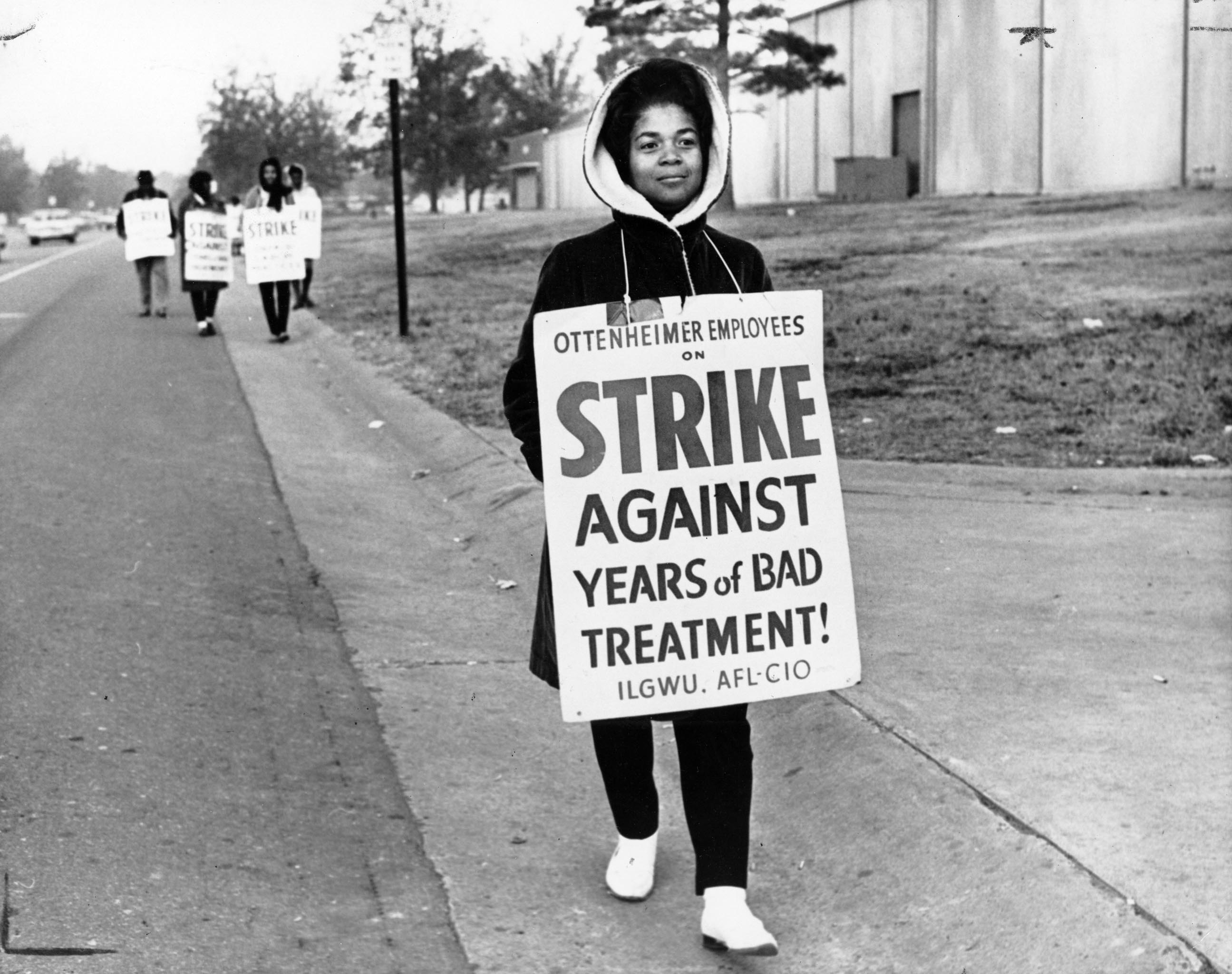
The veteran labor activist offers some thoughts on that most elemental experience of the class struggle, the transforming action–objective and subjective, individual and collective–that is the strike.
‘The Strike: Its Past and Future’ by Jay Fox from Labor Herald. Vol. 2 No. 9. November, 1923.
“I am, as you know, in full sympathy with Organized Labor; but between you and me, strikers have no right to prevent other workers taking the jobs wanted by them.”
The above quotation is from a letter I received recently from a lawyer friend. Upon reading it I was a bit riled and felt like batting my friend on the bean. Distance preventing the use of the bat I was compelled to resort to the highbrow stuff. With the bat I could have completed my answer in exactly two seconds. This civilized method is much more laborious and probably not so convincing. This may be the reason civilization is so long in taking hold of the people. Anyway, here is my reply:
I quite agree with you that a striker has no legal right to keep a scab away from his job Under none of your calfskin covers is it written that a working man has any such right. No bunch of lawyers in their capacity as a law-making body have ever defiled the sacred records of their doings with the vile inscription of a working man’s right. A working man has no right to do anything except to submit to every thing. You lawyers have seen to that.
Ages ago you legislated away from us every right that nature gave us. You trimmed us proper. And when you had stripped us of every human right you took these rights and divided up with the rest of the gang that helped you put over the trick. There were kings and lords and merchants, judges, generals and numerous other parasites, all shared in the loot of Labor’s liberty and have lived, lavishly, on Labor’s back ever since. So, when you say we have no legal right to defend our jobs I can well agree with you. I know enough about the law for that. I have had it beaten into my bones a few times. And there is nothing that will awaken the dull brain of a working stiff quicker than a wallop from a well handled hickory.
Do you know that it is not so long ago that you could have said with absolute truth, not only that we had no right to keep a scab away from our struck jobs, but that we had no right to give the scab the opportunity to follow his chosen profession. In other words: we had no right to strike.
Strikers’ Ears Cut Off
Seventy-five years ago it was a greater crime to strike a job than it is now to strike a scab. About a hundred years ago strikers were branded with hot irons and had their ears lopped off for daring to assert their natural right to organize and strike. In those days the striker was regarded as the most dangerous of ruffians, a deadly enemy of society, and the interest of civilization demanded that he be ruthlessly dealt with. Things as they were had to be kept as they were. There was no need for change or further progress. Everything was lovely for the “better clawses,” and it was for them that civilization existed. Despite all the power of the possessing classes to keep things as they are, somehow change takes place in spite of them. The torture and mutilation of the workers ought to have kept them in their place. Still it seems they were not wholly convinced by these civilized arguments, for we see them striking today by the millions and few there be who question their right to strike. You would not prosecute them for striking. Your grievance against them now is that when on strike they do not always behave according to your legal code of ethics. Now I want to ask you a question: What brought about this change of front on the part of society? Why are strikers tolerated today? What is the answer of the law to this question?
I hear you say: “Why, simply this: Public opinion has changed on the question of the right to strike and as a result has ceased to demand the prosecution of strikers.” That will be the answer of the law, and it is all very well in its way; but it doesn’t say much. It still leaves unanswered the question: why did the public change its opinion? Nowhere in your law books is it written down why the change of front was made by society in the matter of strikes; but you will see it written in red on the scroll of Labor history. There it is written plain how the working class got the right to strike they struck for it.
Right Conquered, Despite Torture
When the workers got enough horse sense to realize that they had no rights as human beings, that you lawyers had legislated them all away, they thought they would establish a few rights, amongst them the right to strike. When they became conscious of the fact that they were humans and not beasts of burden they protested. Regardless of your law they struck. In spite of your public opinion, which was, as it is today, the opinion merely of the rich parasites, they asserted their manhood. They knew they were right, even though the law and public opinion and the lawyers and preachers and bosses said they were wrong, that it was a crime against high heaven to stop working without being ordered by the boss.
Knowing that they were right they went ahead and broke the law and defied public opinion until finally the ruling class had to give way and modify its attitude towards the workers through fear of revolution. (The ruling class never does anything out of the goodness of its heart for the slaves upon whose backs it rides.) By organized opposition to the barbarism of the ruling class, by suffering the torture of the branding iron, the butchery of the knife and in many instances death upon the gallows, our forefathers have conquered for us the right to organize and strike; and far from us letting these dearly bought rights slip away from us, we are going to use them as the stepping stone, to other rights that are still written down on your law books as terrible wrongs.
How the Workers Reason
The striker that tries to persuade the scab to keep away from the struck job must have an idea that somehow he has a claim on that job. The idea may be vague in outline, but it must be there, or why should he bother about protecting the job? He may have merely the notion that his claim is a permit to work at the will of the boss. But the strike having forced him into the arena to fight for it he soon enlarges upon that original idea. You have noticed how ideas grow under pressure from the merest shimmerings into solid concrete facts. Given the faintest idea of a claim on the job the striker will build it up logically and carry it to its final analysis: “In order to live I must have food and shelter; without them I would die. The job is the means through which I secure these necessities of life. Therefore the job is for me the most important thing in the world, and it is now owned by another man. That is not right. For while that other man holds the means by which I live I am at his mercy, I am his slave. I thought I was a free man. Now I see I cannot be free until I own my job. Every man should own his job as a birthright.
“Individually I cannot own my job. I see that would be impossible. I will speak about this to my fellow workers and bring it up in the union. The union could take over the whole shop and secure all our jobs. But there are other unions in the shop. That is bad. There should be but one. We must amalgamate all these unions and have one big industrial union that can take over the control of the entire industry, thus securing each and all of us workers in the absolute possession of our jobs.”
Will Strike to Own the Job
That’s the way he dopes it out every time; and the number of him that is pursuing that line of reasoning is increasing so rapidly that consternation and alarm are creeping into the camp of the present “owners” of the jobs. For while it is true that legally the worker has no claim on the job once he leaves it, none the less he every right to possess it outright. Moral values is rapidly coming to feel that morally he has are superior to legal values every time and I can see just where this whole matter is going to end up.
The reactionaries tell us that we have no right to strike, as was told the railroad men lately. Our answer is simply this: Where did you dig up that ante-deluvian stuff? Our forefathers established for us the right to strike the job without legal sanction, and we are not going to defile their memory by letting that dearly bought right slip away from us. On the contrary, some fine morning we may take it into our heads to go a step further and establish our right to own the job.
The Labor Herald was the monthly publication of the Trade Union Educational League (TUEL), in immensely important link between the IWW of the 1910s and the CIO of the 1930s. It was begun by veteran labor organizer and Communist leader William Z. Foster in 1920 as an attempt to unite militants within various unions while continuing the industrial unionism tradition of the IWW, though it was opposed to “dual unionism” and favored the formation of a Labor Party. Although it would become financially supported by the Communist International and Communist Party of America, it remained autonomous, was a network and not a membership organization, and included many radicals outside the Communist Party. In 1924 Labor Herald was folded into Workers Monthly, an explicitly Party organ and in 1927 ‘Labor Unity’ became the organ of a now CP dominated TUEL. In 1929 and the turn towards Red Unions in the Third Period, TUEL was wound up and replaced by the Trade Union Unity League, a section of the Red International of Labor Unions (Profitern) and continued to publish Labor Unity until 1935. Labor Herald remains an important labor-orientated journal by revolutionaries in US left history and would be referenced by activists, along with TUEL, along after it’s heyday.
PDF of full issue: https://www.marxists.org/history/usa/pubs/laborherald/v2n09-nov-1923.pdf

