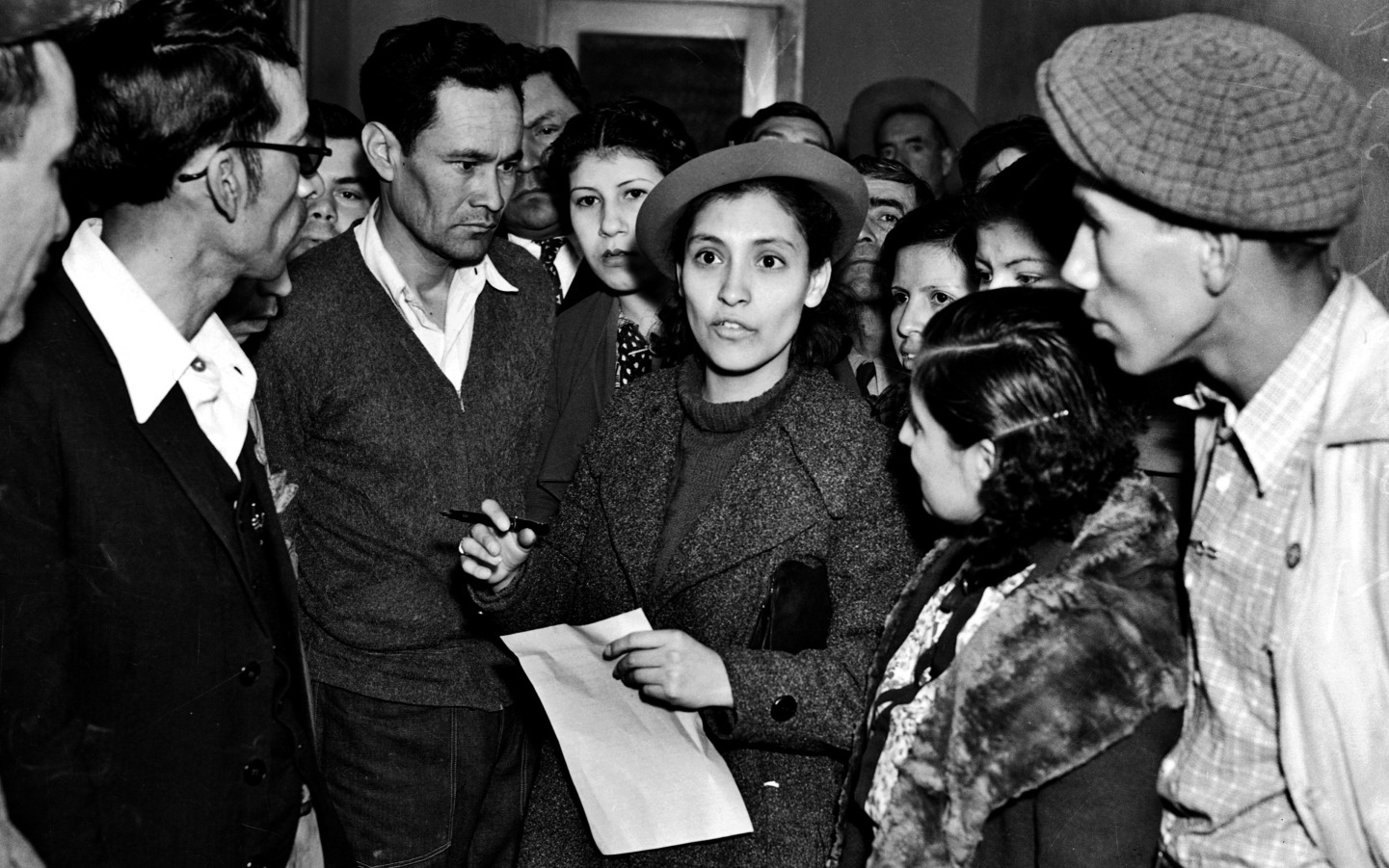
An important document from the history of Mexican organizing within the U.S., sees Emma Tenayuca, then State Chair of the Communist Party of Texas, along with its State Secretary give a detailed analysis of the Mexican population in the U.S. Southwest with a purpose of framing the question–broadly, a national struggle for self-determination or a struggle for rights within the U.S.
‘The Mexican Question in the Southwest’ by Emma Tenayuca and Homer Brooks from The Communist. Vol. 18 No. 3. March, 1939.
State Chairman and State Secretary, Communist Party, Texas
HISTORICAL BACKGROUND
THE war of the United States with Mexico, in 1846, following the annexation of Texas, resulted in the conquest of the territory which now makes up the states of California, New Mexico, Arizona, Colorado and part of Utah and Nevada. From the historical point of view the forcible incorporation of these areas in the United States was progressive, in that it opened up for development these territories which until then had stagnated under the inefficient, tyrannical, and semi-feudal control of Mexico. The predominant influence of the Spanish in the Southwest, particularly in California, New Mexico, Arizona, Colorado and: Texas, can be seen in the names of such cities as Los Angeles, Santa Fe, San Antonio, San Diego and San Francisco.
The acquisition of these lands brought into the Union a population originally Spanish and later Mexican, whose customs, language, traditions and culture were essentially different from those of the rest of the country. In the border area of the Southwest the Mexicans have always constituted a majority, both before and after the war with Mexico.
The expansion and industrialization that followed the Civil War, lasting until a relatively late period in the Southwest, saw the importation of thousands of Mexican workers into Texas, California, Colorado and Arizona. (To a lesser degree this was true of New Mexico, for geographical reasons. Deserts and mountains bordering Mexico prevented free interrelation with old Mexico; at the same time this border region has not made for the development of large-scale capitalist farming.) Railroad companies alone were responsible for a great number of those imported. It is safe to say that most of the railroads of these five states were built by Mexican labor.
With the development of capitalist farming in these states, and particularly in California and Texas, Mexico was again a source of cheap labor. Early figures on the number of Mexicans immigrating into the United States are not available, since until a relatively late period entrance into the United States was comparatively simple. Complete figures as to the number of Mexicans in the United States are today not available, since until 1930 Mexicans living here were not classified separately.
However, between 1925 and 1929 the heaviest immigration from Mexico took place. In the course of these five years, 283,738 Mexicans entered the United States, as follows:
1925 50,602
1926 58,017
1927 77,162
1928 58,456
1929 39,501
Source: The World Almanac, 1937.
The 1930 census showed 1,500,000 Mexicans residing in the United States. Of these, all but 150,000 were found to be living in the states of California, Texas, New Mexico, Colorado and Arizona. However, these figures include only the foreign-born and first generation Mexicans. They exclude the large Spanish-speaking population of New Mexico, which, according to H.T. Manuel of the University of Texas, numbers over 250,000, or approximately half the state population. These figures also exclude Mexicans of the third, fourth and fifth generations and those descendants of the early Spanish colonists of any of the other four states. Therefore, we can readily state that the Mexican population of the Southwest numbers approximately 2,000,000.
Thus, we can see that the present Mexican population in the Southwest is made up of two groups: descendants of those living in the territory at the time of annexation, and immigrant Mexicans and first or second generation native-born drawn from the impoverished peasantry of Northern Mexico to work as super-exploited wage workers in railroad and building construction and in highly developed (capitalist) agriculture in the border area.
However, there is no sharp distinction between these two groups, either in their social conditions or in their treatment at the hands of the Anglo-American bourgeoisie. Assimilation among those groups which were here before the conquest of these territories by the United States has been slow, and the Spanish language remains today the language of both groups.
The distinction has been sharpened somewhat in New Mexico, since a lack of direct contact with Mexico led the majority of Mexicans to regard themselves as Spanish-Americans or Latin Americans, and consequently to regard Spain rather than Mexico as the mother country. However, this distinction is being done away with more and more by the social conditions under which the Mexicans or Spanish-Americans are suffering, which are breaking down barriers and leading to unification. The pro-Mexico sentiment among the people in New Mexico was seen when the Spanish-speaking population rallied to support Mexico during the recent oil expropriations and even raised funds to be sent to Mexico.
Those Spanish-speaking people of Texas whose ancestors were in the state prior to its annexation from Mexico today regard themselves as Mexicans. We can thus state that the Spanish-speaking population of the Southwest, both the American-born and the foreign-born, are one people. The Mexican population of the Southwest is closely bound together by historical, political and cultural ties.
The treatment meted out to the Mexicans as a whole has from the earliest days of the sovereignty of the United States been that of a conquered people. From the very beginning they were robbed of their land, a process that has continued even up to the present time. In 1916, immediately following the abortive De la Rosa movement in the Texas lower Rio Grande Valley for an autonomous Mexican regime, Texas Rangers, in cooperation with land speculators, came into small Mexican villages in the border country, massacred hundreds of unarmed, peaceful Mexican villagers and seized their lands. Sometimes the seizures were accompanied by the formality of signing bills of sale—at the point of a gun. So that, where, until 1916, virtually all of the land was the property of Mexicans, today almost none of it is Mexican-owned. In many cases farmers who were well-to-do land owners today barely eke out a living employed as irregular wage workers at 6oc to 75¢ a day on the very lands they once owned. This land-grabbing has continued under one guise or another throughout the Southwest. In New Mexico fewer than one-half of the Mexican or Spanish-American farmers retain any of their ancestral lands.
THE PRESENT SOCIAL STATUS OF THE MEXICAN PEOPLE
With the penetration of Anglo-Americans into these states, the Mexicans have been practically segregated into colonies. This is particularly true of Colorado. Disease, low wages, discrimination and lack of educational facilities are typical of these communities.
Mexican labor imported into the United States has uniformly received lower wages than those paid Anglo-American workers. The vast majority of the Southwest are today found doing only the most menial work, the bulk of them having been excluded from skilled crafts. In the cities, although Mexicans are found in the garment industry and laundries and as laborers in building construction, the overwhelming majority are also seasonal agricultural workers. This is true of the Mexicans in all states except the Spanish-Americans of New Mexico, where instead of being agricultural workers, the majority are small farmers, tenants or share-croppers.
In Texas, in the area of Corpus Christi, few if any Mexicans are found working in the extensive oil field discovered there several years ago. Corpus Christi, we may add, is one of the cities that lies within the belt where the Mexicans form the majority of the population. An example of the kind of industry that Mexicans are not excluded from is the pecan industry in San Antonio, which until recently employed 12,000 Mexican workers, with wages averaging two to three dollars a week.
Near-starvation faces thousands of Mexican agricultural workers who must live part of the year in the cities and try to get work on W.P.A. A special clause in the relief appropriation act of 1937, which excludes foreign-born workers who have not taken out citizenship papers, resulted in dismissals of thousands from W.P.A. In El Paso, for example, 600 out of 1,800 on W.P.A. were so dismissed.
The reaction of most of the Mexican W.P.A. workers to these dismissals could not lead to acquiring citizenship papers due to language, cost, and other burdensome obstacles. Their resentment was expressed by demanding the opportunity to work on all jobs, regardless of citizenship, a demand which by virtue of their historical rights in this territory is unchallengeable.
Discrimination against the Mexican people can also be seen in regard to relief appropriations. The Relief Commission of Los Angeles presents a special budget for Mexicans, claiming that diet and living expenses are lower among the Mexicans than among other sections of the population.
Since the Mexicans live in houses without electricity or natural gas, they are subject to smaller relief portions in every state in the Southwest.
The conditions of the Mexican agricultural workers can be compared only to those of the Negro sharecroppers in the South. According to the United Cannery, Agricultural, Packing and Allied Workers of America, the average wage of the Mexican beet worker in Colorado is from $100 to $200 per year. The average wage of the Texas cotton picker is considerably less; in 1938 it ranged from 35c to 75c per 100 lbs. In those places where the U.C.A.P.A.W.A. carried on struggles, the prices were raised.
In New Mexico, where the Mexicans or Spanish-Americans have been engaged in small farming, fully one-half of the farmers have lost their land. Individuals such as John T. Raskob and large corporations have taken over ownership, and sharecropping is rapidly taking the place of small independent farming. Another factor which threatens the existence of the farmers of New Mexico and the agricultural workers of the Southwest has been the large migration of Anglo-American farmers from the dust bowl.
The crisis has intensified the competition for jobs; a fact that is resulting more and more in displacing Mexican workers in the cities. For example, the Sun-Tex canneries in Texas, located in a city with an overwhelming majority of Mexicans, hires only Anglo-American workers.
The Mexicans are not only subject to wage differentials and discrimination, but a view of their political status in the five states referred to, reveals conditions in many ways comparable to the political status of the Negro people in the South. Denial of voting rights to the foreign born means disfranchisement of nearly half the adult Mexican population. Secondly, the semi-migratory character of the work of most of the Mexican workers disfranchises in addition many of those who are citizens. Finally, in Texas the poll tax disfranchises many of those who would otherwise be able to vote. Thus, due to one or another of the three causes, in San Antonio, a city of 250,000, nearly half of whom are Mexicans, only 8,000 Mexicans were eligible to vote in 1938.
This disfranchisement has resulted in nearly complete Anglo-American domination politically in most of the communities where the Mexican people are a majority. In only two or three counties in Texas do the Mexicans hold the decisive elective positions. (In New Mexico the situation is otherwise, since there the majority are Spanish-American, non-migratory, and no poll tax is in force.) The 800,000 Mexicans in Texas have only two representatives in the State Legislature.
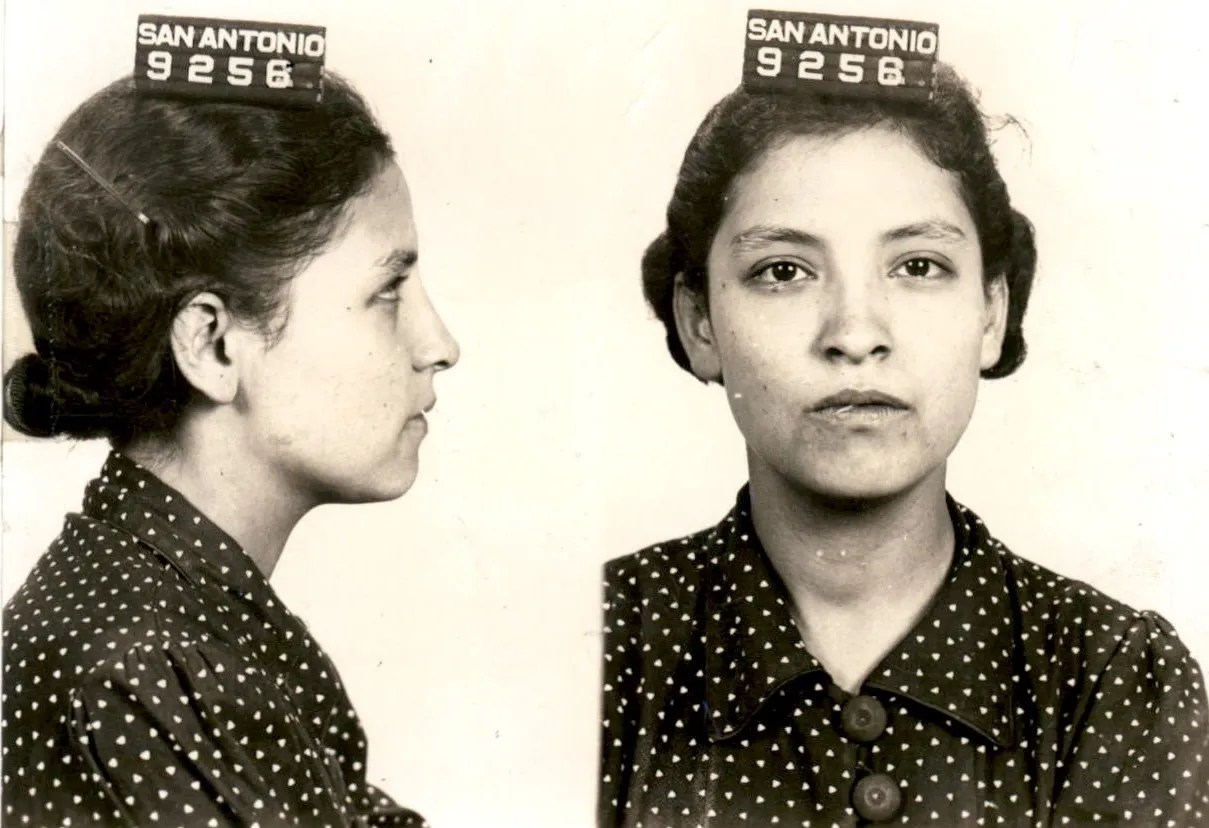
Lack of representation in local or state politics and low economic standards have resulted in poor health conditions and lack of educational facilities. An example of this is Texas, where the death rate among Mexicans is decidedly higher than among Anglo-Americans, and even higher than the rate among Negroes. The following statistics well illustrate this fact:
Per cent of Illiteracy– Deaths per 10,000
Counties with a heavy Mexican population 15.5–98
Counties with a heavy Negro population 6.7–86
Counties with Anglo-American population 1.7–58.5
Actually, the relative difference in the death and illiteracy rates is higher, since the statistics refer to county averages which include considerable Anglo-American and some Negro populations in all of the counties having a heavy Mexican population. Health conditions among the Mexicans are evidently worse than among any other section of the population in the Southwest, or even in the United States. San Antonio has the highest infant mortality rate of any large city in the United States. It likewise has a higher rate of deaths from tuberculosis than any other city in the country.
The unequal treatment that the Mexican people suffer is manifested in all phases of life. The practice of excluding Mexicans from hotels and restaurants is prevalent in all these five states. A few years ago an international incident took place in Victoria, Texas, when an official delegation of students from Mexico was excluded from a restaurant. Signs bar Mexicans from dance halls in Los Angeles. In Colorado small town restaurants display signs: “White Trade Only.” Segregation of Mexican children in small town public schools in Texas is a common practice. Several years ago a group of Mexican tax-payers in San Antonio, by threatening to withhold the payment of school taxes, successfully fought this issue. A few months ago Dr. Juan Del Rio, a resident of San Marcos, had to bring suit against the school board of that city to win the right of his children to attend the school established for Anglo-American children.
The suppression of the Spanish language, of the native culture of the Mexicans, is one of the reasons for the high rate of illiteracy. The most important reason is, of course, the semi-migratory life of the agricultural worker, which forces the children out of school at an early age, and makes school attendance irregular for many.
The social conditions of the Mexicans can well be summed up by the following statistics based on the census of 1930:
PERCENTAGE OF ILLITERACY
New Mexico—Arizona–Colorado
Native white 7.7—5—8
Mexicans 36.4–28.5–22.0
Negroes –*–3.9
Source: The World Almanac, 1937.
To summarize, the Mexican people of the Southwest have a common historical background and are bound by a common culture, language and communal life. It should be noted, however, that the Mexican communities exist side by side with Anglo-American communities within a territory where the populated districts are separated by large but thinly populated mountainous and arid regions.
Should the conclusion, therefore, be drawn that the Mexican people in the Southwest constitute a nation—or that they form a segment of the Mexican nation (South of the Rio Grande)? Our view is no. Historically the Mexican people in the Southwest have evolved in a series of bordering, though separated, communities, their economic life inextricably connecting them, not only with one another, but with the Anglo-American population in each of these separated Mexican communities. Therefore, their economic (and hence, their political) interests are welded to those of the Anglo-American people of the Southwest.
We must accordingly regard the Mexican people in the Southwest as part of the American nation, who, however, have not been so accepted heretofore by the American bourgeoisie; the latter has continued to hinder the process of national unification of the American people by treating the Mexican and Spanish-Americans as a conquered people.
Comrade Stalin’s classic definition of a nation states: “A nation is a historically evolved, stable community of language, territory, economic life and psychological make-up manifested in a community of culture.”* We see, therefore, that the Mexicans in the United States lack two of the important characteristics of a nation, namely, territorial and economic community.
* Joseph Stalin, Marxism and the National and Colonial Question, p. 8, International Publishers, New York.
THE SIMILARITY BETWEEN MEXICAN AND NEGRO CONDITIONS
The status of the Mexican people as an oppressed national group may be compared in a number of aspects with that of the Negro people in the South today. The policy of a wage differential, based upon the superexploitation of the Negroes, has been carried over from the South and applied to the Mexican population of the Southwest. The treatment accorded the Mexicans is also a carryover to the United States of Wall Street’s imperialistic exploitation of Latin America.
The degree of oppression can also be compared to that suffered by the Negro people. Every effort of the Mexican people to organize has been met by repression, as in the case of the lettuce strikers in California; or by attempting repression, as in the case of the San Antonio pecan workers. The threat of deportation has been an important weapon used by the reactionary forces to break strikes and keep the workers from organizing.
Likewise, we might compare the social forms of discrimination of the Mexicans, previously cited, with those of the Negro people.
SOCIAL AND POLITICAL DEMANDS IN RECENT STRUGGLES
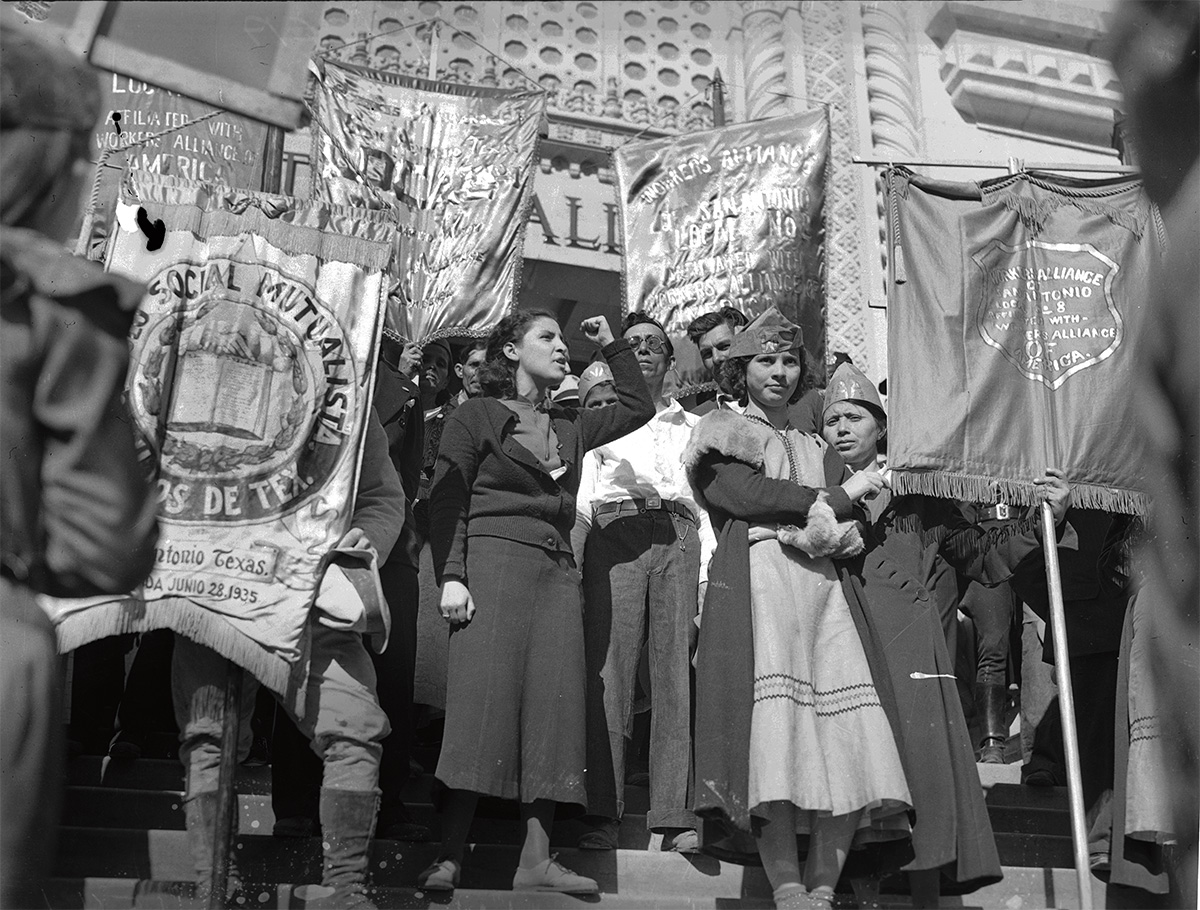
During the first series of demonstrations among the unemployed in San Antonio, the Border Patrolmen were used against the Mexicans. Scores were herded before the United States Immigration office and threatened
with deportation merely for membership in the Workers Alliance. On one occasion a number were beaten, including several American-born Mexicans.
The demand for the right to organize into unions without interference from the immigration authorities was immediately raised. As a result of the struggle by the Mexicans around this issue, the Border Patrolmen of San Antonio have not been used again as a strike-breaking agency.
Upon the formation of locals of the U.C.A.P.A.W.A. in the Rio Grande Valley in Texas, the Mexican workers raised the demand for schools conducted in Spanish. At the Brownsville (Texas) district convention of the U.C.A.P.A.W.A., a resolution calling for the establishment of schools to be conducted both in English and Spanish in all towns where Mexicans were a majority was unanimously adopted. A year ago the announcement by the Workers Alliance of San Antonio of a campaign to combat illiteracy brought 250 Mexicans who registered for classes. However, the Mexicans would only attend classes providing they were taught in Spanish, a demand to which the W.P.A. acceded.
The tendency of the Mexican people toward solidarity was clearly manifested during the pecan strike in San Antonio a year ago. Scores of small Mexican merchants signed petitions demanding of Mayor Quin the right of the strikers peacefully to picket the factories without interference from the police.
The recent struggles of the Mexicans in New Mexico are significant. Liga Obrera, an organization of small farmers, has not only fought evictions successfully, but has also taken up the struggle against all kinds of discrimination and for W.P.A. jobs. Thus, Liga Obrera and the U.C.A. P.A.W.A. unions in Texas and Colorado have not only taken up the economic demands of the workers, but have entered the struggle for social, cultural and political demands.
WHAT PATH TO FOLLOW
Until now the various struggles of the Mexican people in the Southwest have been limited in the main to isolated instances enjoying only partial or purely local support. Strike struggles by the Mexican workers in all Southwestern states; struggles to hold the land in New Mexico; large demonstrations against discrimination in relief in most centers of Mexican population, particularly in San Antonio; and, finally, occasional struggles by various middle-class organizations, especially the League of United Latin American Citizens (L.U.L.A.C.) against discrimination and segregation, is the record of recent years.
The struggles of the last few years signalize the awakening of the Mexicans and Spanish-Americans in the Southwest. The task now is to build the democratic front among the Mexican masses through unifying them on the basis of specific needs and in support of the social and economic measures of the New Deal.
A significant beginning in this direction is the forthcoming First Congress of the Mexican and Spanish-American people, to be held in Albuquerque, New Mexico, on March 24-26. The preparations for the Congress are a direct outgrowth of the mass struggles in San Antonio and New Mexico. It is sponsored by labor, fraternal and religious organizations among the Mexican people, as well as by Anglo-American political, and community leaders in Southwestern states.
The desire of the Mexican people for unification is indicated, not only by the present preparations for this Congress, but also by two conferences held recently in Texas, initiated independently of the Congress movement but which now have joined in its sponsorship. We refer here to the Dallas national conference of the Camara de Trabajadores Mexicanos of the United States, a national group of loosely federated workers’ clubs, and the Port Arthur State Conference of Mexican Societies, initiated by a number of Mexican fraternal societies with consular support.
In California, a thoroughly representative State Congress of the Mexican people has been held in preparation for the national gathering. Similar steps are under way in New Mexico, Colorado and Arizona.
Upon what is this movement for Mexican unification based? What are its main objectives?
It is a people’s movement, uniting the interests of large and important sections of the population, over two million strong, who, in alliance with the country’s democratic forces, in the Southwest and nationally, can free themselves from the special oppression and discrimination in all its phases that have existed for almost a century. The struggle is directed:
1. Against economic discrimination—extra low wages; expropriation of small land holders; discrimination in the right to work in all trades and crafts, particularly skilled trades; discrimination against professional and white collar workers; discrimination in relief and right to employment in W.P.A.
2. For educational and cultural equality—equal educational facilities for the Mexican population; no discrimination against children of Mexican parentage; a special system of schooling to meet the needs of the migratory families; the study of the Spanish language and the use of Spanish as well as English in the public schools and universities in communities where Mexicans are a majority; the granting of equal status to the Spanish language, as has been done in New Mexico and in those counties and states where the Mexican people form a large part of the total population.
3. Against social oppression—for laws making illegal the various forms of Jim-Crowism, segregation in living quarters, schools, parks, hotels, restaurants, etc. This struggle must be linked with that of the Negro people.
4. Against political repression. The struggle for the right to vote is divided into two phases:
(a) The majority of the Mexicans are American-born. The problem is, therefore, one of enforcing their citizenship right. This means demanding that all legal and extra-legal restrictions to the free exercise of the ballot be removed. These include residence qualifications, difficult for semi-migratory workers to meet; and in Texas, the elimination of the poll tax.
(b) Those who are foreign born must join with all of the immigrant groups in the United States to secure the democratization of the federal regulations pertaining to length of time, cost, and language conditions required for citizenship; the aim being to simplify the process whereby all who intend to remain permanent residents of the United States—and this includes nearly all of the Mexicans— and who express a desire for naturalization, can become citizens.
In some states, as in Texas, it may become feasible to restore, at least until federal requirements for becoming citizens become less onerous, the provisions in the Texas state constitution which, until 1921, granted voting rights to all Mexicans and other foreign born, citizens and non-citizens, providing they met residence requirements and declared their desire for American citizenship.*
[* The special status due to historic conditions that the Mexican people occupied prior to the migration of Anglo-Americans into the Southwestern states can be seen from the following two factors: First, only six months’ residence but not citizenship was the requirement for voting among Mexicans in Texas until after 1921, when the state constitution was amended. Secondly, the Spanish language has, from the earliest days, been an official language alongside of English in New Mexico. However, this does not mean that the Mexicans during this time were not subject to discrimination, Jim-Crowism and unequal wages.]
In this general movement the leading role will undoubtedly be played by the proletarian base of the Mexican population, its overwhelming majority. This is already evident from the impetus given the movement for Mexican rights by the large strike struggles in Texas, California and Colorado. The surest guarantee for the full and successful development of the people’s movement will be in further trade union organization among the Mexican workers; in the first place, in the U.C.A.P.A.W.A., affiliated with the C.I.O.
It would, of course, be the greatest mistake to give a purely labor aspect to this broad people’s movement. But to be most effective, this movement must bring about the closest relationship with the labor and democratic forces in the Anglo-American population of the Southwest.
That the Anglo-Americans will respond to any initiative taken by Mexican people in seeking a closer relationship and mutual benefits is evident from such examples as that in Colorado, where the Mexican beet workers (U.C.A.P.A.W.A.) have an agreement with the Anglo-American farmers for joint action against the beet-sugar interests that exploit them both.
In San Antonio, last year’s strike of 12,000 pecan workers could not have been successful without the important support it received from national and state councils of the C.I.O. and from progressive Anglo-American political leaders, such as Maury Maverick, in defense of civil rights. In the Texas Rio Grande Valley, unity between the small Anglo-American farmers and the Mexican agricultural workers will be the key to improving the conditions of both.
STERILE PATHS
One of the oldest organizations among the Mexican people is the League of United Latin American Citizens (L.U.L.A.C.) with branches in most of the Southwestern states. In the past, its viewpoint was colored by the outlook of petty-bourgeois native-born, who seek escape from the general oppression that has been the lot of the Mexican people as a whole. It meant an attempt to achieve Americanization, while barring the still unnaturalized foreign-born from membership.
It resulted in the glorification of the English language and Anglo-American culture to the extent of prohibiting Spanish within the local societies. And, finally, it ignored the need for labor organization among the masses of super-exploited workers. This program of the L.U.L.A.C. resulted almost from the beginning in its isolation from the Mexican masses, who felt that it would lead them nowhere except to a possible split between the native and foreign-born. The extreme to which this policy led the L.U.L.A.C. was shown in Colorado a few years ago, when, at the height of the depression, a Republican governor proposed to deport 50,000 Mexican workers who were on relief, and the L.U.L.A.C. in Denver endorsed this proposal.
Recently, this splitting policy of the L.U.L.A.C. has undergone significant changes. An amendment to its constitution recognizes Mexico as the cultural motherland. In several cities in Texas and in New Mexico, the L.U.L.A.C. has entered into cooperative relationship with other Mexican groups, including labor organizations. In Texas they have led successful struggles against segregation in public schools, parks, etc., not only in behalf of American citizens, but of all Mexicans. With this change in the orientation of the L.U.L.A.C., which is welcomed by all friends of the people’s unification, it can be confidently expected that this important organization of the Mexican middle class will play an increasing role in the general movement for Mexican rights.
Among the proposed solutions to the Mexican question is the idea of repatriation. By this proposal, the 2,000,000 Mexican and Spanish-American people in the Southwest can be transported to Mexico. It is easy to see that this plan is fantastic, if only because, as we have shown, the 2,000,000 people under consideration are bound to the American soil by historical roots, cultural peculiarities, due to intermingling through several generations with the Anglo-American people in the Southwest, and by present economic and social ties. No, the solution to the problem of the Mexicans and Spanish Americans lies in the Southwest and not in Mexico. There are those, even among liberal Anglo-Americans, who hold that either repatriation or some other means of exodus—at least from the larger cities—is an economic necessity, on the assumption that (as, for example, in San Antonio) “there is such a large proportion of unskilled common labor that the problem of their reemployment can never be solved.” To these people we must say that the solution lies:
1. In removing the barriers to employment of Mexicans in all categories of skilled, white collar and professional work.
2. In facilitating the cultural development of the Mexican people, which will help eliminate the conditions responsible for their status as unskilled workers.
The attitude of the American bourgeoisie to the Mexican question in the Southwest is not uniform. That section which derives super-profits from the exploitation of Mexican wage-labor is content with the status quo. Another section is anxious now that capitalist expansion and construction in the Southwest have passed their peak to get rid of the relief burden of the unemployed masses, by deportation to Mexico, a la Hitler. A third section still clings to the former program of the L.U.L.A.C.—Americanization by assimilation.
It is only recently, with the growth of the labor movement among the Mexican people, that a correct program has developed, calling for abolition of all restrictions—economic, political and cultural—and for due recognition of the historic rights of the Mexican people in this territory.
THE SIGNIFICANCE OF THE MEXICAN RIGHTS MOVEMENT
“No people oppressing other people can be free,” wrote Engels in 1874. [*Volksstaat, 1874, No. 69.] The correctness of Engels’ statement is validated in the low wages, and generally low social status of the majority of the Anglo-American workers who live in the areas where the Mexican people form a large portion of the population. The status of the Mexican people in those areas has, further, tended to make them easy prey to corrupt and reactionary political machines—a consequence that affects the vital interests of the Anglo-American population in the Southwest.
The rise of the Mexican people’s movement is therefore of crucial importance to the general democratic and progressive movement of the Anglo-American people in the Southwest, which is already developing under the leadership of such men as Maury Maverick in Texas and Olson in California.
It is likewise significant in relation to the movement for Negro rights in the South. For, the special exploitation of the Mexican people in the Southwest is, in many respects, simply a continuation of the special exploitation and oppression to which the Negro people in the South have been subjected. A blow against the oppression of one will be a blow for the freedom of both.
Internationally, the Mexican and Spanish-American people’s movement in the United States has an important bearing on the relationship between the United States and Latin-America, especially Mexico. Unless the “Good Neighbor” policy begins at home, with respect to the treatment of the Mexican people, it will be difficult to convince Latin American of the sincerity of this policy.
It is interesting to note that a fascist publication in Mexico City, Novedades, a vehicle for Nazi influence, and therefore an opponent of the efforts made at Lima to organize the Western Hemisphere against fascist penetration, seized upon the fate of the 2,000,000 Mexicans in the Southwest—whose condition it described as being worse than that of the Jews in Germany—as an argument: (1) against the Mexican people concerning themselves with Jewish persecutions in Germany; (2) for a struggle against the “Jewish-dominated capitalists” of the United States, who “hold the Mexican population of the Southwest in bondage.” The winning of the people in the Southwest for an anti-fascist peace policy and for continental solidarity of the Western Hemisphere, therefore, means winning them to a realization of the need for granting recognition to the historical rights of the Mexican people in the Southwest. Due to their proximity to Mexico, it is important to the democratic people’s front movement in that country that the Mexican people of the United States be organized, united and brought into progressive alignment with the democratic forces of the United States, as a barrier to the efforts of the Nazi-financed Mexican fascists to win a base among the Mexicans in the border states in order to further their aims in Mexico itself.
The Mexican people’s movement in the Southwest will constitute one more important and powerful link in the growing movement for the democratic front in the United States. The achievement of its objectives will be a decisive step forward toward the national unification of the American people.
There are a number of journals with this name in the history of the movement. This ‘Communist’ was the main theoretical journal of the Communist Party from 1927 until 1944. Its origins lie with the folding of The Liberator, Soviet Russia Pictorial, and Labor Herald together into Workers Monthly as the new unified Communist Party’s official cultural and discussion magazine in November, 1924. Workers Monthly became The Communist in March ,1927 and was also published monthly. The Communist contains the most thorough archive of the Communist Party’s positions and thinking during its run. The New Masses became the main cultural vehicle for the CP and the Communist, though it began with with more vibrancy and discussion, became increasingly an organ of Comintern and CP program. Over its run the tagline went from “A Theoretical Magazine for the Discussion of Revolutionary Problems” to “A Magazine of the Theory and Practice of Marxism-Leninism” to “A Marxist Magazine Devoted to Advancement of Democratic Thought and Action.” The aesthetic of the journal also changed dramatically over its years. Editors included Earl Browder, Alex Bittelman, Max Bedacht, and Bertram D. Wolfe.
PDF of full issue: https://www.marxists.org/history/usa/pubs/communist/v18n03-mar-1939-The-Communist-OCR.pdf

