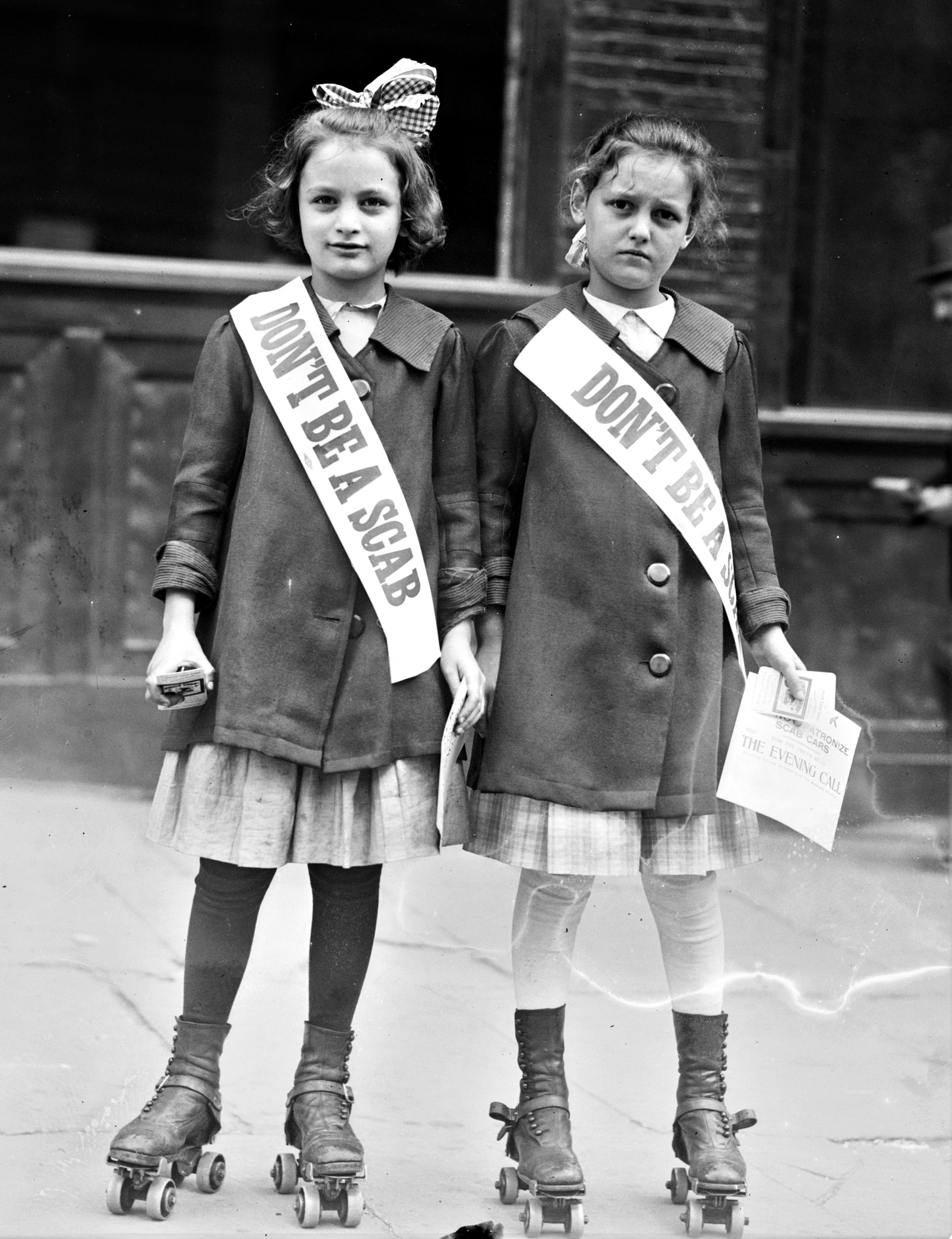
It took generations of struggle before the tens of thousands of transit workers in New York City won a union, Transport Workers Union Local 100 in the mid 30s. It was not for lack for of trying. Here is the story of the 1916 strike as it faced the companies, the City, and the company union in an ultimately losing battle, in part because the rest of New York labor did not join in solidarity.
‘The Strike of New York Carmen’ by Henry L. Slobodin from International Socialist Review. Vol. 17 No. 5. 1916.
The scene is laid in the City of New York, early in August, Nineteen Sixteen. Enter on the stage : Theodore Shonts, the Panama Canal Building Grand Fiasco and the New York Street Railway Looting Grand Success; James L. Quackenbush, won first renown as a spy on the death cell of Czolgosz, assassin of McKinley, brought to New York to succeed Robinson, attorney for the New York Street Railways, who was removed when the practice of the company in suborning witnesses, bribing juries, judges and court attendants was revealed. Behind them came arrayed the gigantic powers that be—the elephantine press, trumpeting its mastodonic lies of the hardships to the capitalists and prosperity of the workingmen. Mayor Mitchell, oily and foxy, rubbing his hands, with a friendly smirk to the workingmen on his face and loyalty to the capitalists in his heart. Commissioner Strauss, a good man as good men are found, but steeped in capitalistic bias and prejudice as a herring is steeped in pickle. Behind all of them loomed Wall Street, greedy, ugly, and brutal, ready to pounce, tear and devour.
And who were the men that opposed this mighty force? William Fitzgerald, indomitable fighter in labor’s cause, who, is standing on the threshold of a vision, yet would not step across. William Mahon of the Amalgamated, one of the “aliens” on the side of the strikers. A fairly solid body of surface street railway car men; a substantial minority of the subway and elevated railway car men; organized labor of New York City in its pledged sympathy and support; American Federation of Labor, loyal, yet extremely cautious.
Trouble started in the suburbs of the City of New York in the beginning of August. The car men of Yonkers walked out. Some car men of the Bronx joined. It was suddenly bruited about that the entire street railway system of New York City was going to be tied up by a walkout of all the carmen. Organizer Fitzgerald admitted the possibility. President Mahon came to New York. The revolt of the street, subway and elevated conductors was at hand. This any one could observe. Conductors in vast numbers, attended openly, in their uniforms, the organization meetings called by Mahon and Fitzgerald, defying the companies to discharge them. Union buttons were openly flashed from cap and coat by men at work, challenging the companies to “put up or shut up.”
It was evident that the companies were panic stricken. The railway men had just grievances from any point of view. They were paid less than the street railway men of any other great American city. Yet the street railway magnates were piling up vast profits. Also the scandal of the subway building contracts, disclosed by the Thompson Commission, revealing the looting of the city, blackmailing and bribing under the guise of “commitments,” were still fresh in the memory of the people. On the whole, the situation and conjecture of circumstances seem to be favorable to the street railway employes. It was a strategic moment for them to strike out, straight and true.
For that very reason it was incumbent for the railway magnates to prevent drastic action on the part of the street railway workers. They knew, the magnates did, that they could not personally achieve anything before the railway employes, except complete submission; nor before the public, which would treat them with laughter of derision. Here is where oily Mitchel and “good man” Straus stepped in to lend a hand. They rolled up their eyes heavenward and avowed that they were going to be absolutely honest, just and fearless in judging the issues between the railway employes and their employers. They invited both sides to submit the matter to the judgment of the Public Service Commission, in which Mayor Mitchel sat by courtesy.
With that fatal gullibility which seems to obsess the laboring man since the first time when one man labored for another for hire, the street railway employes rushed into the trap. Everything went through swimmingly. The only demand made by the employes was recognition of the union to the extent that the companies should not refuse to deal with representatives of the employes regardless of whether the representatives were themselves employes of the companies or not. The question of wages and hours they were willing to arbitrate. An agreement was signed and “underwritten” by Mayor Mitchel and Commissioner Straus. “Everything is settled,” said Mayor Mitchel. “Do you think so?” queried Fitzgerald, doubtingly. “Well, they have signed it, have they not?” His Honor reassured him.
Yet only a few days have passed and the companies withdrew their satin-gloved hand and put forth their cloven hoof. Full page advertisements appeared in the newspapers setting forth the grievances of the companies. We may” laugh at the matter contained in such advertisements, but the companies know better. They do not throw money out without weighing results. The advertisements served a two-fold purpose: they bribed the newspapers and arrayed public opinion against their employes. At the same time individual contracts were circulated and submitted to each employe of the street railways. In many other brutal ways the companies sought to intimidate and terrorize their employes. Bribing employes by the offer of double pay was resorted to.
It must be remembered that the subway is owned by the City, which has formed a partnership with the Interborough Rapid Transit Co., the company gathering all the profits and the City paying all sorts of strange liabilities, but never receiving any profits. It was openly announced by the companies that the City will have to pay the increased running expenses, meaning the cost of breaking the Union. The companies ignored the signed agreement underwritten by Mayor Mitchel and Commissioner Straus, and began to discharge every employe who was active in the Amalgamated, including the committees that were sent by the employes to negotiate with the companies’ officials. At the same time the companies began to organize “Yellow” Unions, pretending to concede the point of collective bargaining. They announced that they will deal directly with their men, individually and collectively; that no “aliens,” meaning the representatives of the National Organization, will be allowed to interfere; that theirs was a happy family, all working for a common cause, all having a common interest, Theodore Shonts, of $100,000 annual salary, James L. Quackenbush of $75,000 annual salary, and the ticket chopper of 21 cents an hour.
Yet some may wonder how such a raw deal could go through. The sufficient answer is—it went.
There was a reason. The favorable conjuncture of circumstances for the railway workers has passed away. Say what you may, yet it must be admitted that public opinion is a weighty factor in strikes. For the public includes all other wage earners whose conservative views are molded by the press. And public opinion has veered about. At the beginning of the controversy, attention was centered on the fact that the railway barons were organized, yet would not permit a similar privilege to the railway workers; that the railway plutocrats were piling up vast fortunes, yet refuse to pay their employes a living wage. Now, the newspaper campaign of the companies began to tell. Firstly, only shortly before, the Four Brotherhoods “held up” Congress and President and, at the point of a stop-watch, exacted nobody knew what, but something tremendous. It meant the overthrow of organized government, yelled the newspapers. The public was taken aback. Anyhow, attention was diverted from the original issues. Also the work of bribing employes to remain “loyal” to the companies began to bring results. There are always “weak brothers” in any labor controversy. And at this time the impression spread that the companies will not yield, no matter what may happen. It was natural that thousands of the employes were little inclined to abandon the meagre subsistence which their jobs afforded them and plunge their families into privation and suffering. At the same time the companies brought down from the West the cohorts of professional strikebreakers, brought together by the steam railroads for the eventuality of a strike, and marched them with great ostentation for the intimidation of their employes.
The Amalgamated Union found itself in a situation where it could pursue one course only—it declared a strike of all street railway employes. Charges of breach of faith and other recriminations, between the leaders of the street railway employes on one side and the street railway magnates and public officials on the other, filled the air. But never was a great labor victory achieved by leaders who resorted to guile and shrewdness instead of courage and audacity. The representatives of street railway employes were outwitted and outgeneraled completely. They were compelled to accept battle under most unfavorable circumstances.
Here it must be noted that the confidence which other labor leaders placed in Fitzgerald and the support which they were ready to lend him were remarkable indeed. There was no length to which many of them were not prepared to go to help a just cause out of a great difficulty. The employes of the surface cars went out in a fairly solid body. But the subway and elevated lines continued to run, manned by their old employes. What proportion of the subway and elevated employes went out I will not state here for the reason that I do not desire to come into conflict with any statement made by the leaders of the strike. It was, however, admitted that only a small minority of them struck. The bulk of the subway and elevated employes remained at work.
With great skill and perseverance Fitzgerald raised squarely the issue of destruction of all unionism. It was not, he claimed, a question of the local organization only. If the Amalgamated should be defeated in New York City, it will be attacked everywhere and destroyed. And it would mean not the destruction of the Amalgamated alone. It meant an attack on all labor unionism. He called upon all trade unions to accept the gage of battle and make of this strike an issue involving the existence of labor unionism. Color was lent to Fitzgerald’s contention by a statement of Quackenbush, attorney for the companies, who, paraphrasing Lincoln’s statement that “the country could not exist half free and half slave,” said that the country could not exist half union and half non-union.
The Central Federated Union of Manhattan lined up solidly behind Fitzgerald and appointed a committee with the authority to call a general strike. It must be here noted that the C.F.U. itself had no such authority as all union men know, For the calling of strikes of members of national organizations authority is vested only in the national officials. Whether the rank and file of labor unionists were at this time in favor of a general strike, I greatly doubt. General strikes are not brought about by skillful engineering and manipulating. Yet all that the labor leaders could do in the matter of a general strike at this time was engineering, manipulating and threatening. But of that anon.
The reader may get some original impressions by perusing the statements issued at this time by both the strikers and the companies. Here is the statement issued by the strikers published in a leaflet form and distributed broadcast:
WHY THERE IS A STRIKE ON THE NEW YORK CAR LINES
More than eleven thousand car men are on strike in Manhattan, Bronx and Queens boroughs and in Westchester on subway, surface lines and “L.” They want a living wage and organized themselves into a union to demand an increase. They were getting LESS than traction employes in any other large city in the country. The men were organized and Shonts, Hedley and Whitridge yielded. They granted slight increases and signed a compact with the union officials and with the mayor and chairman of the Public Service Commission that further increases and other demands would be arbitrated. The union officials were glad to arbitrate. The men returned to work.
This was early in August. A month later Shonts and Hedley discharged hundreds of employes because they would not quit the union. They demanded that the carmen throw away their union buttons. “We have you signed up on individual contracts,” they said, “and that means you cannot belong to any union but ours.”
The men refused to give up their union for Shonts and Hedley. Whitridge started to imitate Shonts and Hedley. He was hiring strikebreakers in anticipation of forcing the men out just as Shonts and Hedley had done The men were compelled to leave their jobs.
Shonts and Hedley want to break the union. They want to control the wages and lives of the men and their families, just as they have done. The men want to be free. They are taxed from seventy-five cents to a dollar a month for Mr. Shonts and Mr. Hedley’s “Benevolent Society.” They would rather pay that sum to a union of their own. They don’t want to pay that much to the company’s union to be further “controlled” and subjugated. They don’t get anything back if they leave the company and they lose the sick benefits they paid for. In their own union they retain this benefit if they resign or leave.
Shonts, Hedley and Whitridge are only tools. They must enforce the will of the masters. Rockefeller and Morgan want the men subjugated. They want unionism destroyed. They want to control their employees like chattels.
WHAT THE CARMEN WERE RECEIVING
Electric surface lines: Conductors, 25 cents an hour first year; 28 cents an hour fifth year and after. Motormen: 26 cents an hour first year; 29 1/4 cents fifth year and after.
Storage battery lines: Conductors: 23 1/3 cents first year; 24 cents second year and after. Motormen: 25 cents first year; 26 cents second year and after.
Horsecar lines: Conductors and drivers, 22 cents first year; 23 1/2 cents second year and after.
These wages were increased one and two cents an hour AFTER the union was organized. Subway and “L” guards and conductors who were receiving $2.10 and $2.45 a day for ten hours, were increased ten and twenty cents a day. Motormen, special officers and other employes were also increased as a result of the union’s activities.
THE MEN ARE NOT STRIKING FOR HIGHER PAY OR SHORTER HOURS.
These questions they agreed to arbitrate. They are striking because Shonts, Hedley and Whitridge want to destroy the unions which compelled them to grant the slight increases. They deliberately violated their solemn pact and discharged men who would not quit the unions and sign the company’s individual agreements. Many of them had signed through fraud and intimidation. Now Shonts says the directors were no party to the compact which Hedley and Quackenbush made on August 30th for the Interborough and which the Public Service Commission says they broke. Had they not broken this agreement there would be no car strike, says the commission.
Quackenbush made the issue. He told the commission, “I believe that as Lincoln said, ‘This country could not exist half slave and half free’; and that it could not exist half union and half non-union.” Quackenbush, attorney for the Interborough, N.Y. Railways Co. and Third Avenue Railroad, admitted under oath that he drew the individual agreements which, if accepted, would destroy trades unionism in America. Quackenbush, advocating peace in August, was preparing for war on trades unionism in September. THIS IS NOT A TRACTION FIGHT. IT IS A FIGHT AGAINST UNIONISM. Roads on which there was no strike loaned car crews to break the strike.
***
Some portions of the strikers’ statement, not pertinent to the strike were omitted by me.
And here is the statement issued by the Interborough Rapid Transit Co., which dominates all the street railways in Manhattan:
TO THE PUBLIC
Let no one be misled by the charge that the Interborough is trying to crush out unionism.
WE ARE NOT FIGHTING UNIONISM.
The fact is that the company actually encouraged the formation of a union, to be entirely controlled by the men themselves and to include every employe on the payrolls not having disciplinary power over other employes.
The fundamental ideas of the company in encouraging the formation of such an organization were:
1. That the men in their dealings with the company should enjoy the benefits of collective action without expense;
2. That the public should be protected against sympathetic strikes arising out of disputes in which this company and its employes were not concerned;
3. That more efficient service to the public would result if the relations between this company and its men collectively were conducted within the company’s ranks and without the interference of third parties;
4. That the interests of this company, its employes and the public they serve would be fostered if all relations between this company and its employes were conducted in the light of their common interests, rather than with reference to the interest of outside parties.
Some 9,700 men out of 11,800 eligible to vote embraced the opportunity to ballot for representatives to form a general committee of this union.
A working agreement was arrived at between the company and this union providing increased wages and improved working conditions for the next two years.
This was a “collective bargain” just as much as any union agreement is.
But the company went one step further: it not only agreed to a contract with the men collectively, but it asked that the agreement also be submitted to each man individually.
That it was satisfactory to the men individually as well as collectively is shown by the fact that over 10,500 have signed and are now working under it.
An important feature of the Interborough Union is this provision for arbitration in the constitution adopted by the men, and unanimously approved, by formal action of the board of directors of this company:
“If for any reason the general committee for the entire Brotherhood and the officers of the company are unable to settle any matter of mutual interest between them—it is then the plain duty of the Brotherhood and the officers of the company to submit the matter in dispute to a board of arbitration.”
Thus the men of the Interborough have an effective union of their own which is obviously satisfactory to them.
The real point underlying the existing difficulty is the determination of the Amalgamated Union to impose itself upon the company, and to supplant the union of the Interborough employes against the expressed will of the men themselves.
This company is only protecting its employes in their right to work and the public in its right to ride as against the efforts of the Amalgamated Association to prevent the doing of these two things.
Interborough Rapid Transit Company, Frank Hedley, Vice-President and General Manager. Approved:
Theodore P. Shonts, President. New York, September 11th, 1916.
***
The forces of labor and capital were lined up without any confusion. Mayor Mitchel placed policemen on every car to protect the scabs; every subway station and elevated platform was manned by the police. It was shown at the public hearing that policemen were used to hold forcibly strikebreakers in the sheds and to club the few who became recalcitrant. Commissioner Strauss repudiated all sympathy for the strikers, charging them with breach of agreement. There was nobody behind the strikers but organized labor. There was no question of public opinion or sympathy. All available material of that sort was controlled by the companies.
GENERAL STRIKE
The New York general strike is famous for the fact that it never occurred. As a matter of fact and in justice to Fitzgerald and other labor leaders it must be stated that it was never called. The men in charge of the matter were experienced, old-time labor union leaders. They knew very well that the strike of the building trades could be called only by the Building Trade Council, and a strike of unions belonging to International bodies could be called only by national officials. Now, the question first occurred as to the strike of trades that would cause most harm to the railway companies, as the longshoremen, boat men, who handled and delivered coal and other material to the companies, and of the firemen and engineers who manned the power houses of the companies. The local longshoremen were willing enough to line up with the strikers, but the national officials vetoed such action, claiming that they must stand by their contracts with employers. The National Typographical Union officials acted likewise, giving the same reason. Some thousands of brewery workers, machinists, painters and some other trades came out on a sympathetic strike, evidently believing that the general strike was on. They had to return to work, as they had no controversy with their own employers, at that time. So the general strike was not.
And it could not be. The New York Times said editorially: “It would have been a marvelous strike that could feed the laboring men and starve the capitalists.” Indeed the general strike involved a problem which the labor leaders could not solve by any means of reasoning—how could the millions of working people in this city exist with all food industries tied up? Yet, we hold that a general strike is far from being an impracticable proposition. It could take place in New York City right now. But it must be inspired by a greater motive than the labor leaders have shown at this time. It must fire the imagination of the masses and lead to an outburst of revolutionary fervor before which all engineering and manipulating pale into insignificance and all difficulties become evanescent. Great revolts and even revolutions have occurred before with a suddenness that defied reason. How were the people fed at those times? The sufficient answer is—they were. In the City of New York, during the month of September, Nineteen Sixteen, a general strike, a revolt of organized and unorganized wage earners, which would have shaken the present economic system off its foundations, could have taken place; that it did not take place was due to the want of two great indispensable things in the labor leaders and the masses—ideas and vision.
The International Socialist Review (ISR) was published monthly in Chicago from 1900 until 1918 by Charles H. Kerr and critically loyal to the Socialist Party of America. It is one of the essential publications in U.S. left history. During the editorship of A.M. Simons it was largely theoretical and moderate. In 1908, Charles H. Kerr took over as editor with strong influence from Mary E Marcy. The magazine became the foremost proponent of the SP’s left wing growing to tens of thousands of subscribers. It remained revolutionary in outlook and anti-militarist during World War One. It liberally used photographs and images, with news, theory, arts and organizing in its pages. It articles, reports and essays are an invaluable record of the U.S. class struggle and the development of Marxism in the decades before the Soviet experience. It was closed down in government repression in 1918.
PDF of full issue: https://www.marxists.org/history/usa/pubs/isr/v17n05-nov-1916-ISR-riaz-ocr.pdf

