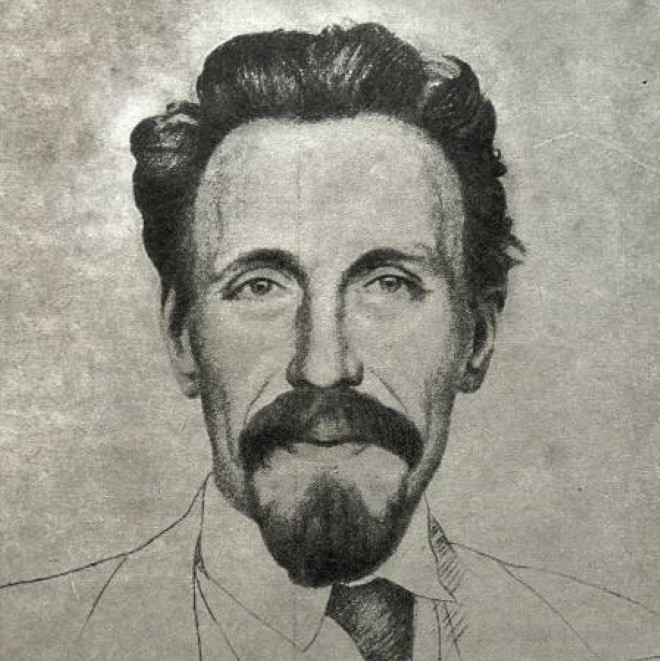
Introducing U.S. comrades to a key figure of the Revolution now assuming Lenin’s role as head of Soviet government. Though Alexei Rykov was a top leader of the Bolsheviks, because he had little role in the International he was relatively unknown to Communists outside of the Soviet Union when he replaced the deceased Lenin as the Chair of the Council of People’s Commissars in January, 1924. An Old Bolshevik and member of the Politburo along with Bukharin, Kamenev, Stalin, Tomsky, Trotsky, and Zinoviev, his main role previously had been in guiding the socialist reconstruction as Chair of the Supreme Council of National Economy. He would be central to the original formulating of the first Five Year Plan. With Tomsky and Bukharin, Rykov would lead the so-called ‘Right Bloc’ in the late 1920s, losing power in 1929. A victim of the purges, Rykov was accused at the Trial of the Twenty-One and executed along with Bukharin, Krestinsky, and others on March 15, 1938. He was not ‘rehabilitated’ until 1988.
‘Lenin’s Successor–A.I. Rikov, Soviet Russia’s New Premier’ from the Daily Worker Magazine. Vol. 1 No. 365. March 15, 1924.
Alexis Ivanovitch Rikov was born March 19, 1881, in Saratov (the capital of the province of that name in Central Russia) to which city his peasant father moved from the Viatka Province to engage in trading. When Alexis, who was the youngest member of the family, was eight years old, his father became very poor and soon died, a victim of cholera.
The young Alexis was placed in the Gymnasium (a school with a course of study equivalent to high school and two years of college) by his oldest sister, a teacher, who maintained him up to his sixteenth year. After that he was forced to earn his own livelihood and take care of his tuition fees.
Rikov’s first contact with the revolutionary movement came during the attendance of the gymnasium where he joined the secret study circles and participated in the issuance of an illegal journal. It was during this period that Rikov got acquainted with the works of Karl Marx and other studies of the Socialist and labor movement of Western Europe. Suspected of participating in revolutionary circles, he was prohibited from entering the universities of the capitals (Leningrad and Moscow).
In Solitary Confinement.
Upon graduation from the gymnasium in 1900, Rikov entered the university of Kazan (now the capital of the Tartar Soviet Republic) where he immediately became active in the workers’ organizations and was chosen to membership on the leading revolutionary committees. The underground Social-democratic organization of Kazan, in which Rikov played an important role during his short student life, was liquidated by the secret police in 1901 through wholesale arrests of the leaders.
After nine months of solitary confinement, Rikov was sent to Saratov, to live under police surveillance. Returning to his own home town, Rikov engaged again in active revolutionary work among the railroad and metal workers. He organized the May Day Demonstration of 1902 and served as a member of the joint committee of the Social-Democratic and Socialist-Revolutionary parties. After this demonstration Rikov was obliged to assume an illegal existence, and from that time on we find Rikov in the ranks of the so-called “professional revolutionists,” whose whole life is devoted to the cause of the revolutionary movement.
During the period of 1902 to 1905, Rikov occupies a prominent position in the Jaroslaw, Nijni-Novgorod, Moscow and other social-democratic organizations. The third congress of the Social-Democratic party in 1905 in London elects Rikov a member of the Central Committee of the party to which position he was re-elected by several successive party congresses. Rikov served as organizer of the Moscow district and was a member of the Russian Bureau of the Central Committee, i.e., that part of the C.C. whose members resided and worked in Russia. Rikov visited the emigrant revolutionary centers—Paris, London, Geneva—only when important matters concerning the revolutionary movement were being dealt with by the leading party elements, compelled to live outside of Russia.
Betrayed by Agent-Provocateur.
Rikov was arrested soon after the third London Congress at a secret meeting of the Leningrad Committee. Freed by the revolution of that year, Rikov was elected a delegate to the first Soviet of Workers’ Deputies, where he served until that body was disbanded by the authorities.
On May 1, 1907, Rikov is again arrested and after June 28, 1908 lives under police surveillance by order of the Minister of the Interior. Having been later sent out of Russia, Rikov returns with an illegal passport, but on Feb. 1, 1910 is again arrested and sent to the province of Archangel for three years. He soon escapes from there and joins the Central Committee of the party at Paris. In the summer of 1910 Rikov returns to Russia again to organize the work for the coming national congress of the party. He is turned over to the police by the agent-provocateur Briandinski soon after his arrival. In August, 1911 Rikov falls into the hands of the authorities in Moscow and after serving nine months in prison, is sent back to the Archangel region where he remains till February, 1913.
In October, 1913, Rikov is exiled by order of the Minister of the Interior to live four years in the far away region of Narim in Siberia, but he escapes from there Sept. 20, 1914 to Samara where he is arrested in a month and sent back to his place of exile. Altogether Rikov spent seven and one-half years in solitary confinement in prison and several years of exile in Archangel and Siberia from which he managed to escape on three occasions.
From the very beginning of the March revolution in 1917, Rikov works in the Moscow Bolshevik organizations, and in August of that year is again elected member of the Central Committee of the Social-Democratic party (Bolshevik) as the Communist party was then still called.
Held Important Posts.
As a member of the presidium of the Moscow Soviet, Rikov prepared and secured the passage by the Soviet of resolutions, censuring the Kerensky government and the Mensheviks who were supporting him. When the All-Russian Congress of Soviets voted to take over the powers of the State in November, Rikov was a member of the Executive Committee, and when the first Bolshevik Cabinet was formed upon the successful conclusion of the proletarian revolution, Rikov entered it as a Commissar of Internal Affairs. He was later transferred to be head of the Supreme Council of National Economy when that body was formed, with the cooperation of the Council of Factory Committees of Leningrad.
When Russia was living thru her most critical years—counter-revolution and blockade—Rikov was charged with the provisioning of the Red Army and the re-establishing of Russian industry. With the illness of Lenin in 1921 came the need of a substitute. Rikov was made associate chairman of the Council of Commissars and that of the Council of Labor and Defense at the suggestion of Lenin. Since 1920 Rikov serves as a member of the Central Committee of the Communist Party, and when he was chosen Chairman of the Council of Peoples’ Commissars in place of his teacher and brother-in-arms Lenin, he was a member of the All-Russian Council of Trade Unions, Member of the Central Executive Committee of the Union of Socialist Soviet Republics and Chairman of the Supreme Council of Public Economy.
Rikov is now 43 years of age.
The Saturday Supplement, later changed to a Sunday Supplement, of the Daily Worker was a place for longer articles with debate, international focus, literature, and documents presented. The Daily Worker began in 1924 and was published in New York City by the Communist Party US and its predecessor organizations. Among the most long-lasting and important left publications in US history, it had a circulation of 35,000 at its peak. The Daily Worker came from The Ohio Socialist, published by the Left Wing-dominated Socialist Party of Ohio in Cleveland from 1917 to November 1919, when it became became The Toiler, paper of the Communist Labor Party. In December 1921 the above-ground Workers Party of America merged the Toiler with the paper Workers Council to found The Worker, which became The Daily Worker beginning January 13, 1924.
PDF of full issue: https://www.marxists.org/history/usa/pubs/dailyworker/1924/v01-n365-supplement-mar-15-1924-DW-LOC.pdf

