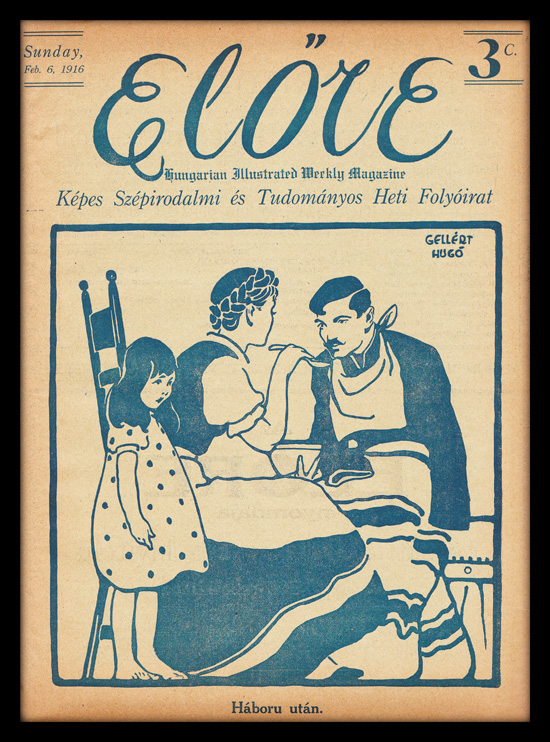
Hungarian radicals have a tradition in the U.S. going back to the ’48ers, with Hungarian-speaking Socialists organizing themselves into clubs and societies by the 1890s. The I.W.W., Socialist and Socialist Labor Parties, and anarchist formations all had Hungarian groups and newspapers. By 1915, the S.P.’s Hungarian Socialist Federation claimed 1500 members in 40 branches, with its paper Előre (Forward) a circulation of 10,000. The Hungarian Federation would be one of seven language federations (Russian, Lithuanian, Ukrainian, Polish, Hungarian, South Slavic, and Lettish) expelled by the Socialist Party’s outgoing leadership in 1919 for their adherence to the Left Wing. The Federation would line up solidly with the old C.P.A. in fracturing of 1919 and follow Ruthenberg as a group into the United Communist with the former Communist Labor Party the following year.
‘Origin and Growth of the Hungarian Socialist Movement in the United States’ by Armin Loewy from American Labor Year Book. Rand School Press, New York. 1916.
The close of the past century saw the beginning of emigration from Hungary and its crownlands in numbers vaster than ever heretofore. Social and political inequality is the basic cause of this exodus (now at a stand-still because of the World War). Exorbitant taxes, the brutality of the authorities, inhuman treatment at the hands of the gendarmes, the system of land ownership, and militarism were the forces responsible.
The first Hungarian socialist club was organized in the city of New York in the year 1894. It was hard sailing, but the comrades weathered the storm bravely.
This was followed by an organization in Cleveland with the first Hungarian socialist publication, known as Hajnal (Dawn). The paper first saw daylight on the 1st of May, 1894, under the able editorship of Comrade Adam Abet. Unfortunately, the paper was but short lived, due to lack of funds.
Later, through the combined efforts of all the comrades, another weekly publication was started (under the old SLP platform) and named Amerika Magyar Népszava (Voice of the Hungarian People in America) — which, after a brief, uneventful career, went into the hands of a Hungarian printer, who changed its policy.
In the year 1900 a split occurred in the Hungarian ranks, as a result of which “The Workingmen’s Sick Benefit and Educational Federation” came into existence, numbering upwards of 60 active branches throughout the country.
On the 1st day of May in 1903, with the launching of the periodical Nepakarat (The Will of the People), the real socialist work was begun. The paper, however, went with the SLP faction at the time of a second rupture in October, 1904.
Following close upon this, the remaining SP members started a monthly paper, the now daily Elöre (Forward). From a monthly it soon, in 1906, became a semi-monthly and in 1907, a weekly publication.
Branches of the Federation were organized throughout the country, thus laying a solid foundation for the existing Federation.
In 1911 a union was effected with some of the “deserters” who had, in the meantime, withdrawn from the SLP. It was soon discovered, however, that the newcomers had no use for political action and departed again, only to organize IWW branches.
In 1912, the majority of the then so-called United Hungarian Federation decided to join the American Socialist Party, and has been an integral part of the Party since. The next noteworthy event in the history of the Federation occurred in November 1912, when the party organ, the Elöre, became a daily.
The Federation has not been growing by leaps and bounds, but withal showing a steady increase. With over 40 branches in good standing, we show a membership of well above 1,500.
The NEC of the Federation has published over 18 booklets and books, and imported, before the outbreak of hostilities, thousands of pieces of Propaganda matter from the sister party in Hungary. Thousands of leaflets, pamphlets, and books have been sold and distributed. The Elöre is now known throughout the Western hemisphere and has a circulation of somewhat over 10,000, doing work of a revolutionary nature. The paper is owned by the Federation. There are nearly 40 people employed at the printing plant, most of whom are members of the party as well as the Union. The printing press is also party-owned.
We have had to contend with serious obstacles cause by the war-fever so eagerly fanned into flame by the so-called Hungarian patriotic press, pulpit, and societies.
We keep in close contact with the Party in Hungary, but due to the ruthless censorship of the Hungarian government, we are unable to give an adequate statement of their standing.
Rand School of Social Science was founded in 1906 by supporters of the Socialist Party of America in New York City. A worker educations school, in addition to classes a publishing house, research institute, as well as camps and retreats were developed. The school came under the Social Democratic Federation after the split in the Socialist Party in 1936 and changed its name to the “Tamiment Institute and Library” with Its collection forming the basis the Tamiment Library and Robert F. Wagner Archives at New York University.
PDF of full book: https://hdl.handle.net/2027/mdp.39015011055012?urlappend=%3Bseq=19%3Bownerid=13510798885938091-25

