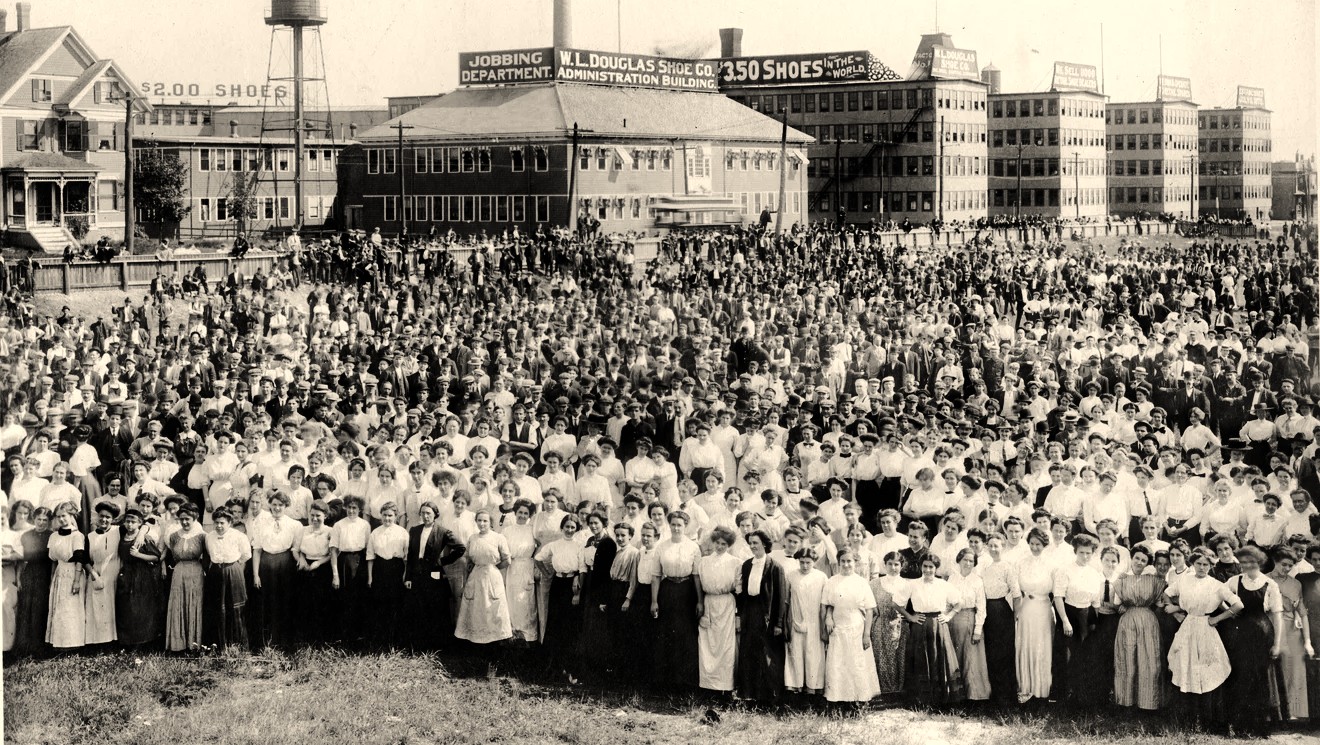
A longtime Massachusetts shoeworker and Socialist activist in their unions speaks to the situation in the industry after the 1923 revolt of Brockton workers against the bosses and craft union leaderships.
‘Situation in the Boot and Shoe Industry’ by Michael T. Berry from Labor Herald. Vol. 3 No. 1. March, 1924.
I HAVE been requested to write this story on condition in the Boot and Shoe industry for THE LABOR HERALD. I readily accede to the request, that the workers in other industries may be enabled to mirror their own future if they persist in following the trail of Craft Unionism.
Once, and that within the memory of the writer, the shoeworkers were in the front ranks of the organized workers. It is no accident that from the ranks of the shoemakers came two signers of The Declaration of Independence, two Vice Presidents of the United States, and numerous lesser lights famous in the history of the country. But two generations of craft unionism with its ability to dig out the brains of its victims has changed all that and the workers in the industry that gave the Quaker Poet, Whittier to the world, and which he glorified in his verse, is now but a caricature of that former greatness. It is but a mob of 200,000 men and women for whom there are not over 100,000 jobs at the best. Some 70,000 of them are “organized” in more than a half dozen different craft organizations, each of these fighting all of the others for the crumbs in the shape of jobs that falls from the employers table. All of them are the victims of the labor displacement which the product of the United Shoe Machinery Co. is constantly introducing, with the consequent drop in wages which is the necessary result. The deplorable situation may justly be charged up to craft unionism and its training of the rank and file, which is bound to benumb and defeat the working class unless its rule is overthrown.
Three years ago the shoe workers of America felt, rather than knew, that what has been said above was true, and they started to bring about an Amalgamation of all the independent unions in the trade, some nine or ten of them, in fact all unions except the Boot & Shoeworkers Union, the A.F. of L. union was invited, and eight of them responded by sending delegates to Boston where two conventions were held. After several preliminary conferences held in Chicago, Rochester, N.Y., Lynn, Haverhill and other cities in the East, an “Amalgamation” was affected, or at least the rank and file thought so when the last convention adjourned.
Some one, at some time, coined an epigram which says “Inscrutable are the ways of Providence.” I will coin another and say” tortuous are the ways of craft unionism,” something that is being driven home to the rank and file every day since the adjournment of the last convention for perfecting an Amalgamation which was October 1922.
The unions that participated in the Amalgamation conventions were, enumerated in the order of the size of their membership, the United Shoeworkers of America, the Shoeworkers Protective union (an organization that was and is largely confined to Haverhill and nearby towns), the Allied Shoeworkers Union of Lynn, a local affair, the Childrens Shoeworkers Union of N.Y., the Salem, Mass. Heelworkers, the Amalgamated Fitters of N.Y. the Salem Edgemakers, and locals from both Boston and Stoneham, Mass., the latter two members of the Allied Shoeworkers group.
“There is many a slip ‘twix cup and lip.” The shoeworkers attempt at Amalgamation was a case in point. No sooner had the October, [sic] last convention adjourned, than the “Medicine Men” of the employing class began to get busy to save their jobs which were going into the discard if Amalgamation prevailed. In doing so they were forced to work in the interest of the employers and continue the age-long fratricidal contest, born of craft unionism, and which has put crepe on the door knob of the shoeworkers for the past 15 or 20 years.
In the October convention, every delegate except one from New York, arose and pledged himself or herself to go back home and work for Amalgamation. They went back home alright, but they, in the case of the delegates from the shoeworkers protective union, and certain locals of the United Shoeworkers headed by officials of that body, refused “to come across” as per their pledge to the convention.
In the case of the United Shoeworkers, the officials went into court and by injunction and contempt proceedings sought to snuff out what ever little had been won for Amalgamation. Numerous actions which have not been terminated yet were brought for that purpose although Thomas F. Lynch, Gen. Sec.-Treas. in behalf of the G.E.B. sent a message to the first convention pledging the United to the Amalgamation.
Amalgamation started to function on Feb. 5, 1923, and from then until now it has had a stormy existence, beset on both the inside and the outside by foes who were ready to invoke heaven or hell to prevent one union in the industry if their job, which is their only concern, could be preserved and made perpetual. In the case of the Protective, they simply refused to come in, but they did not resort to court proceedings as did the United officials. So much for what has happened since the shoeworkers started three years ago to get together.
All shoeworkers, union and non-union alike, have an uncanny dread of an organization that exists in our trade, and it is the largest and richest of them all, the Boot and Shoeworkers Union. This fear which the shoeworkers have for this organization is not without foundation in fact. In the years that have gone, ever since 1899, it has performed in a way that brands it as an auxiliary of the employing class. It was chased out of Lynn after a stormy battle with the Cutters some 22 years ago, and it is forced to play second part in the affections of the Haverhill workers which is the home of the Protective, which was built up as a result of dissatisfaction with the Boot and Shoeworkers way back in ’99. Conditions in both Lynn and Haverhill where the wages are higher on the whole than in any other shoe centers, have been bad for the past year. The workers had high wages when they worked, but as the industry is in a terribly unorganized condition, the workers in these cities got little work with the consequent starvation that capitalism sees to it dogs the footsteps of the class unconscious slaves, who because of their craft union training, have not yet perceived the cause of their misery or the way out.
The result has been that the workers of both Haverhill and Lynn, Protective and Amalgamated, have lost some of the conditions and wages that they hitherto enjoyed. The employers took advantage of this situation in Lynn to start a crusade for installing the Boot and Shoeworkers in this city, something that meant death to the Amalgamated, which outside of Lynn, has a small membership in New York and Brooklyn, and a few other small locals.
This has had the effect of waking up the Protective which has recently absorbed the remnants of the United that the Amalgamated failed to get when it started. The Protective group is next in size to the Boot and Shoe workers, it has now got a membership of something like 20,000 members, the Amalgamated has about 12,000 and the A.F. of L. union, the Boot and Shoeworkers has something like 40,000. When the Lynn employers headed by the banks of the city started to bring in the Boot and Shoeworkers Union, the Protective interpreted this as an act that sooner or later, would mean the extinction of the Protective, thus leaving the Boot and Shoeworkers Union in undisputed possession of the organized workers, or the most of them in the entire country. As a result it at once began to understand the necessity for Amalgamation and as a result there is a movement now in full swing between the Protective, and Amalgamated to at once complete the work that was begun some three years ago. It is a noteworthy fact that this latest attempt which was initiated by the rank and file of the Protective, starts by that group electing a rank and file committee, no officials or salaried officers to be allowed, and it demands that each local of the Amalgamated do likewise, this joint committee to work out the ways and means for an Amalgamation.
Later, when this plan has got further on its way and it will be possible to appraise it at its correct value we will write the next chapter of the attempt of the shoeworkers to secure Amalgamation. But whether it succeeds now or later one thing is sure, there must be One Union of the Shoe and Leather Industry. We are fighting a united foe, we cannot win split up into divided groups, and the inexorable law which necessity dictates on pain of extinction will see to it that these workers will be drawn together. We are brothers in misery. We must be brothers in victory.
The Labor Herald was the monthly publication of the Trade Union Educational League (TUEL), in immensely important link between the IWW of the 1910s and the CIO of the 1930s. It was begun by veteran labor organizer and Communist leader William Z. Foster in 1920 as an attempt to unite militants within various unions while continuing the industrial unionism tradition of the IWW, though it was opposed to “dual unionism” and favored the formation of a Labor Party. Although it would become financially supported by the Communist International and Communist Party of America, it remained autonomous, was a network and not a membership organization, and included many radicals outside the Communist Party. In 1924 Labor Herald was folded into Workers Monthly, an explicitly Party organ and in 1927 ‘Labor Unity’ became the organ of a now CP dominated TUEL. In 1929 and the turn towards Red Unions in the Third Period, TUEL was wound up and replaced by the Trade Union Unity League, a section of the Red International of Labor Unions (Profitern) and continued to publish Labor Unity until 1935. Labor Herald remains an important labor-orientated journal by revolutionaries in US left history and would be referenced by activists, along with TUEL, along after it’s heyday.
PDF of full issue: https://www.marxists.org/history/usa/pubs/laborherald/v3n01-mar-1924.pdf

