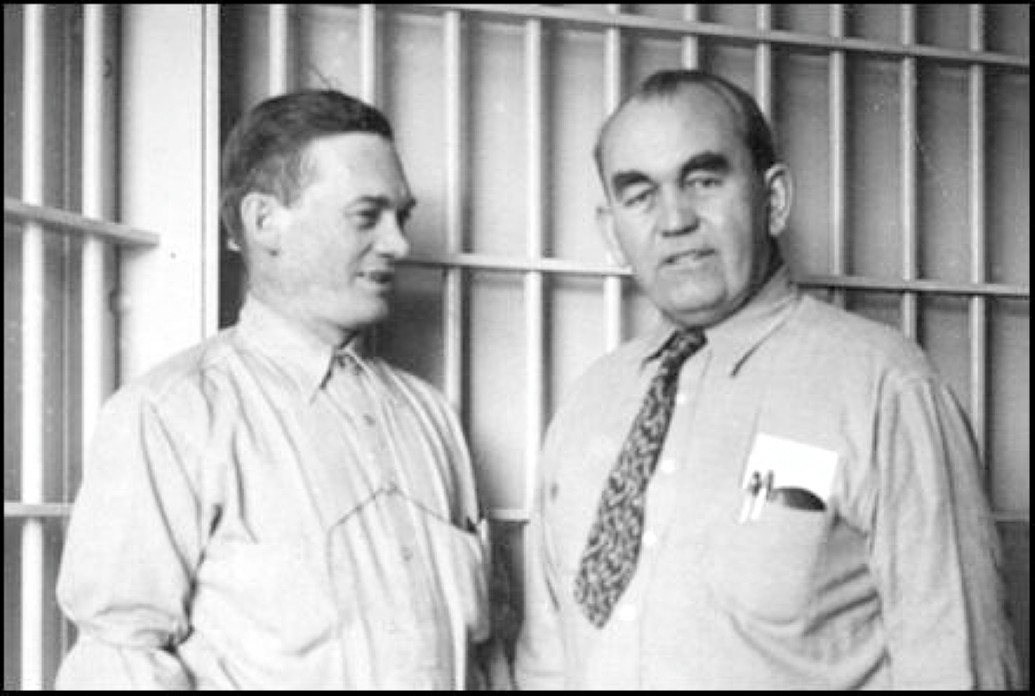
The class war inevitably creates prisoners of war. It has been, and is, the obligation of those of us outside to help our comrades and their families who are inside. Prisoner defense can also be a galvanizing builder and any movement that does not meet this obligation is not a real movement. Socialist labor militant Warren K. Billings is far less known than his comrade Tom Mooney, nevertheless spent more time in prison, serving over 23 years after being framed-up for the 1916 Preparedness Day bombing in San Francisco that killed 10. Released in 1939, he did not receive a pardon until 1961. Here, he speaks to readers of Labor Defender on the smalls, but needed, comforts a little money can buy the prisoner.
‘The Value of Money to the Man Inside’ by Warren K. Billings from Labor Defender. Vol. 1 No. 12. December, 1926.
THERE are, after all, not many of the members of organized labor who have suffered the curse of imprisonment. A few of us have been unfortunate enough to get ourselves into jail, a county jail or a city prison, usually, for a few days during some strike or lockout and a very few of us have been unlucky enough to enjoy this experience more than once during an exceptionally active career but there are nevertheless but a few of us indeed who have ever been so unfortunate as to get ourselves into the penitentiary as a result of labor activities. Then, out of this small band there is a still smaller percentage of us who have so far incurred the displeasure of the bosses that we have been sent to the penitentiary for long terms, even for life; and it is to this last unfortunate band that I belong. I do not mean to insinuate that it is labor’s fault that I am in prison. No, it is distinctly my own fault. But the mere fact that it was my activities in labor’s war which directly led up to my persecution and imprisonment puts everything that labor might do for me during my incarceration. This brings us down to a consideration of the matter in hand—the matter of money.
Suppose now, that you had been in prison for eight years and a half or more and that all during that time you hadn’t had a piece of chocolate candy, and suppose some of your friends “outside” banded together and took up a little collection and sent you—let us say—five dollars, and this five dollars enabled you to buy some of that chocolate candy that you’d been craving for eight years or more—now wouldn’t you be pleased and grateful? And would not you be very liable to say to yourself, “Well, I’m damned glad to see that I’ve still got some good Mends on the ‘outside’?” Well, that’s just the way I feel about it.
Of course, chocolate candy isn’t the only thing that money enables one to buy in a penitentiary although it is an important item at that—especially to a man who hasn’t enjoyed the liberty of buying it at any time he wanted it. But money means much more to the “convict” than mere chocolate candy. It means peace and security—it means that he can buy stamps and thus keep in touch with his friends “outside,” that he can buy writing materials—that he can buy hooks with which to improve his mind or to while away the time—it means that he can also enjoy such common, every-day luxuries as possessing a turkish bath towel; a comb; a brush; a mirror; real toilet soap to use instead of the “Jimmy Hope” brown soap that is the only “free” kind to be had. It means that he can buy extra tobacco with which to assuage the only vice the law allows him in a place of this kind; that he can buy chessmen and checkers or dominoes with which to amuse himself and his companions and that he can buy a thousand and one other little things which folks on the outside have come to consider as necessities rather than luxuries because they have had them always at hand and have never been denied them. We “inmates” are not denied them, either, but neither are we supplied with them. There are no provisions in the laws governing the running of prisons which state that each inmate shall be supplied with toilet soap, bath towels, amusements, text books, bed sheets, summer underwear and safety razors, yet all of these things are within the reach of an inmate who has a little money at his disposal and it is all this that makes the prisoner so greatly appreciate what little assistance friends and friendly organizations can give him. If you want to truly realize what all this means to the man behind the bars, try it out on yourself. Go without the toilet articles you use daily, wipe on a linen towel as rough and sturdy as a cement sack, get shaved once a week in the Moler Barber College and do all this while all the men around you are enjoying the benefits of all these little luxuries. If you tried to live that way for a year, the mere sight of a turkish towel would make you envious and seeing the other men smoke when they wanted to and grin at you over their chocolate bars on “commissary day” would make you want to commit robbery or “general mopery” or some other such heinous crime but when it was over you’d realize what a few dollars might mean to the man “inside.”
I haven’t covered this subject in the way that I feel it ought to be covered because a little money to other men, perhaps, more or less material than myself—or perhaps with dependents on the outside, or under some other circumstances, might mean more to them but it at least means this much to me and I’m quite sure that it means at least as much to every other member of organized labor who is now in prison.
At any rate, keep up the good work. No matter how much or how little you do for the fellow “inside” if you do it he knows you are “out there” for him and he’ll always appreciate it.
Labor Defender was published monthly from 1926 until 1937 by the International Labor Defense (ILD), a Workers Party of America, and later Communist Party-led, non-partisan defense organization founded by James Cannon and William Haywood while in Moscow, 1925 to support prisoners of the class war, victims of racism and imperialism, and the struggle against fascism. It included, poetry, letters from prisoners, and was heavily illustrated with photos, images, and cartoons. Labor Defender was the central organ of the Scottsboro and Sacco and Vanzetti defense campaigns. Editors included T. J. O’ Flaherty, Max Shactman, Karl Reeve, J. Louis Engdahl, William L. Patterson, Sasha Small, and Sender Garlin.
PDF of full issue: https://www.marxists.org/history/usa/pubs/labordefender/1926/v01n12-dec-1926-ORIG-LD.pdf

