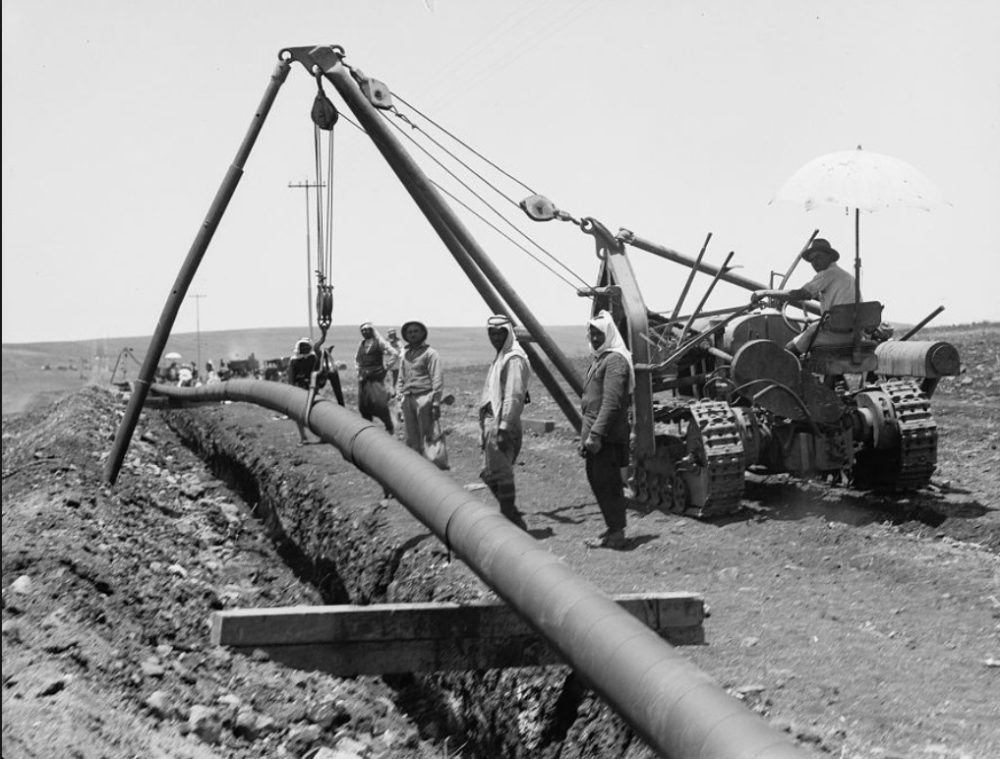
Oil and its control has been a source of constant conflict, internally and externally, for every nation that has grown dependent on it. Owning and exploiting its source is just one portion of its control. Invariably, oil must be transported, with that transit also dependent on oil, from source to refinery to consumer, creating ever more interests, choke points, and nodes of conflict as it crosses boundaries and changes companies.
‘The Fight for the Pipe Line from Mosul’ by Joseph Berger from International Press Correspondence. Vol. 10 No. 58. December 18, 1930.
The question of the oil pipe-line occupies an important place in the war-preparations which are being carried on with increased intensity in the Middle East. The fight for the pipe-line has now assumed a phase which deserves attention for several reasons. In the first place the solution of the question is now being obviously forced by the Shell Group, which is at the head of the interventionist group against the Soviet Union. In the second place, in this question there is once again seen the rivalry between America and England. Thirdly, a number of British political manoeuvres, such as for instance the treaty with Iraq, the so-called White Book on British policy in Palestine, the negotiations with Ibn Saud, are more or less connected with the solution of this question.
Great Britain has the greatest interest in the solution of this question. It is generally assumed that Britain possesses only half of the shares of the joint stock company which controls the oil fields of North Iraq. It must be remembered, however, that the pipe-line is not only intended to convey to the Mediterranean the oil yielded by the Baba-Gurgur field, which is in the hands of the Iraq (formerly Turkish) petroleum company. It is true the English possess only half of the shares of this company, the rest of the shares being in the hands of French and Americans. But the pipe-line is also intended to serve the oil fields of Naftkhana, in the neighbourhood of Khanakin, which is in the hands of the purely British Anglo-Persian Company and is one of the richest petroleum reservoirs of the world.
Sir Henry Dobbs, a leading British colonial politician and former High Commissioner of Iraq, records these facts in an article which appeared in the September issue of the “Nineteenth Century and After”, and emphasises the great strategical importance from the British standpoint which must be attached to the pipe-line. From the British military standpoint it appears that both projects: pipe-line and railway line are inseparably connected. Together they are to form not only the main support of any British advance against the Caucasus and Azerbeijan, but are to be of decisive importance for operations against India and Arabia and also, should occasion arise, against Turkey, Afghanistan, and Persia.
On this point, moreover, the interests of France and England are identical. Neither the one nor the other imperialist power, declares Sir Henry Dobbs, can in time of war be compelled to rely for its supplies of such an important commodity from a long distance by neutral ships, or to purchase it on a free market against neutrals or enemies.
The intensive activity displayed in the last few months in speeding up the construction of the pipe-line and of the railway thus clearly shows how seriously the British and French experts regard the approach of war. A part of the oil reservoirs of the Shell Co. in Haifa, a part of the Haifa war harbour and several important aerodromes in British and French territory have been completed.
Nevertheless, the common front against the Soviet Union by no means does away with the antagonism between the Imperialist Powers themselves. According to the Franco-British oil treaty, the pipe-line is to run through French mandatory territory, a circumstance which would give French imperialism a number of immediate economic advantages, and in the event of war the superiority over England. The British government, however, does not think for a moment of keeping this treaty which was concluded in the year 1920 in San Remo.
According to England only British mandatory territory is suited for the installation of the pipe-line and only Haifa, situated on British territory, comes into question as the terminus of the pipe-line. The Iraq government, a tool of Great Britain, serves as the mouthpiece of British interests in regard to this question. All the protests of the French government (which on its part makes use of the Syrian bourgeoisie for its own interests), would have been of no avail if the American partner, the “Near East Oil Corporation” had not approached the French standpoint. Thus a compromise was arranged. The pipe-line is to be laid from Mosul to the frontier of Iraq on British territory, at which point it will bifurcate: Franco-American oil running through Syria (French mandatory territory) to Tripolis, and the British oil being conveyed through Transiordania and Palestine Haifa.
The French were compelled to agree to this compromise, but the fight is net by any means thereby ended. British interested parties are exerting every effort in order to hinder the diversion of the French Share to Tripoli The division of the oil will undoubtedly result in a fierce competitive struggle, and the petroleum agnates are anxious on account of their profits.
In this conflict the question of “Securities” plays no small role. Whilst England points out that the line would have to pass Jebel Drus and other rebellions districts if the French standpoint is accepted, and openly alludes to the experiences of the revolt against the French mandate in 1925-27 the French point to the numerous anti-British revels in Iraq, Transjordania and Palestine, as well as to the doubtful attitude of Ibn Saud, in order to defeat the British resistance. To obtain the cooperation of the native feudal strata and the bourgeoisie in maintaining order in the countries through which the precious mineral oil is to flow, forms therefore a part of French and British imperialist policy li cuter war is to be waged (against the Soviet Union), then at the same time the strategic lines and the pipe-lines must be protected against the rising wave of indignation of the oppressed fellahin and workers. This task is now to be performed not only by tanks and areoplanes, but by the treacherous Arab landowners and compradores.
International Press Correspondence, widely known as”Inprecor” was published by the Executive Committee of the Communist International (ECCI) regularly in German and English, occasionally in many other languages, beginning in 1921 and lasting in English until 1938. Inprecor’s role was to supply translated articles to the English-speaking press of the International from the Comintern’s different sections, as well as news and statements from the ECCI. Many ‘Daily Worker’ and ‘Communist’ articles originated in Inprecor, and it also published articles by American comrades for use in other countries. It was published at least weekly, and often thrice weekly.
PDF of full issue: https://www.marxists.org/history/international/comintern/inprecor/1930/v10n58-dec-18-1930-inprecor-Virginia.pdf

