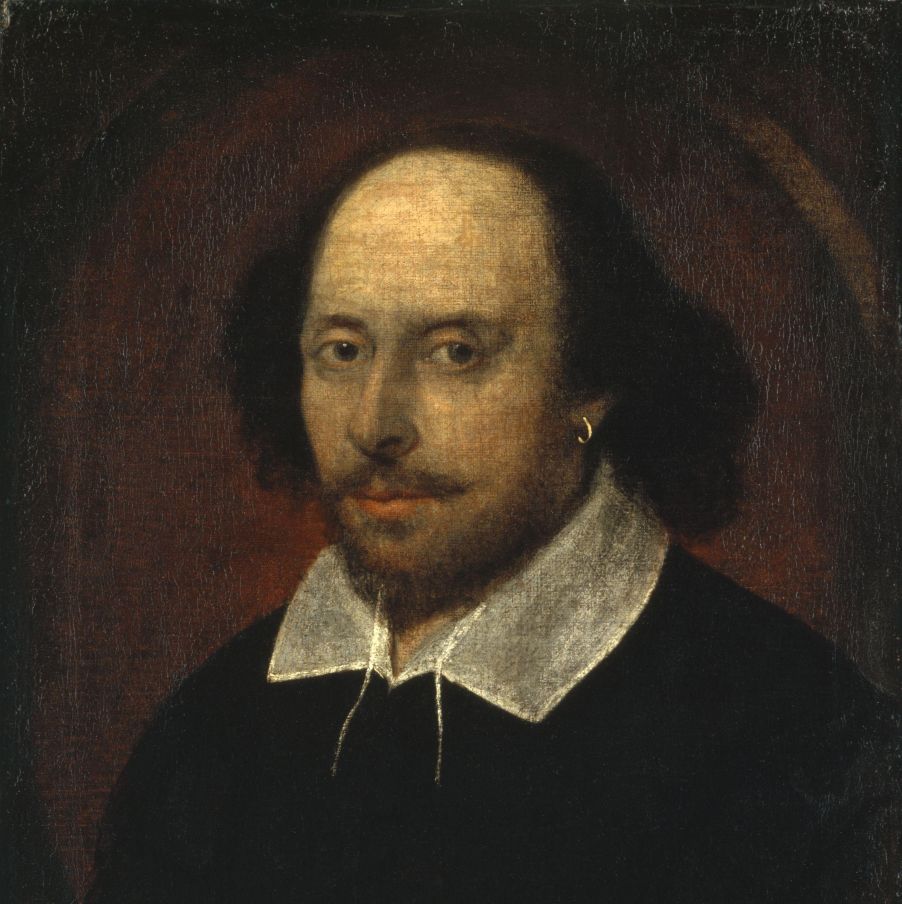
If for no other reason, though there are many, than to understand the countless allusions to Shakespeare in the work of Marx and those that followed him, well-read Marxists require at least a working knowledge of the writer’s plays. As well, Shakespeare criticism has also long been in discussion among the more literary wing of our movement, indeed it is almost where Marxist literary criticism begins, that the changing method and concerns employed are an illuminating reflection of each generation engaged. Burnshaw, longtime New Masses theater critic, reviews contemporary scholarship and offers notes of his own on the debate of his time.
‘Material for a Note on Shakespeare’ by Stanley Burnshaw from New Masses. Vol. 14 No. 2. January 8, 1935.
WHEN a new Shakespeare production comes to Broadway it usually gives bourgeois critics an excuse for unburdening themselves of a certain amount of erudition about the poet’s struggles, personality, love-life, etc. But, as everyone knows, most of such commentary never goes beyond the hypothetical, being essentially repetitious of the available Shakespeare facts, which continue to be few. The most fruitful recent research has illuminated Shakespeare’s contemporaries rather than himself (for example, Leslie Hotson’s detective work on the killing of Christopher Marlowe). Nevertheless, faced with the perennial problem of “introducing” the new Shakespeare production, the bourgeois critic chooses the simplest means and revamps essentially the same material that had filled his columns when Shakespeare last came to town, (for example, Brooks Atkinson’s recent “Preface to ‘Romeo’,” introducing Katharine Cornell’s fresh and brilliant Romeo and Juliet.)
For the Marxist critic, however, a new performance of Shakespeare raises a series of questions which American criticism has so far failed to analyze, and which the ideological enemies of Marxism take keen pleasure in complicating. With venom and rapt intellectual confusion, they insist that all sorts of nonsensical “conclusions” must logically follow from certain false premises which they generously attribute to revolutionary criticism. For example, Shakespeare must be entirely damned or 95 percent discredited (1) because he was a bourgeois, (2) because he idolized the nobility and mocked the servile classes, and (3) because he made frequent statements predicating belief in supernaturalism. A full answer to these three chief “questions” alone would require a lengthy essay. For our purposes it is sufficient to adduce some of the facts involved in a revolutionary understanding of Shakespeare, thereby to wash away the falsifications which opponents of Marxist criticism have contributed to the question.
At the risk of restating the obvious, let it be recorded at once that any work of art which provides a faithful picture of a given period in history is of inestimable value and importance, for reasons of cultural documentation if for nothing else. To Marxist criticism, which is scrupulous to understand every last atom of history, denying nothing as unimportant if it helps to explain a period in the career of mankind, the plays of Shakespeare assume consummate importance for their unparalleled reflection of their period. But just how faithful and typical are these plays?
How representative an Elizabethan was Shakespeare? Born in the last third of the sixteenth century and fed by the dwindling but persistent stream of medieval culture, Shakespeare lived and worked through some of the most significant years in England’s development. British explorers were laying the basis for far-flung imperialism, loading the treasuries of individual merchants and the crown with wealth filched from new colonies. In trafficking her goods from country to country, England’s fleet was speedily establishing British commerce as the richest and her warships as the strongest. The island teemed with military power and economic success. Meanwhile Henry Ejighth’s clash with the Pope opened the way for intellectual growth; it was the initial emancipation from the deadening mental influence of Catholicism. And despite the unsettled years (1547-58) following Henry’s death, Queen Elizabeth had managed to separate the State from the church sufficiently to permit “worship according to conscience” rather than edict. When the Renaissance reached England, therefore, poets, playwrights, and scholars had already been allowed the latitude necessary; the spirit of free inquiry was not to be menaced by a governmental hand of God.
All of this economic and intellectual progress remains meaningless unless related to the historical movement of which it is a part—unless explained as an effect of the expropriation of feudalism by the bourgeoisie. In this liberating attack on surviving medievalism, the rising middle classes played a revolutionary role. Their rise to economic power had already a sound beginning as early as 1485-1495; and during the hundred and fifty years that followed their strength so increased that a final outbreak was possible—the 1642 rebellion under Cromwell which was the attempt of the bourgeoisie to achieve the effect of their economic power by seizing political power. Obliged to practice thrift, Henry VII (1485-1509) encouraged the use of country gentlemen in the Privy Council–unpaid members of the middle classes functioning as justices of the peace. This allocation of political power to the non-nobility was inseparable from the rise of the cloth industry which had nationwide effects on England’s economy. The importation of Flemish weavers who could manufacture finished products stimulated the sheep-growing industry to such a degree that the capitalist type of agriculture gradually supplanted the subsistence type. By grabbing off and “enclosing” for pasture purposes land hitherto used for cultivation, the large bourgeois cloth promoters froze out the small farmer and created a wandering beggar class. A further economic change which increased the power of the bourgeoisie came as a result of Henry Eighth’s break with Rome (1529). The dissolution of the abbeys and monasteries caused nation-wide land speculation resulting in widespread growth of profiteers. By the time Elizabeth was entrenched in power (1558-1603) the revolutionary role of the bourgeoisie had reflected itself clearly—for example, in the type of architecture, which no longer concentrated on church or castle but on the domestic house already obtained most of England’s wealth. In power and influence they had approached the nobility so closely that a gentleman landowner had a perfect right to challenge any noble, from a duke down. Like her Tudor forebears, Elizabeth was prone to exclude nobles from important governmental posts in favor of intellectually capable members of the bourgeoisie. England was divided into numerous layers of classes, in accordance with the numerous gradations in wealth and rank, the lower classes, augmented by the freezing out of the subsistence farmer, failed to define themselves in any program of organized demands. There were pamphlets published against the government, as well as strong populist movements. But these attacks were relatively sporadic and caused no basic change in the system. Elizabeth’s Poor Law, designed to solve upper class griefs caused by the beggar class that roamed the country, succeeded in stifling the flames of any national proletarian uprising…all to the deeper security of the bourgeoisie which had displaced the nobility as the economic basis of the crown. Shakespeare, from what scraps we possess of his career, followed the usual pattern of a member of the lower middle class who made good. His native Stratford-on-Avon was a typical small metropolis, flourishing architecturally, stratified, with a social hierarchy of its own, a select retiring place for solid citizens. His father, originally a farm tenant, became a glover and married the daughter of a rich farmer. Before Shakespeare left for London he also had married the daughter of a rich farmer. Most of the myths that have obscured his career—that he was a poacher, wife-deserter, Bohemian, held horses outside theatres—have been summarily disposed of.1 We can now be reasonably sure that he went to London in his youth, made a great success in the theatre, and returned to Stratford rich enough to buy the finest house in town and conformist enough to request a coat of arms for his household.
By 1592 he had become a leading actor in England’s foremost theatrical: company; before a decade had elapsed his advance was such that the playwright Chettle, with whom he became embroiled, apologized and mentioned…that “divers of worship” had attested to Shakespeare’s character and standing. The testifiers were the dashing young bucks among the nobility with whom he associated and for whose delectation he wrote his plays—Essex, Southampton, and other friends of Lord Strange. It is important to remember that in his intercourse with the intelligentsia of the nobility, Shakespeare knew that as a bourgeois he could go just so far and no further. Every acting company served some lord; in fact, each leading noble manor-house was in itself a miniature court, having its own retinue of artists, musicians, etc. Whatever his aspirations to noble rank may have been, there is no indisputable proof of them in his plays. Indeed, he gives no evidence of having seriously questioned the hierarchy of classes, either from the right or the left. And we find no indications of his having ever questioned: the rightness of a system which exploited vast numbers of lower class Englishmen whom it compelled to live in poverty, filth, and servility. Shakespeare’s much lauded “universality” and “human sympathy” fail to include the overwhelming numbers of the proletariat—which need hardly surprise us when we recognize that his works reveal him as a class-conscious member of the Elizabethan bourgeoisie.
But as a bourgeois Shakespeare achieved something which none of his contemporaries could approach a breadth of knowledge of his class, of its aspirations and failures, of its reactions in the face of love, death, treachery, revenge, and so on. It is today common knowledge that a number of his characters were variations on his contemporaries and intended (probably) as designs for personal conduct—”patterns for ideal action”—all, of course, within the framework of values which his class took over and developed from: the nobility. Nevertheless, within these limitations Shakespeare succeeded in shaping characters whose artistic realism can hardly be questioned; whose mouths are made to utter fragments of magnificent poetry and absorbing, ringing truth. Today it would be almost childish to argue the importance of his plays as psychological penetrations of character. No literate person needs to be told this. But it is necessary, for our present purpose, to emphasize the enormous value of Shakespeare as an illuminator of his contemporaries, of their sense of values, of the mind and character of the dominant Elizabethan classes. Thus for documentary as well as artistic reasons, Shakespeare’s plays are of inestimable importance to revolutionary criticism.
Whether or not these plays can be enjoyed as plays is another matter. It is hardly necessary in this cursory note to discuss Shakespeare’s magnificent stature as an artist; for the playgoer content with fragments almost any Shakespeare play holds delight; but for the enormous majority that judges a play in its totality, the problem is far more complicated. The Soviet theatre, for example, has regarded Hamlet as essentially a study of a neurotic whose vacillation and spectral fears are the stuff for humor rather than tragical pity. From an American playgoer aware of the genuine reasons for international war, Henry V’s “stirring speech” to his men, which high school students are obliged to recite with the appropriate obligato of emotions—all that this can draw is an irreverent and wry smirk:
Once more unto the breach, dear friends, once more;
Or close the wall up with our English dead!
In peace there’s nothing so becomes a man
As modest stillness and humility:
But when the blast of war blows in our ears,
Then imitate the action of the tiger;
The central theme of King Lear and his daughters loses contemporary significance to those who have arrived at a basic understanding of the family as an institution; who realize its origin as an economic measure and its future as something which must be made compatible with a classless society or disappear.
For similar reasons the historical plays must be regarded in an entirely new light: the light which Marxism as a world philosophy sheds upon all phenomena. It is no feat of perception to recognize in the plays of medievalism, drenched in blood, the assertive pride of a bourgeois mercilessly exposing the feudalism which his class had driven out. Nor is it difficult to see in the chronicle plays the class-conscious bourgeois in his emphasis on national unity writing powerful propaganda for the British empire. In a cursory note like this, however, we can do no more than indicate some of the facets which the thorough scholar must examine in a full consideration of Shakespeare.
That Shakespeare gives credence to supernatural manifestations now recognizable as illusory is, of course, known to everyone who has read him; but unless we understand this as a hang-over from medievalism we fail to understand its significance at the time Shakespeare lived. Alchemy, cabalism and all forms of occultism remained part of the mental climate well into the seventeenth century; they were part of the intellectual baggage not only of proletarians and nobility, but of enlightened writers as well. It is impossible to regard them, therefore, as constituting an attitude original with Shakespeare or as beliefs peculiar to him. When we meet them in his plays they may be recognized as anachronisms, frequently as character-devices, sometimes as convenient symbols, but hardly as essentials of the Shakespearian point of view. Indeed, it has been impossible, as students pointed out, to abstract from Shakespeare’s body of work any consistent philosophic approach to life. At one time faith in man is adduced with conviction only to be discredited by skeptical statement elsewhere; and this is true of other indicative bases of his world view. Each character consistent with his experience and motivation contributes his particular philosophy—making a totality chaotic with contradiction: unreconciled relative truths.
In The Essential Shakespeare Prof. Wilson attempts to find one all-pervading world vision of Shakespeare’s which sums up and reconciles the totality of the dramatist’s utterances, with his thesis, he is compelled to turn him into a religious platonist whose final, all-subsuming conception of life is a kind of apocalyptic vision—an ingenious demonstration indeed. But there is nothing incontrovertible in all this, and despite Wilson’s fresh commentaries on The Tempest the argument utterly fails to convince. Shakespeare remains an individual consistently changing from one philosophical judgment to another, and apparently disinterested in—perhaps determined against—placing in any single world “mouthpiece” character an all-inclusive world philosophy capable of subsuming the conflicting ideas that weave in and out of his plays.
It would be much more reasonable, it seems to me, to substantiate a case for a sceptical Shakespeare, one who gleaned a modicum of truth here and there and elsewhere, but was unable to reconcile them into a satisfactory whole, and unable, therefore, to arrive at any serene, consistent or satisfying philosophy. Frequently, in fact, his searching mind reflects some of the contradictions of his period which was able to enjoy exquisite music and tender lyrics as well as the hangman’s ability to disembowel victims before they lost consciousness. “That Shakespeare went beyond his time would be difficult to prove from his work; but that he presents despite the strict limitations of his class attitude an unexampled record of his period—this is something which the historian as well as the esthetician in the Marxist critic can acknowledge with admiration. Although phases of his work can be matched by other poets, he stands head and shoulders above them by his single possession of their combined attributes; the breadth of his interests; the depth to which he penetrated representative characters from the classes he chose to understand; the degree and range by which he outdistanced his contemporaries in the poetic objectives of his period.
Perhaps this material for a note on Shakespeare may indicate the enormous need for a revolutionary evaluation of him; perhaps it may prove a suggestion to some Marxist literary scholar in search of a theme.
1. J.S. Smart, Shakespeare: Truth and Tradition (Longmans, 1928). This documented investigation smashes the mystical notion of Shakespeare as an unlettered ignoramus inspired by God-given flashes of genius. Many of Shakespeare’s foreign references supposedly lifted from translations never appear in the original.
The New Masses was the continuation of Workers Monthly which began publishing in 1924 as a merger of the ‘Liberator’, the Trade Union Educational League magazine ‘Labor Herald’, and Friends of Soviet Russia’s monthly ‘Soviet Russia Pictorial’ as an explicitly Communist Party publication, but drawing in a wide range of contributors and sympathizers. In 1927 Workers Monthly ceased and The New Masses began. A major left cultural magazine of the late 1920s and early 1940s, the early editors of The New Masses included Hugo Gellert, John F. Sloan, Max Eastman, Mike Gold, and Joseph Freeman. Writers included William Carlos Williams, Theodore Dreiser, John Dos Passos, Upton Sinclair, Richard Wright, Ralph Ellison, Dorothy Parker, Dorothy Day, John Breecher, Langston Hughes, Eugene O’Neill, Rex Stout and Ernest Hemingway. Artists included Hugo Gellert, Stuart Davis, Boardman Robinson, Wanda Gag, William Gropper and Otto Soglow. Over time, the New Masses became narrower politically and the articles more commentary than comment. However, particularly in it first years, New Masses was the epitome of the era’s finest revolutionary cultural and artistic traditions.
PDF of full issue: https://www.marxists.org/history/usa/pubs/new-masses/1935/v14n02-jan-08-1935-NM.pdf

