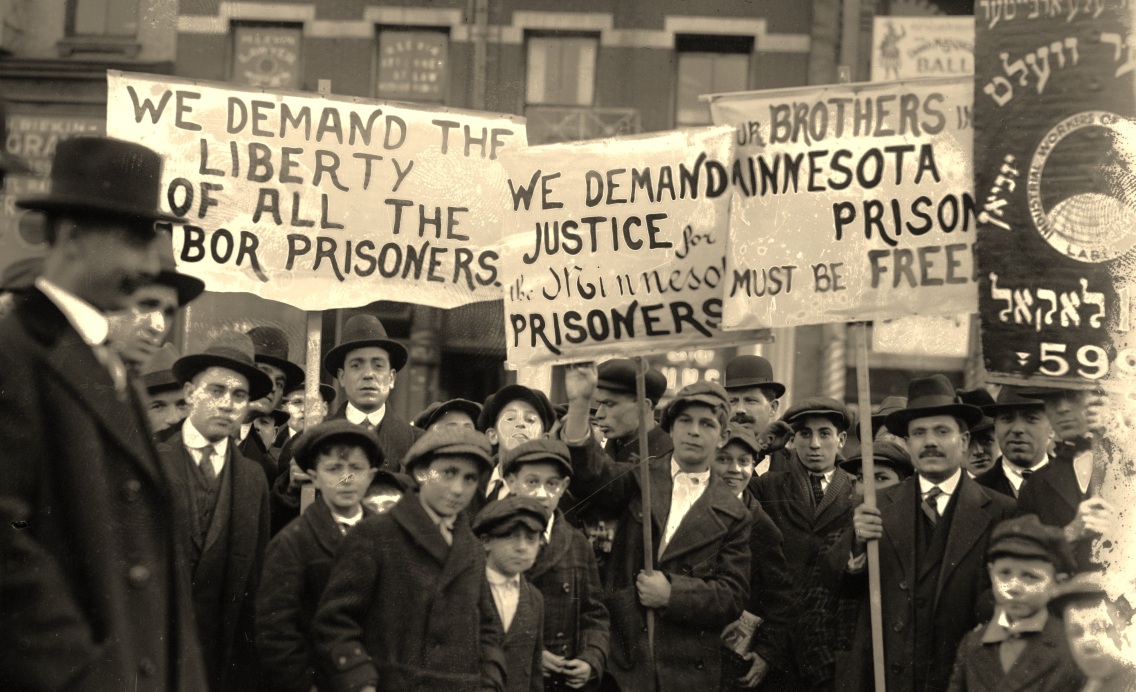
Mary Heaton Vorse in usual fine form with this piece from northern Minnesota on the circumstances which led to the ridiculous charge of murder against organizers Carlo Tresca, Joseph Schmidt, and Sam Scarlett during the 1916 iron miners strike.
‘Accessories Before the Fact’ by May Heaton Vorse from The Masses. Vol. 9 No. 1. November, 1916.
THE country of the Mesaba Range–where are the richest mines of iron ore in all the world and where Steel is again fighting organized labor–is a country of great, gory pits with men and teams crawling, small as flies, at the bottom of chutes so vast that they seem to be the result of some cataclysm of nature and not the work of the hand of man: towns, and the pits which are the mines surrounding them. There are other sorts of mines, holes in the earth, a series of tunnels, vast, mysterious, ending in blackness, tunnels shored up each foot of the way with heavy timbers: water drips from the walls, the place is full of small, disquieting noises. Now and then the darkness is pierced by the wavering light of a lamp on a miner’s coat.
All about the mine are vast stock piles of ore, and everywhere one sees cars, train after train of little red cars loaded with red ore, trains so interminable that they cease to seem real, seem like some interminably repeated stencil.
Long red roads join one range town to another, along whose length lounge gunmen–large, brutal and given to strong drink. On the same roads at night the darkness is forever broken by the gunmen’s fires by the roadside or by the flash of an electric light on the passing cars. There are gunmen of all kinds from the property gunmen the mine owners show visitors and the respectable company guards, to plug-uglies reeling drunk down the street of a sordid, forsaken camp. But wherever you turn, now silhouetted against the skyline, now crouching by the roadside–there, watchful and on the lookout for trouble.
At first you smile at them, many of them are such caricatures later you do not feel like smiling when you have seen the bruises on the bodies of women caused by their hands and clubs, or after you have heard the excited women in the little bleak villages tell in broken English stories of fights for water, of arrests and abuse.
They lurk at the back of strike meetings, audiences of serious Finns with their blonde and powerful wives of Croats, of Italians, of Austrians, of Greeks, all that population that the steel companies brought on the range from Europe to break the strike of 1907 when they blacklisted three strikers and sent them forth to find homes for themselves in the wilderness.
I have in my ears the voice of one of these strikers as he shouted “Scabs” at some miners, and a poignant memory of their shamed and beaten look. All the intensity of the struggle was in that word. It summed up that new morality which decrees that scabbing is for a worker what desertion is for a soldier.
These are some of the pictures I have of the Mesaba Range, but I have also the picture of the other part of the story in Duluth, where a fat, kind-hearted sheriff’s wife sat rocking on a porch outside a jail.
“I don’t know what to do with her,” she lamented. “I want her to let me take the baby out for air. But she’s afraid–she thinks I’ll kidnap it. You can’t make her understand. She just cries and cries something awful! She don’t understand what it’s all about. Sometimes I think it’s lucky she don’t understand, for the girls in the jail–you know the kind–talk awful.” It happens that Mrs. Masonovitch is in jail accused of murder. Just why she’s there it’s hard for anyone to understand. It’s not much wonder she cries and cries, and that she won’t even trust that kind, comfortable Irish body, the sheriff’s wife. In the other part of the jail is her husband and their three boarders, all held for the murder of Deputy Myron.
There, too, are Carlo Tresca, Joe Schmidt, Sam Scarlett and two other organizers who were all conveniently gathered in as accessories before the act.
This is what happened to Mrs. Masonovitch in the interests of law and order on the Mesaba Range: the miners on the range went out on strike in June and early in June a striker was shot and killed by a deputy. No arrests were made for that.
Philip Masonovitch and his three boarders were striking miners. He lived in a bleak little frame house near the county road about a mile from Biwabik. It is an isolated place with woods behind and a mine not far off. On the afternoon of June 3rd the woman sat, with the baby in her arms, the other children played around, the men sat playing cards. Into this peaceful household walked Deputy Myron and three other Deputies. They didn’t knock; they just came in and told Masonovitch he was “wanted.” Just why they came is obscure. Some say there was no warrant, that it was manufactured afterwards. Some say that Masonovitch had trespassed on company land to get water instead of going a mile and a half to town; for one of the ugly features of this strike has been forbidding the strikers the use of wells on the company land. Almost every mine has its little cluster of houses around it, sometimes on company land, sometimes not, but the well is more often than not on company land. There is a third report as to why Masonovitch was wanted and that was that he had a “blind pig.”
He started to get his shoes from an inner room when a Deputy named Dillon, an ex-bouncer of a disorderly house, hit him on the head with a club. The woman with the baby still in her arms, now arose, and another deputy clubbed her. This caused trouble. A big Austrian, one of the boarders, knocked down the deputy and the brawl was on.
Myron drew his gun; the boarders grappled with him. The deputy who had been knocked down fired his gun. According to his own testimony the bullet that killed Myron came from a distance and as though fired by someone on the floor–but none of the strikers had guns.
This wasn’t the end, although the State of Minnesota wasn’t interested in anything that happened after the death of Myron.
During the struggle the other two deputies vanished, and a passing driver of a pop wagon heard the shots and came running toward the house. He was shot and killed by a deputy who must have thought him some other striker come to help.
There were no arrests made for his death.
It was an ordinary clash of strikers and deputies, for this was during the period of wholesale arrests. Many another striker has had his home entered and has been told to come along, but its tragic ending played into the hands of the mining companies.
The charge of murder as Accessory before the Fact is an old acquaintance of anyone who has followed the labor disturbances of the past years. With this convenient law it can always be alleged that a death was the result of incendiary talk on the organizer’s part.
That’s why Carlo Tresca and the others are in jail. The wife of one of the imprisoned men wheels the baby up and down before the jail all day. Joe Schmidt’s wife is in Pennsylvania expecting her second baby.
Eleven people in jail for the chance killing of Deputy Myron, and no arrests for the shooting of the striker or the driver of the pop wagon.
There’s nothing new in the situation. It’s hard to write about it, for the strike has gone its appointed way. It’s the same case as that of Ettor and Giovannitti: we’ve seen a similar state of things in Colorado and in California.
This case may be in some ways more flagrant, for the range is sixty miles long and the organizers were rounded up on all parts of it. Nor will the men get off easily. Any more than any of the strikers have gotten off easily for small charges. They have a judge up on the range whom the miners call “Old Ninety-days.” When there is trouble between gunmen and strikers the strikers get ninety days and the gunmen go free, even for murder. That’s another familiar strike feature–the gunmen.
The strike technique is something like this.
A strike is called. At this the mine-owners cry “outside agitators.” Next, public opinion against the agitators is aroused by an obliging press. Then an army of gunmen, composed of crooks, and disorderly characters, is imported, and it’s a pretty poor crowd that can’t start something so that we presently find the strike leaders in jail charged with murder as accessories before the act.
This strike has progressed along its classic way. The mining officials cannot imagine what it’s about; they even assert that their men are, for the most part, getting more than they are asking, and that it is only the inefficient part of the workers who are on strike.
They are asking $2.75 a day for open pit work, $3.00 per day for underground mining, and $3.50 for wet underground work, an eight-hour day and the abolition of the contract system.
This is not a hunger strike, but a strike caused partly by the disappointment of the failure of the company to raise the wages of the contract miners, partly through the cumulative effects of small injustices and the fact that under the present system the miner never knows where he stands.
It’s a queer, quiet, earnest strike marked with reserve on the attitude of the miners and the local officials of the mining company. It’s not the fault of the local officials that the company has refused to talk with the strikers even when urged to by the Mayor and business men of the municipalities who are the strikers’ friends. It isn’t the Sheriff John D. Meinings’ fault that the gunmen are on the range making trouble.
It’s the fault of the United States Steel Corporation.
Steel is making its own relentless fight on organized labor. Because Carlo Tresca and three others were engaged on the range in organizing labor it will exact from them the highest penalty possible.
This is the sacred principle of the Steel Trust. We know its record from homestead days to the present strike on the Mesaba Range. It has never treated with labor and it never will, and with its limitless power it will try to crush all attempts of organization among its workers.
The Masses was among the most important, and best, radical journals of 20th century America. It was started in 1911 as an illustrated socialist monthly by Dutch immigrant Piet Vlag, who shortly left the magazine. It was then edited by Max Eastman who wrote in his first editorial: “A Free Magazine — This magazine is owned and published cooperatively by its editors. It has no dividends to pay, and nobody is trying to make money out of it. A revolutionary and not a reform magazine; a magazine with a sense of humour and no respect for the respectable; frank; arrogant; impertinent; searching for true causes; a magazine directed against rigidity and dogma wherever it is found; printing what is too naked or true for a money-making press; a magazine whose final policy is to do as it pleases and conciliate nobody, not even its readers — There is a field for this publication in America. Help us to find it.” The Masses successfully combined arts and politics and was the voice of urban, cosmopolitan, liberatory socialism. It became the leading anti-war voice in the run-up to World War One and helped to popularize industrial unions and support of workers strikes. It was sexually and culturally emancipatory, which placed it both politically and socially and odds the leadership of the Socialist Party, which also found support in its pages. The art, art criticism, and literature it featured was all imbued with its, increasing, radicalism. Floyd Dell was it literature editor and saw to the publication of important works and writers. Its radicalism and anti-war stance brought Federal charges against its editors for attempting to disrupt conscription during World War One which closed the paper in 1917. The editors returned in early 1918 with the adopted the name of William Lloyd Garrison’s The Liberator, which continued the interest in culture and the arts as well as the aesthetic of The Masses/ Contributors to this essential publication of the US left included: Sherwood Anderson, Cornelia Barns, George Bellows, Louise Bryant, Arthur B. Davies, Dorothy Day, Floyd Dell, Max Eastman, Wanda Gag, Jack London, Amy Lowell, Mabel Dodge Luhan, Inez Milholland, Robert Minor, John Reed, Boardman Robinson, Carl Sandburg, John French Sloan, Upton Sinclair, Louis Untermeyer, Mary Heaton Vorse, and Art Young.
PDF of full issue: https://www.marxists.org/history/usa/pubs/masses/issues/tamiment/t67-v09n01-m65-nov-1916.pdf

