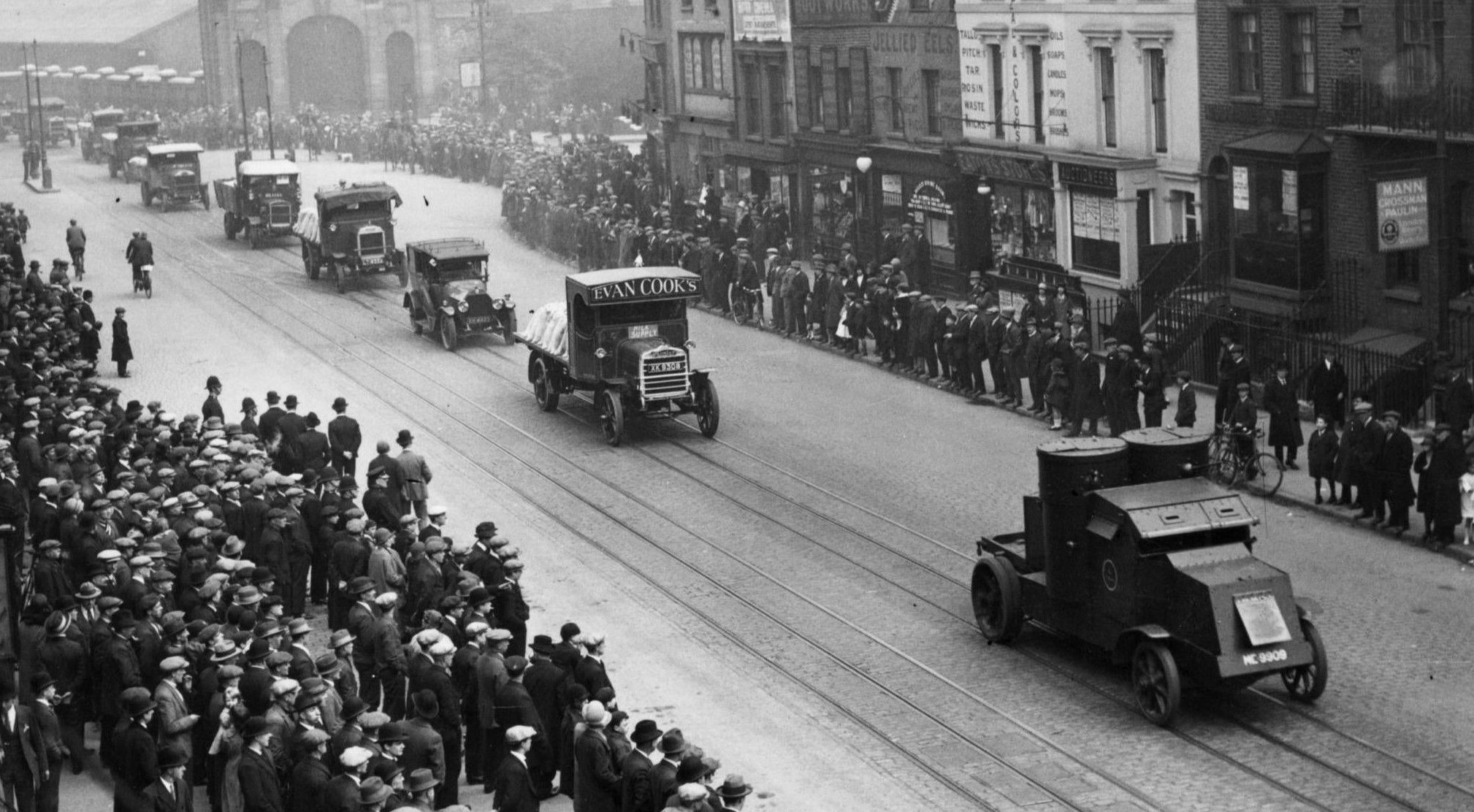
On the centenary of the struggle, Trotsky writes on Britain’s General Strike, and the roles of general strikes, in this preface for a new German edition of his 1925 work written on May 6th, 1926 as the confrontation began.
‘Where is Britain Going? Preface to the Second German Edition’ by Leon Trotsky from International Press Correspondence. Vol. 6 No. 46. June 10, 1926.
The following was written by Comrade Trotzky on May 6, i.e. six days before the calling off of the general strike by the General Council. Ed.
More than a year has elapsed since this book was written. The Conservative Ministry has had its honeymoon. Baldwin preached social peace. As MacDonald had nothing to oppose to conservatism, he competed with it in hatred against revolution, civil war and class war. The leaders of all three parties proclaimed that the British institutions were quite sufficient to ensure peaceful co-operation between the classes. The prognosis for the immediate future of British imperialism made in this book, was of course described by the whole British Press from the “Morning Post” to “Lansbury’s Labour Weekly” as hopeless nonsense and Moscow phantasmagoria.
Now the situation is somewhat changed. England is convulsed by the greatest mass strike. The Conservative Government is carrying on a policy of furious attack. From above everything is being done to provoke civil war. The contradiction between the social factors of power and the lie of an out-of-date parliamentarism has become manifest in England as never before.
The mass strike arose from the contradiction between the present situation of British economics in the world market and the traditional conditions of production and relations between the classes within the country. Formally the question was: reduction of the miners’ wages, longer hours of work, loading part of the sacrifices which are necessary for a real reorganisation of the coal industry on to the shoulders of the workers. Formulated in this way, the question is insoluble. It is perfectly true that the coal industry, as indeed the whole of British industry, cannot be reorganised without sacrifices, even serious sacrifices, on the part of the English proletariat. No one but a fool however can imagine for a moment that the English proletariat will consent to submit to this sacrifice on the old basis of capitalist property.
Capitalism was proclaimed to be a regime of permanent progress and of the systematic improvement of the lot of the working masses. To a certain extent this was true for some countries in the course of the 19th century. The religion of capitalistic progress was stronger in England than anywhere else. In fact it was this that formed the foundation of the conservative tendencies in the Labour movement itself, especially in the trade unions. In England, the war illusions (1914-1918) were, more than in any other country, illusions of capitalist power and of “social” progress. Victory over Germany was to be the final crown to these hopes. And now bourgeois society says to the miners: “If you want at least to ensure yourselves an existence such as you had before the war, you will have, for an indefinite time, to accept a lowering of all your conditions of living.” Instead of the prospect of steady social progress, which was recently proclaimed, it is now proposed to the workers that they should descend one step to-day so as to avoid tumbling down three or more steps at once to-morrow. This is as good as a declaration of bankruptcy on the part of British capitalism. The general strike is the answer of the proletariat which did not and cannot admit that the bankruptcy of British capitalism should be the beginning of the bankruptcy of the British nation and of British culture.
This answer however is dictated far more by the logic of the situation than by the logic of consciousness. The English working class had no other alternative. The struggle–no matter what was the mechanism behind the scenes–was forced on them by the mechanical pressure of the whole situation. The world situation of British industry could not offer any material basis for a compromise. The Thomases, MacDonalds etc. are like windmills which turn their sails when there is a strong wind, but do not yield a single pound of flour as there is no corn. The hopeless hollowness of British Reformism in the present day was revealed with such convincing force that nothing remained for the Reformists to do but to join in the mass strike of the British proletariat. This revealed the strength of the strike–but also its weakness.
The general strike is the most poignant form of class war. After the general strike comes the armed insurrection. This is why the general strike, more than any other form of class war, demands a clear, resolute, firm, i.e. revolutionary leadership. In the present strike, the British proletariat shows no trace of a leadership of this kind. and it cannot be expected that it will suddenly rise in complete form as if conjured up out of the ground. The Trade Union Council began with the ridiculous declaration that the present general strike was in no way a political struggle, still less an attack on the state power of the bankers, the manufacturers and the landowners and on the sacred British Parliament. This declaration of war on the part of faithful subjects appears not to convince the Government at all, which feels that, through the effect of the strike, the real instruments of power are slipping from its hands. The power of the State is not an “idea” but a material apparatus. If the apparatus of administration and suppression is paralysed, the power of the State will also be paralysed. In modern society, no one can rule without having in his hand railways, shipping. Post and telegraph, electric plants, coal etc. The fact that MacDonald and Thomas deny on oath that they have any political aims, characterises them as individuals, but not the nature of the general strike which, if it is carried on to the end, places before the revolutionary class the task of organising a new State power. Those however who, by the course of events, have been placed “at the head” of the general strike, are fighting against this with all their force. And this is the chief danger; men who did not wish for the general strike, who deny the political character of the general strike, who fear nothing so much as the consequences of a victorious strike, must inevitably direct all their efforts to keeping the strike within the scope of a semi-political half-strike. i.e. to deprive it of its power. We must look things straight in the face; the chief efforts of the official leaders of the Labour Party and of a considerable number of the official trade union leaders will not be directed towards paralysing the bourgeois State by means of the strike, but towards paralysing the general strike with the aid of the bourgeois State. The Government, in the person of its most obstinate Conservatives, will doubtless provoke a civil war on a small scale so as to be in the position to resort to measures of terror even before the struggle develops and to suppress the movement. By robbing the strike of its political programme, disintegrating the revolutionary will of the proletariat and sing the movement into a blind alley, the Reformists force the individual groups of workers on to the path of isolated volts. In this sense, the Reformists are one with the Fascist elements of the Conservative party. Herein lies the chief danger the fight which has begun.
It would be out of place at this moment to prophesy as the duration of the fight and its development, to say nothing of its issue. Everything must be done from the international of view to help the fighters and to promote conditions of their success. We must however clearly recognise that success of this kind is only possible in the measure in which the British working-class, in the process of the development and the intensification of the general strike, realises the necessity of changing leaders and succeeds in doing so. An English proverb says how one must not change horses while crossing the stream. This practical wisdom however is only true within certain limits. It has never yet been possible to cross a revolutionary stream on horse of Reformism, and the class which entered the battle under Opportunist leaders, is compelled to change them under the enemy’s fire. In this way, the position of the real revolutionary elements of the British proletariat, particularly of the Communists, is predetermined. They will support the unity of mass action in every way, but they will not admit of any appearance of unity with the opportunist leaders of the Labour Party and the trade unions. The most important piece of work for the truly revolutionary participants in the general strike will be to fight relentlessly against every trace or act of treachery, and mercilessly expose Reformist illusions. In doing so, they not only help forward the chief and permanent task of developing new revolutionary cadres, without which the victory of the British proletariat is altogether impossible, but they contribute directly to the success of the present strike by intensifying it, revealing its revolutionary tendencies, pushing the Opportunists on one side and strengthening the position of the revolutionaries. The results of the strike–both the immediate ones and those which lie more in the future–will be all the more important, the more decisively the revolutionary will of the masses breaks down the barriers and obstacles of the counter-revolutionary leadership.
The strike in itself cannot alter the position of British capitalism and the coal industry, especially in the world market. This requires the reorganisation of the whole of British economics. The strike is only an emphatic expression of this necessity. The programme of the reorganisation of British economics is a programme of the new power, the new State, the new class. Herein lies the fundamental significance of the general strike; it sharply puts forward the question of power. The real victory of the general strike can only be expressed in the conquest of power by the proletariat and in the establishment of a proletarian dictatorship. In view of the hopeless situation of British capitalism, the general strike should be regarded less than ever as an instrument of reform or of partial conquest. To put it more exactly, if the mine-owners or the Government were to make this or that concession under the pressure of the strike, these concessions would, in view of the whole situation, have neither a deep nor a permanent significance. This by no means implies that the present strike is faced by the alternative of all or nothing. Had the British proletariat been under a leadership which to some extent was in keeping with its class strength and the maturity of conditions, power would have passed from the hands of the Conservative into the hands of the proletariat in the course of a few weeks. As it is, we can hardly reckon with an issue of this kind. This again does not mean that the strike is hopeless. The more widely it develops, the more violently it shakes the foundations of capitalism, the more completely it rejects the treacherous and opportunist leaders, the more difficult will it be for bourgeois reaction to take up a counter-offensive, the less will the proletarian organisations suffer, the sooner will the next, decisive stage of the fight be arrived at.
The present class conflict will be a tremendous lesson and have vast consequences, quite independently of its immediate results. It will be clear to every proletarian in England that Parliament is not able to solve the fundamental and vital tasks of the country. The question of the economic salvation of Britain will now present itself to the proletariat as a question of the conquest of power. A death blow will be aimed at all mediatory elements with conciliating, compromising and pseudo-pacifist tendencies. The Liberal party, however its leaders may turn and twist, will come forth from this test even more insignificant than it was before it entered the fight. Within the Conservative party, the die-hard elements will gain the predominance. Within the Labour party, the revolutionary wing will increase in influence and will find more complete expression. The Communists will push forward resolutely. The revolutionary development of England will advance enormously.
The course of events has shown that the questions raised in this book a year ago, will now, from the political point of view, brook no delay. Seen in the light of the mighty strike which is at present developing, the questions of evolution and revolution, of peaceful development and the employment of force, the question of reforms and of class dictatorship, will, in their full intensity, occupy the consciousness of hundreds of thousands. nay millions, of British workers. Of this there can be no doubt. The British proletariat which was kept in a condition of terrible backwardness as regards its ideology by the bourgeoisie and its Fabian agents, will now bound forward like a lion. Material conditions in England have long been ripe for Socialism. The strike has made the substitution of a proletarian State for the bourgeois one, a question of the day. If the strike itself does not bring about this change, it will at least greatly hasten its approach, though in what period of time, we cannot of course say. We should however be prepared for the possibility of a near date.
Crimea, May 6th, 1926. L.D. Trotzky.
International Press Correspondence, widely known as”Inprecor” was published by the Executive Committee of the Communist International (ECCI) regularly in German and English, occasionally in many other languages, beginning in 1921 and lasting in English until 1938. Inprecor’s role was to supply translated articles to the English-speaking press of the International from the Comintern’s different sections, as well as news and statements from the ECCI. Many ‘Daily Worker’ and ‘Communist’ articles originated in Inprecor, and it also published articles by American comrades for use in other countries. It was published at least weekly, and often thrice weekly.
PDF of full issue: https://www.marxists.org/history/international/comintern/inprecor/1926/v06n46-jun-10-1926-Inprecor.pdf

