The impact of war and revolution on an emerging art form from an early and lifelong avant garde filmmaker. Herman Weinberg pioneered the use of subtitles, ran theaters, made movies, and wrote prolifically on his favorite sunject. An encyclopedic knowledge displayed by the 22-year-old below came from decades of work in cinemas beginning as a teen and would lead to hundreds of articles and more than a dozen books.
‘A Decade of World Cinema’ by Herman G. Weinberg from Modern Quarterly. Vol. 5 No. 4. Winter, 1930-31.
BOTH France and America dispute the right to claim for themselves “the cradle of the cinema”—yet it is neither of these which has created and developed this new means of expression, nor is it Germany with her advanced knowledge of chemistry and lighting, nor the intellect of the Swedish. It remained for a people considered “out of the running” at a time when these countries were turning out their Caligaris, Gosta Boerlings, Miracle des Loups and Birth of a Nations. It remained, curiously enough, for Russia—not the Holy Russia of the Romanoffs, but the New Russia of the Soviets, A.D. 1917.
From out of the West had come this invention, “that ingenious toy,” the motion-picture camera—and Russia, heavy with the burden of many centuries of oppression, steeped in an Oriental lethargy and religious mysticism, was slow in grasping the secret of kinetic power which lay in the film. The basis of the film was speed—light-motion—and the West had been attuned to speed. The East had been slow and easy-going—the camel against the train. The relation between time and space was different.
After the October Revolution, Russia emerged from an age-old intellectual stupor of ignorance and squalor. The peasant had been taught to read and write and to think for himself. Social and moral codes had changed. The revolution had brought with it a new, turbulent and cleansing force. What customs, superstitions and prejudices remained had been charged with the breath of a new era calling it to a new life.
Heedless of heretofore accepted canons, formulas and credos, which had made of the Western Cinema a disconcerting mixture of a sophistication in its last stages of decay and the sheerest sort of militaristic-politicosocial propaganda, the Russians went back to the soil and filmed Gogol’s Taras Bulba, Pushkin’s Stationmaster, Tolstoy’s Polykuska, among others of a similar nature. Each little picture with a social problem of its own—showing how unhappy was the lot of the serf under the old régime—and opening the eyes of the peasant for the first time. These were the seeds of what was to come as a natural growth.
The technique in these films was not new. The West had introduced it and had carried it further, elaborating on the same material, instead of endeavoring to create a new film-language, and not only that, but a more perfect and pure expression of the film-language. And it was here that the Revolutionary theatres of Meierhold, Tairov, Andreyev, Toller, Piscator and the rest of them—the cubists, post-cubists, constructivists, which were little more than the backwash of the artificialities swept from the Western theatre, vide, expressionism in Germany, dadaism and sur-realism in France, vorticism in England, futurism in Italy, resulted in an offshoot—a group of young regisseurs who found themselves hampered by the theatre and its limitations, in which they had reduced everything on the stage and in the manuscript to its bare essence and construction and had found—nothing. A vicious circle had been completed. With the invention and introduction of the camera in which the horizon was unlimited and time and space were at the will of the cameraman, a means to a “will to power” had been discovered by them and they deserted the stage for the film.
Sergei Michaelovitch Eisenstein was one such. The Eggert of Aelita was another. There was Pudovkin, Taritch, Room, Protosanow, Alexandrowsky, Preobrezhenskaya, Stabavoj, Kutsnesoff, Trauberg, and even Meiérhold himself. And these discovered a dynamism in the film which none knew existed before.
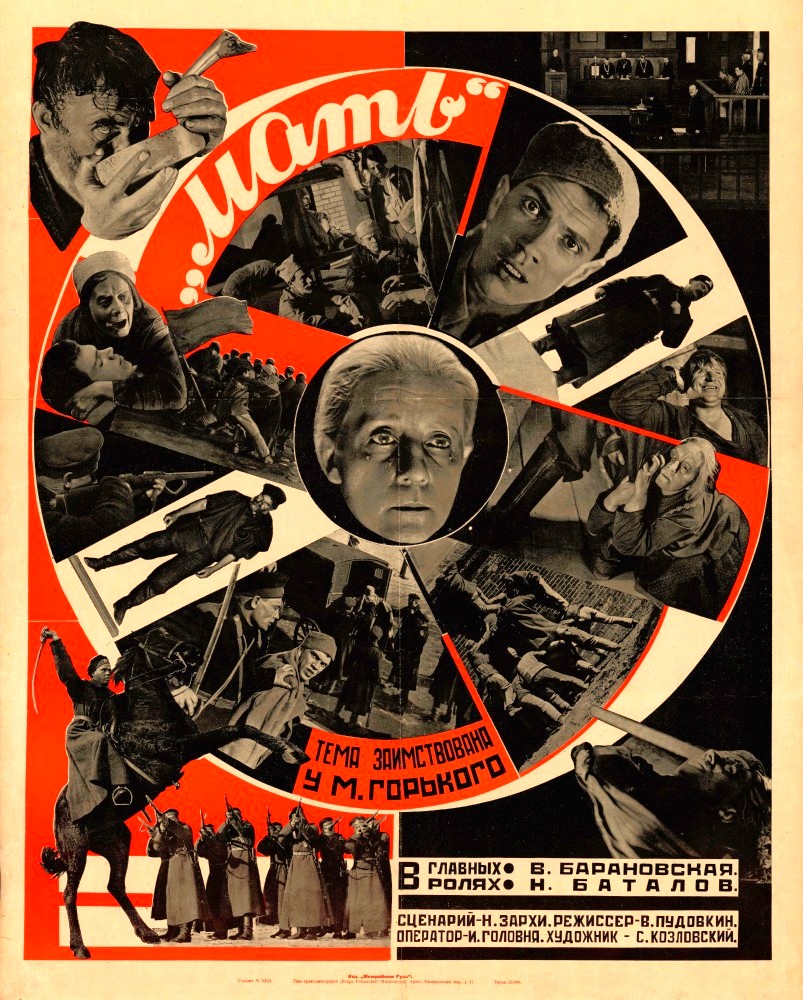
Strike, Mother, Potemkin, The Black Sunday, Ten Days, The End of St. Petersburg, The Village of Sin, Two Days, Ivan the Terrible, were film documents which carried a message to the peasant, and, if they would see it, to the peasant of the West. They were labeled propaganda films by the West. Yet wherein did they differ from the propaganda films of the West?
Only in so far as to the class which was being glorified. The message dished out to peasant and bourgeoisie of the West was slightly different from the one the kulak and moujik got in Russia. Western films, like West Point, glorifying a military academy; The Patent Leather Kid, which justified being killed and maimed in the service of one’s government and the honor of the flag; The Big Parade, which showed the war as something of a lark (though it was the least offensive of the lot in America); Behind the Front, a farcical treatment of the war which must have made the ghosts of the corpses lying in the cemeteries of France shrivel in the thought that they did die in vain; Wings, an incredibly juvenile concoction reminiscent of the Rover Boys and Frank Merriwell species of fiction, which glorified fighting in the air for God and Country and the Right; Lilac Time, the reductio ad absurdum of Wings; The Flying Fleet, more sugarcoating of the aeroplane and military academies, and innumerable others. Or, what was worse, the flood of films manufactured in America during those benighted days of the Great Liberty Loan Drive in 1917—The Beast of Berlin, Yankee Doodle in Berlin, To Hell With Potsdam, etc. Films manufactured with the sole intent of instilling into the minds of the American people what ruthless barbarians the Germans were and why they should give their last mite to purchase powder and cannon to wipe off every German from the face of the earth. Or the popularizing, via the film, of a non-existent Teutonic “hymn of hate.” Or the incredible films of the early Edison Company, like The Unbeliever, showing an impossible “Hun” officer shooting women and children in Belgium, ad nauseam…
Germany, with Metropolis, later tried to rehabilitate good will among nations. Ufa (the Universum Film Atkeingesellschaft of Neu Babelsberg), their chief production unit, began a strictly pacifistic film, Am Rand der Welt, but Heugenberg, anti-socialist and financial controller of a score of Nationalist newspapers and of the destinies of that company, stepped in and muddled the works. England, with Mons and The Somme, tried weakly too in this direction. Also with a sea film—The Coronel and the Falklands. Germany, with a brave little film, The Raider Emden, produced with the cooperation of the British Admiralty, and France, with Le Grand Epreuve, Verdun, Pour La Paix du Monde, went further in the field of anti-war propaganda. And then Vsevelod Pudovkin in Russia settled once and for all the problem of war in The End of St. Petersburg by showing war robbed of its last vestige of glamour. It was war as Andreyev pictured it in The Red Laugh and as it was to Andreas Latzko in Men in War. Who will ever forget that scene of the rosegarlanded cannon rising slowly to position? And as this is being written, in the summer of 1930, there has been nothing in all literature and the graphic arts to show the awful desolation and ghastliness of war so penetratingly as the war scenes in Pudovkin’s great film—notably one scene which shows a group of soldiers rolling in their death agony in the mud-colored dust down the side of a hill until the scene is blotted out by, the, choking dust and poisonous vapors in the air and then, having cleared, discloses stiff corpses lying strangled and discolored on the earth…
It was necessary to create a new film language. The war had upset everything, including the entire old order. The staid, complacent, negative demeanor of before had to give way to a new and cleansing one. And as a matter of record, as historical documents made so that the world should not too quickly forget, Pudovkin and Eisenstein, those two proteans of the world cinema, made those films which the West turned around and called insidious and unashamed Soviet propaganda. The West had forgotten all too soon.
For one thing, Russia startled the rest of the movie world with a decidedly iconoclastic and revolutionary film technique. Short scenes, as quickly transient as life itself. Nebulous in themselves but eloquent in the grotesque juxtaposition with which they were placed with symbols of the old and new orders as their physical context. Piercing, trenchant, meaningful innuendo. Warmth and humanness, and affirmative where the West was negative or non-committal.
Of course, these films were propaganda for something. You’ve got to have something to say even before you attempt to make a film. There may not be any truths—but there are certainly some half-truths and, in all fairness, we must grant Pudovkin and Eisenstein that. They were immeasurably more justified in making Mother and Potemkin than the Edison Company was in producing The Unbeliever or Universal was in making The Beast of Berlin. It all resolves itself down to a question of whose propaganda was justified or had a measure of truth to support it.
The “short-shot” technique of the new film language developed by the Russians is like “hammer-blows” which would awaken the people from their lethargy of innocuous complacency. This is their secret. That is the difference between the “long-shot” technique of most Western films which gloat and dawdle over scenes because they don’t know what to do with the material or how to divide it up into biting psychological thrusts at stupidity and inanity. Or making fragments speak for a whole. Or waking to a conscious irony. Or in short realizing that this is not the best of all possible worlds.
The West has its heritage in the works of Swift, Defoe, Voltaire, Anatole France and others. If the mass of the world’s people would undertake to read Candide and let it sink in, it is very probable that much of the world’s woes would cease. There is nothing quite so destructive to established institutions and customs as the laughter of ridicule. And that is just what the Russian film makers have succeeded in doing. They have caused a frequent succession of knowing smiles to break out on the face of the intelligent spectator witnessing their films.
***
The films from Germany have almost consistently been steeped in the psychoanalytical school of photoplay technique. Pabst, Dupont, Murnau, Grune, Lang, May, Pommer and the rest of them employed a film language made up in the main of symbols, often obvious and easily recognized (basing and justifying this use of symbolism, no doubt, on the timelessness, the universal acceptance and knowledge of these symbols) and which fitted into the general scheme by several virtues. Often, these symbols took the form of still-life, mechanical objects, swinging doors, elevators, mirrors, motor cars, uniforms, electric signs—all that were part and parcel of our much-vaunted twentieth century civilization. These things were often excellent photographic material, for the trenchant camera lens caught the sheen of their surfaces and imparted to them a special and meaningful significance.
But this, it must be understood, was merely the application to a new medium of a form of expression that had served its purpose in the advance-guard literature, in poetry of the moderns and all the post-war literati on the surging wave of expressionism which swept over Germany after the war, as if to reduce everything to a didactic principle, to break with artificiality, and sentimentality (sentiment, they had, for these things, but not sentimentality), to be free—the triumph of order and clarity. (Mondrian, of Holland, for instance, had sought to achieve this in painting).
But the Germans never got stronger than Variety and the sail-cloth over the sailors in Potemkin is worth all of Variety, excellent though that film was. The Last Laugh, that finest flower of the Teutonic cinemacraft, heralded the birth of the film-poem. The unwieldy architectural films of Lang (Metropolis, the Nibelungen, Spies, etc.) were static things with more of an eye to visual composition than to pure cinema dynamics and warmth of humanness. Pabst in Jeanne Ney, La Rue Sans Joie and Pandora’s Box, went back to Freud for his dissecting of the human animal in a series of intensely interesting and provocative pictures. He is, to me, the most promising figure of the German cinema today.
Sweden, of those Swedish films I have seen, was to me a disconcerting mixture of intellect and mysticism, and either these things are not good cinema-material or the cinema is not yet ready to assimilate them, but with one thing and another nothing virile, nothing charged with that “life blood” which makes of even the lowliest of the Russian films, of Polykushka, for instance, a breathing thing, has emanated from the film studios of Scandinavia. Yet Sweden, in Mauritz Stiller, gave the world an unusually brilliant director, whose late lamented death is mourned by all lovers of the artistic cinema.
The French discovered at an early date the secret of dynamism, of kinetic power, of psychical photographic innuendo which was at the same time cinematographic. But it was, in many cases, a literary innuendo which fostered the cinematographic, and the French film art was an offshoot of French painting and literature and, in a less noble way, of the French stage. It was not a thing conceived in terms of light and shadow and the shunting of these two in restless, fluid, mobile movements which is cinema. The abstract films of Man Ray, Henri Chomette, Andre Sauvage, Rene Clair, de Beaumont, Sevier, Kuhn, etc., are an exception, of course; but even in many of their works we felt the influence of Picasso, Leger, and Braque, though Rene Clair is probably the most original talent in France. A young Brazilian, Alberto Cavalcanti, has done some splendid work in En Rade, Rien Que Les Heures, L’Petite Lilie. Jacques Feyder enriched the literature of the French cinema with his Visages des Infants and Therese Raquin. Dreyer, the director of the unforgettable Jeanne d’Arc, is a Dane and did as much as any single person to raise the status of film to a point of aristocratic respectability.
America, after deluging the world with its swill, has come out with one or two respectable photoplays which survived the advent of that monstrous anomaly, the talking picture, in All Quiet on the Western Front and Hallelujah. These can be added to such landmarks of the history of the American movie as the early Griffith films, Chaplin’s A Woman of Paris, and one or two things each by Vidor, Lubitsch and von Stroheim. The former, from Erich Maria Remarque’s vivid book, is brave and uncompromising. Progress has been made since those early and dark days from 1917 to 1920.
But the Russians have not remembered their paintings and their literature to adapt their forms to the screen. True, in rare instances, as in Preobrezhenskaya’s Village of Sin, certain compositions of peasant women in the fields recall Bilibin’s paintings come to life, but these are incidental and unstudied. Ten Days, Potemkin, St. Petersburg, and Storm Over Asia were all conceived and told in terms of the camera. They are primarily visceral and dynamic, depending for their effect on the weird, shunting play of light and shadow, on lines, planes, and surfaces crossing the screen, on the interplay of mass and line, like a gigantic geometrical problem, unswerving in its course towards the inevitable goal, as full of fate and foreboding as life itself.
It is the first definite film language and yet it is but one form that the film language can take. The other is that suggested by the method employed by Murnau, Freund and Mayer in The Last Laugh. Whether the outcome will be the film poem or the film document, time alone can answer. The technique of the talking pictures can prove to be of an expansive rather than of a compromising nature. Eisenstein has even gone so far as to draw up a manifesto of the sound picture in which he would use sound (not necessarily talking, or music, or sound effects, but conglomeration of all three) polyphonically. It is his intention to fuse sound and light contrapuntally as in music. Just as the fugue and counterpoint are the structural skeletons upon which all music is based, so may the use of sound and light, employed in the sound-films of the future, lay the basis for a new and fundamental cinema technique—opto-phonetics.
Modern Quarterly began in 1923 by V. F. Calverton. Calverton, born George Goetz (1900–1940), a radical writer, literary critic and publisher. Based in Baltimore, Modern Quarterly was an unaligned socialist discussion magazine, and dominated by its editor. Calverton’s interest in and support for Black liberation opened the pages of MQ to a host of the most important Black writers and debates of the 1920s and 30s, enough to make it an important historic US left journal. In addition, MQ covered sexual topics rarely openly discussed as well as the arts and literature, and had considerable attention from left intellectuals in the 1920s and early 1930s. From 1933 until Calverton’s early death from alcoholism in 1940 Modern Quarterly continued as The Modern Monthly. Increasingly involved in bitter polemics with the Communist Party-aligned writers, Modern Monthly became more overtly ‘Anti-Stalinist’ in the mid-1930s Calverton, very much an iconoclast and often accused of dilettantism, also opposed entry into World War Two which put him and his journal at odds with much of left and progressive thinking of the later 1930s, further leading to the journal’s isolation.
PDF of original issue: https://archive.org/download/modern-quarterly_winter-1930-1931_5_4/modern-quarterly_winter-1930-1931_5_4.pdf

