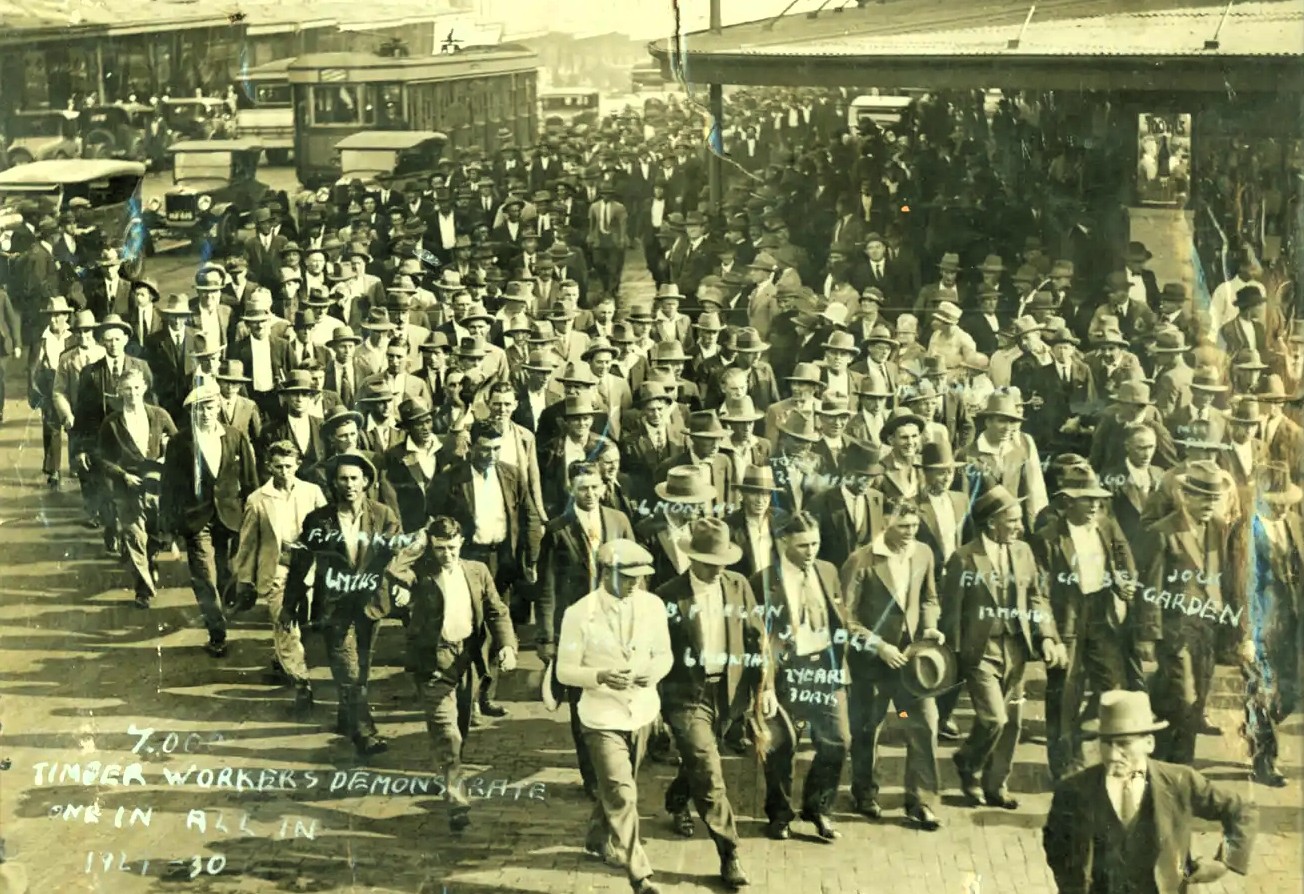
An orientation document from the R.I.L.U.’s 1929 Pan-Pacific Congress for its supporters in the Australian Council of Trade Unions to overcome organizational division, class-collaboration and its outgrowth of white supremacy that was the ‘White Australia’ policy, a hallmark of the colony’s reactionary and ineffectual ‘labor’ movement for generations.
‘The Tasks of the Trade Unions of Australia’ from The Pan-Pacific Monthly. No. 32. November, 1929.
1. In the struggles against the offensive of capital of the past two years, the Australian working class and particularly the trade union movement have revealed all the strong and weak points in their own ranks. The Australian working class has displayed a splendid spirit of class solidarity and fighting tenacity, once they are aroused and forced into a fight. The recent timber workers’ struggle is a classical example. However, at the same time, the weaknesses of the Australian trade union movement have also been clearly revealed. These are of two-fold nature: organizational and ideological.
Organizationally, the Australian trade union movement is divided both nationally (ACTU, AWU, Independent unions), and industrially. There exist hundreds of autonomous craft unions, with dozens of them competing with each other and fighting each other in one and the same industry or shop. Industrial unionism is practically non-existent; factory and shop committees are equally rare.
Ideologically we find a certain section of the Australian trade union movement steeped in illusions of class peace, arbitration, on white chauvinism, which is nurtured by capitalists and imperialists and their agents: and a very dangerous racial prejudice based not only on the fear of economic competition from lower-paid labor from this or that country, but also the false doctrine of the superiority of the white or “Nordic” race, a doctrine which is deliberately being fostered by the imperialists in their own interests and in preparation of coming imperialist wars.
2. The experience from the struggles which the Australian working class has carried out during the last two years against the capitalist offensive, (which was carefully and planfully developed by the Australian capitalist class) is already beginning to show some encouraging signs for the future. The ruthlessness with which the Australian capitalist class have launched their offensive (anti-Trade Union Law, Crimes Act, Transport Act, Beeby Award, Lukin Award, attack on the miners, etc.) could not but shake large sections of the Australian working class from their faith in strictly “constitutional” and “democratic” methods, from their belief in and dependence on the “sense of justice” of this or that Arbitration Court judge. The best proof of this was furnished in the truly historic action of the NSW timber workers, when they burned the ballots of the Arbitration Court together with the effigy of Judge Lukin also when the mockery of the Industrial peace conference was brought to a well-deserved end by the more advanced section of the trade union movement.
The dawning class-consciousness of the Australian working class also finds its expression in the affiliation of the ACTU to the Pan-Pacific Trade Union Secretariat, in the splendid fight of the more advanced elements in the ACTU against the reactionaries, who are blinded by their own craft spirit, by their national and racial prejudices against international working class solidarity, not only in words but in deeds. In this connection the Pan-Pacific TU Secretariat expresses its gratification at the action of the ACTU in formally approving their affiliation to the PPTUS, at their last National Congress, and also in their sending duly accredited representatives to take an active part in the work of the Vladivostok Conference. The ACTU executive is also to be congratulated on its efforts to counteract the despotic ban by the Bruce Government of the PPTUS Congress from being held in Australia.
3. The PPTUS is of the opinion that the ACTU can and must become the leading central body of the Australian working class. But the history of the trade union movement has taught us that this is possible only on one condition, namely, that it must work out and base all its activities on a definite, clear and consistent program, founded on the principles of the class struggle, and fighting for the interests of the working class. Such a program is absolutely incompatible with the policy of class or industrial peace, compulsory arbitration and also so-called conciliation tribunals, etc.–which rob the trade unions of their freedom of action and deprive the workers of their most effective weapon of self-defense, namely, the right to strike. Nor is such a policy compatible with the fostering or maintaining of national or racial prejudice, which are in crying contradiction to working class solidarity and true internationalism.
4. In order that the Australian labor movement may be able to withstand the capitalist offensive and eventually take up the counter-offensive it is necessary to take energetic steps for the amalgamation of the many small craft unions into large and compact industrial unions. These industrial unions will represent a strong force only if they are formed in each enterprise, if factory and Shop Committees are elected by the workers themselves–(whether organized or unorganized) and if these committees consistently fulfill their function of defending the interests of the workers, at the same time serving as the basis for the corresponding industrial unions. Only by taking the initiative of reorganizing the Australian trade union movement on the principle of industrial unionism and Factory and Shop Committees, will the ACTU be able to become the leading organ of the Australian trade union movement.
5. However, the consolidation of the trade unions is but a first step on the way to strengthening the fighting capacity of the working masses. The organizations carry on a most ruthless struggle against class collaboration, against compulsory arbitration and against industrial peace. Only a policy based on uncompromising class struggle and aimed at the unification of the working masses against the bourgeoisie, can give positive results and lead the Australian working class out of their present difficult position.
6. The solution of the problems facing the TU movement requires most careful attention and sensitiveness to the mood of the masses and the ability to mobilize them for the struggle against the bourgeoisie. Hence it is necessary on the eve of conflicts to form Strike Committees, Vigilance Committees, etc. elected by all the workers of a given enterprise and to pay special attention to the participation of the unorganized, women and youth in these struggles. Otherwise, an effective struggle against concentrated and consolidated capitalism is impossible.
Special attention must be paid to the study of the experiences of strikes and economic struggles, of the weak and strong sides in such struggles. Strict self-criticism of our own weaknesses and errors, is the best means of educating the masses and of avoiding the repetition of mistakes in new struggles.
7. The struggle against the capitalist class will be successful if the Australian trade unions get out to liquidate the reactionary clique of leaders at the head of the AWU, to organize and develop the rank and file. movement within the AWU, chase the reactionary and mercenary leaders out of this organization, and unify the membership of the AWU with the entire trade union movement on the basis of industrial unionism. This work must be carried out parallel with the purging of the trade unions affiliated to the ACTU of any reactionary leaders. The greatest danger for the TU movement in Australia, as well as in other countries, is the demoralizing influence of the reactionary leaders, whether of the trade unions or the Labor Party, who carry out the policy of the bourgeoisie in our ranks. He who does not fight against these reactionaries, helps in the defeat of the labor movement and the victory of the capitalist class.
8. The ACTU which through its affiliation to the PPTUS has inaugurated a new era of working class internationalism for the Australian working class, is however, still connected, through its annual official representations, with the international “Labor” Bureau in Geneva. This organization has time and again unmasked itself as the agency of the imperialist League of Nations, for misleading and demoralizing the workers of the world. The reports of the ACTU delegates to the Geneva Labor Office contain sufficient material to substantiate this fact. Another such agency of international capitalism and imperialism is the so-called Institute of Pacific Relations (Honolulu), with which the Melbourne Trades and Labor Council has taken up connections by sending a delegate to their recent sessions. The PPTUS urges the ACTU, in the interests of the working class of Australia and of the Pacific, to effect the severing of all connections of the Australian labor bodies with these open and disguised agencies of capitalism.
9. The struggle against the Australian bourgeoisie must be carried on parallel with the struggle against British and world imperialism and against those traditions and ideas disseminated by imperialism, which have a poisoning influence upon the workers. The most dangerous of these ideas is that of race prejudice and the false assertion that the white race is superior to the colored races. On the banner of the Australian trade union movement must be inscribed the slogan: “Not race war, but class war.” Under this banner it is necessary to participate actively in the work of the PPTUS and to rally the Australian TU movement to joint struggle with the international proletariat against the national and international bourgeoisie.
TING-YU-LIN (Chairman). BROWDER (Gen. Secretary).
Australian Delegation: F. ROELS. F. WALSH. G. HANNETT.
The Pan-Pacific Monthly was the official organ of the Pan-Pacific Trade Union Secretariat (PPTUS), a subdivision of the Red International of Labor Unions, or Profitern. Established first in Ha in May 1927, the PPTUS had to move its offices, and the production of the Monthly to San Francisco after the fall of the Shanghai Commune in 1927. Earl Browder was an early Secretary of tge PPTUS, having been in China during its establishment. Harrison George was the editor of the Monthly. Constituents of the PPTUC included the Australian Council of Trade Unions, the All-China Federation of Trade Unions, the Indonesian Labor Federation, the Japanese Trade Union Council, the National Minority Movement (UK Colonies), the Confédération Générale du Travail Unitaire (French Colonies), the Korean Workers and Peasants Federation, the Philippine Labor Congress, the National Confederation of Farm Laborers and Tenants of the Philippines, the All-Union Central Council of Trade Unions of the Soviet Union, and the Trade Union Educational League of the U.S. With only two international conferences, the second in 1929, the PPTUS never took off as a force capable of coordinating trade union activity in the Pacific Basis, as was its charge. However, despite its short run, the Monthly is an invaluable English-language resource on a crucial period in the Communist movement in the Pacific, the beginnings of the ‘Third Period.’
PDF of full issue: https://www.marxists.org/history/international/profintern/pan-pacific-monthly/n32-nov-1929-PPM.pdf

