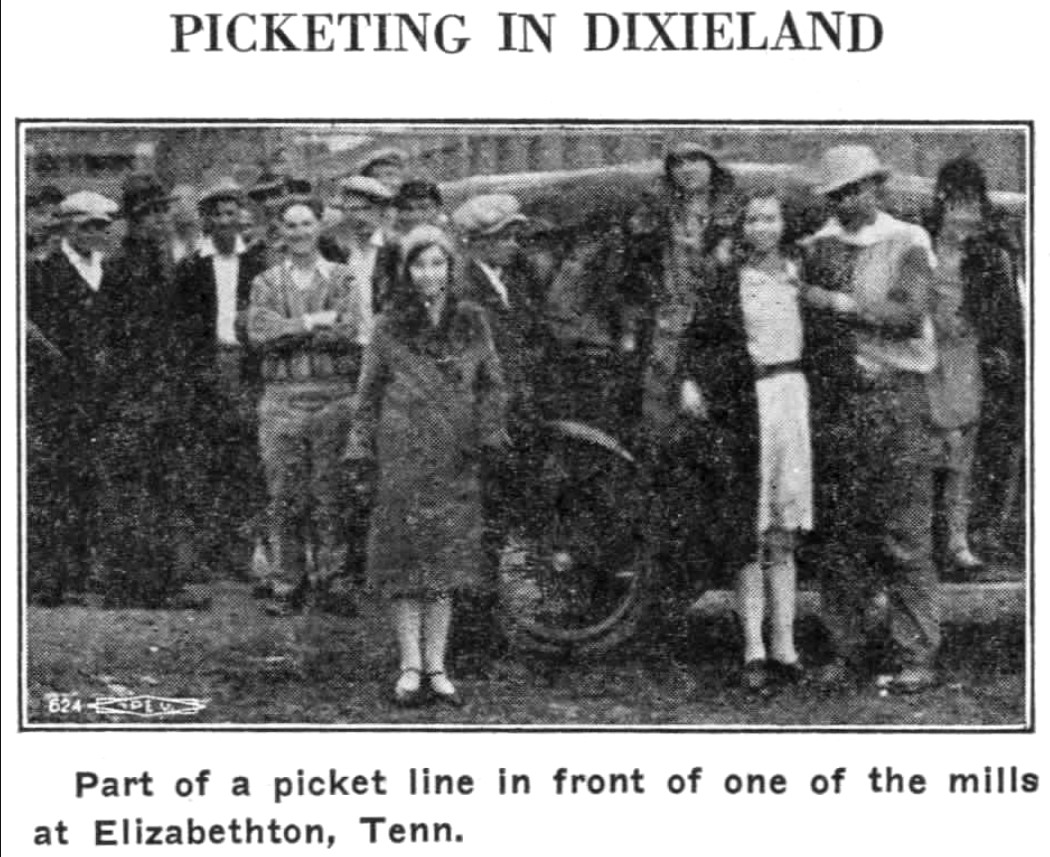
Esther Lowell looks at new technologies and labor processes transforming work and life in Southern mill towns, where unions first made a real attempt at gaining a Southern foothold a century ago. Organizing the South still being, very much, unfinished business for the U.S. working class.
‘Cotton Mill Towns’ by Esther Lowell from Labor Age. Vol. 18 No. 6. June, 1929.
What the New Technique Means To the South
How long will the southern cotton textile mill village survive the onrush of the new industrial technique?
This question comes to mind after reading Lois MacDonald’s careful study of three Carolina cotton textile towns, “Southern Mill Hills.” The author’s intimate pictures of three typical company villages makes one wonder how long the archaic social form will last. The mill hills described are in the heart of the Carolina Piedmont textile district, where workers rebelled this spring against a new speedup “efficiency” system.
Today the mill village may seem in full bloom throughout the southern textile areas. If there is any sign of fading paternalism, it is in the decline of welfare work in older centers—as those of Lois Macdonald’s book—and the transfer of schools from company to county or city.
In the latest development sections of Georgia and Alabama, through which we recently traveled, company villages cluster around each new mill imposed on the landscape. Despite an evident attempt to overcome defects complained of in older villages—by varying house designs and colors, especially—the new mill hills are unmistakably like their predecessors. Houses are small, of light wood frame construction (except in one case where brick and stucco are used), and packed together in the shadow of the mill. The paint so bright now will soon weather. Early eagerness of farm families for mill work quickly wears down to the dull acceptance described by Lois MacDonald, with protest seldom put into action.
On the surface, the southern cotton mill village seems “all set” to stay awhile. The same factors operate as when mills first were started in the south to make company business pretty much a necessity. Mills are placed in the open cotton-growing country where no housing for workers is available until the company builds it. Or if the mill adjoins a small independent town, as do the ten new plants established last year by Alabama Mill Co. (sponsored by Alabama Power), the low-paid textile worker can’t pay big enough rentals from of one of the mills to make private house building profitable. So again the mill village appears.
The chief economic advantage of scattering textile mills in southern rural regions is plentiful cheap labor. Chamber of commerce and power company boosters of southern industrialism agree with more sober students that the surplus of workers willing to labor long hours for low pay is the region’s chief advantage for textiles. Lois MacDonald’s study is a good guile toward understanding these workers. If you want to know why they can be described as “docile, dependable, not influenced by labor agitators, 100 per cent American,” read her “Southern Mill Hills.” You will learn there, too, why they have upset that description at various times, by spontaneous strikes, sometimes in response to United Textile Workers organizers (especially in 1919), and in 1914 when a young girl from New York drew them into the Industrial Workers of the World.
But when modern technology hits the cotton textile industry, good-bye to that cheap labor advantage! There may yet be many a “Deserted Village” in the south. And what of the mill workers? Well, what of workers everywhere in this modern world where machinery is more and more doing the labor, and where radical new processes toss away groups of workers into the scramble for other jobs.
To the layman, the cotton textile industry may seem mechanized already to a maximum. Walking through a mill, the visitor sees rows and rows of spinning frames whirring away with only a few girls and women attending them. In the weave room there are a few more workers for the total of chugging looms. Speeding workers to tend more and more machines has been pushed rapidly during the last decade and may have reached a limit. It is further speeding that workers in the older Greenville, S.C., to Charlotte, N.C., district resisted by this spring’s strikes.
Introduction of the warp-tying machine and circulating spindle-winder, improvements in automatic looms and spinning frames, and change to individual motors on machines cut the labor item considerably in these post-war years. But as yet there has been no such radical change in technique as occurred in the glass industry, for instance. There the new method reduced the workers employed to a fraction of former forces and yet shot production way up. Operating labor, even at low wages, is a large figure in cotton textile production costs, because so many workers are employed in proportion to output or value added by manufacture.
Hand labor is still used in the best textile mills. In one of the big denim mills of Greenville, N.C., which boasts of keeping up-to-date in equipment, I saw a gray-haired old woman bent to use the full force of her thin body in pushing a wheeled fibre bin of bobbins. In all the mills I’ve been through I’ve seen men shuffling empty and full silver cans to and from carding and combing machines. In fact, throughout the mills, practically all moving of material from one set of machines to the next is done by hand labor.
First developments toward modernizing the technique of cotton textile making may be noted in the one-process picker which was introduced last year. In this one machine the first four operations in preparing cotton for spinning are performed without human handling from the time the opened bales are thrown into the hopper until they emerge at the other end mixed into a smooth, even lap of cleaned fibre ready for the carders. In one mill, three of the new machines replace eight old ones and two workers are left where four were. There is an accompanying reduction in power consumed.
Machinery makers now advertise that their engineering forces will help textile manufacturers put present equipment “in range.” Although the material does not actually pass mechanically from one machine to the next, handling by human labor is much reduced, space and power saved, and production speeded. Then there is the vacuum waste removal system being introduced to clean mill machines and automatically carry lint and debris assorted to bins in a special section of the plant.
So, it is fantastic to think there may be very drastic changes in cotton textile technique which possibly will destroy company towns like those of “Southern Mill Hills.”
Mill Villages Doomed
In the new technology, cheap labor will not be the dominating factor in mill location. Workers may not be paid more, but that’s not the point. So few will be required that a picked group will be easy to get—easier to obtain in larger centers of population than in the open country. Advantages of being close to shipping or consuming points will outweigh the present cheap labor factor which brings mills south. The geography of the industry may be radically changed.
What will hurry the appearance of new technique in cotton textiles? What has pushed it in other industries? Growing competition, appearance of a cheaper rival product, need for speedier or greater production, pressure of unions. Why not, in this case, the protest of progressive southern groups as translated into the pressure of legislation? Why not the organization efforts which are being made and will increase among southern cotton mill workers? Forcing shorter hours, banning night work, raising wages, mean higher labor costs for the manufacturers. When the owners of southern cotton mills can no longer squeeze their extra margin of profit from cheap labor, economy must be sought in other ways—maybe by radical technical changes.
New technique requires big money to put over? Surely. Note the merger movements afoot—the frank freeze-out of smaller and less efficient mills by the big fellows. The industry is getting into the big finance group which can afford to modernize—and must to survive. The manufacturers’ associations and Cotton Textile Institute go on searching for new uses and for improvements in marketing, but behind the scenes, engineers may be working even now to revolutionize the industry’s processes.
Lois MacDonald does not take up these questions in “Southern Mill Hills.” She limits her study to a factual consideration of the three Carolina cotton mill villages as social communities, partly to fulfill her requirements for a Ph. D. degree. She develops in more detail the social effects of mill hills than Paul Blanshard in his “Labor in Southern Cotton Mills,” which is a broader study.
The author of “Southern Mill Hills,” is herself a native of South Carolina. She joined other notable southerners in the Southern Industrial Council to seek improvement of mill conditions, following the appearance of Blanshard’s book. More than that, she is a founder of the Southern Summer School for Women Workers in Industry. Every summer she guides girls from southern cotton, rayon, hosiery mills, shoe, tobacco, garment factories to learn economics from their own experiences. She is economics instructor at Washington Square College of New York University in winter.
Everyone interested in unionizing the south’s main manufacturing industry, or indeed in improving conditions of all southern labor, will profit by Lois MacDonald’s study. But the wise labor organizer will cock a weather eye toward the technical trend of his industry, or he’ll learn that an organization of jobless workers can’t function as a trade union.
Labor Age was a left-labor monthly magazine with origins in Socialist Review, journal of the Intercollegiate Socialist Society. Published by the Labor Publication Society from 1921-1933 aligned with the League for Industrial Democracy of left-wing trade unionists across industries. During 1929-33 the magazine was affiliated with the Conference for Progressive Labor Action (CPLA) led by A. J. Muste. James Maurer, Harry W. Laidler, and Louis Budenz were also writers. The orientation of the magazine was industrial unionism, planning, nationalization, and was illustrated with photos and cartoons. With its stress on worker education, social unionism and rank and file activism, it is one of the essential journals of the radical US labor socialist movement of its time.
PDF of full issue: https://www.marxists.org/history/usa/pubs/laborage/v28n06-Jun-1929-Labor%20Age.pdf

