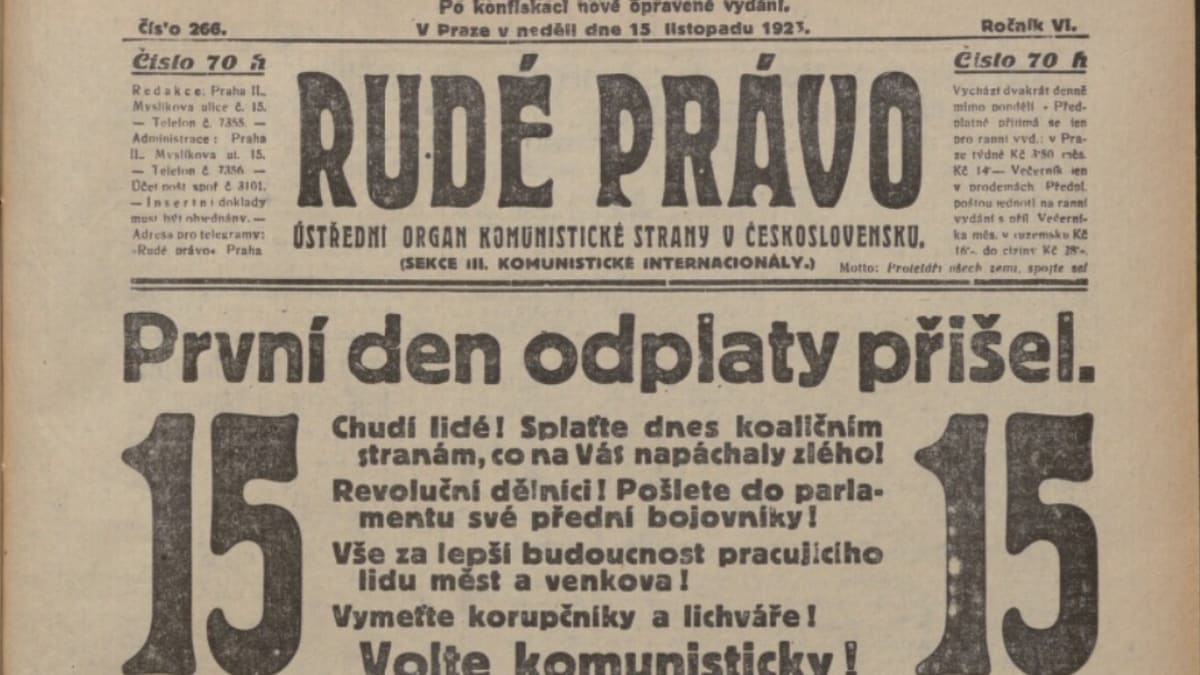
Proving itself among the most important parties on the Comintern, In the first Czechoslovakian parliamentary elections it participated in saw the Communist Party become the second largest party in country, far larger than the Social Democrats, with nearly one million votes.
‘The Parliamentary Elections in Czechoslovakia and Victory of the Communist Party of Czechoslovakia by Alois Neurath from International Press Correspondence. Vol. 5 Nos. 75 & 83. October 22 & November 26, 1925.
I. The Parliamentary Elections in Czechoslovakia
The Coalition government is bankrupt; it has decided upon fresh elections to the National Assembly and the Senate, which are to take place on the 15th of November. The new election of these two representative bodies is taking place before the expiration of the legal term. The coalition parties are simply unable to carry on any longer. Since the last parliamentary election they have accomplished a great deal against the interests of all sections of workers in Czechoslovakia. The so-called social achievements of the revolutionary period have all been abolished by the coalition government, with the exception of the eight hour day, which in the most important branches of industry only remains on paper. The social-democrats have been the foremost in this work of abolition. Following the notorious example of the German social patriots, the workers’ councils, for example, were “embodied” in the legislation, that is to say, they were completely deprived of their political content. With the help of the “elastic” tactics of the reformist trade union leaders and of those social-democrats who belong to the Coalition government, the Czechoslovakian exploiters were able greatly to reduce wages in all branches of industry and to worsen working conditions. For a considerable time the prices of all food stuffs and articles of mass consumption have been increasing. The Coalition government has flung thousands of civil servants on the street, and as the bourgeoisie was able to worsen the working conditions of all categories of wage workers, it was also possible to carry out enormous reductions of the staffs of private capitalist undertakings. No wonder therefore that a great portion of the petty bourgeoisie has lost all confidence in the Coalition government.
Czechoslovakian Foreign policy has been carried on entirely in the interests of French imperialism, that is against the economic interests of the entire population of Czechoslovakia. In the judging and handling of national problems the incompetence of the Coalition government has been revealed, so to speak, in its totality. Under such circumstances, it would appear to have been best for the Coalition parties to postpone the elections as long as possible. But as a matter of fact the present situation, although it cannot be regarded as very optimistic from the standpoint of all the Coalition parties, is still relatively the most favourable for the following reasons: the Coalition parties, and in the first place the social democratic leaders, anticipate that during the next few months still greater burdens will be placed upon the Czechoslovakian proletariat and the petty bourgeoisie and peasantry than has been the case hitherto. At the Marseilles Congress of the II. International the Czech social-democrat, Habrmann, who occupied the position of Minister for Education and also Minister for Labour in the Coalition government, openly pointed out that the eight hour day could not be retained in Czechoslovakia unless it was re-introduced in Germany. That means, the Czech national socialists, as well as the two sections of the II. International in Czechoslovakia, consider that the Czechoslovakian bourgeoisie, in view of the present European situation, is about to deliver fresh economic blows against the whole working population of Czechoslovakia. The bourgeoisie argues that if Czechoslovakian industry is not to be driven from the field by German industry, then the conditions of work and wages of the Czechoslovakian working class must be still further worsened. Things are developing in this direction as a result of the stupid foreign policy of Czechoslovakia which, in the interest of French policy, renders impossible any serious and comprehensive economic connection with Soviet Russia. In addition to the reactionary tariff policy adopted by the old parliament, the Czechoslovakian bourgeoisie wishes to overcome its economic difficulties by means of fresh wage reductions. The Social-democrats fully realise that, as hitherto, they have not only to act as a screen behind which the bourgeoisie can realise these sinister plans, but that they have to fight directly on the broadest front as guard-troops of the Czechoslovakian counter-revolution against the economic and politic interests of the entire proletariat of this State. The Czechoslovakian bourgeoisie does not wish to lose any time. The whole economic and political situation throughout Europe demands prompt action. If the approaching rigorous measures against the working class are carried out with the help of the social-democratic leaders before the new elections, then the social-democrats will lose their last supporters among the working class. And for this reason, in spite of the almost hopeless situation, they are in favour of the new elections being carried out as soon as possible.
One can understand that the social-democrats, along with their coalition accomplices, in such a depressing time are resorting to everything which they consider can in any way shake the position of that party which they all fear: that is, the C.P. of Czechoslovakia. In the summer the government and social-democratic newspapers were jubilant; they considered their success and the defeat of the C.P. of Czechoslovakia as certain. And in fact before the meeting of the Enlarged Executive of the Communist International they had no little cause for looking to the future with hope. But now they are confronted with the collapse of their policy as regards their intention to shatter the C.P. of Czechoslovakia. All other measures of the Coalition heroes have been wrecked, they finally only served the propaganda purposes of the C.P. of Czechoslovakia.
The situation of the Czechoslovakian bourgeoisie can be judged by the following data: The National Assembly consists of 19 parties comprising in all 294 members. The 5 coalition government parties have altogether 167 mandates, that is barely 3/5ths of all the votes. It is only with the help of the Czech traders’ party that they obtained the 3/5ths majority.
The Czechish social-democrats will lose a number of seats, which will go partly to the Communist Party and partly to the Czech bourgeoisie. The remaining Czech Parties will just about maintain their present strength, while the clericals and national socialists will gain a few seats. In addition to the Czech social-democrats the National democrats will also sustain losses. The German social-democrats will suffer considerable losses, of which the C.P. of Czechoslovakia on the one hand and the German nationalists on the other will derive the benefit. The German bourgeois Parties will set up a so-called Sudetes united election list. The German social-democrats bargained for weeks with the Parties of the German manufacturers for the purpose of setting up their all-inclusive national united front. Finally, nothing came of the negotiations with their German kinsmen. It is possible that the Coalition Parties as a whole will emerge from the election campaign as strong as they are at present. But should they not even maintain their present strength, then they will not hesitate for a moment to include representatives of the German bourgeoisie in their coalition, whereby they will be able to throw over the German social-democrats altogether. The latter will be forced to beg in order to be included in the Coalition. In this respect we shall witness a very entertaining spectacle.
The C.P. of Czechoslovakia is ready for the contest. All preparations have been made for the election campaign. On Saturday the 17th of October the National Assembly and the Senate were dissolved, and on the following day our newspapers printed the election Manifesto of the C.P. of Czechoslovakia and published the list of our candidates in all the constituencies of the Republic. In all the other Parties a furious quarrel is going on over the candidatures. The German social-democrats have convened a Party Conference, from which the public is to be excluded, in order to decide on the candidates. In four weeks, that is on the 15th of November, the revolutionary working class of Czechoslovakia will show the real strength of the so- called collapsed Communist Party.
II. The Election Victory of the Communist Party of Czechoslovakia.
Of the 6,659,939 votes which were polled at the elections for the National Assembly in Czechoslovakia, 931,769 were in favour of the C.P. of Czechoslovakia. This means that every seventh voter supported the cause of the Communist Party or that 1 out of every 14 inhabitants of Czechoslovakia voted for the communists. The Communist Parliamentary Club will have 42 or 43 members. In May 1924 the C.P. of Germany recorded extraordinary success; 1 out of every 100 electors voted for the C.P. of Germany. In Czechoslovakia, 15 out of every 100 electors have declared themselves in favour of the policy of the C.P. of Czechoslovakia.
The most important political results of the Parliamentary elections are expressed in the shattering of the coalition system which has prevailed hitherto and in the accentuation of the necessity of a “national agreement”, that is of an understanding between the German bourgeoisie and the bourgeoisie of the national minorities in general and the ruling Czechoslovakian bourgeoisie. In the old Parliament, the coalition parties had a small majority of about 30 votes; this majority they have lost. Even now however they can secure a very small majority by including in the coalition Bloc the Czech Artisans’ Party which has hitherto not belonged to the coalition. In this case, 3,200,000 votes of the opposition would stand against 3,500,000 votes of the coalition parties. Up to now we have no exact survey of the final results of the second and third scrutinies, but it already possible to calculate that the coalition fraternity, even if they include the Artisans’ Party in their friendly alliance, will be obliged to govern with a majority of about 8-10. The result of the election would have been still more unpleasant for the coalition, were it not that at the eleventh hour an appropriate reform of the franchise law had extinguished the smaller parties in the interest of the large ones and especially of the coalition parties.
Nothing now remains for the Government to do but to come to an agreement with some part of the opposition groups. And, if the truth be told, the German parties have simply been longing for this understanding. All the Teutonic divisions (with the exception so far of the National Party led by Lodgman) have declared themselves in favour of “activism”. “Activism” is the name for that policy the aim of which is to bring about the great coalition, the entry of the German bourgeois politicians into the Government. An understanding of this sort is to the interest of the economic policy, especially of the German banks and the German manufacturers. The result of the elections for the Czechoslovakian National Assembly shows once more in the most telling way how extraordinarily closely the interests of the exploiting class are bound up with the policy both of the bourgeois and the social-democratic parties. Those parties which had opposed the idea of a national settlement, the German National Party on the one hand and the Czech National Democratic Party on the other hand, were defeated in the election campaign. The parties which propagated the “activist” policy on the contrary, were extraordinarily successful. This applies for instance, to the League of German Agriculturalists whose leader has for long been demonstrating his love to the Czech Coalition fraternity in the most servile way. It seems however very unlikely that the German bourgeois parties will be successful in their wooing. For once in a way the Czech Coalition Group will have to ignore the strategic principle of advancing along the line of least resistance. It is much more in keeping with the feelings and tastes of all Czech National circles for the Coalition to try to come to an understanding with the Slovak forces. The Slovak People’s Party which polled 474,000 votes is the one which comes into question. There is no doubt that the Slovak People’s Party and the German bourgeois champions will each betray their national programme in exactly the same way, but the Hlinka group will not surrender on the question of national autonomy without some concessions.
It will be a spectacle for the gods when the bourgeois parties of the national minorities, in fighting for a place at the Government manger, simply shed a considerable part of their “high national aims” and “interests”. The working strata of the Czechoslovakian people will then recognise more clearly than ever that the C.P. of Czechoslovakia is the only party which defends and knows how to protect the rights of the national minorities. And it goes without saying that the “Liberal” and “Socialist” Czech parties will, more decidedly than ever, have to renounce any discussion with clericalism and will have, in the school question, to make considerable concessions to the reactionary demands of the clericals. The Czech coalition fraternity will talk in the spirit of Huss and the members of the People’s party will act in the spirit of the Roman Catholic Church. This policy of the Coalition Parties will meet with direct support from the Czech and with indirect (often even direct) support from the German Social-Democrats. It remains for the C.P. of Czechoslovakia to defend the schools against the reactionary spirit of clericalism.
Both sections of the Hamburg International were defeated. The Czech Social-Democrats received 1,590,520 votes in 1920 and now received 631,113. The German Social-Democrats polled 689,589 votes in 1920 and 411,477 this time. The defeat of the German Social-Democrats would be still more severe, had they not benefitted from the complete destruction of the so-called German united front. On the occasion of the last municipal elections the German Democratic Party had about 40,000 votes. This time, this party was not able to enter the election campaign independently; its adherents voted largely for the German Social-Democratic party. The relation of German capital to German Social-Democracy is best expressed by the attitude of the leading newspapers of the German bourgeoisie. The “Prager Tagblatt”, the leading organ of the German banks and manufacturers, in a leading article, not only took up an attitude in favour of the German Social-Democrats, but actually wrote that it would be in the interests of the German manufacturer to give his vote to the German Social-Democrats. Both sections of the Hamburg International carried on the election campaign in the most vulgar way, almost exclusively against the C.P. of Czechoslovakia, the Communist International and Soviet Russia. Since the result of the election became known, the central organ of German Social-Democracy has not yet recovered its voice. For the present it describes the defeat of the German Social-Democratic party as an “honourably” fought battle. The “Pravo Lidu”, the central organ of the Czech Social-Democrats has lost none of its impressive insolence. Among other things it writes: “We expected this result from the election and are not surprised by it. The characteristic of our policy is self-possession and cool calculation in estimating our opponents.” The “Pravo Lidu” by the bye, writes that not the Czech Social-Democrats but the Communists have lost the great battle. This organ of counter-revolution writes: “In reality the election result is an unexpected and fearful defeat for the Communists.” And those inhabitants of Czechoslovakia who read this point of view in the “Pravo Lidu”, hold their sides with laughter.
Let us take the bourgeois Press. The ruling classes are dismayed. Their Press has for months been prophesying the final fall, the collapse of the C.P. of Czechoslovakia. And now this annihilated C.P. of Czechoslovakia appears as the strongest party in the Czechoslovakian Parliament! Even the coolest bourgeois politicians find this for the moment more than they can bear. Part of the Czech bourgeois Press is already making tentative efforts to inspire us with the necessary respect for the foundations of the Czechoslovakian State and urging us as a strong, or rather as the strongest party, to aim at last at a policy of “positive” achievements. The attitude of the German bourgeois Press is not without interest. The “Prager Tagblatt” writes: “This comparatively unusually strong representation of the communist element in the Chamber is a unique phenomenon in Central Europe.” This paper then tries to calm the capitalists and to explain to them that the only reason why, for the time being, there are so many communists, is that all the discontented elements are running after this party which conducts an “energetic opposition”.
It is no mere coincidence that the whole bourgeois Press has, with dignified silence, passed over the awful farce of the Bubnik renegades, the so-called “Independent Communist Party” which had 7866 votes altogether. We understand that the bourgeois and social democratic Press had no desire to draw the necessary conclusions from the defeat of the Independent Communists who were simply wiped out altogether. A group of malicious renegades had, in the interests of the bourgeoisie, undertaken to organise treachery in the ranks of the communist movement of Czechoslovakia. The party leaders, in common with the Executive of the C.I., discovered these treacherous goings-on, stigmatised the traitors and expelled them. The Czechoslovakian Government found no sacrifice too great in order to maintain this “Independent Communist Party” and to help it to fight the C.P. of Czechoslovakia. The workers have now pronounced their verdict, and this verdict is as emphatic as it is simple: anyone who dares seriously to fight against the Communist International loses all influence with the revolutionary workers and only earns their complete contempt. There is no need to fight the Bubnik party, it has perished under the curse of ridicule.
International Press Correspondence, widely known as”Inprecorr” was published by the Executive Committee of the Communist International (ECCI) regularly in German and English, occasionally in many other languages, beginning in 1921 and lasting in English until 1938. Inprecorr’s role was to supply translated articles to the English-speaking press of the International from the Comintern’s different sections, as well as news and statements from the ECCI. Many ‘Daily Worker’ and ‘Communist’ articles originated in Inprecorr, and it also published articles by American comrades for use in other countries. It was published at least weekly, and often thrice weekly.
PDF of full issue: https://www.marxists.org/history/international/comintern/inprecor/1925/v05n75-oct-22-1925-inprecor.pdf
PDF of issue 2: https://www.marxists.org/history/international/comintern/inprecor/1925/v05n83-nov-26-1925-inprecor.pdf

