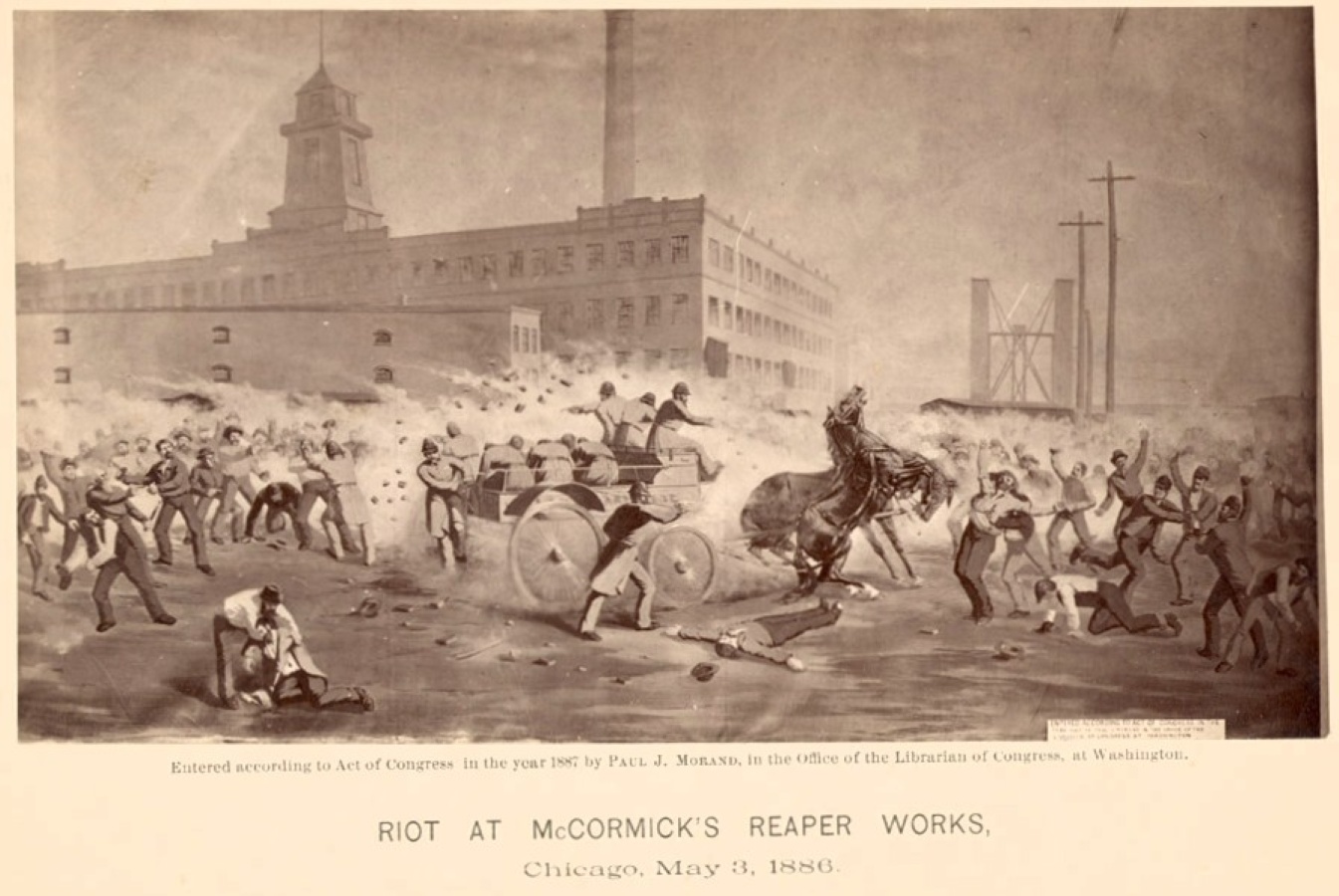
Almost exactly a year before a struggle at the McCormick’s harvester factory became the flashpoint for Haymarket, it was the site of another violent strike, in which picketing workers disarmed and disbanded the Pinkertons sent to smash them.
‘Victory in the McCormick’s Strike’ by Albert R. Parsons from The Alarm (Chicago). Vol. 1 No. 21. April 18, 1885.
VICTORY! SIXTEEN HUNDRED PROLETARIANS ENGAGE IN A BATTLE FOR BREAD.
McCormick’s Great Reaper Factory Deserted by its Workingmen.
THE MEN FIRED UPON AND SLAUGHTERED BY THE PINKERTON POLICE.
The Strikers Capture Two Cases of Winchester Rifles and Twenty-Five Colt Revolvers–Disarm the Police and Burn the Bus on the Highway.
SCENES AND INCIDENTS.
The most exciting, serious, and determined struggle between capitalists and wage laborers that, has occurred in Chicago for several years past began on Tuesday, April 7, and ended Saturday, April 11, by the unconditional surrender of the great McCormick Reaper, Binder and Harvester factory, located on Blue Island avenue, near Western avenue, in the outlying region of the city.
The McCormick Reaper factory is probably the largest institution of its kind the world, employing from 1,500 to 2,000 workmen, and turning out from 18,000 to 20,000 machines annually.
Trouble had been brewing in the factory for some time past, growing out of the poor pay, long work hours, coupled with the insulting and dictatorial bearing of the foremen and superintendent.
A reporter for THE ALARM was upon the ground every day, and took notes of all the scenes and incidents connected with this great strike. Our reporter himself being a member of Typographical Union No. 16, of Chicago, and well acquainted with a great many of the men at work in McCormick’s factory, was given access to all information, and otherwise treated as one of the strikers themselves. The following interview had with a member of the “strike committee” will prove of interest to our readers.
“What was the cause of this strike?”
“Well, the main cause in our department was persecution.”
“What was your department?”.
“The foundry or molding department, where all the iron used in the construction of the reaping and mowing machines was manufactured.”
“Of what did this persecution consist?”
“The foreman of the moulders was a man named Ward. To illustrate the character of this man, let me give you an instance of his tyranny and meanness: Last December he got up a “raffle” among the men of the shop for his own benefit. He sold chances on a watch of his own to his own men and withheld the money from their wages which passed through his hands. The man who drew the watch was discharged afterwards because he did not return the watch to Ward, the foreman, Ward, stating as a pretext that it was only a ‘complimentary raffle.’ This man is brutal, unjust and overbearing in his manner towards the men. These things produced a feeling of general discontent among the molders. In the month of January following a cut was made in our wages of 15 per cent, as well as all other piece workers in the factory. The day workers were cut at the same time 10 per cent.”
“How many molders were at work?”
“Eighty-four.”
“How many piece workers were employed in the factory?”
“I should say about 1,200. There were about 500 day workers, those who work by the day, making a total of about 1,600 men whose wages were reduced.”
“What were the wages at the time of the cut?”
“The average for molders was about $18 per week.”
“What were the wages of the other piece workers?”
“There are probably 300 blacksmiths and machinists, about 100 painters, about the same number of carpenters, canvass makers, binder men and some few others who work by the piece. Their wages vary–running from $1.50 to $3.00 per day. The day laborers in the foundry receive $1.25 per day; yardmen get 90 cents per day, and many laborers around the factory are doing a hard day’s work for 80 cents per day.”
“When did this strike occur?”
“About three weeks ago the molders quit work because the company refused to restore the reduction made last January on the 1st of March as they had agreed to do. After being out about a week non-union molders were put to work in the shop. The dissatisfaction spread. The machinists and others who were organized appointed a committee to inform us that they would come out also, provided we would not accept any settlement until their grievances were settled also. We agreed to this proposition. They came out on last Tuesday and with them came every person working in the fac tory. The strike was then thoroughly organized; committees were appointed to look after the interests of the strikers.
“What did the company then do?”
“This man Ward stated publicly that he had been laying his plans for the past six months to enforce this reduction, and that he had made every arrangement necessary to carry it out, and he defied the moulders or anything they could do. He then went to work through the agency of a man named Tom Fay (a man who learned his trade as a moulder while in the Sing Sing penitentiary, where he had been confined for six years for highway robbery) who procured twenty-one ‘scabs’ for the factory. They were slipped up the river on a tug boat at night and smuggled into the factory, where they were kept closely confined, and were fed and lodged and supplied with arms inside the factory, by the company.”
“What occurred then?”
“The company then employed a lot of the Pinkerton police to protect, as they claim, their property from the abuse of the strikers. As was but natural the men loitered about the street near the factory waiting to hear what was done and see what was going on. Accordingly, on Wednesday, the 8th inst., about 5 o’clock p.m., a bus was driven out at the factory gate. It was driven up the street until it reached Hoyne avenue, when some of the men, who had assembled to the number of about four hundred in this neighborhood, tried to peer into the bus and ascertain if it contained any ‘scabs.’ The bus, however, was filled with Pinkerton’s police, who drew their revolvers and began to fire shots in the direction of the crowd. Fortunately no one was wounded. This action of Pinkerton men infuriated the crowd, which made a charge upon and seized the bus. They dragged the inmates out and disarmed them. During this melee one of the Pinkerton’s was so roughly handled that he had to be carried home on a stretcher. The strikers then drove the bus back to the factory, where they left it standing at the gate. On the next day (Thursday morning) while the men were quietly waiting around in the vicinity of the factory, a bus filled with 12 of the Pinkerton police came out of the factory gate about 11 o’clock a.m. Mr. Averill, the factory superintendent, who had set up the wine and handed round the cigars to these Pinkertons, as they left the factory instructed them to use their weapons upon the strikers and ‘give them fits’ as they passed along through the. Each of these 12 Pinkerton police were armed with an American ‘bull dog’ and a Colt’s navy revolver, with special instructions from the superintendent to use them upon the strikers. At this juncture a person stepped forward and looked into the bus, when the Pinkerton police began firing indiscriminately into the crowd, about 500 of whom had assembled to get their pay, this being the regular pay day. George Rhode, who was standing about 30 feet away, and who had just drawn his pay, was shot, probably fatally wounded. Of course at this the crowd became excited, and made a rush for the bus, cursing and denouncing the inmates and swearing vengeance against them and the company which had sent them out to murder the defenceless workmen. The driver seeing the danger lashed his horses into a run and escaped from the infuriated men. A call was made for the police patrol, which came and made pursuit. The bus containing the murderers was overtaken at the junction of Center and Blue Island avenues. Its inmates were arrested and taken to the station, where four of them were identified as having participated in the shooting.”
“What was the feeling of the men over these occurrences?”
“They became very bitter and much excited. All day long the cowardly acts of the McCormick company in sending the Pinkerton murderers out to kill the people was the subject of denunciation, and when in the evening at about 8:25, a bus from the city came trotting by in the direction of the factory, and the men standing around recognized it as the bus from which they had been fired upon in the morning, a scene of terrible madness took place. I should say that over two hundred strikers were present. They ordered the bus to stop, failing to do which a heavy fire was opened upon it by the whole crowd. One of the horses was wounded. The crowd charged upon the vehicle and surrounded it. The inmates were ordered to get out and throw up their hands, to be searched and disarmed. At this Capt. O’Donnell, of the city police, got out of the bus and said: ‘For God’s sake, don’t shoot, boys, I’m Capt. O’Donnell,’ the old O’Donnell was well known to many of those present as a rather clever police officer. I am satisfied it was this fact alone that saved his life and those of the men with him. It was dark and that made it difficult to make out forms and faces, owing to which, the three Pinkerton police, who were also in the bus, made good their escape. Their’s was indeed a narrow escape, for had they been identified, they certainly would have been exterminated right then and there. Some of the men entered the bus to search it, where they found two cases of Winchester rifles, 25 Colt’s navy revolvers and several hundred cartridges. These were confiscated then and there by parties unknown, but I have every reason to believe they fell into the hands of good and true men who have the nerve and skill to use them should it become necessary. This was the bus that had fired upon us in the morning and wounded George Roth. Some one called out: ‘Take it to the prairie, and burn it,’ and acting upon that suggestion, the crowd gathered round and, amid shouts of derision and anger, the bus was taken from the street, across the ditch to a vacant spot, where it was saturated with oil and burned to ashes, only the iron tires of the wheels remains to mark the spot where the bandits of law and order were overtaken by the infuriated people and brought face to face with those whom the McCormick’s had sent there to rob and kill. Seeing that there was no further work to be done that night the workmen dispersed to their homes to renew the struggle more determinedly than ever on the morrow.
“Was there anything of interest occurred on the next day?”
“On Friday morning our executive committee was sent for by the superintendent, Mr. Averill, and he as usual used a great deal of palaver and intimated a compromise. The men, however, were firm in their demand, and after stating to the superintendent that they were sent there to represent the men of the whole factory, who were determined to stay out until the old rates were restored, the comittee withdrew.
“On the morning of this day the Switchmen’s union refused to handle the cars loaded with freight at the McCormick factory, and sent us a check for $500 with a statement that $500 more could be had wherever we needed it. We returned the money with thanks as we were not yet in need of aid, and from the probable short duration of the strike we did not think we would need this help. This act of the Switchmen’s Union, however, had a powerful effect upon the McCormick Company. There was nothing of any further interest occurred during this day (Friday), would like to state to your readers in this connection that for the two days prior to the shooting of George Rhode, the workmen had been enlivened by the music of the ‘La Salle’ band, composed of sixteen members, all of whom worked in the factory. Of course, after the wounding of one of our comrades, who was not expected to live, we discontinued the music. An entertainment given by the ‘La Salle’ band at Workingmen’s Hall, corner Waller and 12th streets, Saturday night, was well attended by the victorious strikers.”
In the afternoon the reporter for THE ALARM met a delegation from the Malleable Iron Works, which is located near the McCormick factory, who informed him that a committee representing the 800 men working at the Malleable Iron Works, had that very afternoon waited upon the agent of the company and demanded an advance of 10 per cent. The company conceded the demand at once, besides rectifying the grievance of about 800 day laborers who got a raise from $1.40 to $1.50. and ten hour’s work with pay for over time. They had been formally working about fourteen hours per day for $1.40. Members of the delegation informed THE ALARM reporter that it was to avert a difficulty like that now going on at McCormick’s which made the Malleable Iron works concede the demands of their workmen.
On Saturday morning at 10 o’clock a.m., Superintendent Averill sent for the executive committee of the strikers, and upon their appearance at his office in the factory, he informed them in a very indirect and round-about manner that he thought the company would be ready to make a compromise with the men. He had a great deal to say about his kindly relations with the men, etc., how much he liked them, etc., dealing in palaver and taffy until it disgusted the committee, who knew and recognized in him McCormick’s paid tool to keep the wage-slaves of the factory in submission to poor pay, long hours and penitentiary rules and regulations. After some discussion, the committee stated that it had no power to accept a compromise, but they would report the matter to the meeting which was to be held by every person who had worked in the factory for its acceptance or rejection. The committee then retired to the meeting place at 1089 Blue Island avenue, where it was decided not to accept any compromise. It was also decided at this meeting that no settlement would be accepted which did not protect the men from discharge who would be called upon to testify in the courts against the company and the Pinkerton’s for the murder of George Roth and firing upon the people. The committee then retired to the factory, where it stated the decision of the meeting to Superintendent Averill who said in reply that the company had decided to give in to the demands of the workmen. The committee at once withdrew to make its report to the meeting, which was kept in waiting, where it was received with wild cheers of exultation and joy…
SCENES AND INCIDENTS.
The following incidents growing out of the strike will be of interest to our readers:
THE WATER CLOSET.
Some months ago a man was appointed as overseer of the McCormick factory water closet. His duties consisted in keeping minute account of those who visit this place and report the same. A man who went there three times in one day was discharged. The slaves were not permitted to stay more than two minutes.
A PINKERTON CLUBBING.
On Wednesday evening the Pinkerton’s were trying to remove a bus” for the transportation of “scabs.” The strikers told them to return the vehicle, when one of the Pinkertons drew his revolver and fired in the crowd, slightly wounding a man in the leg. The next moment he was lying on the ground. His revolver and club were taken away, and he was so unmercifully clubbed that the patrol wagon had to remove him, and the physician thought the bloodhound could not live.
HOWARD.
Howard, the rascal who taxed the workers last summer for a grand flower display at the burial of old McCormick, was also given a good thrashing by one of the strikers.
MORE WORK, LESS PAY.
A machinist, who had been working in the factory for the last 20 years, told us that in 1868 he received 50 cents for making a beam. They then made about 10 per day. The price was then reduced alternately to 40, 36, 30 and 25 cents, and is now 17 cents, less 15 per cent on the proposed reduction. The men, of course, have always tried to overcome the reduction by working harder and longer, until some of them made and now make 14 per day. The more and the harder they worked the less their wages were. The men are now overworked to such an extent that a large number of those working by the piece are continually sick.
THE YOUNG MASTER.
On Thursday young McCormick, the very picture of human depravity and viciousness, only common to people who have exhausted their vitality and manhood by unbounded licentiousness, stated that he would have nothing to do with the strikers, who ought to be thankful if they were allowed to work for any wages at all. After the strategical move of the strikers on Thursday evening, the capture of the bus, 70 rifles, 25 revolvers, etc., and threats that his “dear” carcass was not in a state of great safety, he yielded everything the strikers demanded, by making an unconditional surrender.
ARMS AND AMMUNITION.
The strikers were quick to see that the success or failure of their undertaking was reduced to a question of force. The McCormick company set the example by turning the late center of industry into an arsenal. They filled the factory with “scabs” and policemen, and armed them with rifles, revolvers, slung shots, etc. The men took the hint and procured pistols and bombs, and upon the capture of the bus containing the Remington rifles, placed themselves upon an equal footing with the McCormick robbers. The result shows the wisdom of their course.
The Alarm was an extremely important paper at a momentous moment in the history of the US and international workers’ movement. The Alarm was the paper of the International Working People’s Association produced weekly in Chicago and edited by Albert Parsons. The IWPA was formed by anarchists and social revolutionists who left the Socialist Labor Party in 1883 led by Johann Most who had recently arrived in the States. The SLP was then dominated by German-speaking Lassalleans focused on electoral work, and a smaller group of Marxists largely focused on craft unions. In the immigrant slums of proletarian Chicago, neither were as appealing as the city’s Lehr-und-Wehr Vereine (Education and Defense Societies) which armed and trained themselves for the class war. With 5000 members by the mid-1880s, the IWPA quickly far outgrew the SLP, and signified the larger dominance of anarchism on radical thought in that decade. The Alarm first appeared on October 4, 1884, one of eight IWPA papers that formed, but the only one in English. Parsons was formerly the assistant-editor of the SLP’s ‘People’ newspaper and a pioneer member of the American Typographical Union. By early 1886 Alarm claimed a run of 3000, while the other Chicago IWPA papers, the daily German Arbeiter-Zeitung (Workers’ Newspaper) edited by August Spies and weeklies Der Vorbote (The Harbinger) had between 7-8000 each, while the weekly Der Fackel (The Torch) ran 12000 copies an issue. A Czech-language weekly Budoucnost (The Future) was also produced. Parsons, assisted by Lizzie Holmes and his wife Lucy Parsons, issued a militant working-class paper. The Alarm was incendiary in its language, literally. Along with openly advocating the use of force, The Alarm published bomb-making instructions. Suppressed immediately after May 4, 1886, the last issue edited by Parson was April 24. On November 5, 1887, one week before Parson’s execution, The Alarm was relaunched by Dyer Lum but only lasted half a year. Restarted again in 1888, The Alarm finally ended in February 1889. The Alarm is a crucial resource to understanding the rise of anarchism in the US and the world of Haymarket and one of the most radical eras in US working class history.
PDF of full issue: https://digitalcollections.crl.edu/record/1117349?ln=en

