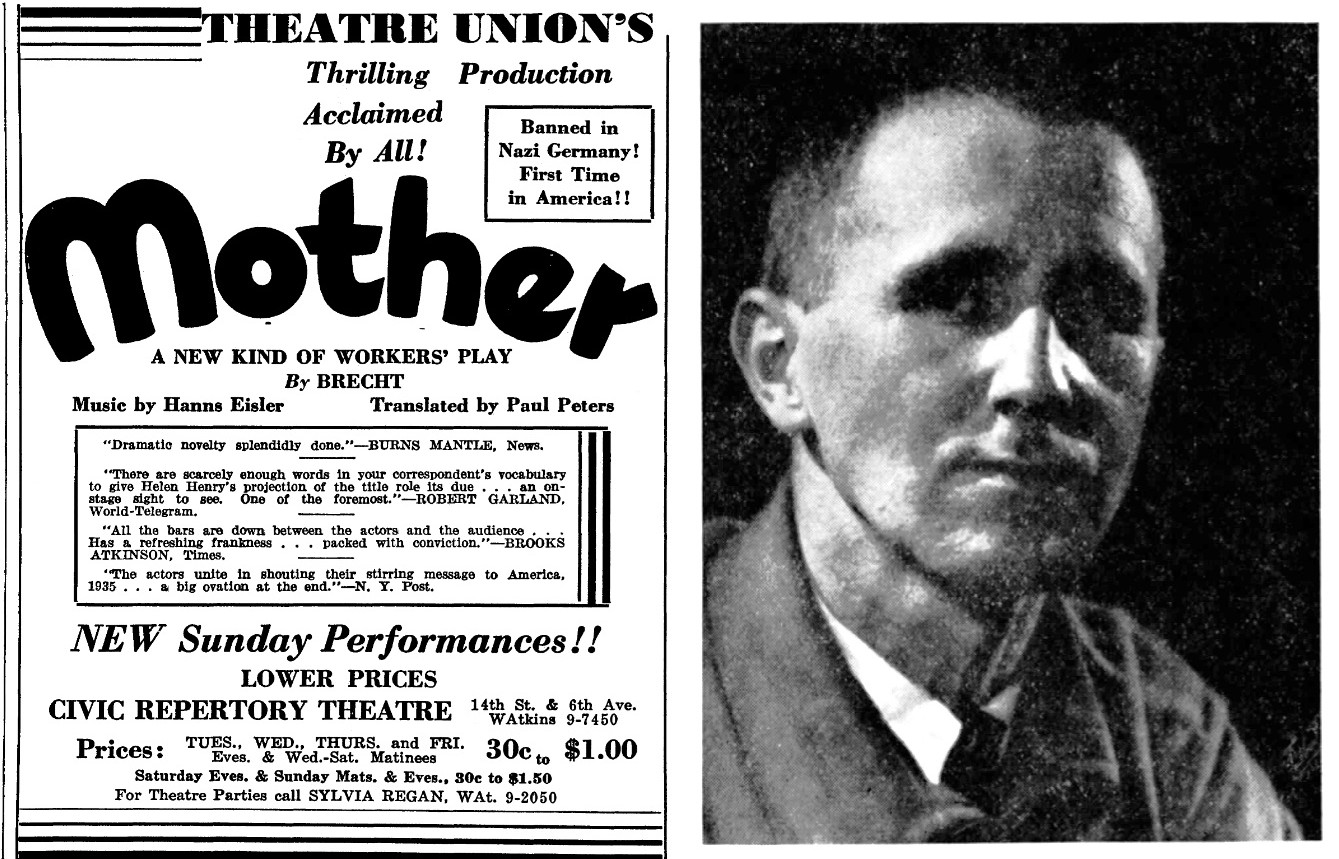
Burnshaw with a review of the Theatre Union’s 1935 production altered for U.S. audiences of Bertolt Brecht and Hanns Eisler’s adaptation of Gorky’s Mother.
‘The Theater Union Produces “Mother”’ by Stanley Burnsahw from New Masses. Vol. 17 No. 10. December 3, 1935.
ALL during the intermissions at Mother I was reminded of an unusual Paris opening I attended seven years ago. Instead of the bile-green walls and stuffy antiqueness of the Civic Repertory Theater stood the up-to-the-minute chic of the Salle Pleyel with its beige plush seats and mulberry-carpeted aisles, The occasion was a new Prokofief symphony. The first few numbers, familiar to the audience, drew the usual dispensation of applause, but as soon as the Prokofief work began, with its violently experimental orchestration and fearless technical innovations, there were outcries of “Awful!” “Insulting!” “How dare you!” from the well-bred auditors in the front rows. “Stop it!” one of them demanded, but the orchestra played on. Finally three rotund patrons in evening dress, appointing themselves bodyguards of French culture, raised their umbrellas in a desperate effort to stop the program. The Prokofief work was something radical, uncompromising—expressing an unwillingness to accept the limitations of the cultural status quo. And the bourgeois audience reacted as it so often reacts when something fearless and questioning invades its security. How different the response of the Civic Repertory audience to the innovations of the new Theater Union production, with its unexpected stage-effects, acting, singing, lantern-slides, etc. Its timid hand-clapping made plain that it could not immediately accept all this strangeness, but sudden bursts of applause testified to an overwhelming friendliness and sympathy. For the audience instinctively knew that any sincere attempt to tell a revolutionary story in a revolutionary way deserves a devoted hearing. Although accustomed to the realism of previous Theater Union plays, it recognized at once that such a progressive experiment as Mother has an unimpeachable place in the left-wing theater.
There is actually nothing abstruse about Mother; in fact it is one of the clearest plays imaginable. “Take some Agit-prop, add a bit of Piscator and Meyerhold and a Greek chorus—put them all together and they spell Mother,” somebody wise-cracked half-seriously. And the authors, Bert Brecht and Hanns Eisler, would heartily agree that they have drawn on every source which offered suggestions and materials for their adaptation of Gorky’s classic novel. But they would insist on explaining the basic principle which shaped every instant of their play. Brecht would point out that Mother differs from other drama because it is a “learning play” and as such belongs to his “epic theater.”
A new type of play is essential, wrote Brecht, if the theater is to present great contemporary themes in a useful manner. But effectual work is impossible so long as the spectator is approached in the usual way, so long as the play “hypnotized” him and he becomes emotionally entangled. In the “epic” theater the spectator watches the action. No longer identifying himself with the players, he develops a critical attitude toward the social problems unravelled on the stage. Thus he is capable of making judgments and decisions which will determine his own future conduct. The “epic” theater, by showing the world as it changes and how it may be changed, therefore involves the audience in a process of learning. And the emotions may be directed toward understanding and judgments. The music contributes toward this end. Instead of intensifying the emotions of a scene, Hanns Eisler’s songs strive to “resolve” and clarify the feelings aroused in the spectator. Somewhat in the Greek chorus manner, the music becomes an instrument for restating, arranging and thinking through the meaning of the action. An “epic” play then becomes a dynamic experience in which the entire audience collaborates with the chorus and players in a single process of learning/
Now the Theater Union has not attempted to reproduce Mother strictly according to the Brecht-Eisler theory. Its own experience with past productions made some drastic changes advisable. What is now playing at the Civic Repertory, therefore, is an adaptation of the Brecht-Eisler play in accordance with the Theater Union’s conception of the tastes and needs of American audiences. The music, for example, originally scored for thirty voices, and orchestra, is sung by a much smaller group and to a double-piano accompaniment. Instead of addressing the audience as a chorus always separate from the players, the singers alternate between this and participation in the action—with the resulting mixture of styles. Also, a scene and a song have been omitted.
Now it is obvious that to judge this adaptation one must have seen the original 1933 Berlin production. But whether or not the Theater Union was right in revising the original is at present merely an academic question. The important question is: Is this an interesting play? Is it a rewarding experience? Is it really worth seeing?
The answer is an unqualified yes. With startling simplicity the actors and chorus retell the story of Pelagea Vlasova, widow of a worker, who is suddenly drawn into the class struggle through her son, a militant worker in the Sukhlinov factory at Tversk in 1907. A bitter hater of violence, she soon finds herself compelled, by the logic of circumstances and the violence of the exploiters, into action on behalf of her class. We see her distributing strike leaflets, marching in the May 1 demonstration; we watch her learning the truths at the foundation of the class struggle; we see her transformed by the logic of critical events into a revolutionary of heroic stature. The outline of the story is now well known, for Gorky’s novel has long been a classic; and yet Brecht has remade it in a manner of his own. Pelagea Vlasova lives through the world war period, suffers the death of her son, agitates against war, sees at last the magnificent day of triumph for the proletariat of her country.
This outline, of course, tells nothing of the quality of Mother which is above all a “learning” play. Nothing is disdained—direct address to the. audience, lantern slides showing a worker’s expense account, songs underscoring the meaning—if it can make memorable the message implicit in the story. When Pelagea at first denounces strikes and opposes militancy, a group of workers give her a three-minute course in the rudiments of revolutionary theory which is a little masterpiece of clarity and concreteness. Similarly, the songs make a direct statement to the audience saying in frankly explicit terms that “knowledge is class-struggle,” that we must make ourselves “ready to take power,” or reflecting on socialism, the thing that’s “so simple and so hard to do.”
Mother provokes so many questions that it would take pages and not paragraphs for answering. One immediately thinks of Brecht’s whole theory of channelizing the emotions away from the players—how does this apply to the scene in which Pelagea’s son, escaped from prison, returns for a painfully brief visit with his mother before he flees to the border? According to the “epic” principle, this calls for no display of emotion for that would “entangle” the audience; and as this scene is performed the mother and son hew to the “epic” line. But that hardly leaves the audience emotionally unentangled—in fact, the very restraint of the mother and son becomes an understatement a thousand times more emotionally stirring than realistic surrender to impulses (a la Bertha Kalisch and the school of hysterics) could ever be. Then there is the very form of the scenes, which has been mad- familiar to our audiences through some Theater of Action productions. Is the method (generally similar to that of Newsboy, for example) capable of supporting a full-length drama? or is it most effective when used to concentrate a host of apparently disparate elements into a single focus of tremendous power? And what of the scene in which Pelagea, fevered with grief at her son’s death, rises from her sickbed to carry on for the Party? As produced at the Civic Repertory, with the chorus shouting at her, “Get up, get up, for the Party is in danger,” the impression is utterly distorted. The very suggestion is a brutalization of Bolshevik thinking.
There is the question of “didactic” drama, which has long been a bogey of criticism. Brecht is not afraid of forthright didacticism because didactic art when suffused with revolutionary meaning is simply political art; and as such it touches the very root of Marxian purpose. If Mother, like many well-intentioned products, were didactic in an inorganic sense, it could be dismissed as a failure. But Brecht has fused the form and the content of his play in such a way that its didacticism is part of the very texture. If Mother had accomplished nothing more than this demonstration of successful didacticism, its present production would be justified.
People inevitably compare Stevedore, Let Freedom Ring and the Sailors of Cattaro with Mother in the hope of deciding which type is the more desirable. But there is really no comparison to be made. The realistic play can be powerful revolutionary drama, the agit-prop play (Waiting for Lefty, Mother) can be powerful revolutionary drama. One form does not exclude the other, and there is no question of “choice.” Our theater needs both kinds of plays and will need a great many new kinds as yet uncreated. The immediate fact is simply this: today there are two plays in New York striving in different accents to make their single story heard above the noises of chaos—Let Freedom Ring and Mother—plays which demand the attention and deserve the devotion of every sane person who cares anything at all about his own future and the future of the world.
The New Masses was the continuation of Workers Monthly which began publishing in 1924 as a merger of the ‘Liberator’, the Trade Union Educational League magazine ‘Labor Herald’, and Friends of Soviet Russia’s monthly ‘Soviet Russia Pictorial’ as an explicitly Communist Party publication, but drawing in a wide range of contributors and sympathizers. In 1927 Workers Monthly ceased and The New Masses began. A major left cultural magazine of the late 1920s to early 1940s, the early editors of The New Masses included Hugo Gellert, John F. Sloan, Max Eastman, Mike Gold, and Joseph Freeman. Writers included William Carlos Williams, Theodore Dreiser, John Dos Passos, Upton Sinclair, Richard Wright, Ralph Ellison, Dorothy Parker, Dorothy Day, John Breecher, Langston Hughes, Eugene O’Neill, Rex Stout and Ernest Hemingway, Artists included Hugo Gellert, Stuart Davis, Boardman Robinson, Wanda Gag, William Gropper and Otto Soglow. Over time, the New Masses became narrower politically and more journalistic in its tone.
PDF of full issue: https://www.marxists.org/history/usa/pubs/new-masses/1935/v17n10-dec-03-1935-NM.pdf

