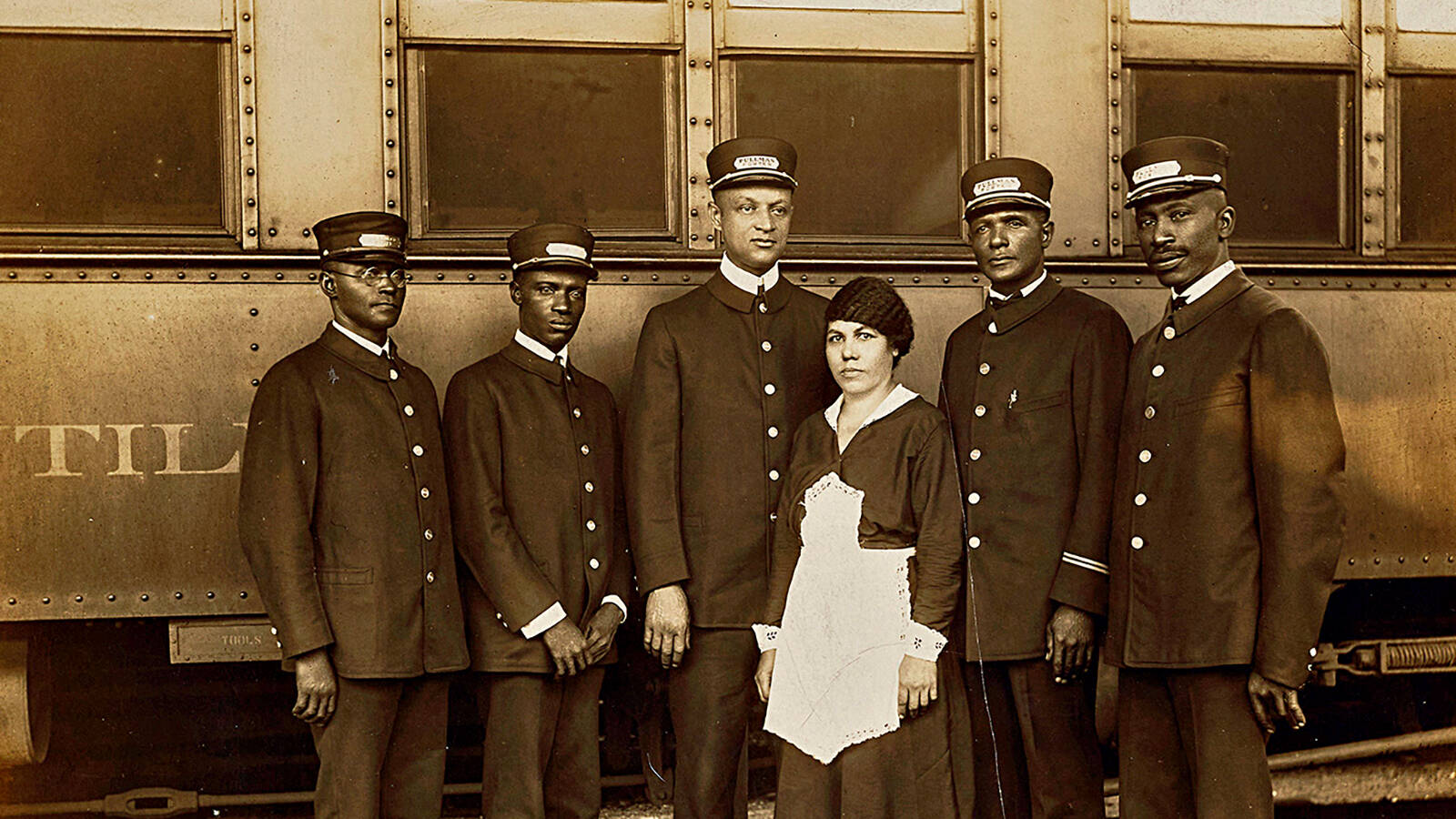
Randolph reports to the membership on the activity and accomplishments of the Brotherhood of Sleeping Car Porters in its first year of organizing.
‘The Brotherhood’s Anniversary’ by A. Philip Randolph from The Messenger. Vol. 8 No. 9. September, 1926.
Dear Brethren and Fellow-workers, Greetings:
One year ago this month we were born. It was August 25th, in New York. The occasion was a monster mass meeting in the Elks Hall. This had been preceded by a secret conclave at the home of Brother Des Verney with himself, Brothers Lancaster and Totten and the writer. At that mass meeting, perhaps, the most unique and significant movement among Negroes was projected. It began and has steadily moved forward within the veil of secrecy. This was essential to avoid the victimization of the men. The wisdom of this method has been tested through a period which has tried men’s souls.
WHY DID WE BEGIN?
Is the question which has rung down the changes. Have we not accepted, too often in abject resignation, unmerited scorn, reproach and persecution for over one thousand years? Have we not drunk, in America, a land made beautiful, prosperous and powerful, by our own sweat and blood, tears and toil, the bitter dregs of privation and want, hate and hell? Have we not, as virtual peons of Pullman property, built up mountains of gold and goodwill, for over a half century, without a murmur, on starvation wages, in fact, on practically, no wages at all? Have we not listened to the honeyed words, the siren call of our pretended white friends and black leaders who counselled satisfaction and contentment; “to let well enough alone,” to accept pity for pay; to wait for ours in the sweet bye and bye instead of fighting for justice in the here, now and nigh? Have we not been easily flattered, quickly deceived, and systematically exploited? Have we not ever appeared as children of laughter and levity, joy and jokes, innocence and ignorance? We sang in sorrow, danced in darkness and worked in worry.
Who then, Brethren, could take us seriously? The tragedy of our lives could not be sensed by the outer world of white men.
What though, ask the white men of power, black children wail for bread they never eat; black women weep for raiment they never wear; and black men toil to the tune of torture? Is it not written in holy writ: “Slaves, obey thy master”? Have they not been the slaves of men down the centuries! They have accepted insolence in silence, contempt with contentment, derision in docility. Have they not been the disinherited and dishonored of the sons of men? Then how can the world reverse its reason on right and wrong in relation to a race of blacks? Thus spake the age-old masters of slaves. Nor have they changed in their thinking today, nor will they change, Brethren, until we change them. This then is why the Brotherhood was born. We are in quest for the holy grail of economic freedom. Yes, and we shall find it. But we must destroy the engines of industrial slavery ere we breathe the air of free men.
SMASHING THE EMPLOYEE PLAN
Realizing that the Employee Representation Plan stood. athwart our path to freedom, we resolutely assailed it without let or hindrance or equivocation. All of the resources of the Pullman Company have been thrown in the balance against us. Still we are steadily smashing it, retiring it to oblivion. Every subterfuge has been resorted to with a view to fortifying a decadent, decrepit, and deceptive plan for settling workers’ grievances. The operation of the Plan has securely established its own failure, its own futility as an instrument for achieving economic justice for the porters and maids. So thoroughly has the Plan been discredited that the Company, in order to give it a new lease of life, has placed a porter on the Board of Industrial Relations, in order that it might appear that the porters and maids have a voice on every committee of the Plan. One, Mr. George Shannon, has been chosen to represent the porters. Regardless of his qualities or virtues, he is absolutely helpless to benefit the porters. He is like a lamb in a cage of lions. He is being used as fly-paper to ensnare the porters. The new scheme is merely calculated to deceive the porters into believing that the Plan will work, that the Brotherhood is unnecessary. But the Pullman Company cannot fool the Pullman porters all of the time. Porters, like conductors, were bound to wake up. Sheer necessity forced it. Oppression, in the nature of things, contains the seeds of its own abolition. No institution, or system, or doctrine founded upon the tyranny of body or mind, can stand. The Plan represents autocracy. It suppresses freedom. It stifles initiative. It suffocates thought. Its rules merely regulate injustice and intrench industrial serfdom. It was built to discourage organization of, by and for the porters and maids. It cannot any more serve the interests of the porters than can a sewing machine grind corn.
The fact that every official of the Plan must be an employee of the Company, gives the Company the power to discharge any man who shows a spirit to fight in the interest of the men. The whole fight of the Company against the Brotherhood is based upon the fact that it doesn’t control the officials of the Union. Such is the reason for the trade union movement everywhere. It is seeking to break the irresponsible domination of the boss over the workers. In one year then, Brethren, we have thoroughly broken the power of the Plan. It is one of our most signal victories. The Company may be reluctant to admit it, but history will reveal it.
OTHER OPPOSITION
Upon discovering that the Plan could not withstand the mortal blows the Brotherhood was dealing it, the Company proceeded to mobilize forces within the race to oppose the Union. The powerful Negro papers of the West went over completely to the Pullman Company and arrayed themselves against us. Pullman gold was being lavishly dispensed among Negro editors. Few had the stamina to resist the pressure. Happily, all of the Negro editors did not surrender to Pullman power. The Eastern papers very largely maintained their freedom, and so have some of the Western ones.
But, undaunted and undismayed, we fought on and won the respect and admiration of friend and foe.
Conferences of some of our leading Negroes were adroitly plotted, planned and juggled to glorify the so-called Pullman friendship for the race. Corrupt and wicked Negro politicians and preachers were subsidized to proclaim the blessings of the so-called monopoly which porters and maids enjoy, a monopoly which does not yield a living wage or civilized hours and conditions of work. It was boldly asserted that no other race enjoys such a monopoly as though there was any other race except the white serving as conductors on Pullman cars or railroad trains. Are not these jobs monopolized by the white race?
Even the much oppressed Filipino was belabored into some of the club cars in order to frighten the porters away from the Brotherhood. But to no avail.
We were in dead earnest this time. The Company saw it. We would not surrender, we would not equivocate, we would not retreat a single step, and we resolved that we would be heard in the great forum of public opinion, and we were heard.
SIXTEEN CENTS MORE PER DAY
But, brethren, the Pullman Company is resourceful and inventive. It has fertile brains. Seeing the tide of organization steadily rising, it made its supreme bid to stem the tide by calling a wage conference under the Plan and distributed a few crumbs from its big banquet table of some seventeen millions net profits for 1925) in the form of an eight per cent increase or sixteen cents a day. And to the utter amazement and dismay of the Company, it only stimulated the men to organize more strongly, since it was apparent to them that the increase was the direct result of the Brotherhood. Thus the Brotherhood is already paying the porters over 300 per cent on every dollar they have invested in it, granting that they have paid their joining fee of five dollars and twelve dollars dues, for the year. In a bank, at the current rate of interest, they would only have earned six per cent, or $1.02 on $17, a year’s interest, whereas the Brotherhood has put $64.80 in the pockets of the porters for $17. Not a bad record, this. And the porters are getting this increase of $64.80 every year, but only pay $12 dues. Obviously, the Brotherhood has paid big dividends.
But this is only the beginning, my brethren.
THE REFERENDUM
is on, and at its conclusion, a conference will be sought with the Company. Should we fail to secure same, we shall seek the services of the Mediation Board.
We have come a long way to reach this point. And we are ready, willing and prepared to fight through the years to attain our goal, economic security and freedom.
Thus, brethren, let our anniversary be an occasion of joy. It is the race’s first serious and significant knock at the door of economic justice.
Let us look forward with our heads erect and souls undaunted. Ours is a great spiritual victory for the race. To the utter disappointment, consternation and despair of Pullman officials, the Brotherhood has demonstrated to the world that it is beyond the reach of corruption. Be assured, my brethren, that the Pullman Company may have money enough to purchase preachers and politicians, papers and prestige, but it has not got millions enough to cause me to desert your cause. Every dollar you put in the Brotherhood is systematically handled by an expert accountant. Your money is as secure in the Brotherhood as it is in the Pullman Company. It is being used for no other purpose than your economic emancipation. Your officials are honest, upright and capable.
The great success of your movement is due to the valiant, unselfish and efficient labor of Roy Lancaster, General Secretary-Treasurer; W.H. Des Verney, Assistant General Organizer; A.L. Totten, Second Assistant General Organizer; S.E. Grain, Field Organizer; Frank R. Crosswaith, Special Organizer; M.P. Webster, Organizer, Chicago Division; George A. Price, Secretary-Treasurer, Chicago Division, and Brother Berry; George S. Grant, Secretary-Treasurer of Los Angeles; Dad Moore and D.J. Jones of Oakland; Clarence E. Ivey of Portland; Burgess of Salt Lake City; Benjamin of Boston; Rev. Prince of Denver, and a host of heroic, self-sacrificing souls whom circumstances prevent naming at this hour. The men have ascended to the highest heights of human struggle–loyalty to a great cause. They have been weighed in the balance and not found wanting.
“Tempt them with bribes, you tempt in vain; Try them with fire, you’ll find them true.”
Yours, brethren, has been a marvelous demonstration of devotion, zeal, faith, and action.
To deter such souls from their purpose or vanquish them in combat is as impossible as to stop the rush of the ocean when the spirit of the storm rides upon its mountain billows. You are hourly increasing in number and strength and going on from conquering to conquer.
White America has always reasoned that no Negroes had the moral stamina to resist the influence of money. Your Pullman officials thought that in order to halt this movement it was only a question of sending out a few thousand dollars to buy up your officials. But Pullman officials and white America have been rudely awakened to a realization that a New Negro has come upon the scene who places manhood above money, principles above price, devotion to duty to his race and a great human cause beyond the reach of gold, whether it be in tens of thousands or millions.
To my mind, brethren, this is our greatest spiritual landmark. It has won the respect of the employer, worker, educator, politician and preacher, alike. You have shown that it is not true that every Negro has his price to sell out the race. Yes, your movement is incorruptible by gold and undaunted by power. I would rather go in rags, live in a hovel, drink water and eat the crust of bread, and go down to the voiceless silence of the dreamless dust before I would betray your trust for the riches of this world.
And, brethren, we cannot fail if we remain united. For the cause of justice there is:
“A voice on every wave,
A sound on every sea!
The watchword of the brave,
The anthem of the free!
Where’er a wind is rushing,
Where’er a stream is gushing,
The swelling sounds are heard,
Of man to freeman calling,
Of broken fetters falling–
And like the carol of a cageless bird,
The bursting shout of freedom’s rallying word!”
Why should we not rejoice in our triumph? Is not the star of hope beginning to illumine our path to power. Do you not see the pitiless storm which has so long been pouring its rage upon you breaking away, and a glorious bow of promise spanning the sky–a token that to the end of time, if we are resolute, the billows of prejudice and oppression shall no longer cover the earth to the destruction of our race, but seed time and harvest shall never fail and the laborer shall eat the fruit of his hand and brain.
Then let us be tolerant. Let us forgive our enemies, though remain ever vigilant and alert. Let us as workers be ever mindful of our duties, obligations and responsibilities to the Pullman Company and to the public. A high standard of service depends upon us and we must give it. No Brotherhood man should ever shirk his duty or violate the rules of the Company. The purpose of the Brotherhood is not to shield dishonesty, insobriety, indolence, but to foster industry, a high sense of responsibility, intelligent initiative, courtesy and devotion to principles of justice, righteousness, fair-play, freedom, self-reliance, loyalty to truth and service to mankind.)
But what have we done? We have achieved nothing short of a miracle through solidarity.
ACHIEVEMENTS OF THE BROTHERHOOD
1. It forced the Company to call a wage conference last February under the Employee Representation Plan and grant the porters and maids an eight per cent increase, thereby raising the pay from $67.50 per month to $72.90.
2. It forced the Company to revise the Time Sheet with a view to removing basis for criticism on same.
3. It has forced the local officials to become quite lavish with courtesy and attention.
4. It has carried the message of labor unionism to over half a million black and white workers from August 25, 1925, to August 1, 1926. Over 500 meetings have been conducted from origin of movement up to date. The meetings have ranged from 100 to 2,500 or more. Thousands of Negroes addressed had never heard a talk of organized labor before. Many of the Negro preachers did not know what it was all about, except that some “black reds” were coming to town to urge insurrection among Negroes. That was the propaganda of the Company. It is estimated that there were over 60,000 persons at the opening of the Sesqui-Centennial at which the General Organizer spoke May 31st. He stressed the cause of black labor. Herbert Hoover, Secretary of Commerce, and Frank B. Kellogg, Secretary of State, the other speakers, stressed the prosperity of the country.
5. The case of the Pullman porters in particular and the Negro workers in general has been presented to central labor bodies in various cities visited as well as to individual trade unions. A large number of white workers said that they had never seen a Negro before advocating the organization of Negro workers.
6. The Brotherhood has secured entrance into a number of Negro churches.
7. The case of the Pullman porters and the Negro workers has been presented in addresses to Reed College in Portland, Oregon; a body of students of the University of Denver, and a group of industrial Y.W.C.A. girls; University of California; University of Southern California; Chicago University; University of Minnesota; the fraternity of law students of Howard University; the National Association for the Advancement of Colored People’s Convention, together with a large number of liberal and labor forums throughout the country; also to a number of Negro business clubs; National Federation of Colored Women’s Clubs, the Shriners and Knight Templars in convention.
8. The Brotherhood has secured the endorsement of the National Association for the Advancement of Colored People in convention assembled; the leaders of the National Urban League; the Chicago State Federation of Colored Women’s Clubs; the Thirty-seventh Annual Session of the Grand Lodge of the Knights of Pythians of New York State; the Empire State Federation of Colored Women’s Clubs; the Brotherhood of Federal Post Office Employees; National Young People’s Baptist Union; the Trade Union Committee for Organizing Negro Workers; the National Federation of Colored Women’s Clubs.
9. During eleven months of organization and agitation, over three million five hundred thousand pieces of propaganda literature have been circulated.
10. Over 75,000 miles of territory have been covered by the organizers.
11. The Brotherhood has brought to the porters for their education such leaders of thought as James Weldon Johnson, Secretary of the N.A.A.C.P.; John Fitzpatrick, President, Chicago Federation of Labor; ex-Governor Sweet of Colorado; Norman Thomas, Director, League for Industrial Democracy; Mary McDowell, Head of the Department of Charities of Chicago; H.E. Wills, Assistant Grand Chief, Locomotive Engineers; Mr. Lovell, Vice-President, Locomotive Firemen; Mr. Clark, Vice-President, Train Conductors; C.H. Brown, General Chairman, Adjustment Board of Railway Clerks and Express Handlers; Mr. Eagan, Special Representative of William Green, President of the A.F. of L.; William Pickens, R.W. Bagnall, Walter White of the N.A.A.C.P., Eugene Kinckle Jones, Executive Secretary of the National Urban League, James Oneal, Morris Hillquit, Chandler Owen, C. Francis Stradford, lawyer, Abraham Lefkowitz, Prof. Bowman of Columbia University, Joseph Schlossberg, Secretary-Treasurer, Amalgamated Clothing Workers, Gertrude E. MacDougal, Assistant Principal, Public School 89, August Classens, ex-Assemblyman, Algernon Lee of the Rand School of Social Science, Congressmen Emanuel Celler and LaGuardia, Arthur Garfield Hayes, Rev. A.C. Powell of the Abyssinnia Church, New York City, Thomas J. Curtis, First Vice-President, State Federation of Labor of the A.F. of L., Charles W. Erwin, Editor of the Advance, organ of the Amalgamated Clothing Workers’ Union, Samuel Beardsley, of Jewelry Workers, Philip Zausner, of Painters and Paper Hangers, Harry Laidler, Benjamin Stolberg, McAllister Coleman of Federated Press, Robert L. Dunn, Gurley Flynn.
In all of the districts where the Brotherhood has set up local organizing committees, speakers from the American Federation of Labor have been secured to address the porters from time to time. It has developed a higher sense of race pride and responsibility among Pullman porters and maids.
13. Ladies’ Auxiliaries to the Brotherhood of Sleeping Car Porters have been established in New York, Chicago, Washington, Boston, St. Paul, Minneapolis, Oakland and Los Angeles, Calif., Denver and Omaha, Salt Lake City. The auxiliaries are active propaganda nuclei for the Brotherhood.
Such is our achievement, Brethren. Let us renew our courage and faith and rededicate our hearts and minds and hands to the unfinished task and high mission of Negro emancipation. Forward to victory.
Your faithful servant,
A. PHILIP RANDOLPH, General Organizer.
The Messenger was founded and published in New York City by A. Phillip Randolph and Chandler Owen in 1917 after they both joined the Socialist Party of America. The Messenger opposed World War I, conscription and supported the Bolshevik Revolution, though it remained loyal to the Socialist Party when the left split in 1919. It sought to promote a labor-orientated Black leadership, “New Crowd Negroes,” as explicitly opposed to the positions of both WEB DuBois and Booker T Washington at the time. Both Owen and Randolph were arrested under the Espionage Act in an attempt to disrupt The Messenger. Eventually, The Messenger became less political and more trade union focused. After the departure of and Owen, the focus again shifted to arts and culture. The Messenger ceased publishing in 1928. Its early issues contain invaluable articles on the early Black left.
PDF of full issue: https://www.marxists.org/history/usa/pubs/messenger/v8n09-sep-1926-Messinger-RIAZ.pdf

