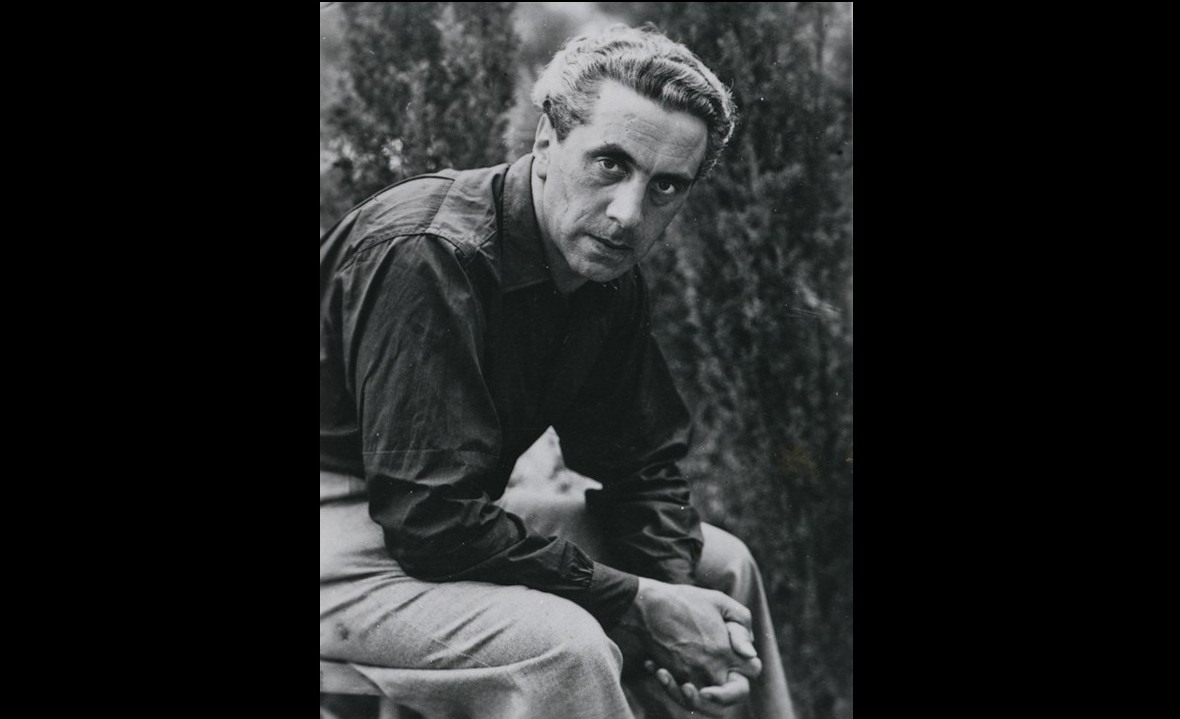
Released after serving five years for his leadership during the German Revolution, Toller emerges from prison with a warning, lest the lesson of 1914 be forgotten.
‘A Call to The International’ by Ernst Toller from New Leader. Vol. 1 No. 44. November 15, 1924.
Comrades! young men and women of the revolution! A terrible experience has come to me, stinging me to draw a comparison at once horrible and mocking: I have seen our era face to face. It was evening, and I stood on the grass in a garden of palms. Rockets shot up into the air, crackling and hissing, many-colored forms of light, shimmering and circling and vanishing in dust. A voice beside me murmured in an ecstasy of joy: “As at the front.” And Echo, the woman, dreamily: “As at the front.”
And I clenched my hands, and a cry of exhortation was on my lips, a beseeching cry: “You lie! You lie. Remember! Remember! you are beside yourselves, blinded by these circling lights, you are beside yourselves once more! Oh, remember!”
But I was swept away already in the eddying mass, and above us the starry dome of the sky stretched in eternal calm.
Do not be proud, oh man, that you stand here with fists clenched in your hatred of war. What did you do ten years ago? What did you do against the war? German or Frenchman, Englishman or American, what did you do against the war? “Hurrah!” you cried, “Hussa! Eljen! Eviva la guerra!” That is what you did.
Do not be proud, oh woman, that you stand here, knowing more than your unseeing sisters, and accuse the war which robbed you of husband, brother and son. German or Frenchwoman, Englishwoman, or American, what did you do against the war? You decked your husband and lover, your brother and son, with summer flowers, your eyes lighted up and, drunk with sweet sorrow, you let him go. You did not fling yourself before the train–you let him go.
Young men and women, what did you do? Your words were rejoicing, your steps the beat of a drum: Up! to the war!
It is said, we were compelled. Who can compel a man? No one can compel a man. We were blinded, we were slaves! Slaves! We here, all, all of us, we were slaves, forging shells, brewing the smouldering, murderous poison-gases. All of us, we were slaves, throwing bombs upon tortured towns.
Comrades! Lock back! Do you hear in the barbed wire the shrieks of the dying. Do you feel the accusing silence of murdered forests? Do you hear the dull bellowing of animals deserted?
Men, animals, forests–murdered! murdered! murdered!
You millions of dead in the World War! I call to you in this hour. Enemies? Poor victims! Bodies embracing in friendship in the vast common grave of Europe, Asia and Africa!
Oh, comrades, when the hour struck it was to a generation that failed. Yes, we have all, all failed. The workers of the world have failed. Oh! may that word tear at your heart with the million hands of all who were fruitlessly sacrificed on the battlefields of the world. We failed!
A generation failed, in in which the spirit of the International should have burned! Comrade fought against comrade, woman cursed woman. And yet the light did not turn to darkness within us. And yet our heart-beats did not cease.
And then one man arose, Karl Liebknecht. Then the nameless rebels arose, shot down against walls and in trenches.
They remained alone.
The war died down. It died of itself, not because of the iron will of the peoples.
And that, oh workers of the earth, was your second sin against the spirit of the International. You might have killed the war after the madness of the first months. You did not do it! You let it live five years, till at last it died of itself. And, now we are burdened with five years of peace. Peace? A great barbed wire entanglement, stretching over the whole world; that is what the peace became. The peoples writhe in it and groan and moan, seeking the dream of peace which was once their joyous heartbeat.
Peace? I hear laughter–whence? From prisons and houses of correction. The laughter of revolutionaries in chains!
Peace? Peace?
Do not the masters wage war day by day against the proletarian peoples? An unwavering. unending war?
Wake up, you peoples, wake up! There is a way! There is a way! Working peoples of the earth, unite! Unite!
The foundation of your lives is plague-stricken from the stench of the rotting bodies of the victims of a glittering lie, of the greed for gold draped in the Toga of patriotic phrases.
Peoples of the earth! Dig new foundations!
You can dig them, you can!
Oh, that my voice might rouse you, that it might rouse you, young men and women of the revolution! Bring forth deeds!
Down with war! Down with war! Long live the revolutionary union of free, of liberated peoples!
Long live the united International of the future.
New Leader was the most important Socialist Party-aligned paper from much of the 1920s and 1930s. Begun in 1924 after the S.P. created the Conference for Progressive Political Action, it was edited by James Oneal. With Oneal, and William M. Feigenbaum as manager, the paper hosted such historic Party figures as Debs, Abraham Cahan, Lena Morrow Lewis, Isaac Hourwich, John Work, Algernon Lee, Morris Hillquit, and new-comers like Norman Thomas. Published weekly in New York City, the paper followed Oneal’s constructivist Marxism and political anti-Communism. The paper would move to the right in the mid 30s and become the voice of the ‘Old Guard’ of the S.P. After Oneal retired in 1940, the paper became a liberal anti-communist paper under editor Sol Levitas. However, in the 1920s and for much of the 1930s the paper contained a gold mine of information about the Party, its activities, and most importantly for labor historians, its insiders coverage of the union movement in a crucial period.
PDF of full issue: https://www.marxists.org/history/usa/pubs/new-leader/1924/v01n44-nov-15-1924-NL.pdf

