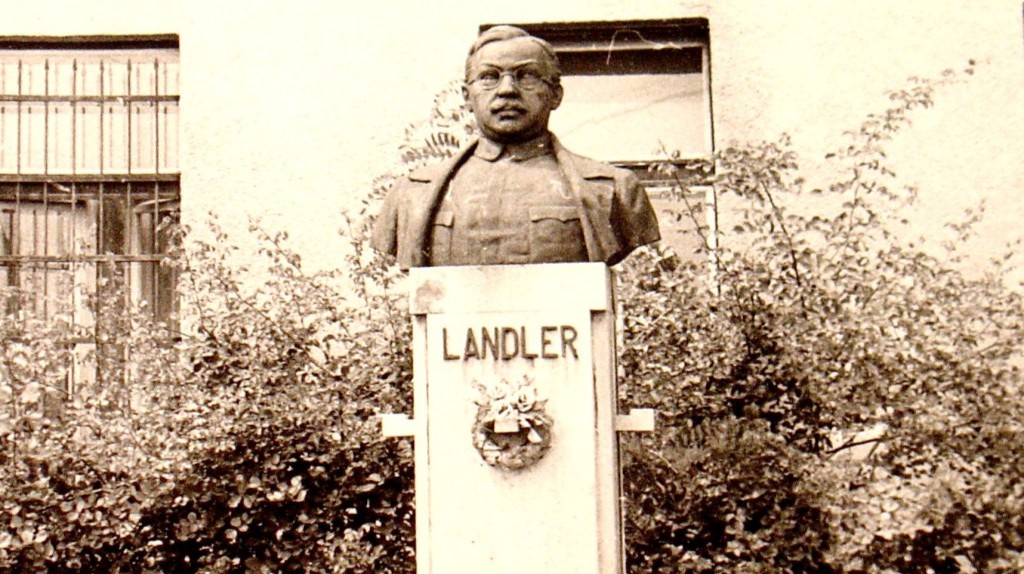
Notices from the International on the death of Eugen Landler. Landler was in the left wing of the Social Democrats when the 1919 Hungarian Soviet was proclaimed, joining with the Communists he was Commissar of Trade and a Hungarian Red Army commander. Fleeing with a number of Hungarians to live in Vienna, Landler was a chief rival to Bela Kun in the emigre Party. A delegate to the 3rd, 4th, and 5th Comintern Congresses and on the International’s Executive. Dying in exile, his ashes were interred in the Kremlin Wall.
‘The Death of Eugen Landler’ from International Press Correspondence. Vol. 8 No. 11. March 1, 1928.
Eugen Landler
On Saturday the 25th of February, there reached us the sad news that Comrade Eugen Landler, one of the most well-known, meritorious and beloved leaders of the revolutionary labour movement of Hungary, had passed away at the age of 54 years after a long illness.
Comrade Landler had for over twenty years played a prominent role in the Labour Movement of Hungary. A lawyer by profession, he soon turned to the Labour movement and, first in the organisation of the railway workers of Hungary and then in the entire labour movement, played an ever greater role. During the world war he belonged to the Left radical wing of the social democracy which fought against the imperialist war. He occupied an active and leading position in the organising of the anti-war mass movement, especially in the repeated strikes of the munition workers. For this activity he was repeatedly sent to prison during the war, and had to face the danger of a summary sentence by the military tribunal.
In the October Revolution, which sealed the collapse of the Austro-Hungarian military monarchy and created a bourgeois Republic in Hungary, he continued his activity in the Left wing of the social democracy in the Workers’ Council. As one of the leaders of this Left wing who strove for an approchement to the Communist Party, he belonged to those who prepared the way for the proletarian revolution, which on the 21st March, 1919, set up the dictatorship of the Hungarian proletariat.
During the months of the proletarian rule, Comrade: Landler was always in the front ranks. First as a People’s Commissar for the Interior, then, when it was necessary to repel the invading imperialist armies, as a Commander of a Corps of the Red Army and, finally, as Supreme Commander of the entire proletarian army of Hungary.
After the crushing of the proletarian revolution he was persecuted by the hirelings of Horthy and was compelled to live in emigration. As one of the leaders of the Communist movement of Hungary he worked in these years unweariedly for the organisation of a Communist mass Party, for the emancipation of the proletariat. Nine years of life in emigration and of unceasing work, full of deprivations, undermined his health. It was not granted him to realise his longing desire, which was to fight again at the head of the working masses of Hungary, who saw in him their most popular and beloved leader, and to witness the retribution which the Hungarian proletariat is preparing for its executioners. After long months of severe illness he died in Cannes where he had gone in the hope of recovery. The Hungarian working class will preserve and revere his memory as a sincere fighter for the cause of their emancipation.
The activity of Comrade Landler as a leading member of the C.P. of Hungary was well known in the Communist International. The international working class mourns with the proletarians of Hungary.
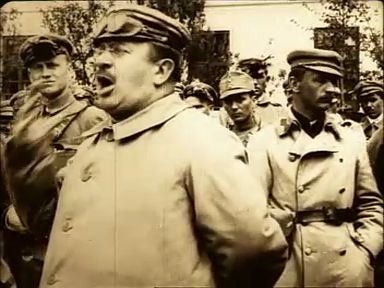
Declaration of the C.P. of Hungary on the Death of Comrade Landler.
23rd November 1874–25th February 1928.
The prominent leader of the revolutionary labour movement of Hungary, and of the Communist Party of Hungary, Comrade Eugen Landler, has passed away. His death is a tremendously heavy loss not only for the working class and the Communist Party of Hungary, but also for the whole international Communist movement, which Comrade Landler joined immediately after the formation of the Communist International as a fighter in the foremost ranks.
Such leaders, such fighters as Landler are produced solely by the heroic epoch of the proletarian revolution. Sacrifices were for him not sacrifices but were accepted as a matter of course. The activity as leader which he displayed at the head of the proletariat, was a devoted and successful service to the class of the suppressed and the masses fighting for their emancipation. In him there was embodied in the revolutionary times, but also before, in an exemplary manner, the boundless readiness for self-sacrifice of the intellectual who had completely identified himself with the working class. He could say of himself that he was one with the working class in its struggles and its ideas. For him, however, socialism was not a humanitarian ideal, not a charming picture of the distant future, but an uninterrupted, inexorable and unwearying, obstinate struggle.
The proletarian revolution, which commenced with the October revolt of the Russian proletariat, accomplished in him, as in the best of the Western socialists, an individual revolution. When the greater portion of the old social democrats, at the time of the proletarian revolution, at the time of the immediate struggle for power, went over to the bourgeoisie and took their place on the other side of the barricades, Eugen Landler remained in the ranks of the proletarian revolution. He saw with pain and bitterness the bankruptcy of social democracy during the war. He did not take part in supporting the war. On the contrary, he openly placed himself at the head of the masses, in face of the bayonets, combated in the same way by the gendarmes and by the social democratic leaders. He was an instinctive revolutionary, and was therefore one whom in Hungary the social democracy compelled to unite with the Communists, along with them to capture power and to found the Hungarian Soviet Republics, the first Soviet Republic after the Russian.
From an instinctive revolutionary he became a conscious revolutionary, a Bolshevik. There was a great path which he, a social democrat who was inclined to blanquism and whom this inclination to blanquism in the social democracy saved from reformism and opportunism, had to traverse. But he succeeded in overcoming Blanquism, and there are few who penetrated so deeply into the depths of Marxism and Leninism as he. He did not commence as a theoretician, but no one was able to appreciate with more certainty and more concretely than he the importance of the unity of revolutionary theory and revolutionary practice. This rendered him valuable in that period of the Hungarian revolutionary labour movement when not the great mass movements, but the constant, underground, revolutionary detail work occupied the centre point of the activity of the C.P. of Hungary.
His sickness had been causing him suffering for a long time. But this sickness could not for a moment force him to concern himself with his own affairs. It could not break his profound belief in the revolution and its victory. The last words which he addressed to us were; “I am fighting against terrible forces in order that I shall once again be a useful member of the community”. He did not wish to be incapable of work. He exhausted his last forces in order to be able to work together with us, in order to be able to fight together with us, to fight with the revolutionary workers and poor peasants of Hungary, with the revolutionary proletariat against the Horthy regime, against international imperialism, for the Soviet Union, whom nobody loved more than he, which possessed no more firmer patriot than him. His last words, with which he concluded his letter, were: “The Doctor will not even allow me to take a walk. Nevertheless we shall triumph”.
The workers and poor peasants of Hungary will, under the leadership of the Communist Party of Hungary, vanquish the Horthy-Bethlen regime and found the Second Hungarian Soviet Republic. In its free soil we shall inter the ashes of Eugen Landler, begirt by the love and gratitude of the workers and poor peasants.
The Central Committee of the Communist Party of Hungary. (Section of the Communist International.)
The Redaction of “Uj Marcius”, Organ of the C.P. of Hungary.
International Press Correspondence, widely known as”Inprecorr” was published by the Executive Committee of the Communist International (ECCI) regularly in German and English, occasionally in many other languages, beginning in 1921 and lasting in English until 1938. Inprecorr’s role was to supply translated articles to the English-speaking press of the International from the Comintern’s different sections, as well as news and statements from the ECCI. Many ‘Daily Worker’ and ‘Communist’ articles originated in Inprecorr, and it also published articles by American comrades for use in other countries. It was published at least weekly, and often thrice weekly.
PDF of full issue: https://www.marxists.org/history/international/comintern/inprecor/1928/v08n11-mar-01-1928-Inprecor-op.pdf
 Revolution's Newsstand