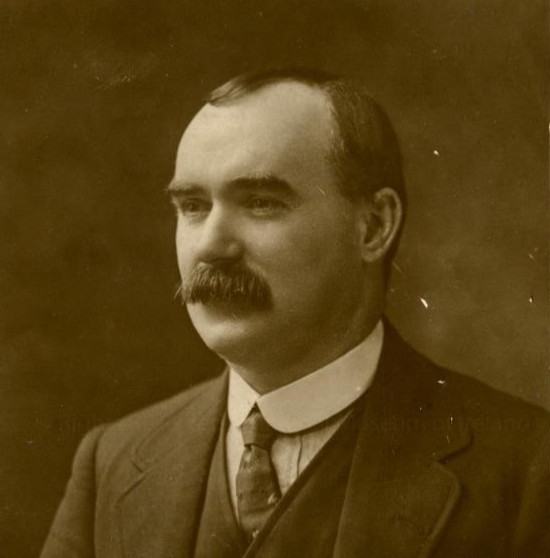
After years living in the United States, Connolly returned to Ireland in July, 1910 to organize for the Socialist Party, where just a few months later he made this report of progress in the movement there.
‘Socialism Growing Rapidly in Ireland’ by James Connolly from The New York Call. Vol. 3 No. 284. October 12, 1910.
Socialism is making rapid progress among the workers in Ireland. So rapid is its progress, in fact, that it has provoked considerable comment, especially in conservative quarters.
Writing in the Glasgow (Scotland) Forward of October 1. James Connolly, editor of the Harp. published at Dublin, Ireland, says:
“Readers of Forward will, no doubt, be glad to hear of the spread of Socialist ideas in Ireland, a spread indicated by the fact that new branches of the Socialist party have recently been formed in Cork and Belfast, and also by the fact that the Irish press, both clerical and lay, is devoting much space to the movement. The latter circumstance is in itself a most infallible index to the growth of the propaganda. For long enough it has been the cue of the capitalist press in Ireland to deny the existence of al organized Socialist movement in Erin, and, unfortunately and foolishly, many Socialists in Great Britain have accepted this denial at its face value, and falling into the trap laid for them, have also written and spoken as if Socialist propaganda were something unknown amongst the Catholic and nationalist population of Ireland. I have even seen it argued that as Irishmen desired home rule, and as home rule was desirable and necessary, therefore Socialist propaganda in Ireland could not make headway until the advent of home rule had disillusioned the Catholic population.
“The excellent Comrades who so argued forgot that precisely the same argument was put forward in Great Britain by the Radicals at the inception of the Socialist movement here, and by the political reformers all over Europe. They also argued that there was no hope or room for Socialist propaganda in their respective countries until the ground had been cleared by the extension of the suffrage, or the establishment of a republic, or the abolition of a house of lords. And their arguments were as cogent as the “wait for home rule” argument in Ireland. But the Socialists in Britain and on the continent answered those arguments by building up a Socialist party which, while aiming at Social revolution, became, in the meantime, the vanguard, champion, and eventually the accredited spokesman of the political reform movement.
Socialist Spokesmen.
“Socialists all over Europe have become the spokesmen of the masses, not by trailing along at the tail of the political reformers, but by making the Socialist parties such aggressive fighters for political reform that the mere political reformers were brushed aside as triflers, and their leadership taken over by the Socialist organizations.
“What was done outside of Ireland may be done and will be done in Ireland. The Socialist party of Ireland is unequivocal and outspoken in its belief in the necessity for the fullest kind of self-government for Ireland, but, having made that clear to a Nationalist and Catholic audience, its speakers find their hearers as appreciative and responsive as they could desire. The demand that we should wait for home rule is not as often heard in Ireland as it is in the mouth of our apologists outside Ireland. The reason is plain. The Irish worker, when he learns that the Socialist party is in favor of true national liberty, sees no reason why the Socialist cannot be as worthy a fighter for home rule as a slum landlord, a briefless barrister, or a publican’s assistant.
Masters Are Uneasy.
“As a result of this attitude of the workers in Catholic and Nationalist Ireland, the spread of Socialist ideas has been such as to cause great uneasiness to the propertied class.
“The Jesuits, ever with their ears close to the ground to detect the rumblings of innovating movements, arranged for one of their most eloquent orators to deliver a series of Lenten lectures against Socialism in Gardiner Street Church, Dublin, and, in order that these might have the greatest effect, induced the home rule capitalist press to print verbatim copies of the lectures on the Monday succeeding their delivery. Probably no sermons in Ireland have been more extensively circulated in our generation–a fact that in itself shows the alarm felt at the progress of the ideas so combated. The interest aroused by the lectures was shown by the fact that a two-penny pamphlet written by myself in answer to the reverend lecturer sold to the extent of a thousand copies in Dublin and Cork in the course of a month.
“If our Comrades in Great Britain, who are always bewailing that there are no Socialists in Ireland, could only convince our capitalist clerical friends that such was indeed the case, I am sure the latter would lie more tranquilly on their beds at night than they do.
“In response to the invitation of the Socialist party of Ireland. I have spent a month in propaganda work in the island, coming from the United States for that purpose. This month has been devoted to meetings in Dublin, Cork, and Belfast, and in opening up correspondence with intending members in other parts. In Dublin the meetings were large and enthusiastic: at one in particular, held in the Trades Hall, granted by the Trades’ Hall committee free for that purpose, the veteran secretary of the trades council took the chair, and declared himself in full agreement with the lecture.
Cork Enthusiastic.
“I had been told that I would be mobbed in Cork, as passions in that city had been stirred to fever heat by the warring home rule factions. But my first meeting in Cork was attended by a crowd estimated variously at from 500 to 700.
“At the second meeting on Sunday night, the street was blocked from pavement to pavement with a crowd of over 2,000 persons-earnest, eager working men and women. Not a single hostile note was heard, a fact commented upon by one of the Cork capitalist papers. I spent a week in Cork, and formed a branch of twenty-four members.
“In Belfast another branch was formed, and it has already secured the support of many men and women who would not join the I.L.P. as they regard it as too unresponsive to Irish sentiment and aspirations. Permit me to say here that the I.L.P. has done yeoman service in Belfast for the Socialist cause, that it still has a function to perform, but that the only logical Socialist movement for Ireland is a party that rests upon Irish conditions, continues the traditional work for national freedom for Ireland as a part of its mission, and draws its inspirations from the revolutionary history of the past as well as the social development of the present. Such a party is the Socialist party of Ireland. It is already attracting the support of some of the brightest men and women, in the literary and national world, of Ireland.
Prominent Adherents.
“Mr. W.P. Ryan, editor of the Irish Nation, is an enthusiastic supporter of the party, and his paper does grand serv ice for our cause; such sterling Gaels as P.J. Daly and J.W. O’Beirne, of Dublin: Liam de Roiste, of Cork: Seaghan Crawford, Seaghan Irvine and Miss O’Farrell, of Belfast, sterling workers in the cause of woman’s suffrage [word missing] the cause of woman’s franchise, like Miss Shannon in Dublin, and stanch labor men like Davy Campbell, president of the Trades Council of Belfast, all represent the manner in which the Socialist party has caught the imagination of every section of intellectual and industrial life in Ireland. On the other hand, the picture would not be complete without citing the manner in which, at least, one Catholic organ, the Irish Rosary, organ of the Dominicans, takes care to disavow all sympathy with the senseless attacks upon Socialism from other clerical quarters. It says:
“To denounce Socialists as destructive and godless is not to make the least advance. The Socialists are quietly reasoning with the people at the Custom house in the Phoenix Park and anywhere else that they can gather a crowd. Moreover, they talk sense–good hard facts about making the future less terrible for the poorly off, increasing the comforts of the worker and giving this unmoneyed people a real voice in government.”
Yea, courage, Comrades all, the future for Socialism is bright in Ireland.
The New York Call was the first English-language Socialist daily paper in New York City and the second in the US after the Chicago Daily Socialist. The paper was the center of the Socialist Party and under the influence of Morris Hillquit, Charles Ervin, Julius Gerber, and William Butscher. The paper was opposed to World War One, and, unsurprising given the era’s fluidity, ambivalent on the Russian Revolution even after the expulsion of the SP’s Left Wing. The paper is an invaluable resource for information on the city’s workers movement and history and one of the most important papers in the history of US socialism. The paper ran from 1908 until 1923.
PDF of full issue: https://www.marxists.org/history/usa/pubs/the-new-york-call/1910/101012-newyorkcall-v03n284.pdf

