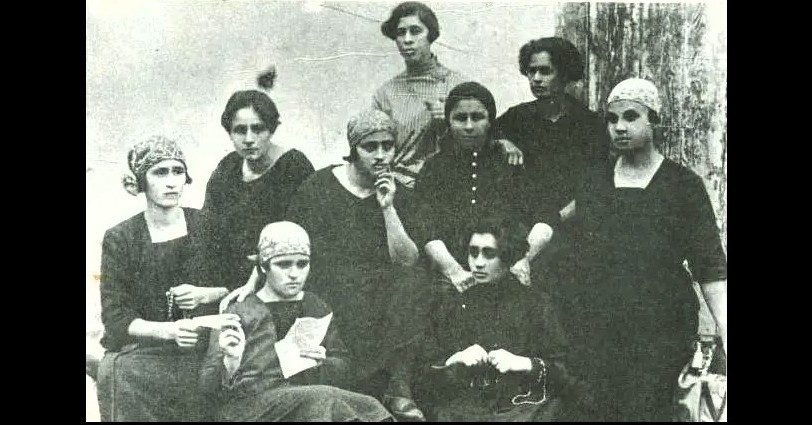
Exploited at home and the workplace, in some of the most reactionary cultural and religious environments of the day, with severe political repression and states of conflict, working class women of the Balkans faced an army of antagonists in their fight for liberation. Two reports from Stela Blagojevo, a leading Balkan woman Communist on the central leadership of the Bulgarian party. Blagoeva joined the movement at her birth, being the daughter of the journalist, Socialist and women’s rights activist Vela Blagoeva and founding Balkan Marxist and historic leader of the Bulgarian revolutionary movement Dmitri Blagoeva. Losing her work as a teacher in the repression that followed 1923’s coup, she was later arrested after the Sofia bombing in 1925. On her release from prison the following year she left for exile in the Soviet Union where she would work for the Comintern, surviving the 30s to return to Bulgaria, now as a member of the ruling party, after the war. She would become ambassador to the U.S.S.R. and was one of the most visible women of the emerging ‘Eastern Bloc’ before her 1954 death at 77.
‘The Fight for the Working Women in Bulgaria and Yugoslavia’ by Stela Blagojevo from International Press Correspondence. Vol. 8 Nos. 77 & 79. November 2 & 9, 1928.
The Working Conditions of the Women in Bulgaria.
Concerning the working conditions of the women of Bulgaria under Fascist rule, the Bulgarian Labour Press publishes shocking reports.
The worker correspondent of the “Novini” contributes the following from the town of Varna:
“In the Nikolov textile mill in our town there are working 1100 girls between the ages of 10 and 20. They are brought in exclusively from villages in distant districts, so that they may not remain in touch with their relatives. For every working girl he procures the agent of the mill is paid 200 levas (3 leva equal 1 d.). The agents tempt the unhappy girls and their starving parents by telling them of the instruction in sewing and embroidering which is given in the mill and also by pointing out the conditions of the contract, which is concluded for a period of 2 years: For the first year 3000 levas and 60 yards of linen, in the second year 3000 levas and a sewing machine. Whoever fails to fulfil the contract is not paid anything at all.
The factory is surrounded by a high stone wall. Strangers are not admitted. The gates are opened once a year at Easter, and the building overseers lead out the mill girls for a walk and take them back again in the same order. In the mill itself sunlight and pure air are luxuries. The food is miserable and the meat, which is served three times a week, stinks. Breakfast consists of black bread and nothing else. There are ten working hours per day and the mill is run with two shifts. The mill girls look like scarecrows, for they are covered in dust and fluff. It is forbidden to wash often as washing wastes time. In order to simplify their toilet the girls get a jail crop. A special remedy is given to the girls to prevent menstruation, so that time may not be wasted on extra washing. When the medical authorities hold an inspection, the sick girls are hidden away in the attic of an old building.
So that they may have proper exercise in their leisure hours, the girls are forced to clean up and wash the yard as “recreation”. If they make a single protest or mistake at work, they are beaten on the bare body with a stick. If a mill girl leaves her place to knot a broken thread she is beaten in the same manner. Within the last few months, those who do not finish the specific quantity of 170 yards a day are punished with fines in the form of deductions from their pay.
Meetings with relatives are permitted very seldom and only as great exceptions, and they take place in the presence of an overseer and then only after the respective girl has been threatened with punishment if she complains. The percentage of sick and dead is extraordinarily high. Relatives are not informed of deaths.”
These communications were got by the worker correspondent from a girl who had got away on account of serious ill health. The factory in question is by no means an exception. Concerning the mill known as “Linen” in Sophia, another worker correspondent writes:
“This mill is a prison. It is operated by girls from 10 to 15 years of age, who are taken on by agents from far-off villages. Many of them do not get out of the mill throughout the year, because they are not allowed to leave the premises. Occasionally, but very seldom, the manager allows a group of girls to go out under the escort of a supervisor. There are two shifts per day of twelve hours each, beginning at two o’clock and ending at two. In their free time the girls do the washing for the manager and the foremen and clean up the mill. The girls get nothing to eat in the morning. At midday and in the evening they get bread and nothing else, or whatever else is offered is wormy. The wage is 10 levas per day. It is paid only at the end of the period contracted for, namely, two or three years. If the girls do not complete this period, they get nothing. Most of the girls run away from the factory. In case of sickness the mill girl are thrown onto the street, for sickness is regarded as breach of contract.”
Working conditions are no better even in those factories in which there are no enslaving contracts. A worker correspondent of the trade-union paper “Unity” reports from Philippopolis:
“The foremen walk about continually cursing and threatening. Once a doctor came to inspect the mill, but he could not stand more than five minutes of the stinking and dust-laden atmosphere. He merely said: “Are you all satisfied?” and disappeared. He did not see that the drinking-water container stood under the steps and that when they were brushed all the dirt fell into the water. The floor is never washed but only sprinkled with water. The doctor had hardly left when two of the girls slipped and fell. There is no dining-room. For the 600 mill girls there is one solitary pump available, so that they cannot wash themselves in the dinner hour. We eat in the dust and dirt of the street.”
The class organisations of the workers of Bulgaria must develop a wide-spread movement among the working women in order to expose all the facts of the slavish working conditions and to mobilise the working class, including the broad masses of women, against Fascism and capitalism.
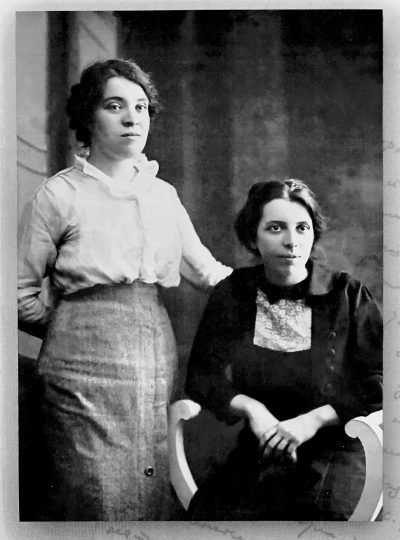
The Fight for the Working Women in Yugoslavia
The ruthless exploitation of female labour, the depriving of the women of their political and juridical rights, the national yoke and the survivals of feudalism in various districts of Yugoslavia are making more profound the contradictions in the life of proletarian women and waking them to activity. The Yugoslavian bourgeoisie, which considers the role of women production as cheap and poorly organised labour, in view of their role in the economic front in times of war and also on account of the revolutionary force of the rebellious masses of women, is trying to master the growing dissatisfaction and to exercise influence upon the working women not only through terror but also through systematic work. This work is being done by the humanitarian educational organisations, by the feminist, clerical and reformist organisations.
In districts where the population is not particularly religious chiefly in Servia the humanitarian and educational women’s organisations are at work. The nature of these societies is national-chauvinistic. They have employment agencies for women and homes for unemployed women. The employment agencies are under the State labour exchange and are most frequent in Servia. These societies receive subsidies from various State departments and are also supported by royalty for the purpose of consolidating the political hegemony in Servia. In consequence an unemployed woman can get an allowance of 2.50 to 5 dinars a day in the homes of these organisations in Belgrade, and as much as 15 dinars a day in Zagreb, Croatia. In Croatia, if a woman has lived on credit in such a home during a period of unemployment, she must pay the money back as soon as she gets work again.
On the initiative of this society the State has created throughout the country so-called trade schools for home workers. The work of these schools is under the protection of the societies of these humanitarian organisations.
Recently the work of these societies has been extended to the villages. Under the slogan of protection of widows and orphans, through instruction in sewing, cooking, hygiene, etc., through courses for illiterates, through getting their children apprenticed in small workshops, these societies ingratiate themselves to the proletarised peasant women, who have a bourgeois-nationalistic-chauvinistic ideology and supply the town with cheap and unskilled female and youth labour.
The clerical organisations are chiefly in Croatia, Slovenia and the Voivodina. On the one hand, they organise the working women in religious societies and thereby strengthen the power of the church; on the other hand, through these religious organisations they draw the working women into the bourgeois-feminist movement and make them clerical.
Formally, there are two kinds of these organisations: the Congregation of Mary and the Third Order of St. Francis. Each of these organisations has a number of sections.
The working woman, who is a member of one of these organisations, is also a member of all sections, which sometimes number from 10 to 15. She must buy a badge and an amulet, which the priest himself puts on her and which she cannot take off; she must pay membership contributions and is obliged to subscribe to the newspaper and a periodical, to give twice a week “a small offering for the Holy Father” and “a small offering for the baptising of non-Christian peoples” and, in addition to this, she must make various contributions to the church.
The money which is squeezed out of the female workers is used among them for “educational work”. The church covers only the expenses for the humanitarian work of giving meals to unemployed and to the poor. The cultural work is carried on by the secular women’s organisations. Every clerical organisation has a “cultural” section: music and vocal societies, athletic organisations for the young, courses for illiterates, dress-making and cooking courses, instruction in hygiene, etc.
To what extent the work of these organisations has recently affected the women workers is apparent from the following: after religious events a female worker speaks about the work and the plans of the women’s organisations, plays are given, dealing with the lives of the saints and also with the lives of the working women; and the women workers sing in the concerts and recite works of their own dedicated to some saint. Women workers who have completed these propaganda courses are sent into the factories and shops to work among the women under the slogan “achieve the rights of women with the help of the Church!” On most festive occasions they make speeches.
Well organised reading rooms and libraries, twenty periodicals, which have a circulation of 100,000, chiefly among women, and of which five are special periodicals for women, supplement the broad net of the clerical organisations and are used to entice the women, and especially the working women. As decoy for the female workers, their children are provided with clothes and shoes, or sent away for holidays, through the intermediary of these organisations.
In consequence of this work the majority of the Yugo-slavian women workers are enrolled in clerical organisations.
The work of the reformists supplements the organisatory net of the bourgeoisie for catching the women workers. The State permits the reformists to monopolise the State workers’ institutes (the so-called Labour Chambers and the organisations for social insurance). They use them to favour their members and for propaganda for the reformist trade unions, which are protected by the police. Cynically and openly they co-operate with the Servian bourgeois humanitarian societies in the management of the trade-union schools in Agram and advertise, in exactly the same way as the bourgeois Press, the cheap labour.
In Slovenia the Social Democrats created a special “Association of Working Women and Children” of the feminist type.
The C.P. of Yugoslavia must devote close attention to work among the women. The Communist Party must, by concentrating its attention upon the work among the working women in the factories and among the working peasant women, take all measures to expose and discredit in the eyes of the Working masses the whole of the bourgeois-clerical, humanitarian, educative, reformist and feminist organisation and its activity.
International Press Correspondence, widely known as”Inprecorr” was published by the Executive Committee of the Communist International (ECCI) regularly in German and English, occasionally in many other languages, beginning in 1921 and lasting in English until 1938. Inprecorr’s role was to supply translated articles to the English-speaking press of the International from the Comintern’s different sections, as well as news and statements from the ECCI. Many ‘Daily Worker’ and ‘Communist’ articles originated in Inprecorr, and it also published articles by American comrades for use in other countries. It was published at least weekly, and often thrice weekly.
PDF of full issue: https://www.marxists.org/history/international/comintern/inprecor/1928/v08n77-nov-02-1928-Inprecor-op.pdf
PDF of full issue: https://www.marxists.org/history/international/comintern/inprecor/1928/v08n79-nov-09-1928-Inprecor-op.pdf

