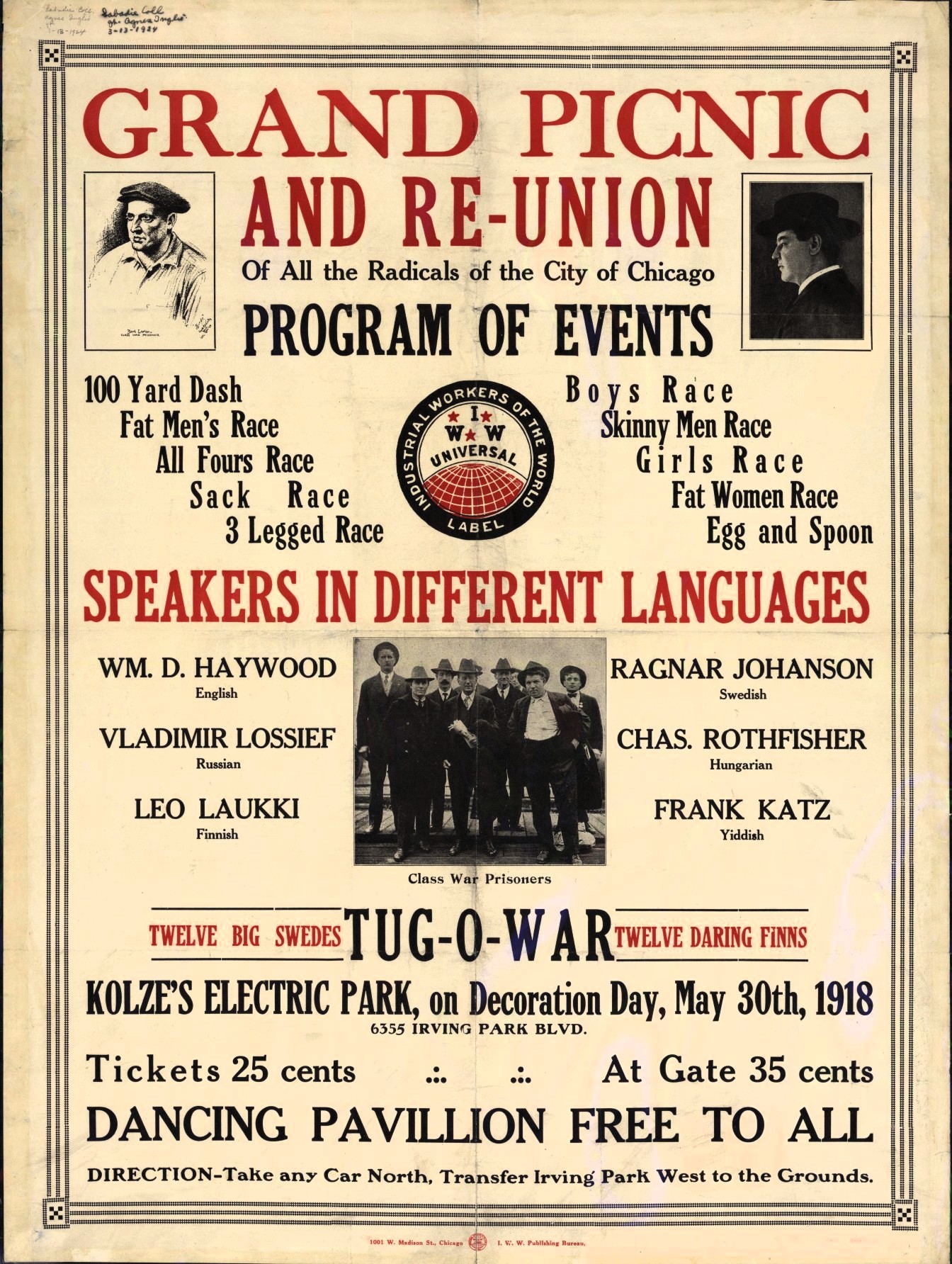
Differences over labor orientations, and relations with the I.W.W. in particular, were key to early divisions among the Communist movement. Here, as the Left Wing developed in the Socialist Party before the split, Fraina speaks to the ongoing negotiations between the I.W.W. and the Third International over unity.
‘The Left Wing and the I.W.W.’ by Louis C. Fraina from Revolutionary Age. Vol. 1 No. 27. April 19, 1919.
THE world is in crisis, which needs the most resolute energy and flaming initiative of the conscious proletariat, imposes the imperative necessity of a concentration of the revolutionary forces of the proletariat for action and the conquest of power. This revolutionary unity is the order of the day. How accomplish this unity, this concentration of the real revolutionary forces of the proletariat? Our Russian comrades answer, in their proposal for an International Communist Congress and the New International of revolutionary Communist Socialism. The unity and concentration of the revolutionary forces of the proletariat must proceed upon the basis of general Bolshevik theory and tactics, in accord with the experience of the proletarian revolution in Russia and in Germany. The old concepts of petty bourgeois Socialism and Anarcho-Syndicalism have been consumed, while incomplete concepts of the Revolution have been completed, tempered by the revolutionary fires into the irresistible, flaming sword of the proletariat in action.
The conscious rebel has learned from the experience of the proletarian revolution in Russia and in Germany, including the Bolsheviki themselves. The concepts of mass action and proletarian dictatorship in theory assume definite form in their realization as life itself. Theoretically, Marxism is in action in the proletarian revolution; partly, I.W.W.-ism; but each in a developed form, in definite expression, compelling an adaptation and revision of the old by the compulsion of experience. Marx projected the necessity of new proletarian state and the revolutionary dictatorship of the proletariat; the proletarian revolution has developed this by organizing the form of this state, the transitional state of the organized producers, the federated Soviets, implicit in Marxism and the Paris Commune, but in its final, definite form. The Soviet Government (which is itself temporary, serving the political function of suppressing the counter-revolution and crushing the old order) is developing a new “government” side by side with itself, the industrial administration of communist Socialism–as projected in the concepts of industrial unionism. This, say the I.W.W.’s, confirms our theory; it does, but only partly, since the decisive thing is the character of the transition period, the means by which the proletariat constructs the industrial state of Socialism. And the experience of the proletarian revolution demonstrates (and is confirmed in theory) that the construction of this industrial “state” proceeds after the conquest of the power of the state by the revolutionary proletariat, under the control of proletarian dictatorship. And this vital phase of the revolution is not included in the old I.W.W. concepts, although, perhaps, implicit; but there are I.W.W.’s who refuse to draw or emphasize this implication….
There has been no revolutionary group in America who possessed the whole of the theory and practice of the Bolshevik-Spartacan revolution. And most of these groups still cling to their old concepts. There is now only one revolutionary group in complete accord, in its Manifesto and Program, with Bolshevism, and that is the Left Wing of the American Socialist Party. And our task is the unity and concentration of the revolutionary forces of the American proletariat on a Bolshevik-Spartacan basis.
Our contributor, Harold Varney, regrets “the growing coolness between our revolutionists of the Left Wing and our revolutionists of the I.W.W.” But it is the Left Wing that is cool to the I.W.W.–is the I.W.W. that is cool to the Left Wing. Varney accuses us of “with deliberate evasiveness” having “endorsed ‘revolutionary unionism'” and not specifically named the I.W.W. This is unjust. There is but one revolutionary industrial unionism in action, and that is the I.W.W.–a fact clear to all except the fool and the hypocrite. The Left Wing makes it clear that the I.W.W. is a vital phase of our revolutionary movement; but in the measure that the I.W.W. clings simply to its old concepts and refuses to supplement them with the concepts of the proletarian revolution in action, in that measure must the Left Wing assume a critical attitude toward the I.W.W., in the interest of the concentration of the revolutionary forces of the American proletariat on the basis of the proletarian revolution itself.
It is not the Left Wing, but the I.W.W. (that is to say, certain of the “leaders” of the I.W.W.) who repudiate the experience of Bolshevik-Spartacan practice…
Varney himself makes this clear. Speaking of the disputes between the Parliamentarians and the Industrialists (and the Bolshevik Left Wing in the Socialist Party is a development of the old Industrialist Left Wing of the Party) Varney concludes:
“Then came Bolshevism. With immortal letters of blood and iron, it wrote the answer to the problem. With the ruthlessness of destiny, it closed the doors of an epoch. Socialism was no longer hypothetical.”
It came. And when it came, it was not Parliamentary. Victorious Bolshevism scrapped the State and proclaimed itself Industrialist. The controversy was no longer debatable. Russia gave to the American Industrialists the unanswerable argument of fact.
It did but only in one sense: that the revolutionary proletariat must destroy the political state and establish an industrial “state.” But this was not accomplished as the I.W.W. proposed (organize the majority of the workers industrially and then seize industry) but by means of revolutionary mass action, the conquest of the power of the state, proletarian dictatorship, and the organization of a partly political (proletarian) government under whose protection the new industrial state proposed by industrial unionism is being organized.
In this we see a confirmation and a supplementary of the I.W.W. concepts. But Varney says:
“Possibly, the I.W.W., of all the world’s movements, was shaken least by Bolshevism…The final link in I.W.W. theory had been forged at last. But there was nought in the new happenings to compel a revision of belief. The I.W.W. had always been anti-parliamentary. The I.W.W. had always sought Industrialism. The I.W.W. had always preached Bolshevism while the Bolsheviki were themselves groping. [Surely this is vividly imaginative.]… The I.W.W. knew that Bolshevism was but the Russian name for I.W.W.”
This arrogant assumption of having always possessed the “final truth,” this refusal to admit that revolutionary experience has introduced a vital supplementary to the I.W.W. (an attitude equally characteristic of the moribund remnants of the S.L.P.) is wrong in fact and dangerous in practice. Bolshevism is not the Russian name for I.W.W.–and I.W.W.-ism is simply potential Bolshevism. Bolshevism does not require an I.W.W. “revision of belief,” but it does impose a supplementary. That which was never adequately clear has been demonstrated by Bolshevik experience the means for the conquest of power, the character of the transition period to Socialism. This is decisive.
“That movement will win America which reflects American economic conditions,” says Varney, and proceeds to show an apparent contrast between Russia and the United States economically: precisely what the yellow Socialist did in Germany and is doing in our country…”In Russia,” says Varney, “the psychology of the situation indicated mass-political action as the means of proletarian expression. In America and Britain, mass political action is unprecedented: mass unionism is the traditional proletarian weapon.” But when unionism becomes revolutionary, it attacks Capitalism; it must use its power to conquer the state; its action then becomes political and develops into revolutionary mass action. Unionism is simply a phase of the proletarian revolution: mass action unites and concentrates the organized and unorganized masses for the conquest of power. Varney is still confused on the means: not the seizure of industry by the industrial unions (how utopian to imagine you can ever organize the overwhelming majority of the workers under Capitalism in industrial unions!) but the seizure of the power of the state by means of revolutionary mass action–that constitutes the tactic of the militant proletariat. The proletarian movement must be political in the revolutionary sense (parliamentarism being simply a phase.) It is not a problem of differences in the emphasis of industrial development, but of Capitalism and the proletarian struggle. The tactics of the international revolutionary proletariat are identical, with minor changes in emphasis determined by minor local conditions.
Let the I.W.W. align itself with the Communist International, with the policy of the Bolshevik-Spartacan revolution. Left Wing and I.W.W.! There must be unity and concentration of the revolutionary forces on a communist basis: will the I.W.W. reject this unity and concentration?
The Revolutionary Age (not to be confused with the 1930s Lovestone group paper of the same name) was a weekly first for the Socialist Party’s Boston Local begun in November, 1918. Under the editorship of early US Communist Louis C. Fraina, and writers like Scott Nearing and John Reed, the paper became the national organ of the SP’s Left Wing Section, embracing the Bolshevik Revolution and a new International. In June 1919, the paper moved to New York City and became the most important publication of the developing communist movement. In August, 1919, it changed its name to ‘The Communist’ (one of a dozen or more so-named papers at the time) as a paper of the newly formed Communist Party of America and ran until 1921.
PDF of full issue: https://www.marxists.org/history/usa/pubs/revolutionaryage/v1n27-apr-19-1919.pdf
 Revolution's Newsstand