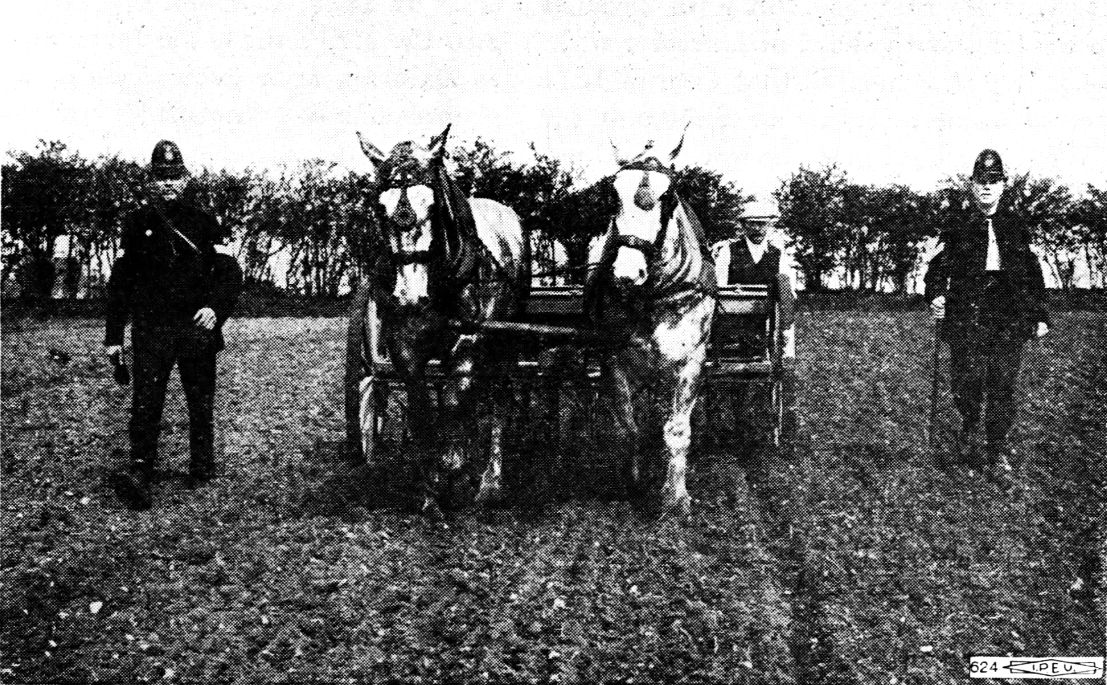
We don’t often think of England as a place of militant farm labor strikes, but here you are. The National Union of Agricultural Workers in battle against the landowners of the Farmers’ Union.
‘Revolt of the British Farm Workers’ by Paul Blanshard from Labor Age. Vol. 13 No. 3. March, 1924.
A Glance at the Most Unique Union in the World
A MILITANT spirit among any group of organized workers gives encouragement to the Labor Movement everywhere. None can fight better, against difficult odds than the farm workers of Great Britain. Last year’s strike in the farm districts gave evidence of that. We present you, herewith, to the most unique union perhaps in the world. Its activities and achievements will make you feel good.
THE greatest agricultural strike which England has had in fifty years left behind it a militant group of Norfolk farm workers who are perhaps the most interesting people in the British labor world. The strike, which came to an end officially last spring with an agreement between the Farmers’ Union and the National Union of Agricultural Workers, dragged on in several localities through discrimination.
The strike was a marvel of modern methods. Ten thousand farm workers, threatened with a reduction of wages and lengthening of hours, went on strike, marshalled their forces into efficient bicycle squads and brought out almost every strikebreaker on the country side under the noses of the policemen. Even an East Side strike in the tailoring industry has rarely been executed with such despatch.
The strike ended in a “victory”. The farm workers went back to work for $6 a week of 50 hours with overtime of four hours at straight pay when absolutely necessary and Saturday half holidays. In money they won 24 cents a week by the strike.
They won more than that. They won more respect for farm workers’ organization than has been won in any district of England for many years. They won a month’s vacation at full pay, since even a labor union could afford to pay $6 a week strike benefit once in fifty years. They won the right to attend union meetings in daylight, even on Sunday afternoon on a public green where a farmer’s automobile might pass at any moment. I saw such a meeting at Ruddam in the heart of the Norfolk district attended by five hundred farm workers and their wives.
The Duke of York—and You
From a little elevation at the back I looked over the crowd while the words of the farm soap-box orators floated across on the summer wind:
“…they allow 35 shillings a week for horses in the army. They allow 25 shillings a week for you and your wives and children…”
“…and the Duke of York got 25,000 (?) pounds when he took a woman. How much do you get when you take a woman?”
(At the hedge along the road are some old farm workers who are timid about coming into the green. Some of them, I am told have never ridden in a railroad train. Some of them have been to London.)
“…15 peers own one-seventh of your country. 168 persons own over 1,000 acres each, more than half of your country. How much do you own?…”
“…You can have some tea now and the band will play a hymn…”
“…That reminds me of a story. (The speaker is stockily built with pink neck and the little children smile when he smiles). There was a chap once who came to a pump in a hollow in the country. He was thirsty and he pumped and pumped but only a few drops finally came for him to drink. When he climbed to the top of the next hill, he met a man and asked: ‘What’s the matter with your pump down there? It’s almost dry.’ ‘Oh,’ said the other chap, ‘that’s because whenever you pump a cup full down there in the hollow, the pump must pump a whole pail full for the manor house on the hill.’”
The House on the Hill
The manor house on the hill is the curse of the British countryside. The great estates of England are held by the nobility and the would-be nobility.
Beneath this land-owning class is the class of tenant farmers, who usually rent about 300 acres from the land owners. These hire the farm laborers to do the work. The owning class is quite different from the American land-owning class. With the exception of the minority of farmers who own their own land it is a purely parasitic class, with that immense social prestige which is one of Europe’s most dangerous superstitions. It is augmented now and then by the city business men, who buy land not for cultivation so much as for family distinction, a distinction that serves as watered stock upon which the farmer and the farm worker are supposed to pay dividends.
The three classes on the British land—the owners, farmers and laborers—are quite distinct. The farmers have their own employers’ organization, the Farmers’ Union. The farm workers who are unionized belong to the National Union of Agricultural Workers. But the industry is poorly organized throughout. At the top is a set of unscientific investors, in the middle is a set of individualistic and equally unscientific employers, at the bottom is the mass of agricultural laborers who have never been half organized.
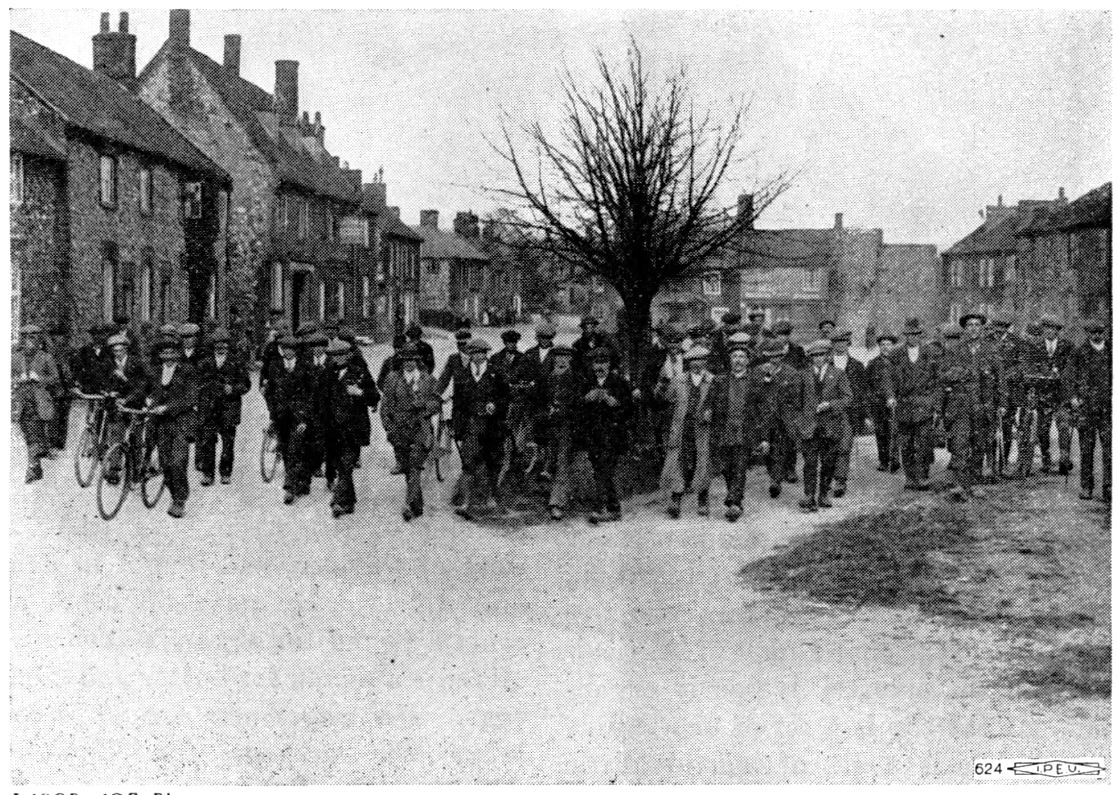
The farm workers are not like our “hired men,” living at the farm house and getting their room and board. They live in separate cottages which are often clustered in little villages some distance from the farm. Sometimes the journey to work may be several miles in length and the man is lucky who owns a bicycle. The cottages are tiny things of brick built in long rows with gardens behind, and renting for about fifty cents a week each. They are owned by the landowners and the laborer who is discharged can be evicted from his cottage if the farmer can prove that his services are no longer needed. This “tied cottage” system is not entirely unlike our company-owned towns in Pennsylvania and West Virginia where the miner who joins a union can be discharged and evicted.
In Castleacre
In the village of Castleacre, Norfolk, I found a family which was said to be typical of farm laborers’ families in that part. The man “supported” his wife and five children on $5.30 a week at the beginning of the strike. (2s 1d.) He had started work at thirteen, had fought in France, and is now only thirty. He pays 56 cents a week rent, 14 cents a pound for sugar, 10 cents a quart for milk, 40 cents a pound for butter and 29 cents a dozen for eggs. His wages now are $6. a week, a few cents below the average for England and Wales. Although the British workers spend one fifth of their income on drink, according to the report of the Labor Party’s investigating committee, the married farm laborer has practically nothing left for drink.
“You will rarely see a married farm laborer in one of our pubs (saloons),” said one of the strike leaders to me, “although we have six pubs in this village of a thousand.”
The agricultural workers do not come under the unemployment insurance law. But they receive about $2.50 a week as an old age pension if they reach the age of 70 in destitution and incapacity. Their poverty is perhaps the most wretched poverty in Great Britain today, with few of the advantages which are open to even the poorest city worker.
Against the Land System
The Norfolk strike was not only a protest against poverty but against the whole British land system. The leaders of the agricultural laborers are aware that they are fighting against a parasitic and inefficient system rather than against individuals.
The strikers told me that you can walk 25 miles in Norfolk on the land of the Earl of Leicester without getting off. It was estimated that even in 1911 the Earl received annual rentals of $250,000 for his land. What the Earl gets the workers do not get. His earnings would pay over 800 farm workers the union scale in Norfolk. A typical tenant farmer often pays twice as much for the rental of the farm as he does for the cultivation of it by the farm workers.
“We are aiming at the control of British land,” said R.B. Walker to me when I talked to him in London. Walker is head of the National Union of Agricultural Workers. “My predecessors, Joseph Arch and George Edwards, fought for the ballot and for a living wage on the farms. We are frankly fighting for more than that, because we know that we cannot gain prosperity as long as the present land owning system exists in Great Britain.”
From Joseph Arch to Now
The revolt of farm workers demonstrated how far the farm workers have come since the days of Joseph Arch. Then it was that the last agricultural strike swept England—two hundred years ago. In the seventies, Sidney Webb tells us, the Bishop of Gloucester suggested that the farm agitators be ducked in the horsepond. In 1923 the Church of England at Castelacre reserved half of its pews on three Sunday mornings for parades of strikers. In 1872 British troops were sent to the farms as strikebreakers. In 1923, although 400 policemen were shipped into the strike area, the farm workers were allowed to maintain their cycle squads which scoured the countryside and “notified” workers of the existence of the strike.
In the seventies sixteen farm laborers’ wives were sent to prison by local magistrates for threatening strike breakers. This year, when 238 summonses were served upon certain strikers to appear at the Walsingham petty sessions’ court to answer charges of violence, the court was suddenly swamped with Labor Party magistrates. These men came in automobiles to exercise their right to act as judges in any magistrates’ court in their own country. The result was that nobody went to jail and a few were fined.
In the seventies the agricultural workers were starved out through lack of strike benefits; in the Norfolk strike the National Union of Agricultural Workers spent about $25,000 in maintaining every striker at full pay. The revolt of the land workers under Joseph Arch was followed by ruin for his union. The Norfolk strike added 5000 members to the union and most of them are still paying dues.
Such progress forecasts the day when England will see the farm laborers successful in their bigger program. That means nothing less than a revolution in farm ownership in the British Isles.
Labor Age was a left-labor monthly magazine with origins in Socialist Review, journal of the Intercollegiate Socialist Society. Published by the Labor Publication Society from 1921-1933 aligned with the League for Industrial Democracy of left-wing trade unionists across industries. During 1929-33 the magazine was affiliated with the Conference for Progressive Labor Action (CPLA) led by A. J. Muste. James Maurer, Harry W. Laidler, and Louis Budenz were also writers. The orientation of the magazine was industrial unionism, planning, nationalization, and was illustrated with photos and cartoons. With its stress on worker education, social unionism and rank and file activism, it is one of the essential journals of the radical US labor socialist movement of its time.
PDF of full issue: https://www.marxists.org/history/usa/pubs/laborage/v13n03-mar-1924-LA.pdf

