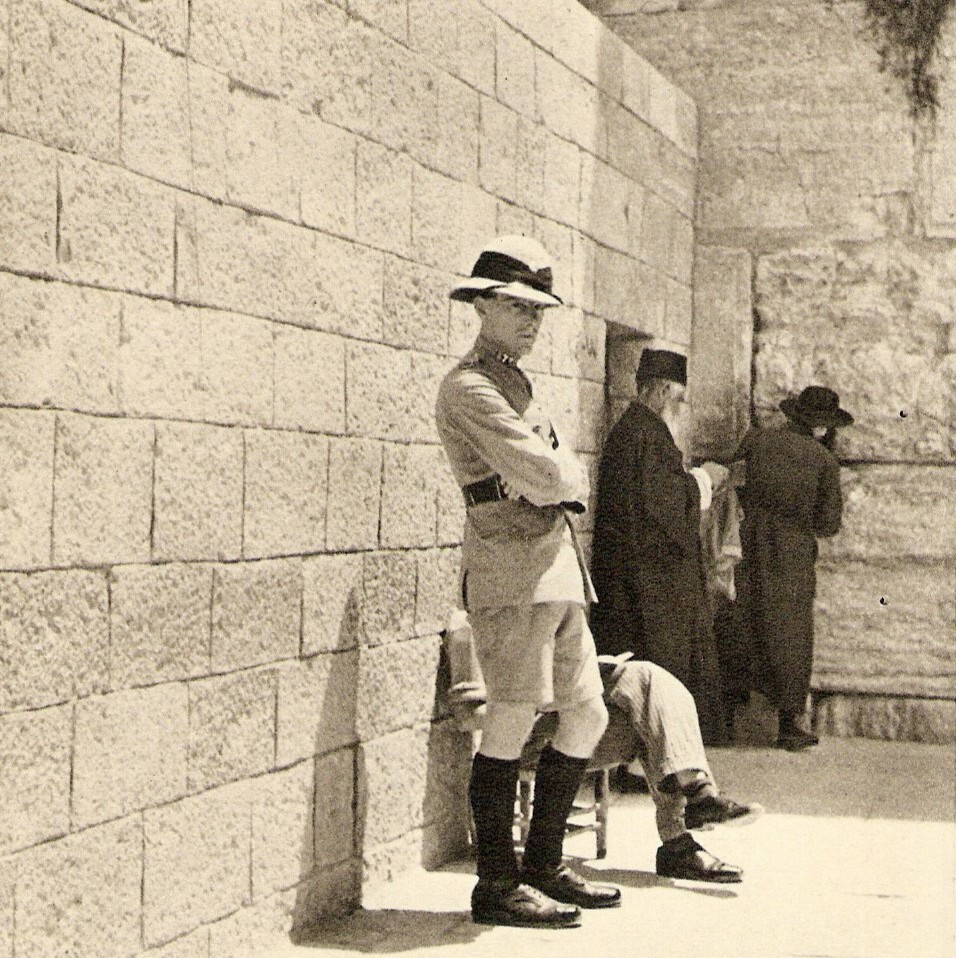
Why would British colonial police attack Jewish worshipers at the ‘Wailing Wall’ while at the same time facilitating Zionist colonization of Palestine? Joseph Berger explains.
‘Imperialistic Provocations in Palestine’ by Joseph Berger from International Press Correspondence Vol. 8 No. 73. October 19, 1928.
The report of an attack by British police on Jews praying at the so-called “Wailing-Wall” on the chief Jewish holiday, with an account of the brutal interruption of this religious ceremony and the maltreatment of numerous participants, including women and children, by the British detachment, must certainly have aroused surprise in all the world. Palestine is surely the country in which Great Britain is engaged in creating a national home for the Jews. A religious ceremony is no Communist demonstration, that it should be forcibly dissolved as such demonstrations generally are. And in Palestine the British are what might be called the allies and protectors of the Jews in general and the nationalistic and religious Jews in particular. And yet the report of the little “pogrom” in which the British police indulged at Jerusalem is quite true.
As a matter of fact, it was an imperialistic provocation, which can only be understood if we take the entire political position of Great Britain in Palestine during the last few years into consideration. Thanks to the absolute regime which the British have instituted in Palestine with the consent of the Zionists, the oppression of the people has greatly increased. The general discontent prevailing in the country made it possible for a tendency to arise among the Arab and Jewish population in favour of a better understanding of the common Arab and Jewish interests in opposition to British imperialism. Even among the Zionists a group came forward advocating an understanding between Arabs and Jews on the basis of a parliamentary administration. The deep-rooted hatred between the Arabs and the Jews, which was the mainstay of British rule in Palestine, was undermined.
Thus the British policy had to be directed towards re-arousing national and religions fanaticism, providing a safety-valve for the Arabs and persuading them that it is not the British but the Jews who are their enemies, and forcing the Jewish population back into the discipline of the Zionist organisation.
The incident of the wailing-wall furnished the favourable pretext for action. For this wall is not only a Jewish but also a Mohammedan sanctuary. Despite Zionism and the Balfour declaration, the Jews are there merely as unwillingly suffered guests. They are only allowed to erect a certain number of lamps and benches there. This “status quo” was confirmed by the Zionists themselves, but it was, however, broken. This fact the British exploited for the purpose of saying to the Arab fanatics, “See here. The Jews want first to appropriate the wailing-wall, but later they will covet your sacred mosque of Omar. And it is only we, the British, that protect your interests. How then can we be your enemies, as the nationalist leaders would have you believe?”
That in this interesting example of an establishment of the “pax britannica” between two races a few Jewish heads were broken, may be considered as no more than the inevitable penalty of a very cleverly managed imperialistic provocation. The British officers and men, trained to the task of thrashing workers and dispersing both nationalist and labour demonstrations (as in the case of the anti-imperialistic demonstration of the Arabs at Gaza last April, which ended in blood shed), may find it hard to distinguish between their friends and their enemies and probably look upon every native as an enemy.
This time the British had to risk a little family row with their Zionist friends. The Zionists, who approve smirkingly of attacks on Arabs and are ready to take an active part in the dispersion of labour demonstrations in co-operation with the police (as on May 1st, 1927), can yet not tolerate the application of such methods to pious and faithful Zionist Jews. Hence the mass meetings and protests against the Government in general and certain officials in particular, demonstrations which in some instances threatened to be carried over the heads of the Zionist leaders, a fact which shows how deeply-rooted the discontent with the British is even in those sections of the population which blindly obey the Zionist behests.
The wave of anti-Government protests, however, quickly subsided and now the British are free to pursue their provocation to its end. The Jews are told that it was only at the request of the Arabs that the raid at the wailing-wall was carried out, while the Arabs are assured that the Jewish demonstrations are directed not against Great Britain but against the Moslems. The result is an atmosphere of hatred and bitterness, which again guarantees to the British their role as umpires and enables them once more to play the part of the laughing third party.
In view of the present tense atmosphere in the Near East, the British cannot risk the possibility of a united anti-imperialistic movement in Palestine. If Palestine is to form a good strategic basis, the nations inhabiting the country must be incited to oppose and massacre one another.
For the Zionists, who, supposing a similar incident had happened in the Soviet Union, would probably have raised a hue and cry about oppression, blasphemy, barbarity, and Bolshevistic inhumanity, but who still continue to lick the boots of the British lords, to idolise British civilisation, and to participate in their name in all sorts of counter-revolutionary conspiracies against the Soviet Union, for the Zionists, who claim for themselves the monopoly of representing the Jewish people, this new British provocation in Palestine should be a salutary lesson, showing them that in the eyes of the insatiable imperialists even the Zionist “allies” are nothing but pawns that may readily be sacrificed as soon as more important aims and political intrigues make such a sacrifice appear advisable.
International Press Correspondence, widely known as”Inprecorr” was published by the Executive Committee of the Communist International (ECCI) regularly in German and English, occasionally in many other languages, beginning in 1921 and lasting in English until 1938. Inprecorr’s role was to supply translated articles to the English-speaking press of the International from the Comintern’s different sections, as well as news and statements from the ECCI. Many ‘Daily Worker’ and ‘Communist’ articles originated in Inprecorr, and it also published articles by American comrades for use in other countries. It was published at least weekly, and often thrice weekly.
PDF of issue: https://www.marxists.org/history/international/comintern/inprecor/1928/v08n73-oct-19-1928-Inprecor-op.pdf

