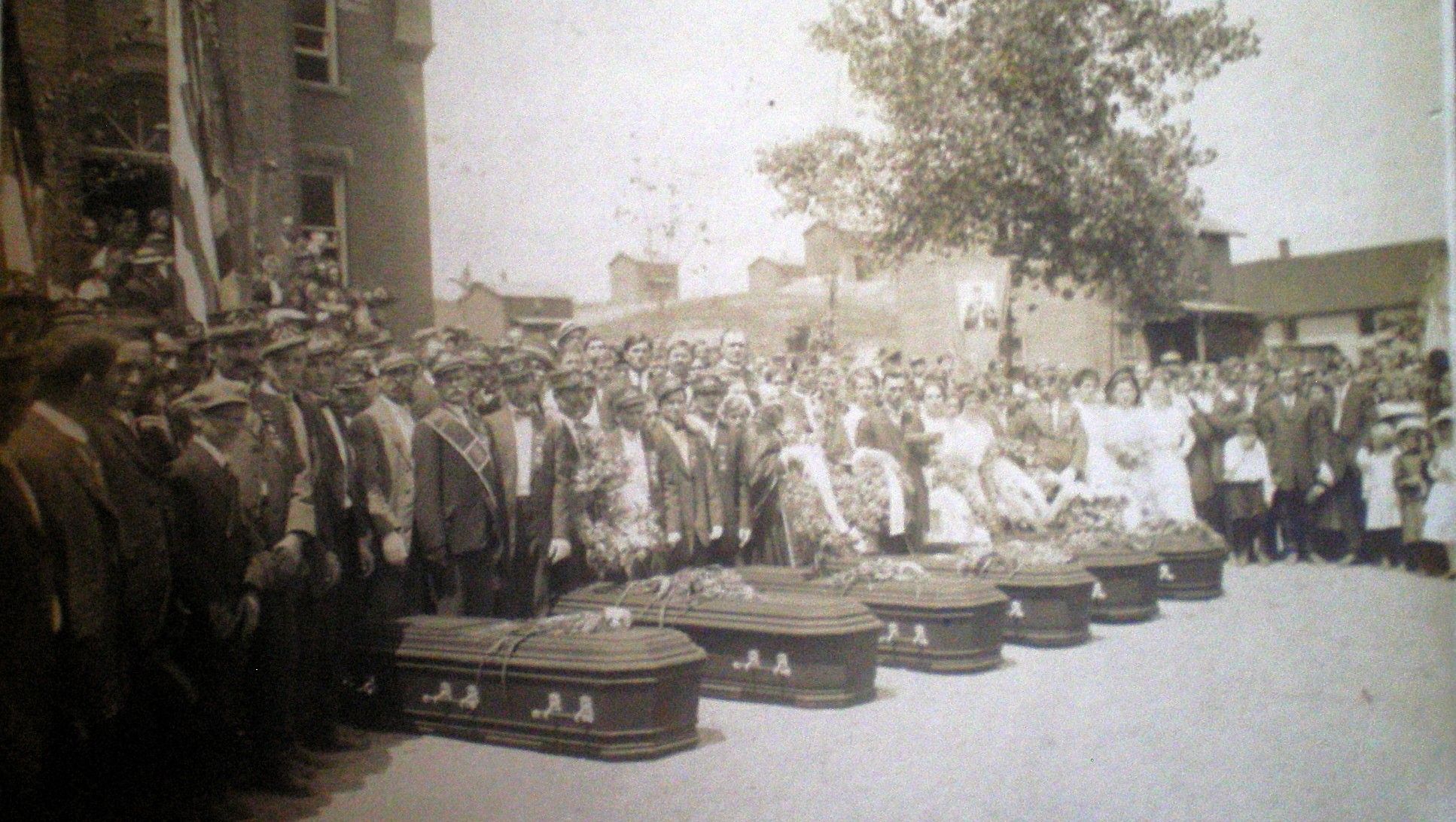
A look at the circumstances leading to the explosion at the Cascade Mine in Sykesville, Pennsylvania on July 15, 1911 that took the lives of 21 miners, just a few of the something-like 100,000 miners to die in this country while digging coal and making profits for the capitalist class.
‘Criminal Negligence!’ from Solidarity. Vol. 2 No. 34. August 5, 1911.
21 Miners Dead!
With the explosion of the Cascade mine, at Skyesville, Pa., on Saturday, July 15, Che more catastrophe has been added to the innumerable mine disasters that have occurred within the last few years.
This time twenty-one miners had their Ilves snuffed out and according to reports it was one of the most brutal murders ever committed.
Efforts are being made to hush up the affair and lay the blame on the poor unfortunates who lost their lives.
One of the papers stated that the explosion was caused by the striking of a gas pocket and intimates that this is the first time gas was found in this mine.
The usual theory that the explosion was caused by dust accumulation is insidiously being spread around.
A coroner Jury which was impaneled on Sunday July 16, where a preliminary hearing was held, was hastily adjourned until Wednesday, presumably (as it is rumored) to allow the company to fix up their testimony.
Your correspondent went to the scene and unlike the others did not go to the mine superintendent and mine inspector for information.
The men who were daily employed in that ill-fated mine were interviewed and in no case did the story differ, all declared that the mine was a gaseous one, and that innumerable small gas ignitions occurred there within the past six months, and on as late as Thursday July 13.
Inspector Warns Against Gas.
That the mine has been a gaseous mine, and that men had been allowed to work in there with open lamps is proven by the following letter and statement. Commonwealth of Pennsylvania. Twelfth Bituminous Inspection District. C.P. Byrne, Inspector.
***
Punxsutawney, Pa. May 27, 1911.
Mr. John Sullivan, President Sub District 5, U.M.W. of A.
Dear Sir: In reply to your favor of the 26th, inst., wish to state that the report of inspection sent to the mine to be posted beads as follows: “Additional safety can be secured by the use of a safety explosive for blasting.” At the time of my inspection I found No. 8 left heading giving off explosive gas is sufficient quantity to be detected with a safety lamp, and I advised the mine foreman to blast in such places with permissible powder.
Mr. Gadd Supt., is evidently mistaken, as those recommendations are in line with the recommendations of the U.S. Federal Bureau of Mines.
Trusting this is satisfactory,
I remain, Yours very truly.
C.P. Byrne, Inspector.
***
To further substantiate the fact that the mine was gaseous and that it was criminal negligence to allow the miners to enter the pit without safety lamps is amply proven by the following statement by the men who worked in the mines.
Miners Testify to Danger.
John Krecziglova, a Slavish miner while working in a cross cut about four weeks ago in eight left back heading, where Saturdays explosion occurred, while bolding his lamp ignited the gas and burned his hand. The fire boss J.A. Brown gave him some linseed oil to relieve his injury until he reached the office of Dr. J.F. Rain for treatment. Nichola Vallendin an Italian miner going into the mine one day early in July found a danger signal at the entrance of his place, he turned back to go home and was met by the mine foreman who ordered him to go back to work after having removed the danger signal that had been placed there by the fire boss, the compressed air was then turned on to remove the gas.
John Mesel, a Slavish miner, one of the victims, told his boarding boss John Homarosky, with whom he boarded since July 5, that while fixing a roof with a crew they came to a danger board and were ready to leave the place when the mine foreman A.L. Noll, called them back and told them that the danger signal was put there on account of a bad roof, although the men claim that the fire boss placed the signal there on account of gas accumulation.
Peitro Colangelo worked at No. 8 left back heading and made the report to the fire boss of gas accumulation there, but no attention was ever paid to the report, and last Saturday the day of the explosion he warned his partner one of the victims to keep out of the mine, that it was his belief that the mine would blow up at any time. Clyde Pettigrew, who worked in the third butt 8 left, stated that he was going to quit the mine long before Saturdays explosion on account of the numerous gas ignitions there, and stated that his lamp ignited some gas there on Thursday, July 13.
The following men stated that they could not work in No. 9, heading unless the compressed air was continuously blowing to keep the gas out: Steve Hulrick, Mike Renquish, Sam Barnaswitch, Joe Gasper and Toney Buchanis.
Sol Balewitch while working at the mine about two weeks ago had to quit his shaft on account of accumulation of gas and the danger of the ignition by his naked light.
Ton Barnechunis working in six heading had to continuously turn on the compressed air to brush the gas out of his room.
Numerous other instances of the condition of the ignition of gas in one of the “safest mines” in the Central Bituminous Coalfield could be cited. The foregoing statements prove conclusively that there has been gas accumulation at that pine from time to time, and that no precautionary measures were taken to prevent any fatal accident, such as has occurred Saturday.
Inspector C.P. Byrne says in his letter to John Sullivan, “At the time of my inspection I found No. 8 left heading giving off explosive gas in sufficient quantity to be detected with a safety lamp, and I advised the mine foreman to blast in such places with a permissible powder.”
If Inspector Byrne advised the use of safety explosive so as not to cause explosions of gas, and at the same time allowed electric wires and naked lights in that mine where gas accumulated, how could they hope to avoid any disaster? If he found gas there, why did he not compel the Cascade Coal Co. to use safety lamps as well as the safety explosives, and thereby safeguarded the lives of the miners?
The use of compressed air to brush out the gas from the workers only stirs up the dust which mixes with the gas and forms a more explosive material than the gas alone. The Coroners inquest will be resumed on Wednesday, July 19, and we are anxiously awaiting their findings, and whether or not the blame will be put on the proper parties.
(From the ‘Workers Standard’, Dubois, Pa.)
PDF of full issue: https://www.marxists.org/history/usa/pubs/solidarity-iww/1911/v02n34-w086-aug-05-1911-Solidarity.pdf
 Revolution's Newsstand