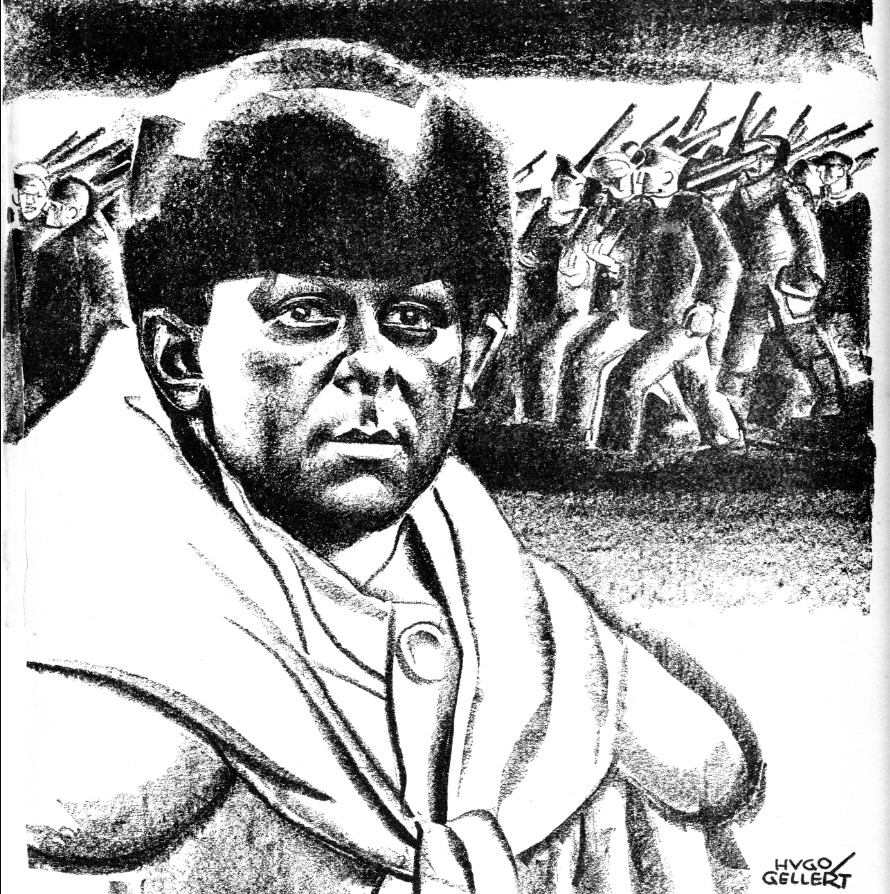
John Reed’s biographer, Granville Hicks, describes his early war correspondence, leaving for Europe at the end of August, 1914, and the profound impact the experience had on the writer who was, arguably, the leading journalist of his generation, and who transformed from chronicler of revolutions to revolutionary actor.
‘John Reed and the World War’ by Granville Hicks from New Masses. Vol. 17 No. 9. November 26, 1935.
“This Is Not Our War.”
At the outbreak of the World War, John Reed was not quite twenty-seven years old, but he was one of America’s most famous war correspondents. After his graduation from Harvard in 1910, he spent eight months abroad, and then returned to work on the American Magazine. During the next two years he won something of a reputation for his stories and poems, wrote a famous Dutch Treat Club play, became one of the editors of The Masses, was arrested in Paterson, and staged the Paterson strike pageant in June, 1913. The next December the Metropolitan Magazine sent him to Mexico to report the revolt of Villa and Carranza against President Huerta. He was with Villa and Villa’s men for four months, spending several weeks with a volunteer troop in the mountains of Durango, and witnessing the capture of Torreon by Villa’s army. His reports brought him instant fame and the name of “the American Kipling.” It was therefore inevitable that the Metropolitan should send him to Europe to cover the western front. From the chapter that follows, the first of five to be published in THE New Masses, certain sections that will appear in the book have been deleted. These deal with more personal episodes in the six months that the chapter embraces. Whatever pertains to Reed’s observations of the war has been retained. G.H.
ON AUGUST 13, 1914, John Reed sailed for Italy. Before he left, he did an article for The Masses that showed how clearly he understood the fundamental issues of the conflict he was to report. “The real war,” he wrote, “of which this sudden outburst of death and destruction is only an incident, began long ago. It has been raging for tens of years, but its battles have been so little advertised that they have been hardly noted. It is a clash of traders.” The German Empire began, he pointed out, as a trade agreement, and not merely the German army but the whole imperial system had been tolerated by the progressive burghers of the country because they believed that commercial advantage would depend on army force. The French and English traders, having seized the most desirable colonies while Germany was disorganized, talked hypocritically about peace and the status quo. France blocked German trade expansion in northern Africa; England checked her advance in Asia Minor. It was no wonder that the business men of Germany supported the Kaiser in his belligerent gestures. His talk about blood and iron was nauseating, but Reed found it less sickening than “the raw hypocrisy of his armed foes, who shout for a peace which their greed has rendered impossible.”
And he regarded as even more disgusting “the editorial chorus in America which pretends to believe—would have us believe—that the White and Spotless Knight of Modern Democracy is marching against the Unspeakably Vile Monster of Medieval Militarism.” “What had democracy to do,” he asked, “in alliance with Nicholas the Czar? Is it Liberalism which is marching from the Petersburg of Father Gapon, from the Odessa of pogroms?” “We must not be duped,” he insisted, “by this editorial buncombe about Liberalism going forth to Holy War against Tyranny. This is not Our War.”
There were an Italian marquis and a count on board his ship, an Italian capitalist who owned a silk mill in Paterson and had helped break the strike, several German barons, an Austrian count, officers of all nationalities, and some three thousand Italians, most of them called home for army duty. Next to the suffering of the workers in the steerage, workers going home to be shot for the sake of the kind of men who laughed from the first-class deck at their misfortunes, what chiefly impressed Reed was the friendliness of the different nationalities. Two Germans, an Italian, and a Frenchman, all on their way to join their respective armies, played bridge together daily. The Germans and Italians read French novels) One German had spent most of his life in Paris; another was a student at Oxford. The young Italian marquis had been educated at the Sorbonne and had worked on a London newspaper. The wife of one of the Frenchmen came from Berlin. “Amusements, education, the intellectual strength of every man on board, came, at least in part, from the very sources they were going blindly to destroy. It was all so confused—so unutterably silly.”
It was so silly as to be incredible. Even the sight of British battleships and torpedoboats off Gibraltar could not make the war seem real. The arrival of a British force suggested a kind of elaborate, humorless joke. The officers were so extremely British, so satisfied with their ignorance of German and Italian, so clearly the kind of men who knew cricket and football scores and took a cold tub every morning, that Reed could scarcely realize the seriousness of what was happening for the Germans on board. Fifty of them were taken off the ship to be interned. The man who signed a promise not to fight, though he had weak Jungs and had long been exempt from service, was disgraced in their eyes. It was more than silly; it was insane.
AS the ship steamed into the harbor of Naples, the singing of the men and women in the steerage was sweet and healthy, but Italy itself was as mad as the rest of Europe. The pacifists had hoped to take advantage of the division of sentiment between the party of the Entente and the party of the Triple Alliance. But the middle class, having defeated the clericals and the conservatives, had disposed of a large section of the unemployed, who had been the principal reliance of the radicals, by recruiting an honorary volunteer regiment for Tripoli. One hundred and fifty thousand laborers, unable to get either work or relief, joined. The trained regiments were brought—back and sent to the Austrian border, and the most dangerous elements of the Italian population were marooned in the Sahara desert. Reed went to Geneva, whence he took what was said to be the last train to Paris. At Cernadon they pulled into the station beside ten third-class carriages, which rocked with singing and cheering. The doors and windows were decorated with green vines and tree-branches, through which he could see the young faces and waving arms of the class of 1914—”bound for the military centers to undergo a training that would stamp out all their impulses and ideas, and turn them into infinitesimal parts of an obedient machine to hurl against the youth of Germany, who had been treated the same way.” The veterans whom he later saw did not cheer or sing; they had “the curious, detached professional air of men going to work in a silk mill in the morning.” “Beasts, they wisely spent their spare time eating, drinking, and sleeping, and for the rest obeyed their officers. That was what the class of 1914 would become.” With the ten third-class carriages joined to their train, they passed through crowded stations, where women cheered and wept and waved their handkerchiefs. At Bourg there was a glimpse of several cars of wounded men, and the sight of bandages and the smell of iodoform dispelled what was left of the sense of war’s unreality.
Paris was dead. There were no omnibuses, no trucks, no street-cars. Shutters were pulled over store-windows. No one sat before the cafes on the Grands Boulevards. Not a person could be seen on the Rue de la Paix. Above silent streets the five flags of the allied nations drooped somberly from every window. The flags were everywhere, ghastly, irrelevant. “It was as if the city had decked itself out for some vast rejoicing, and then had sickened.” At night the theaters. were closed, and the streets were dark and empty. Only the great white beams of the searchlights could be seen crossing the sky, and the one sound that broke the stillness of the night was the marching of troops along the cobblestones.
Reed looked for the courage that he expected from the French, and the stoicism that so many correspondents had attributed to them. What he found was ignorance and apathy. The rich left the city, offering their mansions to the Red Cross in the hope that they would be saved from destruction. Shopkeepers boarded up their stores and announced that they had joined the army. Later he saw the rich come back to their mansions and the shopkeepers to their stores. He found the leaders of the Confederation Generale du Travail cooperating with the government, and the Socialists and Syndicalists supporting the war, while the capitalist press called for the suppression of civil rights, under the pretense of wartime necessity, and advocated the ending of the reforms that labor had won.
The war no longer seemed silly; but it was more confusing than eyer, and infinitely depressing. It was difficult for Reed, as he saw the docility of the soldiers, to hold to his belief that revolutionary change would come out of the war. Moreover, although he had seen nothing of the front, what he had witnessed in Paris was enough to convince him of the tremendous mechanized brutality of the struggle. There was no romance in it. To the personal depression of a sensitive man with a deep feeling for humanity’s sufferings was added the disappointment of the war-correspondent. Even if he had not been cooped up in Paris and half-sick with indigestion, this was not a war he could write about as he had written of Villa’s battles in Mexico.
HE sat about with the other correspondents, all of them barred from the front, discussing the likelihood of a siege, the causes of the war, and the badness of the meals. Occasionally a German airplane flew over the city, and citizens would hurry to the rooftops to shoot at it. Official statements spoke only of the success of the army’s tactical retreat. As stragglers came into the city, the conviction grew that the Germans were within a few miles of Paris. Robert Dunn, a correspondent as restless and as defiant of fear as Reed himself, suggested that they rent an automobile, secure a pass on the pretense that they were going to Nice for their health, and try to work their way to the front.
The pass carried them through the defenses of the city, frantic with preparations for a siege, and they turned north. They met refugees, some pushing on towards Paris, others waiting by the roadside, their enormous farm-wagons piled high with bedding, furniture, and all the little treasures they had been able to snatch. Finally they came to a village that had been demolished the day before by the Germans. The driver of the car refused to go further, and they paid him and sent him back. Although they tried to avoid troops as far as possible, they fell in, towards evening, with the guard of an ammunition dump. The soldiers greeted them with kindly, gentle curiosity, and gave them rum. The Germans were no worse than others, a man told him. “Lord help us,” he said, “the Germans as a rule are good enough chaps. It’s a silly business, this killing of men.”
Another spoke up, “I’m not for war on any count. But us Socialists, we’re taking the field to destroy militarism—that’s what we’re doing. And when we come back again after the war, and Kitchener says to the House of Commons, ‘What will we do for these brave soldiers to show our gratitude for saving the Empire?’ we’re going to say, ‘You can just give us the Empire.’”
An officer came up and told them that the Second Army had crossed the Marne. He had not shaved for days, and his cheek was furrowed with the black groove of a bullet, but he wore a shining monocle. On his advice Reed and Dunn went to general headquarters and, after waiting two hours, in company with four British correspondents who had also made their way illegally into the lines, saw the Provost-Marshal. To their amazement, he lectured them sharply, said he could have them put in a dungeon for three years, and held the six of them for the night. In the morning he turned them over to a chief of gendarmes, with the order that they were to be sent by slow stages to Tours, where they would be released. At Tours they were compelled to promise not to attempt to reach the front again.
The experience, though disappointing, had had its rewarding moments, and Reed found the inactivity of Paris less tolerable than before. He thought of going back to Italy, and thence to Austria and Germany, but at the last moment he decided to make a brief visit to England. At Calais the shops and moving-picture houses were open, and the streets were crowded with soldiers, sailors, and the people of the town. Lonely, Reed picked up an acquaintance with a Socialist, and together they went to an all-night cafe to talk with the soldiers. The Socialist asked a group of men why they were fighting. “Because France was invaded,” said one. “But the Germans say Germany was invaded,” the Socialist pointed out. “That is true,” said the soldier. “Perhaps we were both invaded.”
When he reached London, Reed felt, having left a Paris only recently freed from the threat of siege, that the city was quite unaffected by the war. “The great gray town,” he wrote, “still pours its roaring streams along the Strand and Oxford Street and Piccadilly; endless lines of omnibuses and taxicabs and carriages pass; in the morning the clerks go down to the city in their carefully-brushed silk hats and thread-bare frock coats,—and the amazing London bobbie embodies in his uplifted hand the dignity and precedent of the Empire. At night the theaters and restaurants are going full blast thronged with an apparently inexhaustible supply of nice young men in faultless evening dress, and beautiful women; along Leicester Square and Piccadilly press the same thousands and thousands of girls, and the hundreds of slim young men with painted lips, which yearly grow to be more characteristic of London streets. The same ghastly ragged men rise up out of the gutter to open your carriage door; the same bums slouch along the benches in Hyde Park.”
But there was a difference. For one thing there were the posters everywhere: “Your King and Country Need You. Enlist for the Duration of War. England Needs a Million.” They were even on private cars, and once he saw a huge luxurious motor, two liveried men on the front seat, a bloated, silkhatted broker in the tonneau, and on the back “Lord Kitchener Wants More Men.”
Then there were the soldiers, the officers in the Piccadilly crowd, the territorials drilling in Hyde Park, and—of especial interest— the volunteers. Lord Kitchener’s appeal had, at the end of September, brought forth six hundred thousand men. “It is magnificent,” Reed wrote, “and infinitely depressing. This patriotism—what a humanly fine, stupid instinct gives birth to it, the sacrifices for an ideal, the self-immolation for something greater than self. Generation after generation surging up to the guns to be shot to death for an ideal so extremely vague that they never know what they are fighting for. Ask one of these recruits what England is to him and you will see that it is nothing but a name and a feeling. One of the most widespread accusations hurled at the Mexican revolutionists by virtuous Americans was that they didn’t know what they were fighting for, and the English know even less what they are fighting for than the Mexicans.”
He had had many lessons in the power of patriotism, and he was not blind to the nobility to be found in even the vaguest idealism, but he was also conscious, as he walked about London, that other forces had helped to give Kitchener his volunteers. The Women’s Patriotic League claimed one hundred thousand members, each of whom refused to receive any man not in uniform whose age and condition would permit him to serve in the army. Committees of society women stood in front of the National Gallery handing white feathers to civilians who passed by. Popular actresses in music halls singled out men in the audience and asked them why they did not enlist. Moreover, the paralysis of business at the outbreak of the war had thrown thousands of men out of work, and neither jobs nor relief would be given these men if they were of the age for service. Some firms discharged all men eligible for the army and filled their places with older ones. Others promised to help their employes’ families if they would enlist and otherwise to discharge them. “It was really conscription,” Reed realized, “conscription hiding under a pleasanter name, as has always been England’s way—conscription ready to appear in its true colors the minute recruiting fell off.”
FUNDAMENTALLY, it seemed to him, the masses of people were not interested in the war. They were not much concerned about the invasion of Belgium, and the German peril, so terrifyingly portrayed by the press, still seemed to them remote. They were beginning to be disturbed by British losses, and two months of propaganda had had an effect, but in the factory towns of the north and west, where business in munitions and army equipment had brought prosperity, the people were more interested in football scores and moving pictures than in the war.
It was the aristocracy, Reed came to believe, that wanted the war and was forcing it upon the rest of the country. “We in America,” he wrote, “have long believed that the British upper classes were doomed, that their vitality was gone; and our final proof was the bridling of the House of Lords and the triumph of Liberalism. And now, like a waking lion, the British aristocracy crushes our teeming ant-hill with a blow of its paw, and shows us again, contemptuously, a servile England split into classes, where every man knows his place. Here stands erect what we thought was dead—the stupid, sterile, gorgeous Imperial idea.”
For Reed, Lord Kitchener embodied that idea: “Kitchener of Khartoum is absolute ruler of. England—Bloody Kitchener, the most complete expression of an imperial policy which has consisted in blowing men from the mouths of cannon in order to civilize them. There is something revolting about Kitchener, the cold, the merciless, the efficient—the very Prussian ideal of a military man.” It was Kitchener who was making all England into a war-machine as efficient as the Kaiser’s. He controlled the telephone, the telegraph, the mails. He had cowed the press. The English knew only what he wanted them to know. He had sacrificed Belgium for the sake of England, and, to save England, his will had held the French army firm. Through him the aristocracy ruled the country. The public school boy—”that peculiar, inhuman breed of aristocrat, as pestilential as the Prussian Junker”—was in the saddle.
The war was giving conservative England its opportunity. It was a fashionable war, with benefit concerts and receptions, at which social distinctions were carefully observed. It was true that the upper classes not only supported the war with social influence and forced their tenants and employes to enlist; they also sent their sons. But their sons went, in this great battle for democracy, as leaders. A rich American who had lived in England for twenty-five years wrote down for Reed the names of the leading families in his part of the country. Then he looked up the local regiment in the army list; almost every officer bore one of those names.
The aristocracy was fighting for survival, and it was ready to crush opposition with the utmost ruthlessness. But, Reed saw to his disappointment, there was no opposition worth crushing. He had expected much from the intelligent, politically-conscious working class of England, but the workers there seemed as docile as those in France. The Socialists, after a few mass meetings at the outset, had subsided. The intellectuals, with one or two honorable but impotent exceptions, were helping to create the myth of the German beast. Only a handful of Liberal and Laborite politicians had dared oppose the war, and they had been crushed.
The aristocrats wanted position, power, and prestige. The business men wanted, quite simply, the crushing of German trade. These two groups, a little minority of men who knew what they were after, overcame the inertia of the great majority. The business men were determined that, wherever Germany had secured a commercial foothold by superior manufacture and better salesmanship, English goods must be established. German property in England was confiscated, and German patents were invoked. A campaign began to induce the public to buy only goods made in England, and stores that had German stocks scratched off the German labels and substituted their own. The British fleet virtually blockaded Italy, Holland, Norway, and Sweden, to prevent goods from reaching Germany, and did not hesitate to ruin Swedish industry in the process or starve the Dutch people.
REED had called it a traders’ war, and it did not take much study of England’s policy to prove how right he had been. For fifteen years England had been seeking to isolate Germany, just as Russia, her ally, had worked for the dismemberment of the Austro-Hungarian Empire, Germany’s only support. “On my map,” Reed wrote, “there is a small collection of islands off the northern coast of France, isolated from the Continent by a channel, and together a trifle larger than the State of Ohio. From there stretch the wires that control a tenth of the earth’s surface. England’s guns squat in the mouth of the Mediterranean; Egypt and Malta are hers; she grips the Red Sea, sucks the blood from all India, menaces half a billion human beings from Hong Kong, owns all Australia, half North America, and half of Africa, The fleets of the world salute her ensign on every commanding headland, and her long gray battleships steam unopposed from sea to sea. England’s word is said in every council, conference, treaty. She is the great intriguer, sitting like a spider in the web of nations and disposing of them to her benefit. And it was England’s will that Germany should be destroyed.”
He would have been a poor Socialist if any of this had surprised him, but he could not help being shocked by the blatant hypocrisy of the Empire. The press was trying to popularize Russia, talking about the gentle Cossacks, the end of pogroms, and the growth of civil liberty, though members of Parliament spoke openly about the war with Russia to follow the extermination of Germany. Much was made of England’s championship of treaty obligations and her befriending of smaller nations, though England’s bloody record was spread on every history book. The very England that butchered the people of India, China, and the Soudan, that had driven the natives of Tasmania into a sea-girt corner of the island and slaughtered them like rabbits, shrieked about German atrocities, and the England that had taken the Elgin Marbles and filled its museums with stolen property from Egypt and Greece, called upon the world to witness the iniquity of German looting.
He had no illusions about the superiority of Germany to England, but he hated and feared the monstrous hypocrisy of imperial policy. He saw clearly the danger of the British campaign of lies and distortions, which was doubly a menace: because of British control of the sources of news. The article that he wrote in England—an article that the Metropolitan never printed—was a warning to America. “Do not be deceived,” he cried, “by talk about democracy and liberty. This is not a crusade against militarism, but a scramble for spoils. It is not our war.”
And, despite the ignominious capitulation of the Socialists, he saw signs that the people of the Empire might yet see through the vast deception. Riots in India, revolts in South Africa, and Sinn Fein demonstrations in Ireland hinted that the widely advertised loyalty of the colonies might be less strong than the press pretended to believe. Even in England the war was generally unpopular, and there was some bitterness. “It may be,” he wrote, “that when the cold days come and the toll of wounded lengthens and the continual slackening of trade grips England with poverty that labor in England will see its great opportunity, and that when this war is done there will be no more Empire.” It was only hope, but it kept Reed from utter depression during his weeks in London.
AFTER a brief stay in Paris, Reed went on to Berlin, and immediately applied for permission to go to the trenches, It took a long time for arrangements to be made, and meanwhile there was nothing to do but stand around the hotel bars and drink with the other correspondents. There were concerts, which Reed enjoyed, but at one of them an actor recited a poem of hate against the Allies, and all the pleasure in Haydn and Mozart vanished. Everywhere were evidences of the efficiency of the German war-machine, and he was weary of war-machines. The blunt aggressiveness of the German leaders was only slightly less irritating than the hypocrisy of British statesmen, and the brutality of some German officers to their men was intolerable. Many of the reporters, he discovered, were privately sympathetic to Germany, though they were already shaping their dispatches to match the pro-Ally sentiments of the editorial columns of their papers. For himself, he could discover no basis for preference.
It was encouraging, after all he had seen of the vacillation of Socialist leaders in France and Great Britain, to talk with Karl Liebknecht. The Socialist deputy, leader of the handful who had dared to vote against war appropriations, seemed diffident, almost shy. He played with a paper cutter as he talked. His dark, round face was pallid in the light of a green-shaded desk lamp. His mouth, under the bristling mustache, was calm, and his brown eyes were gentle. Reed asked him if he stood by his attitude of opposition to the war. “What else,” said Liebknecht, “can a Socialist do?”
At last came permission to go to Lille and then to the trenches. Senator Beveridge, Robert Dunn and Ernest Poole were in the group. They rode through German France, where, under the surveillance of German soldiers, French peasants were working in the fields. “Don’t imagine,” he wrote, “that German soldiers are a cruel, arrogant race. They have done many admirable things. I am sure that some of these little northern French towns were never so clean, so intelligently organized. Everywhere they have reopened schools and churches; they have reestablished local institutions and local charities; they have scoured whole towns, lighted every house with electricity, placed up-to-date hospitals, served by the finest doctors in the world, at the free disposal of the humblest citizen.” But the people were a conquered people, filled with bitterness and hatred, with their sons in the French army and all their hopes centered in a French victory.
At Lille the entire party stayed in the best hotel—at the expense, they assumed, of the German government. Actually, they afterwards learned, the bill was paid by the city. Soldiers, officers, and guests of the army were lodged in private houses and hotels, whose owners were permitted to charge a stated amount. The account was paid by a signed order, and the landlord collected his money from the city treasury. Direct war contributions amounted to two million francs a month. The Germans had confiscated food, leather, rubber, cloth, and copper. The population lived on bitter black bread, made half of bad flour and half of potatoes. Twelve hostages, including the mayor’s son, were kept under guard.
And yet Reed found the German soldiers—and most of the officers, for that matter—friendly, decent people. The soldiers were jovial and childlike, with little animosity against the French. Reed could easily believe the story of the Christmas truce, when the men on both sides, in defiance of orders, ceased firing. But, unfortunately, it was just as easy to believe that when the truce was over, the firing was resumed. It was just as it had been in the French and British armies—no hatred for the enemy, no sense of anything to be gained by the war, no ability to give a reason for fighting—and yet complete devotion to the business of killing.
REED wanted to see actual fighting: perhaps it would help to explain the mystery; at least he could say that he had seen war at first hand. The entire party was led to one of the quieter sectors. They could see both the French and German trenches and could hear the constant sound of firing. There was not a human being in sight, though within three hundred yards a thousand Germans were eating, drinking, sleeping, and shooting, and two hundred yards beyond them a thousand Frenchmen were doing the same things. When they were back at the automobiles, their guide asked them if they were satisfied. Dunn promptly said he was not, and Reed joined him. One of the officers telephoned the general in command of the Second Bavarian Army Corps, and they were given permission to enter the trenches in a more active sector that night. They had lunch with the general at his headquarters at Comines. Thousands of soldiers, having spent their three days in the trenches, were resting in the great barracks, a converted factory, in the city. As the correspondents left, they met column after column of heavily laden motor and horse trucks and long lines of slouching, mud-soaked soldiers. They came to Houthem, where recruits were given their final training within range of the French cannon. The road on which they passed was sporadically shelled, and by the time they came to the battery they were to inspect, the explosions seemed unpleasantly close. The captain of the battery was cordial and reassuring. He exhibited his biggest gun, and gave the word to his men. There was a flat roar; flame and gray haze belched forth; and the whistling scream of the roaring shell rose and dwindled. In the dugout a soldier, with a telephone receiver strapped to his ears and an open novel in his lap, reported to the captain that French cannon were being moved into place to shell the battery. Outside, the captain pointed to a French plane hovering high above them in the attempt to find their position, and they saw two German monoplanes rise and drive the scout away.
Some of the correspondents thought they had seen enough, and their guide’s account of the dangers of going into the trench convinced them that they had better return to Lille. Reed was inclined to agree with them, but Dunn insisted that at least they reconnoiter. They went to field headquarters, where the colonel welcomed them with cognac and beer. After supper, with plenty of Munchener, Reed decided to join Dunn, and the two of them left the others with the colonel and his beer.
They trudged on in the rain, talking with Lieutenant Riegel in fragmentary French and German. The French batteries were silent, but the German guns roared steadily. Reed visualized the great switchboard singing and humming in the kitchen of brigade headquarters and the quivering miles of telephone wire that led from where muddy men with night-glasses watched the French lines under the blinding glare of rockets. Smoothly the great machine functioned, calm questions and answers, deliberate judgments, the word passing from trench to gun, from gun to trench, from Houthem to Comines, to Lille, to Brussels, perhaps to Berlin.
They passed a field kitchen, and the two men tending it cried “Gruss Gott” like the simple Bavarian peasants they were. In the darkness they stumbled against men moving along in the rain, relieved artillery. On one stretch of the road rifle bullets spat in the mud, and just after they had passed there was a burst of machine-gun fire. They walked thirty feet apart. “We lose about twenty men a night here,” Lieutenant Riegel commented.
IN the stone-vaulted wine cellar of a ruined chateau the major in command of the trench played the chateau’s grand piano, miraculously unscathed when German artillery had pounded at the handful of English who had held the place a month or two before. He had been on a concert tour in America, talked with them eagerly about the country, and gave them beer.
The approach trench, flooded when a shot hit the bank of the Ypres canal, was impassable, and they walked, again spread out, through an open beet field. Bullets came close enough to splash them with mud, but they reached the approach trench beyond the break and scrambled into it. Struggling on, staggering, falling, thrusting their arms to the shoulder in the wet slime of the sides, they came at last to the trench that stretched the entire length of the German lines.
The lieutenant gave them Munchener and then took them outside. Men stood shoulder to shoulder, shielded by thin plates of steel, each pierced with a loophole through which the rifle lay. Sodden with the drenching rain, their bodies crushing into the oozy mud, they stood thigh deep in thick brown water, and spent eight hours out of every twenty-four in shooting. The officer ordered a man to send up rockets, and in their light Reed could see the opposing trench, a black gash pricked with rifle-flame. Only a little way off lay the huddled, blue-coated bodies of the French who had been slain in an attempted advance of the week before. They were slowly sinking into the mud.
Suddenly the French guns began, far down the line. The firing swept along and began directly opposite them. Diabolical whistlings laced the sky, and shrapnel crackled overhead, The German howitzers went into action, and Reed could, see the flames leap as their shells struck. The ground shook. They staggered into the lieutenant’s dugout. “You’re safer in the trench,” he explained. “But it doesn’t last long,” he continued, and just then the noise chopped suddenly off, and the rifle-fire sounded like crickets in a pasture.
They played poker with the officers in the dugout, and listened, over the telephone wire, as the major in the chateau wine-cellar played Chopin waltzes. As they came out of the dugout, before daybreak, the lieutenant called a soldier and took his rifle. “Would you like to have a shot?” he asked. Tense after their night in the trenches, they laughed feverishly, and both of them fired in the general direction of France. They left the trench with the men going off duty. The firing had dwindled away, and they felt almost safe. Many of the soldiers were bent over with rheumatism, and a few had to be carried on stretchers. They were silent with the silence of desperately weary men. Suddenly there was a scream, and, in the light of the lieutenant’s pocket lamp, they saw a man seized, bound and gagged. His eyes were wide and staring, and his shoulders twitched convulsively. He was quite mad. And then, as they were nearly back to the chateau, they heard a humming deep chorus of hushed voices. It was the thousand men from Comines, washed, dried, fed and rested, marching in for their three days in the trenches.
Neither Dunn nor Reed said much; they had, as Reed recorded, a good deal to think about. Reed had seen at last the actual conduct of the war. The experience gave him the material for the one first-rate article that grew out of his five months in western Europe. He had entered sympathetically into the emotions of the fighting men in the trenches. He took no pleasure in the experience, as he had in sharing the lot of La Tropa, but at least he had seen something that could be honestly recorded without comment or interpretation. This was war, the full brutal, mechanical force of it. He had felt the horror of death and the horror of military life. The fighting not merely lacked glamor; it was starkly terrible. But Reed could have accepted the horror if he had not sensed so fully the futility. He wanted to say to the soldiers of both sides, “This is not your war.”
The New Masses was the continuation of Workers Monthly which began publishing in 1924 as a merger of the ‘Liberator’, the Trade Union Educational League magazine ‘Labor Herald’, and Friends of Soviet Russia’s monthly ‘Soviet Russia Pictorial’ as an explicitly Communist Party publication, but drawing in a wide range of contributors and sympathizers. In 1927 Workers Monthly ceased and The New Masses began. A major left cultural magazine of the late 1920s to early 1940s, the early editors of The New Masses included Hugo Gellert, John F. Sloan, Max Eastman, Mike Gold, and Joseph Freeman. Writers included William Carlos Williams, Theodore Dreiser, John Dos Passos, Upton Sinclair, Richard Wright, Ralph Ellison, Dorothy Parker, Dorothy Day, John Breecher, Langston Hughes, Eugene O’Neill, Rex Stout and Ernest Hemingway, Artists included Hugo Gellert, Stuart Davis, Boardman Robinson, Wanda Gag, William Gropper and Otto Soglow. Over time, the New Masses became narrower politically and more journalistic in its tone.
PDF of full issue: https://www.marxists.org/history/usa/pubs/new-masses/1935/v17n09-nov-26-1935-NM.pdf

