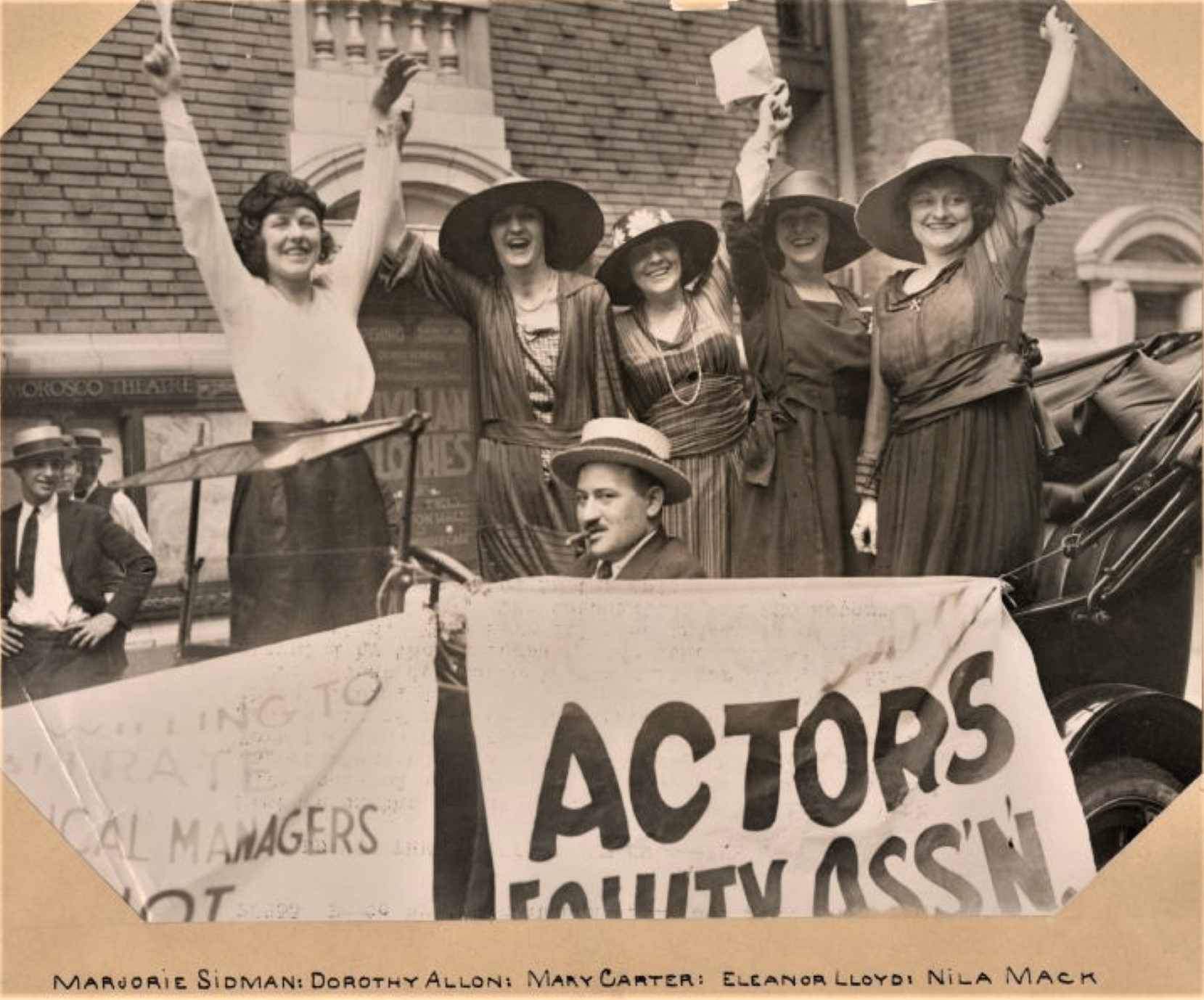
Marot on unionizing among those who previously saw themselves as outside of the working class and labor movement. Just a few years later, a mass strike of actors in the City would follow. Helen Marot (1865-1940) was a journalist from a Philadelphia Quaker background who began the city’s Fabian library in the early 1890s. Comrades of Florence Kelley, she became involved in the labor movement. In 1906, she established the Women’s Trade Union League in New York and would lead the massive shirtwaist makers and dressmakers International Ladies’ Garment Workers’ Union strike in 1909. She left the the leadership of the union for a prolific career as a labor writer, and served as an editor of The Masses. A lesbian, her partner was Caroline Pratt, the famous reform educator.
‘Actors and Teachers’ by Helen Marot from The Masses. Vol. 8 No. 8. June, 1916.
AT a meeting of the Actors’ Equity Association, recently held in New York City to consider the question of joining the White Rats, which is the trade union of vaudeville actors, affiliated with the American Federation of Labor, only one of the eight hundred members present rose to object.
His solitary protest, sounding oddly amid the enthusiasm with which the eight hundred commenced their new adventure, was an appeal to their feelings as artists. He knew they must stand together to get their rights, he said, but why must they put themselves in the same class as bricklayers and hodcarriers? Why must they tie up with labor unions? Why not have their own separate organization?
The question only exasperated the meeting; and when the chairman, Francis Wilson, explained to him that the actors had tried it and found that it didn’t work, the storm of applause which followed signified that they were all of one mind on that subject. They had tried standing alone as artists, and it didn’t work; they must fight for their rights as workingmen.
The organization of a trade union of actors has been in the air for some time. It was precipitated at a performance of Hauptmann’s labor play, “The Weavers,” at the Garden Theater. The “Weavers” company, which was managing its performance co-operatively, gave an invitation performance to the actors in New York City, and between the acts one of the officers of the Actors’ Equity Association made a speech, in which he told the thousand or more actors who were present that the only power which had saved labor today from suffering the conditions endured by the weavers of 1840, was class-conscious organization. He advised them to apply the lesson which common labor had learned, to their own profession This was followed by a call to a meeting of the Actors’ Equity Association to consider the question of becoming a trade union. Meetings were held simultaneously in New York, Los Angeles, Chicago, Philadelphia and Boston. John Drew, Francis Wilson, John Wesley and Grant Mitchell presided at four of them. At every meeting it was voted, in some cases unanimously, to instruct the delegates at the annual meeting in May to vote for affiliation with the White Rats.
At the New York meeting, a representative of the White Rats was one of the speakers. He said he understood the reluctance of actors to taking any action which would seem to imply that they were workingmen rather than artists. But, he told them, their pride in being artists rather than workingmen was the managers’ stock-in-trade; it was good business for the managers to encourage them in thinking that way; for his power over them would end the day they commenced to think of themselves first and foremost as human beings with human wants and necessities. He asked if there was anyone in the room who had not gone through some such experience as this: discovering himself on waking before daylight, on a cold winter morning in an out-of-the-way inn, his engagement having terminated the night before; the only train out of town leaving at an hour which gave him no time for breakfast; walking two miles to the station, and riding in a train with no dining car; arriving in time for rehearsal in a performance in which by luck he had se cured a part by wire the night before, and going through the long rehearsal and the ensuing performance, knowing that he would not get time to eat until midnight. “Do you call that Art?” the White Rat asked. “A bricklayer would call it work, and he wouldn’t do it, and his union wouldn’t let him.” It came out in the discussion that the actors were tired of rehearsing or playing at extra performances without pay; they were tired of making engagements for a season, and at the end of a week finding themselves with a broken contract and unemployed because the receipts did not promise the manager the profits he could secure from some other venture; they were tired of having to pretend that managers were gentlemen; they were tired of pretending that their own needs were different from those of the electricians and stage hands who had made their fight for extra pay for extra work and won it. They were glad to assert themselves as human beings.
They wanted to belong to a trade union because that was the clearest possible demonstration of their change of heart. It made clear their position to themselves and their fellow actors, and, what was still more to the point, to the managers. It made the straightforward announcement that they were in business to get a living and as decent a living as could be got.
It was an interesting coincidence that on the evening of the day when the actors held their meeting, two thousand New York public school teachers voted to carry forward.an agitation among their fellow teachers for trade union organization. This movement among teachers and actors is an indication that some breaches are being made in the social barriers which have so long kept apart those who make their livings in slightly different ways. One must not take those breaks in the walls too seriously, however; the walls are still there. Making a pleasure of their necessity, the actors and teachers are enjoying the unwonted sensations of democratic enthusiasms. But, however integrated with the trade union movement, they will be called “labor’s aristocracy”; and they will be. The actors were reassured by various speakers that affiliation with the A.F. of L. did not oblige them to invite teamsters and longshoremen to tea. It was explained that they did not have to strike in sympathy with the stagehands if they didn’t want to. And somehow one feels that it is probable that they will not want to. I did not attend the teachers’ meeting, but I understand that nothing was said about the value of solidarity between teachers and janitors of school buildings.
These changes are not based on deep-seated instincts of democracy, and anyone who hopes for any striking emergence of that sense among professional people, is likely to be disappointed a little later on. But these changes do offer a hope of substantial social benefits, which their professional pride will help to bring about. Both the actors and the teachers hold, in social estimation, commanding positions in their respective fields of effort. The social tradition that teachers are the authority in matters of education is very strong, in spite of the fact that the governing power in education is lodged in the hands of trustees who are politicians and business men. It is the actors and not the theatrical managers who command the interest and regard of theater patrons; a large part of the play-going world is unconscious of the existence of managers, and pays its respect whole-heartedly where it is really due, that is, to the actors. And we may be sure that neither teachers nor actors are behind the public in appreciation of the importance of their work. These facts make it seem likely that their organizations, when finally established on a realistic basis, will commence a struggle, not merely for control of hours and wages, but for control over the administration of the schools and the stage.
The actors and the teachers have been driven into the labor movement because it is the only movement which has proven its ability and its intention to fight modern business as it is constituted. It is fortunate for the labor movement that conditions in the theater and the schools have made this necessary; for the “aristocrats of labor” are extremely unlikely to use their new-found strength solely in a fight for a few hours a day less or a few dollars a week more. It is in the nature of the situation that the organizing of the teachers will mean a fight to relegate board of education meddling with their business, to the dust-heap. The organizing of actors will mean a struggle to convert managers into elected and paid servants of the actor’s union. Any measure of success they may achieve will establish in the minds of the people the revolutionary significance of trade union organization, inspire labor with a new desire for power, and initiate an era of real industrial democracy.
The Masses is among the most important, and best, radical journals of 20th century America. It was started in 1911 as an illustrated socialist monthly by Dutch immigrant Piet Vlag, who shortly left the magazine. It was then edited by Max Eastman who wrote in his first editorial: “A Free Magazine — This magazine is owned and published cooperatively by its editors. It has no dividends to pay, and nobody is trying to make money out of it. A revolutionary and not a reform magazine; a magazine with a sense of humour and no respect for the respectable; frank; arrogant; impertinent; searching for true causes; a magazine directed against rigidity and dogma wherever it is found; printing what is too naked or true for a money-making press; a magazine whose final policy is to do as it pleases and conciliate nobody, not even its readers — There is a field for this publication in America. Help us to find it.” The Masses successfully combined arts and politics and was the voice of urban, cosmopolitan, liberatory socialism. It became the leading anti-war voice in the run-up to World War One and helped to popularize industrial unions and support of workers strikes. It was sexually and culturally emancipatory, which placed it both politically and socially and odds the leadership of the Socialist Party, which also found support in its pages. The art, art criticism, and literature it featured was all imbued with its, increasing, radicalism. Floyd Dell was it literature editor and saw to the publication of important works and writers. Its radicalism and anti-war stance brought Federal charges against its editors for attempting to disrupt conscription during World War One which closed the paper in 1917. The editors returned in early 1918 with the adopted the name of William Lloyd Garrison’s The Liberator, which continued the interest in culture and the arts as well as the aesthetic of The Masses. Contributors to this essential publication of the US left included: Sherwood Anderson, Cornelia Barns, George Bellows, Louise Bryant, Arthur B. Davies, Dorothy Day, Floyd Dell, Max Eastman, Wanda Gag, Jack London, Amy Lowell, Mabel Dodge Luhan, Inez Milholland, Robert Minor, John Reed, Boardman Robinson, Carl Sandburg, John French Sloan, Upton Sinclair, Louis Untermeyer, Mary Heaton Vorse, and Art Young.
PDF of full issue: https://www.marxists.org/history/usa/pubs/masses/issues/hathitrust/v08n08-w60-jun-1916-u-mich-masses.pdf

