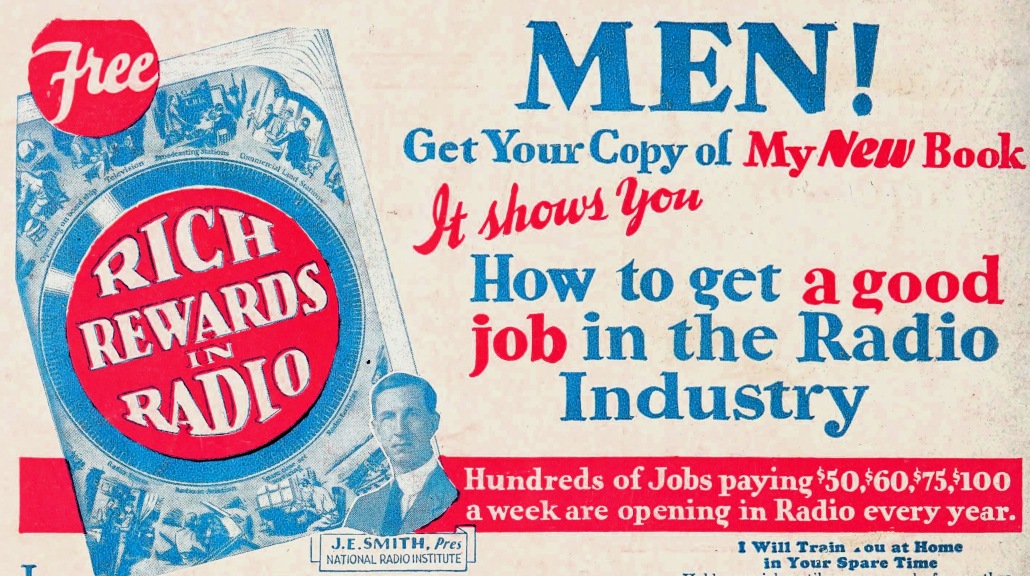
With the first stations airing in the early 1920s, by the mid-30s radio was competing with print and film as the dominant media. Zacharoff looks at another developing technology, that fostered a new mass media, the ‘public’ airwaves, monopolies, reactionary interests, and relations with the government.
‘Radio—the Great American Racket’ by Lucien Zacharoff from New Masses. Vol. 16 No. 2. July 9, 1935.
RADIO broadcasting is an enormous and increasingly powerful medium for mass education, propaganda, organization and entertainment. It reaches simultaneously millions of men, women, and children, literate and illiterate, blind and stay-at-homes. It is on the job day and night.
What is its function today? Is it a public service utilizing those potentialities for the public good? Or is it a monopolistic combine making huge profits at the expense of millions of American workers, promoting fascism, whipping up war spirit, stressing anti-Negro discrimination, enforcing a rigid censorship of news in the interests of finance capital, politicians and demagogues, aiding in strikebreaking, ruthlessly trampling upon the rights and needs of America’s children?
The control which the government exercises over broadcasting is so thorough that all substantial opposition to the Roosevelt regime is effectively suppressed. And why not? Big Business that controls broadcasting is cooperating, obviously in return for favors from governmental agencies, two vice-presidents of the Columbia Broadcasting System are former members of the Federal Radio Commission. The C.B.S. is now holding sway over air channels worth inestimable millions of dollars. Did the two gentlemen now on its payroll have anything to do with providing it with these invaluable properties, while in the pay of the people of the United States, the rightful owners of the air channels?
When a delegation called on Henry A. Bellows, vice-president in charge of Columbia’s Washington headquarters, to complain about denial of facilities for an anti-administration broadcast, it learned a couple of startling facts:
“Much to our surprise, Mr. Bellows frankly stated that no broadcast would be permitted over the C.B.S. that in any way was critical of any policy of the Administration; that the Columbia system was at the disposal of President Roosevelt and his administration, and they would permit no broadcast that did not first have his approval. We pointed out that our speakers were outstanding authorities on the subject to be covered, and nationally known, and that we were entitled to some special consideration.
“The only commitment we were able to get from Mr. Bellows was that if we would get permission from the President or from the Secretary of State, in writing, that they would have no objection to such a program in outlining the position of the Columbia system, stating that he felt that President Roosevelt should be supported by the C.B.S., whether right or wrong, and that inasmuch as he had complete jurisdiction over the programs he was going to see to it that no criticism of any policy or proposed policy was made over the Columbia system.”
Whether right or wrong, Mr. Bellows went to Harvard with Mr. Roosevelt. So much for C.B.S.
The National Broadcasting Company web is equally intent on playing up to the administration in exchange for favors and privileges. Consider Walter E. Myers of Boston, the New England representative of the N.B.C., who was outraged when a conservative spokesman for the American Legion criticized Roosevelt’s slashing of veterans’ appropriations over stations WBZ in Boston and WBZA in Springfield. The criticism was not included in the manuscript which the speaker submitted to the station authorities. N.B.C.’s Mr. Myers indignantly declared that such sacrilegious words were “inimical to the national welfare” and a violation of the “rules of the game.” It was further axiomatic to Mr. Myers that “as a great and powerful agency for the service of the public, these stations cannot become a party to attacks on the national security.”
This sounds like something we have heard before—from Herr Goebbels of Nazi Germany.
Lundeen Bill Banned
REPEATEDLY critical analysis of the various N.R.A. features has been squelched by the self-appointed censors. The radio act specifically states that the political opponents must get equality of treatment on the air. But when Postmaster General Farley journeyed to Rochester to make a political speech over WHAM, the opposition, through skillful subterfuges, was prevented from approaching the microphones. It was not exactly a coincidence that at the time the station was seeking an enlargement of its wavelength from the government commission. Incidentally, Farley’s good man Pettey, who served as the radio man of the Democratic National Committee, was later named secretary of the Federal Radio Commission. Thus, as the Communications Act has it, is “public interest, convenience and necessity” served! There is no graver problem facing the nation in this, the sixth year of the economic depression than social security. So pressing is the necessity for unemployment insurance that a great mass movement, gathering strength swiftly in every part of the country, resulted early in 1935 in the National Congress for Unemployment and Social Insurance in Washington. Nearly three thousand delegates represented American Federation of Labor locals, other workers’ and farmers’ groups, professional and white collar organizations and others.
That representative assemblage regarded the Lundeen Bill as the only adequate measure, really designed to alleviate the misery that six years of the crisis have brought in their wake. After the Congress was over, committees were set up in various states to carry on the campaign for the passage of the Lundeen Bill. As chairman of the committee on radio education for the New York Joint Action Committee for Genuine Social Insurance, the writer approached nine “independent” radio stations in New York City with the suggestion that it would be of mutual advantage to arrange for a regular period on the air, dealing with social security and related questions, such as care of maternity and childhood, health services, old age protection. In vain did the writer stress that the work of the committee was backed in the metropolitan area alone by some 500 organizations, with a total membership of 750,000, embracing all walks of life. In vain did he speak of unqualified endorsement and active participation of the community’s outstanding personalities, like Heywood Broun, Mary van Kleeck and scores of others. In vain did he adduce proof of the absorbing interest and vital importance of such programs.
Political considerations and entanglements played a decisive part in the conspiracy to ignore our proposal. A radio campaign to push a program of genuine social security would run counter to the plans of the administration with its own spurious Wagner-Lewis Bill which has been widely discredited and denounced by wage-earners and the jobless as a counterfeit designed to thwart honest efforts in this direction. Big Business and its government is inimical to any unemployment relief plan that threatens even a fraction of the profits.
So thoroughgoing is the clamp applied by politicians in the saddle that frequently other politicians, equally vicious in their anti-labor attitudes and actions, feel the effects. Recently Representative Hamilton Fish, Jr., of New York, whose Red-baiting crusade of a few years ago had branded him as an open enemy of labor and of all liberty-loving people, got a taste of his own medicine when he was kept off the air by WHN where he was scheduled to deliver a speech of severe Republican criticism of the New Deal. The refusal, as explained by the station, was due to the fact that Fish did not submit his address for inspection two days in advance. But there is no such rule of the Federal Communications Commission.
However, at that time WHN had an application pending before the commission for an increase in station broadcasting power. The station must have feared that the influence of Jim Farley and other Democratic politicians would be felt if a Republican “out” was permitted to criticize the “ins” even though both the “ins” and the “outs” are sworn foes of the working class. Station licenses come up for renewal every six months, Renewals depend on whether the stations live up to the politicians’ notion of “public interest.”
Such is the terror of political control over broadcasting. On the other hand, the Rooseveltian fireside talks periodically broadcast get right of way as well as radio speeches of other Democrats. The Democratic party is right now engaged in a campaign of radio ballyhoo in connection with the $4,880,000,000 “relief” appropriation, the purpose of which is to assist in reelecting the Democrats, and to abet Big Business and war preparations.
And while the Federal Communications Commission is prompt to rise in protest and suitable action when an attack on the administration is broadcast, it tolerates abuses like quack advertising of drugs and patent medicines over the air, advertising so repugnant, so antagonistic to the health and general welfare of the people that even the majority of capitalist newspapers long ago stopped publishing it. It tolerates, to put it mildly, the shady practices of the power trust racketeers and a thousand and one other crimes over the radio. But, while it will occasionally pass a verbal assault by some political “out,” it will under no circumstances countenance genuine analysis, from the working-class standpoint, of the system that has given birth to such abuses.
Similarly, the private interests controlling radio exercise their own censorship. These commercial interests influence persons in strategic positions—Congressmen, leaders of influential civic bodies and others—by granting them broadcasting privileges. Such contacts are mutually advantageous, indeed. Will the politicians act against the evils if they expect to utilize radio in the next campaign?
Money talks and shouts down everything else in the radio racket. Elsewhere the writer has shown that newspapers do not tell the truth about it. Nor do the scores of fan magazines, business, technical and popular-scientific publications. Chains, “independent” stations and writers with commercial entanglements are responsible for most of the printed matter about radio.
Even in such a seemingly innocent arrangement as sports broadcasts a conspiracy exists to rob the audience of true facts. Last year the two baseball clubs in Chicago and the city’s principal broadcasting studios reached an agreement whereby in return for “airing” the summer games, the stations would offer five free periods of advertising on the days when games were scheduled and whereby, as reported in Variety:
“Stations give the baseball clubs a guarantee that all comment on the play-by-play, the weather conditions, decisions of umpires, fights, accidents, and anything that happens within the ball park shall be favorable. No negative comment, neo criticism of players or officials…”
If such gags are applied in the field of sports, why be surprised at the strictest imaginable censorship in the realism of politics, economics, labor relations? An editorial in The Christian Century commented:
“When considered in relation to the future of this vastly important method of mass communication, now only fourteen years old, it is significant. And the significance is not lessened by the fact that several of these stations which have thus signed away their freedom of comment over the air are owned or operated by the same newspapers which have recently been howling their heads off about the N.R.A. threat to freedom of the press.”
The Church on the Air
THE Catholic Church is instrumental in keeping off the air the discussion of birth control and is equally concerned about shutting out other scientific and social problems of the day because of the threat of free intellectual intercourse to its domination of the mentality, psychology and pocketbooks of the faithful. The Catholic Church is the largest corporation in the world. Its wealth in the United States is estimated at about twenty billion dollars; largely real estate, church, school, hotel and rent-bearing residential property, all tax free. Through its priests and laymen it owns huge bank accounts, securities on margin and speculative commodities, etc.
While excluding from the air topics that it does not approve, the church is not backward about promoting its own doctrines on the ether. Its supreme gift to radio is, of course, Father Coughlin.
How thoroughgoing is the vigilance of the Catholic hierarchy over the air channels was recently (April, 1935) demonstrated when it caused sixteen Democratic and Republican members of the House of Representatives to petition the Federal Communications Commission to cancel the licenses of all the stations that broadcast a program under the supervision of the Mexican government. The petition was prompted by the objections of the Catholic weekly America and its editor, Father Wilfred Parsons. Mexico is a sore spot with the priests because of the deflated position of the church in that country and a complete separation of this superstition and ignorance-laden institution from the state and school system. Again and again religious interests have sought an official meddling in Mexican affairs by the United States Government.
The ultimate solution of the radio problem will be provided by some 18,000,000 American families whose investment in receiving sets, accessories, servicing, etc., already constitutes 90 percent of the total investment in the industry as contrasted with 10 percent invested by broadcasters.
This answer will be determined by the degree of awakening of the swindled masses to the realization of the extent of the Great American Radio Racket. It will hinge on the extent of general-opposition to the control by fascists, warmakers and profiteers. This answer will be accelerated by the understanding of the havoc radio programs are playing today with the children’s minds, pouring into them steadily the poison which is certain to leave permanent effects of untold damage.
When the people of this country, whose work and money made radio possible, wake up to the simple facts that theirs is the sovereign right to the ownership of all air channels, without the permission of the power trust, capitalist press and other financial and business interests, when they decide to do something about it, they will be faced with a chaotic condition that under the most favorable circumstances, will not be rectified for a long time to come. They will have to wipe out advertising blather of radio sponsors, the censorship of private corporations, the lobbies, such as recently were instrumental on the air in defeating the Tugwell food and drug bill; at that time advertisers threatened to withdraw their appropriations for proprietary-medicine, drug and food sponsored programs if the stations did not see to it that no campaign against their products was tolerated over the air.
Freedom of thought and speech will be safeguarded so soon as a mass movement to place management of air channels where it belongs gets under way. Under these safeguards the Communist Party and other minority groups in the field of social, political, and economic activity will have outlets for their views. The term “minority” is here used solely for convenience. In the opinion of the writer it is the vested interests, now in control, that are a negligible minority, conducting their sinister business and fleecing the masses for the benefit of the same handful of exploiters. In his opinion, when a great university or museum seeks to broadcast a series of educational programs, or a mass organization attempts to transmit a message of unemployment insurance, to combat war and fascism, such efforts are truly in the interests of an overwhelming majority and tend to advance the greatest good for the greatest possible number of people.
To alleviate the evils—of which but a negligible number has been mentioned—extant in radio broadcasting under the present setup and to realize at least in part the potential public benefits in the near future, the writer proposes the establishment of a Radio Federation. The Radio Federation is to function through local action committees that will utilize mass pressure in support of the following tentative program:
1. Elimination of war, fascist and anti-labor propaganda from the air.
2. Systematic presentation of the message of real social security.
3. Protection of children against injury and exploitation by broadcasters and advertisers.
4. Broadcasts untainted by commercialism.
5. Provisions for regular educational programs for children and adults during suitable hours and through appropriate outlets.
6. Boycott of broadcasters and products of the sponsors who do not live up to the foregoing essentials of public welfare.
7. Establishment of an official organ to advance “public interest, necessity and convenience” in broadcasting.
The New Masses was the continuation of Workers Monthly which began publishing in 1924 as a merger of the ‘Liberator’, the Trade Union Educational League magazine ‘Labor Herald’, and Friends of Soviet Russia’s monthly ‘Soviet Russia Pictorial’ as an explicitly Communist Party publication, but drawing in a wide range of contributors and sympathizers. In 1927 Workers Monthly ceased and The New Masses began. A major left cultural magazine of the late 1920s to early 1940s, the early editors of The New Masses included Hugo Gellert, John F. Sloan, Max Eastman, Mike Gold, and Joseph Freeman. Writers included William Carlos Williams, Theodore Dreiser, John Dos Passos, Upton Sinclair, Richard Wright, Ralph Ellison, Dorothy Parker, Dorothy Day, John Breecher, Langston Hughes, Eugene O’Neill, Rex Stout and Ernest Hemingway, Artists included Hugo Gellert, Stuart Davis, Boardman Robinson, Wanda Gag, William Gropper and Otto Soglow. Over time, the New Masses became narrower politically and more journalistic in its tone.
PDF of full issue: https://www.marxists.org/history/usa/pubs/new-masses/1935/v16n02-jul-09-1935-NM.pdf

