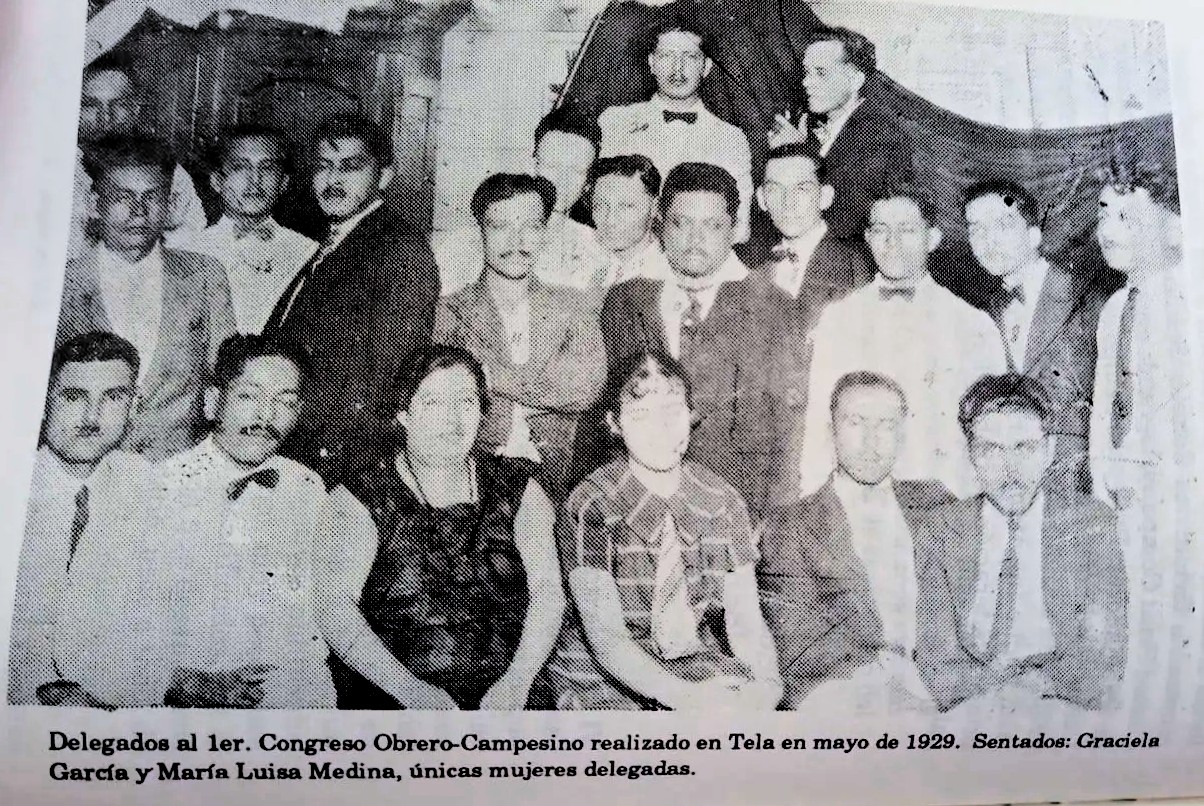
A report on the May 1, 1929 founding of R.I.L.U. affiliate, the Honduran Trade Union Federation (Federacion Syndical Hondurena), which would play a leading role in that country’s class war during the 30s, to eventually be destroyed by repression. Chief among concerns at the meeting was the need to address themselves to Black workers if they were to organize the Central American behemoth that was Empire’s United Fruit Company.
‘Honduran Workers Turn Left’ from Pan-Pacific Monthly (P.P.T.U.S.). No. 30-31. September-October, 1929.
[Transiated from “El Trabajador Latino Americana”]
ON the first of May, at the conclusion of a great Labor Day demonstration, there was held at Tula, Honduras, an important National Trade Union Congress, which established the Honduran Trade Union Federation. The creation of this new center is due to the fact that the leaders of the old Labor Federation not only had failed to uphold labor principles and renounced active defense of the most elementary rights of the working class, but had allied themselves with the national bourgeoisie and the Yankee banana company–the United Fruit Co.
The toiling masses of Honduras, seeing the frank and open treason of their leaders, resolved to create a new center, and this is composed of the absolute majority of the unions of the country, among them the fighting Railway Union (Union Ferrocarrilera) of Honduras.
The yellow and governmental Labor Federation, an adherent of the Pan-American Federation of Labor, remains reduced to a small nucleus, with no influence whatever among the working masses.
The success of the Congress was extraordinary and exceeded the most optimistic expectations. All that is important and healthy in the Honduran trade union movement attended the Congress. One of the most interesting points to the delegates was the continental unity of the proletariat, the Congress resolving by acclamation to adhere to the Latin-American Trade Union Confederation, sending word to that effect to Montevideo by cable.
Especial attention was given to the problem of Negro workers. This problem has serious aspects in Honduras, there having been frequent collisions between native workers and Negro workers brought in from the Antilles by the banana enterprises.
These Negroes are obliged to work for miserable wages, much below the native proletariat, and are used systematically by the company to displace native workers. The Congress dealt with the problem from the standpoint of class, resolving to begin a vast campaign of agitation to organize the Negro workers.
Other questions thoroughly debated were: The peasant question; the organization of proletarian women; the war danger in Latin-America, the danger of a world war, etc.
Upon this last question, it was decided to recommend to the national trade union centers of the Central American proletariat, the holding of a special Central American Anti-War Conference.
The headquarters of the Executive Council of the Honduran Trade Union Federation was established at the city of Tegucigalpa, Honduras, and it was unanimously decided to issue a journal—“El Trabajador Hondureno”, as the Federation’s official organ.
The constitution of the new Federation is based on the principle of the class struggle.
With the Congress ended, the new center began an intense work of organization, reorganizing a number of previously decadent unions. In the short time of one month the Federation has become known and respected by the national proletariat. Because of this, the former “labor leaders” who are really agents of the government and the Pan-American Federation of Labor, allied at the same time to the national bourgeoisie and the Yankee banana bosses, have begun a furious attack against the fighting Honduran Trade Union Federation, accusing the revolutionary workers of “sedition”. ·
This expression gives the measure of the reaction and of the ruinous treason to the workers’ interests on the part of these ex-leaders. On its part, the bourgeoisie is beginning also to attack, quick to respond to the wish of the Yankee capitalists, who have obtained by a thousand subterfuges the closing of the printshop of the valiant revolutionary paper of the Honduran proletariat, “El Martillo“.
The PAN-PACIFIC MONTHLY is glad to announce that, despite the above statement that the shop of “El Martillo” was closed, the paper still appears, defiantly announcing that despite all the persecutions against it, barring it from the mails, seizing its issues, and so on, it will keep up the fight, illegally if need be, in Honduras or “in any capitalist country; and if these put us out, we will go to Russia, to beloved Moscow, from where we will tell the proletarians what are their rights and how to make them effective.” Let the world imperialists take note of these simple words coming from the remote corners of the earth, to know what “Moscow” means to the world’s oppressed–then let imperialism dare to attack the Soviet Union, to find that ere “Moscow” falls the whole world will flame beneath their feet.
The Pan-Pacific Monthly was the official organ of the Pan-Pacific Trade Union Secretariat (PPTUS), a subdivision of the Red International of Labor Unions, or Profitern. Established first in China in May 1927, the PPTUS had to move its offices, and the production of the Monthly to San Francisco after the fall of the Shanghai Commune in 1927. Earl Browder was an early Secretary of tge PPTUS, having been in China during its establishment. Harrison George was the editor of the Monthly. Constituents of the PPTUC included the Australian Council of Trade Unions, the All-China Federation of Trade Unions, the Indonesian Labor Federation, the Japanese Trade Union Council, the National Minority Movement (UK Colonies), the Confédération Générale du Travail Unitaire (French Colonies), the Korean Workers and Peasants Federation, the Philippine Labor Congress, the National Confederation of Farm Laborers and Tenants of the Philippines, the All-Union Central Council of Trade Unions of the Soviet Union, and the Trade Union Educational League of the U.S. With only two international conferences, the second in 1929, the PPTUS never took off as a force capable of coordinating trade union activity in the Pacific Basis, as was its charge. However, despite its short run, the Monthly is an invaluable English-language resource on a crucial period in the Communist movement in the Pacific, the beginnings of the ‘Third Period.’
PDF of full issue: https://www.marxists.org/history/international/profintern/pan-pacific-monthly/n30-31-sep-oct-1929-PPM.pdf

