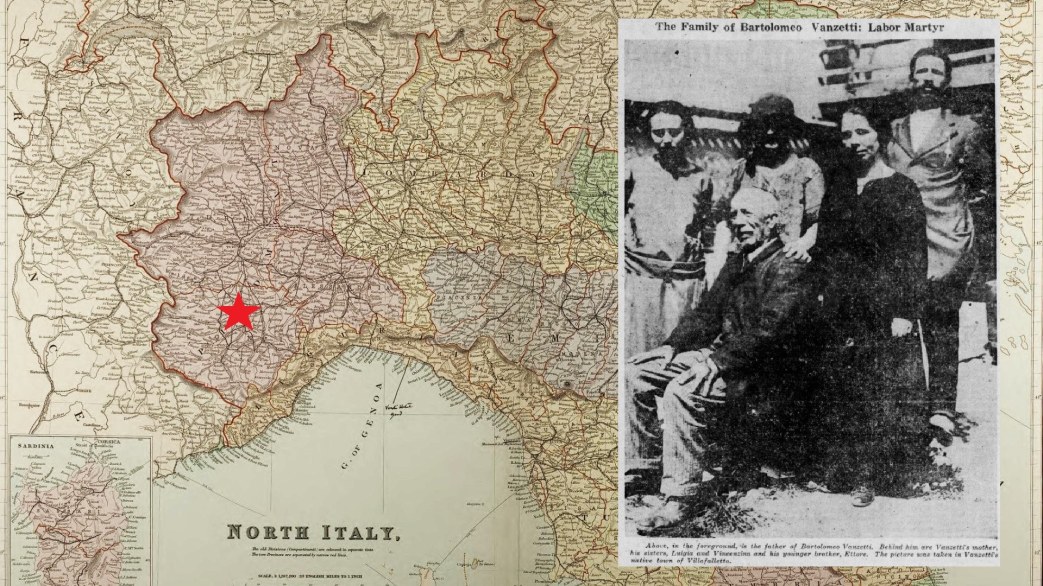
Dana, a Massachusetts Blue Blood, grandson of Henry Wadsworth Longfellow, was an openly gay (as much as could be then) Leftist fired from teaching at Columbia for his anti-war activity in 1917 who then moved to the Longfellow Home in Cambridge, next door to the arrest and trial of Sacco and Vanzetti. A ‘fellow traveler’ who wrote extensively for the Communist and left press, Dana became a central figure in the solidarity movement, getting to know and popularize Sacco and Vanzetti while they were in prison. Shortly before his execution, Vanzetti gave Dana a letter for his family if he was ever in Italy. Below is his report of the evening spent them in the martyr’s hometown of Villafalletto in northwest Italy.
‘Villafalletto: A Visit to the Family of Vanzetti’ by H.W.L. Dana from The Daily Worker. Vol. 5 No. 199. August 22, 1928.
“VILLAFALLETTO,” cried the railway guard at last, and as I stepped off the train at a little isolated station in northern Italy, I read on a sign the word that had been already imprinted on my memory: “Villafalletto.”
Often during the seven long years of his imprisonment, Bartolomeo Vanzetti used to describe to me his native town. “Villafalletto rises on the right bank of the Magra in the shadow of a beautiful chain of hills,” he wrote and added, “The deep green of the north Italian valleys is a living thing in my mind today.” Shortly before he was put to death he wrote to me urging me, if ever I were in Italy, to go and visit his family. Now at last I was able to do so and had come to see the surroundings in which he had grown up and which had always meant so much to him.
Twenty Years Ago.
As I got off on the platform, I realized that it was here at this same railroad station that Vanzetti had said goodbye to his family twenty years ago when he had left home being, as he put it, “drawn to America by my love of freedom.” The freedom for the working class I which he had not found there, he had fought to give America, and America had given him death.
From the railway station it was more than a mile’s drive up to the hill town of Villafalletto itself. I got into a covered wagon crowded with villagers who had returned by the train and the wagon made its way slowly up the winding road towards the little town among the foothills. Already the sun had set behind the mountains and the night was fast coming on.
Villafalletto and Dedham.
At length we rattled across the little bridge over the Magra and passing through an old gateway like that of a castle entered the town of Villafalletto. The one central street with the stream of wat er flowing through the middle of it at which the women washed their clothes offered a striking contrast to the wide lawns of the bourgeois estates in the town of Dedham, Massachusetts, where Vanzetti had been condemned to death. I thought once more of the contrast in the courtroom between the bronzed figure of Vanzetti himself and the shrivelled form of the New England judge. In the two towns as in the two men, Italian labor and American capital seemed face to face.
As I alighted then from the carriage and set foot in this town, I found myself trembling with shame and indignation for my own country. Here was I from Massachusetts, venturing to come here. At the inn, said to be the oldest in Italy, I asked for Vanzetti’s home. I was conscious at once of penetrating glances and yet a warm sympathy. There had been around the whole world a great rending cry at the execution of Sacco and Vanzetti–the voice of an “international of justice” such as the world had never heard before.
In Czechoslovakia in one of the cities the central square that had ten years ago been christened “Wilson Square” has now been renamed “Sacco and Vanzetti Square.” In Moscow there is a “Sacco and Vanzetti Theatre” with large portraits of them on the facade. Instances of this sort can be found today in every country showing that their memory is still alive.
“Gentle, Thoughtful.”
Yet the inhabitants of this little town of Villafalletto seemed unaware of the world importance their Bartolomeo Vanzetti had come to hold. They pressed around me with questions about the trial and the execution in America and volunteered all sorts of information about Vanzetti’s life at Villafalletto. One old woman remembered him as the most gentle and thoughtful boy their town had ever known. One of his schoolmates told me of his brilliance in his studies and of his unquenchable ardor for reading. One and all in Villafalletto were convinced of his complete innocence of the crime attributed to him. But I found in them a sort of mute acceptance of injustice which I came to feel characteristic of poor workers like these under a fascist regime.
They pointed out to me across the darkened street the yellow lights from the windows of Vanzetti’s house. There I found his family warm-hearted in their hospitality through all the anguish of their suffering. I came to see in them the very traits I had learned to love in him. His two sisters, Luiga and Vincenzina, were kindly thoughtful and alert in interest. His younger brother, Ettore, was a shy but friendly lad. The father, a fine old Italian with a face that seemed carved out of hardest granite, came in later. He was courteous and kind but seemed a broken man, unable to talk about the case and sat throughout our conversation ominously silent. From neighboring houses in the course of the evening there dropped in an aunt, some young cousins, and a woman who, Vanzetti had told me, had been after his mother’s death a sort of second mother to him.
They led me to a table and insisted in giving me things to eat and drink. In the letter of introduction which Vanzetti had given me to his family he had written with characteristic thoughtfulness and naivete: “Give Professor Dana white wine because that is better suited to Americans, since they are not accustomed to drink.” With a smile they offered me my choice from the well supplied wine store of the father.
Vanzetti’s Letter.
After supper, I read them the various letters I had received from Bartolomeo, and showed them the pictures in the newspapers, the cartoons, and the posters about Sacco and Vanzetti that I had gathered in America and the various countries of Europe. They in turn showed me family portraits, pictures of Bartolomeo at various ages from earliest childhood, and a long series of letters from him during the seven years of the trial–much the most complete record of his thoughts that exists and one which must be taken into account in any attempt to write the full story of his life. They told me of the terrible days of suspense they had passed and the night of anguish waiting for the final news. They spoke too, of the family of Sacco at Torre Maggiore in the extreme southeast of Italy as they were in the extreme northwest. Half the night was spent in our talk before we finally went to bed.
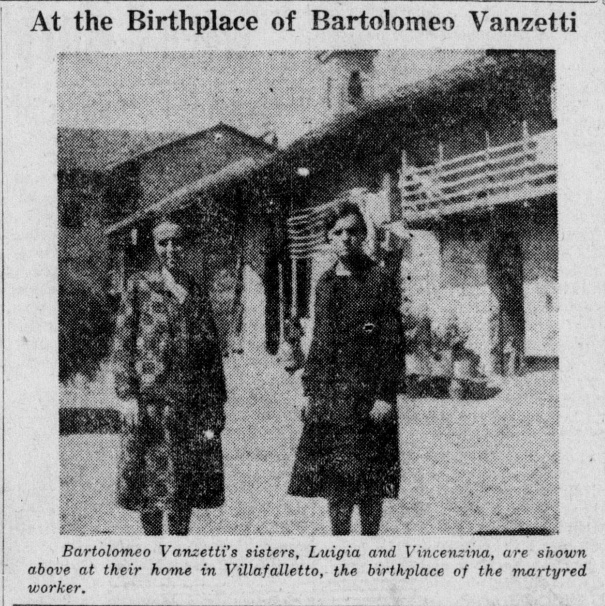
The next day they took me out of doors, through the courtyard surrounded by galleries and through a lane to the vegetable garden where Bartolomeo had told me he used to love to work as a boy. Here now his young brother, Ettore, was at work and pointed out with pride the trees Bartolomeo had planted. The cousins told me of the sympathetic fondness he had felt for all living things in this garden. It all bore out Sacco’s spontaneous characterization of Vanzetti as “the man kind to all.”
His Own Room.
The sisters showed me the room where their mother had died while Bartolomeo was a boy and I remembered his account of his pathetic attempts to stop all sounds that might disturb her during her sickness, rushing out into the street to implore noisy groups of young men please to go elsewhere. We saw the forest where he used to wander in despair after her death and the bridge where he used to stand and look longingly at the bed of the stream beneath.
The family did not share, did not understand Vanzetti’s views, but I always felt their ardent confidence in his character and their complete conviction of his innocence. If they did not raise their voices in strident outcries against the deep damnation of his taking off, it seemed to me only a part of that same dumb submission to unjust authority which I had already felt when I first spoke to these humble village workers in Mussolini’s Italy. But there was not a trace of any sense of shame, only of silent pride.
His Last Letter.
This was brought out clearly when they came to read aloud to me Vanzetti’s last letter of which they allowed me to make a copy. It was a letter written just before his death–a letter full of calm preparation and proud strength. It was dated: “The New Era: The First Day” and was in part as follows:
“I am calm and prepared for all that may come. I swear to you my complete innocence of the crimes attributed to me and of all other crimes. Do not feel ashamed of me. A day will come in which my life will be known such as it really was and then all you who call yourselves by the name of Vanzetti will be happy and proud of that name. Already all those who know me love and respect me. I have inscribed my gravestone with twenty years of life consecrated to the pursuit of justice and liberty for all. If I must now die through fault of the greatest injustice of men and of circumstances, I can rest assured that no one of those who have been my enemies will be mourned as I shall be…I shall fight to the last moment in order to conquer. Then lift up your spirits.”
As I watched the dignified, exalted look on the faces of the family as they stood listening to the reading of this letter, I felt confident that they had lifted up their spirits and that they were proud to bear the name of Vanzetti.
The Daily Worker began in 1924 and was published in New York City by the Communist Party US and its predecessor organizations. Among the most long-lasting and important left publications in US history, it had a circulation of 35,000 at its peak. The Daily Worker came from The Ohio Socialist, published by the Left Wing-dominated Socialist Party of Ohio in Cleveland from 1917 to November 1919, when it became became The Toiler, paper of the Communist Labor Party. In December 1921 the above-ground Workers Party of America merged the Toiler with the paper Workers Council to found The Worker, which became The Daily Worker beginning January 13, 1924.
PDF of full issue: https://www.marxists.org/history/usa/pubs/dailyworker/1928/1928-ny/v05-n199-NY-aug-22-1928-DW-LOC.pdf

