
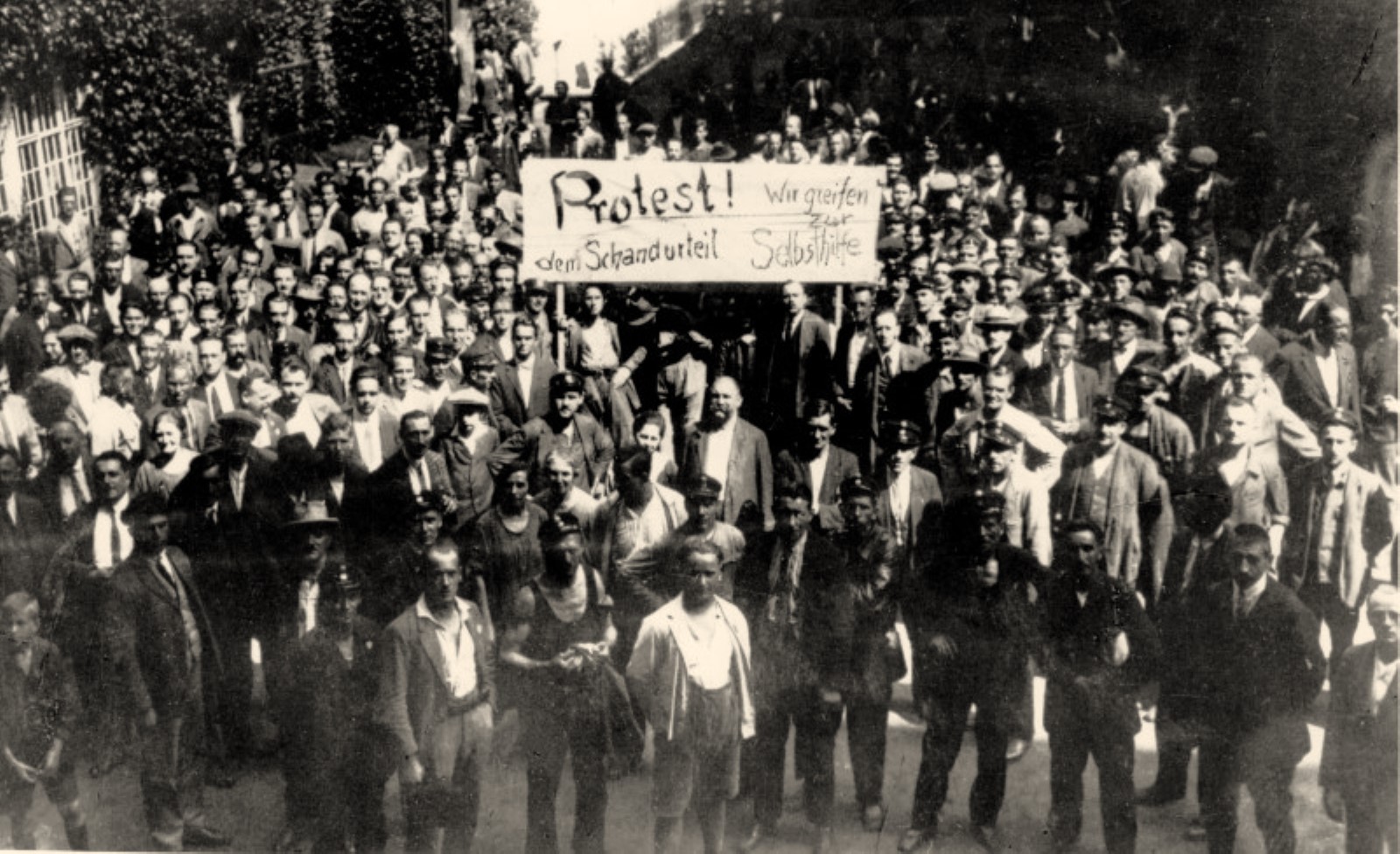
C.I. editorial on the heroic and tragic events in Austria during 1927. The working class of Vienna rose up on July 15, 1927 in a rebellion, Wiener Justizpalastbrand, against the police and the courts. A general strike was called after the acquittal of reactionary nationalists for the murder of two Social Democrats at a rally earlier that January. Beating back the police and erecting barricades, Vienna laid siege to, and then burned down, the Palace of Justice. As security forces fought to regain the city, hundreds were wounded and killed in street fighting and police massacres.
‘Vienna’ from Communist International. Vol. 4 No. 13. September 15, 1927.
“There is but one way of opposing the civil war which our enemies are now preparing. That way lies in voting for Social-Democracy.”—(“Arbeiter Zeitung,” 24-4-27.)
“One important lesson can be drawn from the election campaign: the road we have chosen—-the conquest of State power by democratic means—is shown to be absolutely possible.”—(A speech by O. Baner. “Arbeiter Zeitung,” 5-5-27.)
BLOODY confirmation of Austro-Marxian theories: eight years of Social-Democratic administration of the municipality of Vienna, and on July 15th, 1927, hundreds of workers are shot down by the police right in front of the high citadel of Social-Democracy! With a cruelty never equalled by the police of “imperial” Vienna, the police of “Red” Vienna, the police of the Social-Democratic burgomaster Seitz, shot down defenceless workers from behind. Fight years of Social-Democratic administration, and vet it is proved possible for the police to remain the tool of reaction, the police more than 90 per cent. organised inside the free trade unions.
Our comrades, the constables, whose caps were decorated with red carnations on the 1st of May, were the pride of the Vienna working class, organised on a free and a Social-Democratic basis. When Communists were occasionally maltreated by the police a shrug of the shoulders served as the excuse. The Viennese worker trusted the police blindly, just as he trusted the burgomaster and his other Social-Democratic colleagues.
And then suddenly, expected neither by the Viennese workers, nor by the working class of the whole world, this “Red” Vienna, so proud of the least bloody of all revolutions, becomes the arena of a horrible bloodbath. Fifty years of the Austrian Labour movement, forty years of a struggle against the Hapsburg reaction and the monarchy, the days of the overthrow of 1918 all these have not cost so much workers’ blood in Vienna as this one day—the 15th of July, 1927.
The Fascist Attack
The workers of Vienna have been maliciously attacked. They have been attacked in a Fascist manner, with the consent and support not only of the Austrian bourgeoisie, but of the bourgeoisie of the entire world.
Previously Fascism could not find its place in Vienna. Austrian Fascism consists primarily of ex-officers and the reactionary peasantry. A carefully planned agitation against the workers on the one hand, and the want of understanding of the peasant question shown by the Austrian working class on the other, have enabled Fascism and reaction to gather underneath its banner the overwhelming majority of the peasantry. These Fascist organisations prevent the growth of the Labour movement in the purely agricultural areas. They also try to intimidate the Labour movement in the towns. Five years have now passed since the Fascists, for the first time, provoked the workers by assassinating one of their trusted leaders, Birnecker.
The reply of the Social-Democrats was an extension of their Defence Corps. But the Fascists were not frightened by this step, as is proved by the constantly recurring assassination of workers. Still, Social Democracy remained inactive. Only one thing it offered to the poor victims—a beautiful funeral. Ringing speeches, the playing of funeral marches, and the flourishing of trumpets by the Republican Defence Corps constituted their sole reply to Fascist provocations. And that is not all.
Social-Democracy itself is responsible for the bloodshed of the 1sth of July. It has made the proletariat impotent in spirit and defenceless in practice. The triumphant processions after the recent elections were intended to instill into the workers a belief in the security of democracy, a belief that there was no likelihood of a reactionary attack upon the working class.
Probably many among the victims of the police had been Social-Democratic voters who childishly believed in the promises of Otto Bauer, Julius Deutsch and Friedrich Adler. This did not, however, protect them from being shot down by the police of a Social-Democratic burgomaster.
Reformist Responsibility
The paralysing of the revolutionary spirit of the working class by Otto Bauer and other Austro-Marxists, the allusion concerning a peaceful building up of a “Socialist” community—these are the factors responsible for the July incidents.
Furthermore, the working classes have actually been disarmed, literally speaking. The Austrian Communists had appealed in vain to the workers: “The Fascists are ready for the fight. Get yourselves armed and disarm the reaction.” The Social-Democrats did exactly the reverse. Only a few weeks ago they handed over their arms—which had remained with them since the November days of 1915—to the Government, and so, indirectly, to the Fascists. We have thus in Vienna as a result of eight years of Austro-Marxian governmental policy a moral and material disarmament of the Viennese proletariat.
Such was the preparation. And now for their stand during the incident. Burgomaster Seitz issued no single word of protest against arming the police with rifles. He only “recommended other means.” But Social-Democracy did not even stop there. By putting the Republican Defence Corps into police uniforms and marching them against the workers, Social-Democracy became the direct successor of Noske. Like Kuttner, Julius Deutsch may pride himself with having led organisations that helped to overthrow the revolutionary movement.
Such is the result of the Austro-Marxist governmental policy: moral and material disarmament, and a going over of organisations intended for the defence of the working class to serve the purpose of the bourgeoisie.
Where Communist appeals and warnings failed, the provocations of the Fascists succeeded. They roused the indignation of the Viennese working class to a point of explosion. The Social-Democrats believed, even after the murder of workers in Schattendorf, that a beautiful funeral, as the saying goes in Vienna, was enough to cool the revolutionary indignation.
They were mistaken. The Schattendorf murder trial, which was accompanied by fresh Fascist provocations, showed the workers that the Government was willing openly to acknowledge Fascism. While the Attorney General in court was trying to put the blame of the murder on to the murdered workers, Viennese Fascists made fresh attacks upon Labour organisations in the immediate neighbourhood. And the Social-Democrats issued “warnings” against provocations.
As recently as the 13th of July the “Arbeiter Zeitung” spoke about provocateurs who were committing unconsidered acts. On the 13th of July Social-Democrats were still fooling themselves into a belief that the workers’ indignation was not in earnest. When, however, on the following day the release of the assassins became known, then even the sugary leading articles of Austerlitz were unable to calm the workers.
The demonstration of the workers in the streets was of a spontaneous nature, as on the 1st December, 1921, when the Government doubled the price of bread overnight. As at that time, the unions were amazed at the suddenness of the strike and the spontaneity of the demonstration. There had been no attempt at organising a public demonstration, and yet, as if from nowhere, tame hundreds of thousands of Vienna’s proletariat and gathered outside Parliament, the very heart of the city.
1921 and 1927
How different was this demonstration of protest from that of 1921, when Seipel’s policy of stabilisation was born. The indignation of the demonstrators was then directed against those battening on the misery of the masses; the Hotels de Luxe, the luxury shops in the Ringstrasse and in the Kaitnerstirasse, were destroyed. Stones were thrown into the mirrors of cafés, where the idle sons of the bourgeoisie were making themselves comfortable.
But this time the workers never came near the bourgeois quarters. They did not smash windows but directed their storms of protest against the centre of reaction, of Fascism, against the University, Parliament and the Palace of Justice. At the University and the Parliamentary building the masses were forced to retreat by the police, who attacked them with drawn swords. The Palace of Justice was made the victim of their indignation. There, where otherwise only judges in scarlet robes stroll about, the workers forced their way in, threw documents into the streets, and made a bonfire, which symbolised the destruction of class justice.
Yet another difference. When on a dull afternoon in December, 1921, hundreds of thousands from the factories, and hungry wives of the workers and the unemployed, were gathering in the city, the police sneaked off into their mouseholes. Not a single shot was fired.
Five and a half years later the police fire at the crowd; they do not shoot in one direction but everywhere, wherever even small groups of workers are assembling. The workers, however, do not disperse, but try to offer resistance against the police attack in every possible manner. Barricades, disarming of individual police groups, even an attempt to liberate prisoners and to occupy police stations, characterise the will to fight of the workers. They demand an active resistance, they call for arms—but Social-Democracy has seen to it that they are defenceless.
Between 1921 and 1927 lies the period of stabilisation. The sacrifices and the sufferings of the working class on account of this stabilisation can well be imagined when it is realised that they are ready to face, unarmed, the bullets of the police.
Betrayed by Bauer
At the special delegate conference of the Social-Democratic Party on the 17th July, which was intended to throttle the whole movement, Otto Bauer himself could hardly make clear what Social-Democracy wants. He said:
“The call ‘Give us arms,’ which representatives of the workers have heard everywhere, is humanly very irreasonable. I must justify myself before you for our lack of resolve in not trying to arm, in a disorderly and irregular way, the wildly excited proletarian masses.”
Indeed, why not? That would have led to civil war. And a delegate, an old soldier, replies:
“I have been four years in the trenches and one year a prisoner, yet never did I weep. But when I saw how we faced the police unarmed I wept bitterly.”
These Social-Democrats wept because their leaders gave them no arms. Surely not all? Many understood the Communist call for arms and followed it.
The tragedy of the Austrian Labour movement, which came out clearly in the intense outbreak of revolutionary passion during the July days, is the fact that the revolutionary Austrian working class has been taken in—until to-day—by the left wing phrases of the Social-Democrats. The Social-Democrats have hitherto understood how to give the workers playthings to divert them from their fight. Charity from the Vienna City Council instead of the class war, a policy of “tips” instead of expropriations, Republican Defence Corps instead of arming the workers, funerals instead of measures for defence—that is the practice of Austro-Marxism.
The companion picture to Austro-Marxism is the absence of a Communist mass party in Austria. The Communists have so far failed to secure that position among the workers which the Communists of other countries have gained by fighting. Their weakness, arising from the peculiar situation in Austria, is another reason for the lack of leadership of the Austrian working class during the July troubles.
Weakness of the C.P.
Nevertheless, the Communists of Austria have carried out a correct policy. They introduced the slogans of “Arm the proletariat in the struggle against Fascism!” and “Overthrow the bourgeois Government!” They did all in their power, but they were not strong enough to break down the Social-Democratic influence.

The weakness of the Communist movement enabled the Government to force the Social-Democrats to an unconditional surrender. The Social-Democrats were not afraid of losing their leadership of the working-class movement to the Communists, who had to face the fire of the combined attack of Social-Democracy and the bourgeoisie. Therefore they surrendered. They sent back the workers into the factories without even having obtained the smallest concessions.
The working class will never forget these days. Within the coming weeks and months they will face the same question as on the 15th of July. Will they allow themselves to be shot down, unarmed and unled, by Schober’s and Seitz’s Guards, or will they arm and defend themselves under revolutionary leadership?
Under these circumstances enormous tasks and possibilities arise for the work of the Communist Party. It must now take over the leadership of the masses, because it alone foresaw the need for, the inevitability of the conflict.
We know that at present all the fury of the Social-Democrats and of the bourgeoisie is directed against us. The Austrian Communist Party and the Communist International are being made responsible for the crimes of Social-Democracy. Political emigrants and left wing students from countries of the White terror are being made the first victims of the police terror,
Social Democrats will join Communist Hunt
As in 1919, when the Austrian Communists fought for active solidarity with the Hungarian and Bavarian Soviet republics, so to-day Fritz Adler will assuredly give out the watchword: “No mercy for the Communists.” It was this watchword for which young Viennese proletarians gave their lives on the 15th June, 1919.
We do not know what Austro-Marxism will try to do now. It has but one prospect: participation in the Government. It has but one aim: the peaceful conquest of the State power
The police of Vienna have given a set-back to the workers’ attack. In a sanguinary way they have tried to stifle the workers’ indignation against Fascism and class justice. But the radicalism of the Viennese workers cannot be wiped out by the dum-dum bullets of the police, just as it could not be wiped out by the methods of Bauer and Seitz.
The Future
As an immediate result of these incidents Communis‘s, not only of Vienna but of the whole of Central Europe may expect renewed repression. Communists, however, realise that they alone gave to the workers a definite lead. Communism alone is able to offer the workers a better future.
The Communists stood the acid test in Vienna. A definite task awaits them now: not to allow the indignation of the masses to evaporate, but to exploit it by grouping the masses under revolutionary leadership.
The fallen are now lying in their graves. The shooting of the police has ceased. Members of the Republican Defence Corps still wear their police uniforms, but for the time being they have completed their work of stifling the class movement. The factories are at work, the tramways are running again.
How the Social-Democrats would like to convince the workers that all the recent events were but a nightmare! But the workers are not conquered. To-morrow the indignation may break out again, when class justice takes its revenge on those arrested on the 15th July. The Fascists will become still more impudent, because they know that the Republican Defence Corps is on their side in the struggle for the suppression of the working class under the dictatorship of the bourgeoisie.
But the workers, who built barricades in the streets of Vienna, who defended themselves against the police attack with desperate strength have in this way commenced a new epoch of the revolutionary campaign, not only in Austria but throughout Central Europe.
It is our duty to bring about a final breakdown of the International of Social-Democracy by utilising the July struggles, in which the model party of the Second International delivered the workers to the hands of the butchers. Our Austrian Party, which began the fight successfully in these difficult days, will continue it with the assistance of the whole Communist International. The epoch which began in the July days will be an epoch of heavy struggles. This time the Communists will see to it that the working class is armed.
The ECCI published the magazine ‘Communist International’ edited by Zinoviev and Karl Radek from 1919 until 1926 irregularly in German, French, Russian, and English. Restarting in 1927 until 1934. Unlike, Inprecorr, CI contained long-form articles by the leading figures of the International as well as proceedings, statements, and notices of the Comintern. No complete run of Communist International is available in English. Both were largely published outside of Soviet territory, with Communist International printed in London, to facilitate distribution and both were major contributors to the Communist press in the U.S. Communist International and Inprecorr are an invaluable English-language source on the history of the Communist International and its sections.
PDF of full issue: https://www.marxists.org/history/international/comintern/ci/vol-4/v04-n13-sep-15-1927-CI-grn-riaz.pdf

