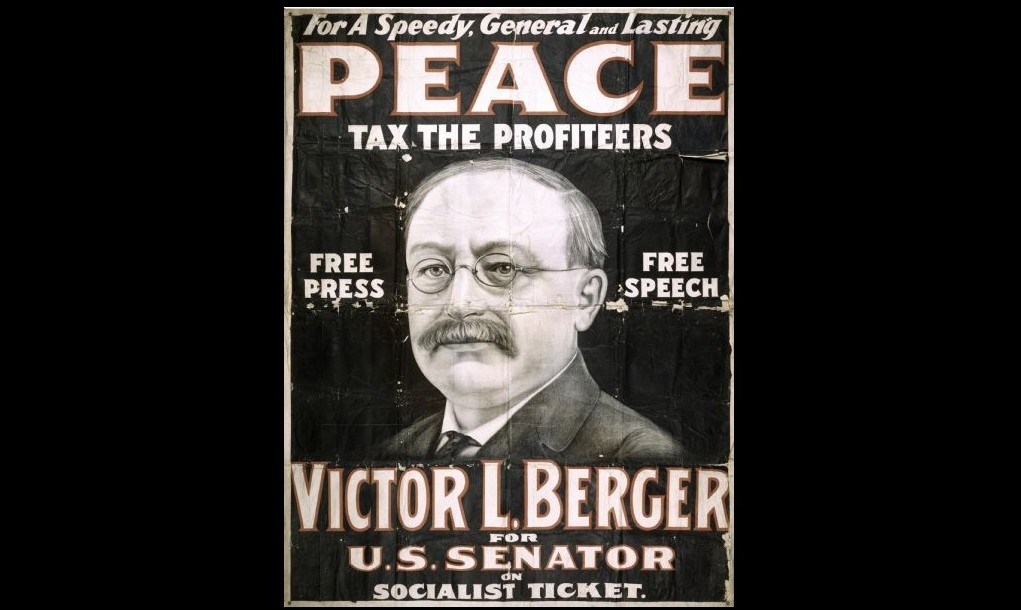
An interesting document coming as it does near the end of the war, with the Russian Revolution developing, the Red Scare repression well underway, and reflecting a Party deeply divided but not yet split between Left and Right. The Socialist Party would win around 3.2% nationally (though running only in a minority of districts) in the elections of 1918, with Meyer London losing his New York City congressional seat but Victor Berger, who had done very well in a Senate special election earlier in the year. winning a House seat from Milwaukee. The limits of bourgeois democracy were made clear, and Berger, duly elected, was refused his seat on the basis of being a felon opposed to the war. A new election was called and Berger won again, leaving the seat open until a suitable victor won the 1920 election.
‘Socialist Party Congressional Program’ from The Liberator. Vol. 1 No. 8. October, 1918.
BEFORE the war the industrial life of every great nation was controlled by private individuals for private gain. A rapidly increasing cost of living, widespread poverty among the wage workers, meagre incomes for the professional class, and the concentration of immense wealth in the hands of a comparative few, these were the natural results of a world run in the interests of big business.
Every civilized nation was split into two warring camps: the non-producers who owned, and the producers who served.
Then war came. It has challenged the domination of our economic life by private enterprise. Private operation and competition are being found totally unequal to the strain of war. The interests of the state become supreme.
Underlying all the problems of international reconstruction is the greatest of all issues with which the world stands faced. The state is dominating industry. Who shall dominate the state? On the answer to this question depends the future of mankind.
Already the lines are forming.
In every belligerent country, friend and foe alike, the men of power in commerce and industry are laying their plans openly to capture the trade of the world.
Already these men seek to enlist the active support of their governments in these schemes of conquest to follow peace. The future of the world for them is a super-struggle for wealth and power; but in that game no mere individual, but nations and governments themselves would be the pawns.
Opposed to this, the ranks of labor are taking form. Within the belligerent nations the mass of the workers are gathering strength. The toilers, of hand and brain alike, are building a new brotherhood in the unity of their demands.
“No forcible annexation, no punitive indemnities, self-determination of all nations.” To the famous formula is now added: “No economic nationalism, no war after the war.”
True to its historic mission, the Socialist Party of the United States seeks to prepare the workers of America to take their part in the new fraternity of labor.
The Socialist Party comes before the people pledged to the service of democracy. Democracy in government, democracy in industry, democracy in education–during the war as well as after the war; government, industry and education, all three must be owned and managed by the people, with no thought of profit.
In the achievement of these aims the candidates of the Socialist Party in the congressional campaign stand pledged to the following principles and demands:
A. International Reconstruction
1. Peace Aims
IN ALL that concerns the settlement of this war, the American Socialist Party is in general accord with the announced aims of the Inter-Allied Conference. We reaffirm the principles announced by the Socialist Party in the United States in 1915; adopted by the Socialist Republic of Russia in 1917; proclaimed by the Inter-Allied Labor conference in 1918 and endorsed by both the majority and minority Socialists in the Central empires; no forcible annexation, no punitive indemnities and the free determination of all peoples.
The Socialist Party believes that the foundation for international understanding must be laid during the war, before the professional diplomats begin to dictate the world’s future as they have in the past.
It therefore supports the demand of the Inter-Allied Conference for a meeting with the German workingmen, convinced that such a meeting will promote the cause of democracy, and will encourage the German people to throw off the military autocracy that now oppresses them. We join our pledge to that of the Inter-Allied Conference that, this done, as far as in our power lies, we shall not permit the German people to be made the victims of imperialistic designs. We protest against the refusal of various Allied governments to permit the free exchange of opinion between the labor groups of the Allied nations, and we demand that passports be granted to bona fide representatives of labor groups regardless of their political and economic affiliations.
2. Federation of Peoples
We call for a Federation of the Peoples of the World, neutral as well as present belligerents, and that this Federation be organized at the time of the peace conference.
Under the control of capitalist nations such a Federation would, of course, be used mainly for the purpose of making rules to govern the international struggle for the markets of the world and to aid the capitalist powers of different nations to keep down their own working classes whereas the Socialist Party desires a federation of socialized nations for the purpose of coordinating the affairs of the world and establishing universal brotherhood.
To minimize this danger, we demand as a first requisite to success, an adequate representation of labor and socialist groups, women and suppressed races and nationalities, in each belligerent nation at the peace conference and in all departments of the permanent Federation of Peoples.
We further demand that in the organization of such a Federation there be adequate provision for the exercise of legislative and administrative as well as judicial functions. The Federation should prevent international disputes rather than try merely to settle them after they arise.
We propose that this Federation develop a uniform monetary system and an adequate international control of credit and exchange, as well as such a regulation of the movement of trade as will best meet the needs of the various nations of the world. Under the authority of this Federation must come all those matters which transcend national boundaries, especially those concerned with colonization and foreign investment.
We demand that the Federation take measures looking to the reduction of armaments to the point of eventually elimination. If will to peace is there, economic pressure will be an adequate weapon against recalcitrants. And, finally, we demand that this Federation shall give international recognition to the union principles of the minimum wage, systematic reduction of the hours of labor based on the development of machinery, and the abolition of child labor.
The keeping of the peace must be placed in the hands of those to whose interests it is to keep the peace–the workers of the world, and we therefore urge upon them the necessity of seeking continually and aggressively to secure control of their respective governments to the end that these policies be officially adopted by all nations concerned.
B. Internal Control
1. Industrial Control
THE private domination of industry for private gain has brought such disastrous consequences both among and within the nations of the world as to make public ownership October, 1918 for public service the first necessity in any forward looking plan of reconstruction both national and international.
The Socialist Party, therefore, demands that all public utilities and basic industries of the United States be taken over by the people, and that this process shall be undertaken as speedily as is consistent with public order and security, and allowing for the utmost possible degree of local autonomy.
In the accomplishment of these ends the Socialist Party demands that compensation if any, paid to the owners in no case exceed the original cost of the physical property taken by the people; that such compensation be paid as far as possible out of taxation and operating revenues; that the unit of ownership–federal, state or city–should coincide as closely as possible with the scope of the industry concerned; and that the operation of all public services be on a strictly cost basis after allowing suitable reserves for depreciation retirement of debts and new construction.
The Socialist Party candidates for Congress stand pledged to the support of the following specific proposals:
(1) Railroads and Express Service. The full and permanent nationalization of the railroads and other means of transportation. The canals, waterways and all essential means of transportation should be developed as rapidly as possible and coordinated with the other means of transport into one unified, efficient and adequate system under public ownership.
In the taking over of some 260,000 miles of railways by the United States Government, the correctness of the principles for which the Socialist Party stands, has been sustained. The guaranteed highest profits to the companies and the method of administration, however, have proven the futility of all sham schemes of government control based on profits instead of a truly cooperative basis. So long as the ownership of the roads is left in private hands, the government, and through the government, the people, must continue to bear a vast burden of unearned income of over a billion dollars a year that represent nothing but the tribute paid to private capital.
(2) Steamships and Steamship Lines. The Socialist Party demands full and permanent nationalization of the existing American steamship lines and the permanent ownership and operation by the government of all merchant vessels under the jurisdiction of the United States Shipping Board.
The vast additions now being made to our merchant marine should never be permitted to become the weapons of private interest in a struggle for trade supremacy. The sea-going vessels of the nation should be owned and operated by the government.
(3) Telegraph and Telephone. The telegraph and telephone are as much essential parts of a national system of communication as the railroads. Every consideration which has demanded a national railroad system, demands also the nationalization of the telegraph and telephone as an absolute social necessity and the operation of these lines as part of the postal system.
(4) Power.The co-ordination of coal mines, water power and the generation of electricity under national ownership and control has already been proposed by the English Ministry of Reconstruction as the only possible policy for the British nation. The establishment of immense super-power electrical plants in the vicinity of mines and waterfalls for the purpose of supplying current to large areas of consumers, including the railroads, offers unparalleled advantages in economy and efficiency of public service and the prevention of fuel famine. By such a system the cost of electricity could be so reduced and the service so extended that every household in the nation as well as every industrial establishment and farm could be supplied with electrical energy at almost incredibly low rates. This is the inevitable future of electricity.
The Socialist Party demands the immediate appointment of a Federal Power Commission with adequate representation of labor to make an exhaustive investigation into this subject and to recommend legislation to Congress which will embody a comprehensive power development policy, as well as proposals for the immediate nationalization of the coal mines and the reclamation and conservation of all the great sources of water power.
(5) Large Scale Industry. Like the British Labor Party, we believe that the people will not tolerate “any reconstruction or perpetration of the disorganization, waste and inefficiency involved in the abandonment of industry to a jostling crowd of separate private employers, with their minds bent, not on the service of the community, but by the very law of their being–only on the utmost possible profiteering.”
Every large scale essential industry whose operations extend beyond the borders of a single state must eventually be owned, and operated by the Federal Government at cost, for the benefit of the people as a whole.
As immediate means to this end the Socialist Party demands a coordination and extension of functions now exercised by the Government War Industrial Board, the War Trade Board, the Federal Trade Commission, and the Federal Food and Fuel Administration so that there may be built up a democratized and unified system of public regulation and control over all phases of large-scale industry in the interest of all the people.
2. Democratic Management
Government ownership without democratic management may become a greater menace to the world than the system of private ownership and exploitation which is passing away. Without the control of industry a democratic government may be a menace to the liberty of the individual. The addition of the immense power over public policy, and over the happiness of the masses, incident to industrial domination, intensifies the menace a thousand-fold.
Self-government in industry is the first essential of a truly democratic nation, and the only guarantee of real freedom for the workers. The Socialist Party, therefore, demands that the right to organize be a fundamental right for all government employes; and that the right to strike be in no case denied or abridged.
In all industries controlled by the government, there shall be established principles of democratic management of the conditions of employment by shop committees, elected by the workers.
To prevent the use of the immensely increased number of government positions for purposes of political patronage, we demand that the merit system of appointment to civil service be extended to every plant or industry as it is taken over by the government, but the political rights of such employes must be safe-guarded.
As a means of strengthening the working class in its everyday struggle and fit it for this complete emancipation, we endorse the principles of industrial unionism.
3. Demobilization
With the problem of the returned soldier, and the cessation of war industries imminent, there is urgent necessity for a national policy in the field of employment.
The Socialist Party demands that the present efforts at coordination by the Department of Labor of federal and state employment agencies be developed into a permanent system to supplant private agencies, as follows:
(a) The use of present labor union organizations as far as possible as bases for a service conducted under union conditions;
(b) The rapid development of a system of vocational education;
(c) The organization of a construction service, under proper standards of labor, to carry on the various government works and to provide apprenticeship to returning soldiers and other workers for permanent employment in developing the land and natural resources of the nation;
(d) The acquisition and permanent holding by the government of tracts of agricultural lands needed by returning soldiers and other workers;
(e) Guaranteed employment for all willing workers.
4. The Structure of Government
The present structure of government is totally inadequate to assume the additional burden of industrial control.
Organized on the theory of separation of powers and constrained by a rigid constitution, the President, two houses of Congress, and the courts have been checks and balances upon one another that have destroyed efficiency, and made ineffective the will of the people. Only by the domination of the executive and the servility of Congress has any effective action been secured. But the loss to democracy has been immense.
The dictates of both efficiency and democracy demand a flexible constitution and a unified form of government. The President and the courts must be responsible to Congress and its members elected by the people without regard to sex and subject to their continual control.
The Socialist Party, therefore, demands:
1. That amendments to the United States Constitution may be made upon the recommendation of a majority vote of Congress and ratification by a majority of the voters of the nation; or by initiative of the people.
2. The abolition of the Senate, and the election of members of Congress by proportional representation subject to recall. Democratization of congressional procedure, the terms of congressmen to begin soon after their election. The election of federal judges by the people subject to recall.
3. The direct election of the President and the Vice-President subject to recall, and the abolition of the veto power.
4. The abolition of the usurped power of the courts to declare acts of congress unconstitutional, and
5. Responsibility of the President and his cabinet to Congress through the power of interpellation.
6. Self-government for the District of Columbia.
7. The initiative and referendum applied to federal legislation.
8. The immediate passage of the amendment to the Constitution of the United States establishing the right of women to the franchise, and
Adequate representation of women in legislative, judicial and administrative fields of government, that the interests of women may be better safe-guarded.
5. Civil Liberties
The war has brought restrictions on our constitutional rights of freedom of speech, press and assemblage which are not only unnecessary, but which menace the whole future of democratic institutions and individual liberty.
Mob violence, spurred on by the utterances of the conservative press, and of many men well known in public life, challenges the orderly processes of democratic institutions. Exploiting business interests are deliberately using these restrictive measures to crush radical labor. Under the cloak of patriotism, they rob the consumer with one hand and pile up huge war profits with the other.
The vague language of the Espionage Act is being used not so much to deal with enemy spies, as to suppress all independent expression of opinion, particularly in relation to war policies and the class struggle. The post-office censorship, under which scores of papers have been deprived of their second-class mailing privileges, is destroying the freedom of the press.
The Socialist Party, therefore, demands:
1. The literal interpretation of the constitution and application of the civil liberties provisions of the constitution during war as well as peace.
2. That mob violence be suppressed through the power of the Federal Government.
3. The immediate repeal of those clauses in the federal statutes which gives the Postmaster General powers of censorship over periodicals suppressed and printed matter. It should be the business of the Post-Office Department only to transmit mail matter, not to pass upon its mailability. The administration of sedition laws is the function of the Department of Justice.
4. The immediate reversal of the arbitrary acts of censorship by the Post-Office Department, and the readmission to second-class privileges of all newspapers and periodicals suppressed during the war for criticizing the conduct of the war, the acts of government officials, or economic and social conditions, or for discussing terms of peace.
5. The amendment of existing espionage legislation which will restrict its application to actual agents or supporters of the enemy and which will render impossible its further use as a weapon of the government against political opposition.
6. The immediate repeal of all legislation restricting freedom of speech and of the press, and the immediate unconditional pardon of all political prisoners.
6. Taxation
The war has brought to the very forefront of importance the question of taxation. The colossal expenditures already made in this war, of which, against the protests of the Socialists, but a small proportion has been raised through taxation, place a heavy burden of debt upon the future. After the war is over, capital will be needed for many social enterprises and the resources of the government must be vastly greater than ever before. Meanwhile colossal fortunes are being made overnight, developing new and powerful spheres of financial influence. Means must be found to discharge our huge public debt, raise the revenue necessary for the rapidly increasing functions of government, and at the same time solve the ever-menacing problem of wealth concentration.
To this end, we favor:
1. The imposition of an excess profits tax approximately 100 per cent. No one should be permitted to secure profit from this war while others are enduring untold sacrifice.
2. A progressive income tax, aiming at the abolition of all incomes above the needs of a comfortable and secure livelihood.
3. A progressive inheritance tax, rising to 100 per cent., in large estates.
4. Taxation of the unearned increment of land; all lands held out of use to be taxed at full rental value.
5. A more adequate corporation tax.
7. Credit
During the past few decades, we have witnessed the creation of a huge empire of finance, dominated by a few financial masters. This control has led to the creation of great unearned fortunes, to the making and unmaking of gigantic businesses, to the manipulation of national policy for the benefit of the few. The United States is rapidly becoming then the greatest investing nation of the world. If private interests still control the nation’s credit, a policy of economic imperialism following the war will be inevitable.
If this disastrous policy is to be avoided and the community relieved of the burden of billions of dollars now exacted by private financiers, the government must completely and democratically control its banks and credit system.
In the direction of such control the Socialist Party demands:
1. That all banks essential to the conduct of business and industry be acquired by the government and incorporated in a unified public banking system.
2. As the government acquires ownership of industries, it shall substitute for metallic money and the present form of paper money an increasing proportion of notes redeemable in the service and commodities furnished by the government, thereby ultimately eliminating entirely the necessity of maintaining a gold reserve, except for international trade relations.
8. Agriculture
Exploited by those in control of the railroads, the grain elevators, and creameries, the packing houses, cold storage plants, banks, agricultural machinery, as well as by other owners of land, capital and life’s necessities, many farmers have been reduced to a condition of poverty.
Their ultimate interest and that of society at large may lie in the public or voluntary cooperative operation of farms supplied with the most improved machinery and the services of scientific experts–free scope being given to those famers so desiring to continue individual operation. Immediately, however, the workers on the farms should be relieved of the oppression of big business which fixes the prices. Especially designed to afford relief in this direction, the Socialist Party pledges itself to the following:
1. Collective ownership of elevators, warehouses, flour mills, stockyards, packing houses, creameries, cold storage plants, and factories for the production of agricultural implements.
2. Public insurance against diseases of animals, diseases of plants, insect pests, hail, flood, drought, storm and fire.
3. The leasing of farm machinery by public bodies at cost.
4. The encouragement of cooperative societies for agricultural purposes.
5. The application of land values tax to land held for speculation and exploitation; exemption of farm improvements from taxation.
6. The retention by the national, state and local government of all land owned by them, and the continuous acquirement of other land by reclamation, purchase, condemnation, taxation or otherwise, such land to be organized as practicable into socially operated farms.
7. Encouragement of unions of agricultural workers.
8. Extension of labor laws to agriculture and the securing to agricultural laborers of minimum standards requisite for a healthy life and worthy citizenship.
9. We also call attention to the fact that the elimination of farm tenantry and the development of socially owned and operated agriculture resulting from the foregoing measures will open new opportunities to the agricultural wage-worker and free him from dependence on the private employer.
9. Conservation of Natural Resources
The steadily increasing concentration of natural resources in private hands has led to untold exploitation and to ruthless wastage of the nation’s raw material. If industrial democracy is to be secured, and if the material heritage of America is to be utilized in the interests of the entire people, all natural resources–including mines, quarries, oil wells, forests and water power–must be brought under public ownership and operation. As immediate measures toward this end the Socialist Party urges:
1. The retention by the Federal Government of all remaining public lands, and of all powers over public streams.
2. Development by the government of a comprehensive system of national river regulation for the storage of flood waters and their use for irrigation, hydro-electric power and navigation.
3. The acquisition and permanent holding by the government of all mountain and other lands necessary for the protection of storage reservoirs and the conducting on such lands of timber operations, under forestry principles, of mineral resources and of coal from the public domain.
4. A comprehensive system of reclamation of waste and arid lands.
10. Labor Legislation
We believe that the intellectual and manual producers cannot obtain equality of opportunity in the struggle of life until they democratically control the fundamental industries of the country.
But as a means of strengthening them in their struggle for industrial democracy we advocate:
1. The re-enactment of legislation prohibiting the employment of child labor.
2. Legislation securing absolute freedom of labor to organize, to strike, to picket and to boycott.
3. Special legislation for women providing for equal pay for equal work, restriction of hours and proper safeguards to health and safety.
4. The securing to every worker of a rest period of not less than a day and a half in each week.
5. The enactment of a minimum wage for men and women workers.
6. Legislation providing for social insurance against sickness, injury, old age and unemployment.
7. Legislation providing for a more effective system of inspection of workshops, factories and mines.
11. Prisons
Our penal system, conceived in barbarity and maintained through the callous indifference of those who frame and execute our laws, is a disgraceful survival of the feudal attitude toward life. With rare exceptions, our prisons continue to be, as they have always been, breeding places of depravity and sources of moral and physical contamination.
We demand that the entire system be replaced by a system governed by humanity and intelligence.
To this end we pledge our best efforts through federal and state action to the following specific proposals:
1. To substitute for punishment, such methods of treatment as may, in the shortest possible time, restore delinquents as useful members of society.
2. The extended use of the suspended sentence and probation to the end that the benefits of the system may be applied to the poor and friendless as well as to those who have social or political influence.
3. The application of the indeterminate sentence to all who may be committed to penal, correctional or reformatory institutions, with adequate provision for parole and after-care of such persons.
4. The abolition of the death penalty.
5. The abolition of the present system of arbitrary and barbarous prison discipline and the substitution therefore of a system combining humanity, honor and self-government, with increasing emphasis on productive industry, education and vocational training.
6. The immediate and complete abolition of the contract system in prison labor.
12. The Negro
The negroes are the most oppressed portion of the American population of which they form one-ninth. They are the victims of lawlessness, including hanging and burning; widespread political disfranchisement, and loss of civil rights. They are especially discriminated against in economic opportunity. We therefore demand:
1. That the negroes be accorded full benefits of citizenship, political, educational and industrial.
2. That Congress shall enforce the provisions of the 14th Amendment by reducing the representation in Congress of such states as violate the letter or spirit of the amendment.
Conclusion
IN offering the above program, the Socialist Party warns the masses that it has reference to a dying social order. Our program is designed to assist in the passing of this bankrupt system of capitalism, not as a final substitute for it. No security can be had from imperialism, trade and investment rivalries, reactionary diplomacy, intrigues against backward lands and peoples, militarism, and exploitation of the masses, without a complete transformation of capitalist society. Anything short of this complete transformation, any program that leaves industry, finance, transportation and natural resources in the hands of exploiting groups, will perpetuate the causes of international discord and lead to another world tragedy. The main struggle of the masses is to secure control of these basic institutions and this requires an education of the people to the necessity of such control.
In this work of education we invite the cooperation of all who recognize the opportunities for rebuilding the world on a basis of equity, democracy and fraternity for all.
The Liberator was published monthly from 1918, first established by Max Eastman and his sister Crystal Eastman continuing The Masses, was shut down by the US Government during World War One. Like The Masses, The Liberator contained some of the best radical journalism of its, or any, day. It combined political coverage with the arts, culture, and a commitment to revolutionary politics. Increasingly, The Liberator oriented to the Communist movement and by late 1922 was a de facto publication of the Party. In 1924, The Liberator merged with Labor Herald and Soviet Russia Pictorial into Workers Monthly. An essential magazine of the US left.
PDF of full issue: https://www.marxists.org/history/usa/culture/pubs/liberator/1918/08/v1n08-oct-1918-liberator-hr.pdf

