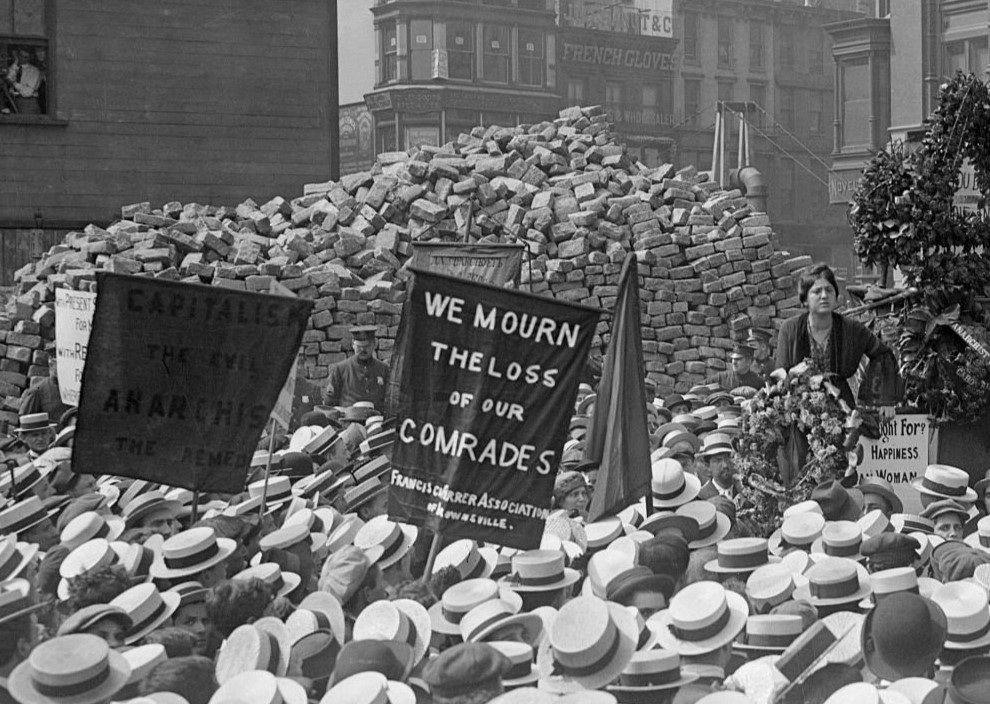
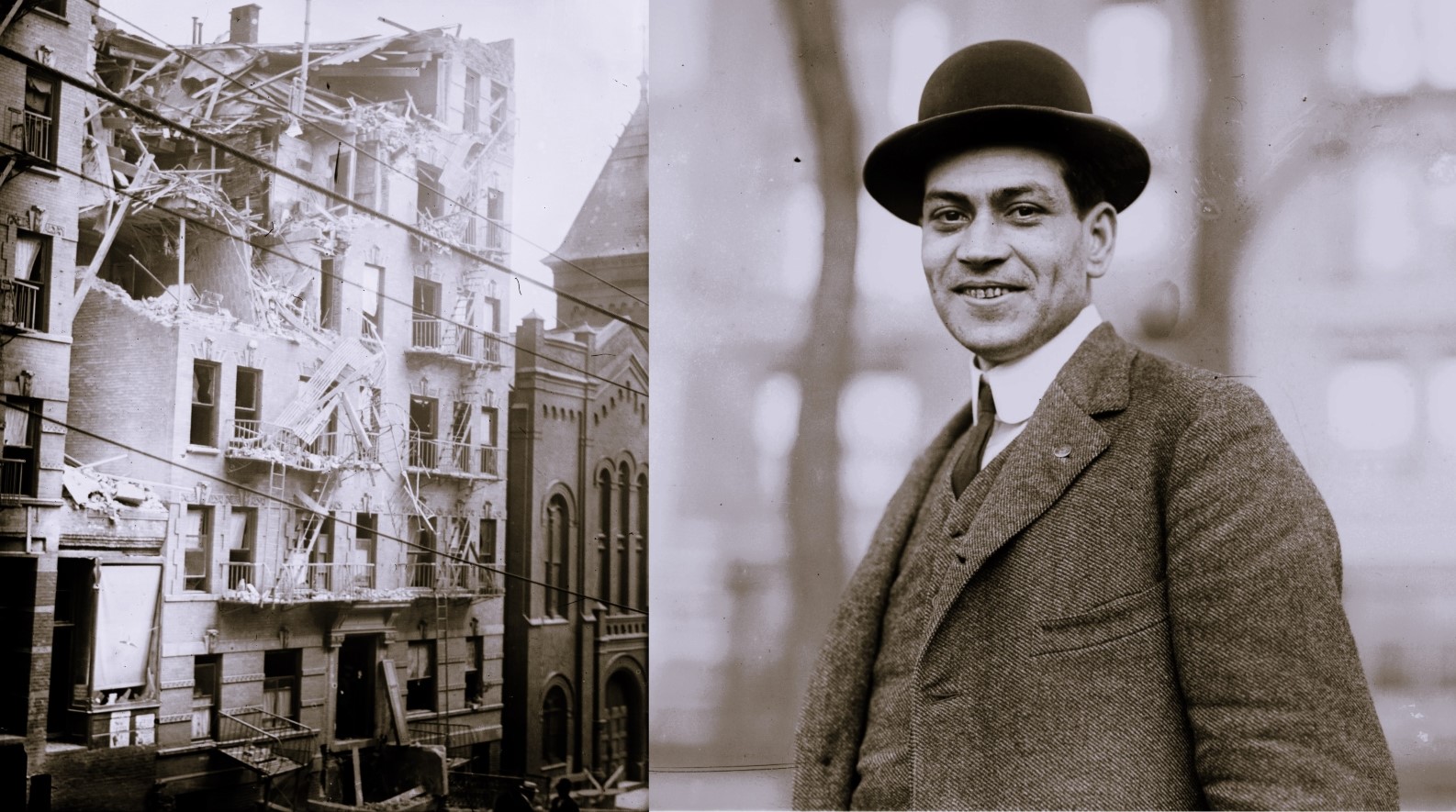
An ill Flynn made it a point to speak at the funeral of those many on the left and in the workers’ movement repudiated at the time. On July 4, 1914 Quebec-born Arthur Caron along with fellow revolutionary anarchists Charles Berg and Carl Hanson were killed in an explosion at their 1626 Lexington Avenue apartment in New York City. Along with them, an uninvolved tenant, Marie Chavez, was also killed and twenty people were injured. Said to be a premature detonation of dynamite meant to assassinate John D. Rockefeller in retribution for the Ludlow Massacre of twenty strikers and their families, including 12 children, three months before, the event split the left with many, including in the I.W.W., of which the three were members or associates, distancing themselves in the aftermath.
‘Speech of Elizabeth Gurley Flynn at the Funeral of Arthur Caron’ from Mother Earth. Vol. 9 No. 5. July, 1914.
Elizabeth Gurley Flynn, who since the Paterson strike has been in bad health, was greeted enthusiastically by the crowd. Her address follows:
Fellow-workers and Friends: I have come here this afternoon not as a representative of the I.W.W., but as a single individual member of the working class. I have come here because I believe the time has gone by when men should be condemned by newspapers and by their public enemies. Times have progressed mightily in the United States since 1886, and today we demand from the accusers of those men who died, just as clear a bill of particulars as if they were alive and under arrest. When a man is accused of anything he is given the benefit of the doubt, and his innocence is relied upon until he is established guilty. But it seems that in this particular case, because a man is dead, he has no chance of a public trial. So we are here today as the court of public opinion; we are here today as the grand jury of the working class, to decide whether or not a case has been really established against our dead fellow workers.
Arthur Caron has been signaled out by the newspapers because he was prominent in the unemployed agitation in this city. Arthur Caron received during the unemployed agitation two very strong impressions. One was when he was clubbed here on Union Square—not by the police, as has been stated, but by detectives, who threw him first into an automobile, and while two of them held him, two others clubbed him. He received the second strong impression when at the end of the unemployed agitation the massacre of Ludlow occurred. Of course there are many others who received the same impression. There are some who received absolutely no impression. And one of these was the beloved Sunday school teacher John D. Rockefeller, Jr. Mr. Rockefeller gave $5,000 to the Better Baby movement in New York City, but Mr. Rockefeller stands condemned in the eyes of 32,000,ooo working people in this country as a hirer of murderers, as the man who paid for the guns that shot up the Ludlow colony, as the man who, secure within his castle in Tarrytown, sent forth the order: “There will be no lése majeste in Tarrytown. My name shall not be taken in vain on the streets of the town that belongs to me.” So, Arthur Caron received the second impression when he was arrested in Tarrytown, and again when he said on the platform, “I am an American citizen,” and they clubbed him and they beat him and they struck him in the mouth with a rock.
Comrade Berkman has very well stated here today that there are two possibilities. One is that these men who died were the victims of a gigantic conspiracy. And I know there are a lot of wise guys in this crowd who smile and who say, “Oh well, they always say that.” But let me call to your mind the fact that this is not the first time dynamite has been discovered by the people who put it there. This is not the first time that there have been such dastardly conspiracies against the cause of labor. And I ask you to remember that during the Lawrence strike sufficient dynamite was planted in the heart of the city to blow up the entire city. By a striker? No. By a strike leader? Oh, no. By a prominent citizen, member of the school board, member of the Democratic party, a citizen who was a pillar of society. Yet he was arrested, found guilty and fined $500. Think of it, $500! for planting dynamite in the heart of Lawrence during the strike for the purpose of prejudicing the case against the strikers. That isn’t all. In the city of Paterson there were bombs found, plenty of them, but there wasn’t a single workingman that could ever be connected up with a single bomb. In other words, the people who found them knew more about them than anybody else. That isn’t all. Just a few days ago during the Westinghouse strike in Pittsburgh a gentleman found dynamite outside the home of the owner of the Westinghouse company. Well, a great case was immediately established in the newspapers. There were a couple of detectives who were not quite satisfied, and when they investigated sufficiently they discovered that Mr. Man that found the dynamite was the man that put the dynamite there, and that he had been very well paid for that particular job. Now, when you have this cumulative evidence, what reason is there to take their word, just to take their word that Arthur Caron was responsible for the dynamite? They didn’t like him. He was too active in the city of New York. They beat him up once before. That’s pretty good evidence that they didn’t have any love in their hearts for him. And I want to ask every fair and open-minded person in this crowd to go home tonight and ask himself this question: “Was it not possible for some individual to go into that apartment after Louise Berger had left the house, and plant some dynamite? Was it not possible? And might it not be very probable?”
Now, until the ones who accuse these comrades of bringing dynamite into a crowded tenement house have proved it, it will not be established to my satisfaction.
But suppose they did; I am going to ask you another question, friends. Suppose they resorted to violence; who taught it to them? Who was their teacher? When Arthur Caron came here, a quiet young man looking for a job, was he thinking about dynamite? When Arthur Caron came hungry into the unemployed army and asked for bread, was he thinking about dynamite? When he went into the church and asked for shelter, was he thinking about dynamite? Remember, when he asked for bread, they gave him the blackjack. When he went to Tarrytown and asked to express his feelings about the massacre and tragedy of Ludlow, they gave him stones. If Arthur Caron and the men who were with him resorted to violence, it was the detectives in this city and the mob of Tarrytown who taught them the use of violence. And more than that: if these men had been given a chance to organize, a chance to find some social method of securing what they wanted, bread and speech, there never would have been a chance to suspect them of the use of dynamite.
Now, I am here to say even more than that. Arthur Caron may or may not have been a member of the I.W.W. But I as one member of the I.W.W. am not here to repudiate Arthur Caron. Because I want to call the attention of our friends, the newspaper men, to something that they forget very conveniently. The I.W.W. is a labor organization and it’s open just as much to an Anarchist as to a Catholic, as much to a Socialist as to a Republican or a Democrat. A workingman who wants to organize with other workers to better his conditions in the shop, to find a job if he hasn’t got one, to bring about a system where unemployment, low wages and long hours will be unheard of—that man is eligible and welcome in the I.W.W. And whatever he might do or whatever he might think in his own private life, the I.W.W. is not responsible for; but the I.W.W. does not repudiate him, either, The I.W.W. was one of the few organizations that, when the McNamaras were thrown to the wolves, said: “Not the McNamaras are the guilty ones; we may not agree with their method, we may consider it was ill-advised and inexpedient; but not the McNamaras, but the Association of Iron Manufacturers is responsible for this thing.” And so I say here, comrades and friends: whatever version you are pleased to take of this tragedy, reserve your condemnation, reserve your repudiation for the system of society that makes these things possible.
Do you suppose that under any decent, happy, well-ordered system of society men would seek recourse to dynamite? Certainly not. And every act of violence that occurs, every act that speaks from a hate as quenchless as our wrongs, is the direct result of the system of society under which we live. And if you want to adequately commemorate the men who died, there is one way to do it: whether you agree with their ideas or not, recognize that they were sincere and that they were self-sacrificing as mighty few of you would be willing to be. But on the other hand, recognize that to adequately and properly commemorate them, you have got to put your shoulder to the wheel, you have got to make up your mind that you are going to work all the harder in your own way: if you believe in political action, in that way; if you believe in direct action, in that way; if you believe in organization, in that way. But whatever way you believe in, make up your mind you are going to put your shoulder to the wheel and do away with the rotten, murderous system of society that makes such things as this not only possible but almost inevitable.
There is one more word, and then I will give way to the others. I am not in a condition to make much of a speech, but I came here because I hope, whatever physical condition I may be in, I am not a coward and I am not afraid. I am not afraid to stand with any man or woman who is fighting the battles of labor. We are going to take up a collection here; or rather not I—the girls are going to take up a collection. Now, you have applauded a whole lot. You always do. You have evinced a great amount of enthusiasm. But do you know that there is a group of poor fellows back here that haven’t a cent in the world, but that have had to borrow $500 to stand the funeral expenses of their dead comrades? They are not kicking about $500, but they want to do more than that. They want to put up some kind of fitting memorial to the men who died. And so I have come here today not only to express my sympathy, but to ask you to express yours, in the American way—because money talks in America. We want you to give to a collection for this specific purpose, to help to pay the funeral expenses and to help give some kind of adequate memorial to the men who died, as well as to defend their names and their cause against any lies and any persecution that may arise therefrom. Now, fellow-workers, these girls are going around, and I hope you won’t miss them; I am sure they won’t miss you. Do as well as you can, but realize that in so doing you are not fulfilling your utmost responsibility. Go home from here tonight sorry for the men who died. Yes. But a whole lot more sorry for the people who are still alive in places like Colorado, in places like Michigan. Determine to help them in their fight. And let us hope that when another ten years comes around, Mr. John D. Rockefeller will be celebrating his 85th birthday, not in Tarrytown in a beautiful mansion, but absolutely stripped of all the ownership that he now has in the lives of workers, stripped of every mortgage he has on the labor of toilers, and compelled to face the world with all its contempt and all its contumely as one individual who has done more to make life miserable for his fellows than any other in the United States.
Fellow-workers, it’s sympathy and admiration for the men who died, but it’s an absolutely unconquerable determination that we are going to end capitalism, root and branch, that brings us here this afternoon.
Mother Earth was an anarchist magazine begin in 1906 and first edited by Emma Goldman in New York City. Alexander Berkman, became editor in 1907 after his release from prison until 1915.The journal has a history in the Free Society publication which had moved from San Francisco to New York City. Goldman was again editor in 1915 as the magazine was opposed to US entry into World War One and was closed down as a violator of the Espionage Act in 1917 with Goldman and Berkman, who had begun editing The Blast, being deported in 1919.
PDF of full issue: https://archive.org/download/mother-earth/Mother%20Earth%20v09n05%20%281914-07%29%20%28c2c%20Harvard%20DSR%29.pdf
 Revolution's Newsstand