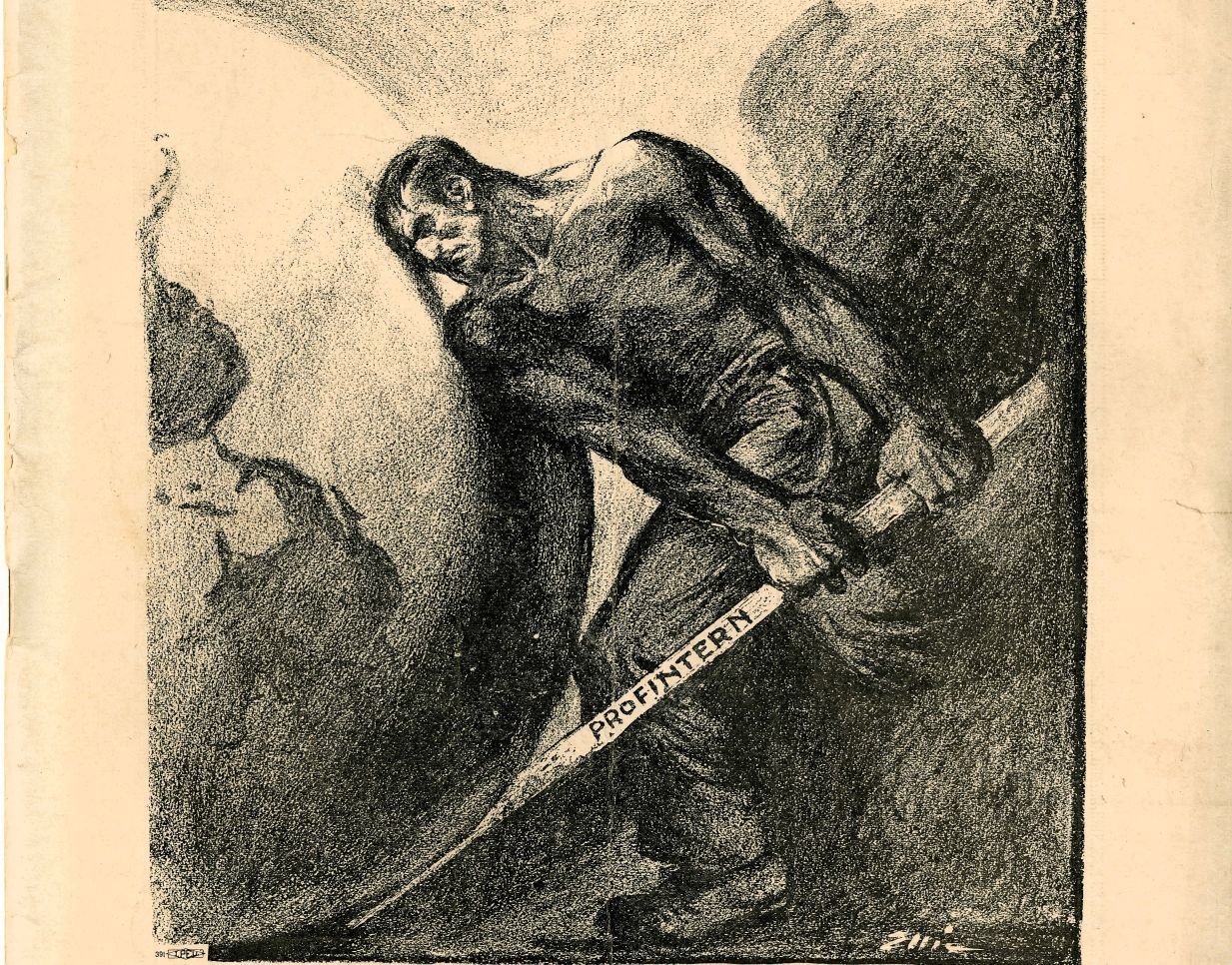
George reviews the background to the 3rd Profintern World Congress and the attempt at a united front with the International Federation of Trade Unions (the Amsterdam International).
‘The Red International’s Third Congress’ by Harrison George from Labor Herald. Vol. 3 No. 4. June, 1924.
WHEN the delegates to the Third World Congress of the Red International of Labor Unions–the Profintern–assemble at Moscow on July 5th–a postponment of ten days from the date first announced–four years will have passed since the birth of this organization which in that short time has gathered 13,000,000 unionists of 42 nations under its banner.
Great strides forward have marked the progress of revolutionary unionism since the Second Congress eighteen months ago, and the rich experience of the period needs to be summarized for guidance of the whole International.
The Red International of Labor Unions, contrary to its enemies, capitalist, reformist and anarcho-syndicalist, is not an artificial creation, but an organization arising from the profound necessities of the world’s workers. These necessities themselves are born out of the internal contradictions of capitalist production, which is entering its historical period of decline and which finds itself unable to maintain a solid ruling class of capitalist exploiters and to permit at the same time even a miserable life for the working masses. If the workers are not to starve to death by millions they must resist. If they wish security even for the slightest reforms, they must not only resist but pass to attack upon capitalism and finally overthrow it.
An added force behind the Profintern is the groping discontent of the masses with their reformist leadership which turned patriot during the war tricked them into the trenches, and after the war continued the treachery by thwarting every revolutionary effort of the workers. In one country they would deceive the masses with fine words, in another they would crush the masses with unexampled savagery–socialist savagery.
Forces Making the R.I.L.U.
Instinctively the masses of the world turned toward Russia. They did not understand the Marxian explanation of the soviet power of the Russian workers, but they perceived–even by the capitalist hostility centered upon the Workers’ Republic–that the Russian workers had by armed revolution ended, for themselves, the imperialist war and had seized power over one sixth of the land area of the globe.
This tendency found its counterpart within Russia itself. There the workers, though they had absorbed the lessons of western unionism prior to the revolution, had been able really to build their unions only after they had conquered political power. As workers of revolutionary purpose these unions naturally began seeking international connections for their 5,000,000 members. Finally all these rivulets met in the organization of the new center for the revolutionary unionists of the world–the Red International of Labor Unions–the Profintern.
Revolutionary Metaphysicians
Besides the heavy reformist assaults the Profintern had to meet guerrilla attacks of the anarcho-syndicalists. This group, so diverse that it is inherently unable to agree internally, finds its chief center in the so-called “international” at Berlin (the I.W.M.A.). This futile group, so far as it has any program at all, is dedicated to “individual development.” But its sole activity is attack on the soviets and an attempt to split the left wing of the unions to add another handful to itself.
The profound difference between the Profintern and the Amsterdam International is that the Profintern starts out from the objective, Marxian analysis that capitalism is historically dying, but is too slow in doing it and must be given a coup de grace. The Amsterdamers believe that capitalism is only temporarily sick, and that if the workers will only sacrifice enough to reconstruct capitalism, in some distant time they may inherit production by peaceful and democratic means without fighting for it.
The anarcho-syndicalists make no objective analysis. They base their actions upon their own desires instead of upon conditions. The Amsterdamers are far and away the largest and most stubborn element, since they reflect the traditional hold of capitalism upon the minds of the masses.
Since the Second Congress, the Profintern has developed to the highest pitch the world-wide struggle to win the masses from the reformist control of the Amsterdamers. Besides the basic program for revolution and the normal resistance to international reaction which has swept across the whole world, the Profintern has developed an international fight against Fascism–which it points out is an international counter-revolutionary menace–and definite a program of action against capitalist wars. To meet these great problems the Profintern proposes the United Front.
The United Front is based upon the fact that capitalist pressure forces even the most politically conservative workers to struggle, while putting the capitalist-serving leaders of these workers in the contradictory position of pretending to struggle against capitalism while really endeavoring to restore it to pre-war strength.
Time and again the Profintern has proposed to Amsterdam: “We disagree with you on many things. We are for the dictatorship of the proletariat. You are against it. We are for revolution; you are for class collaboration. But we agree with you that the eight-hour day must be saved, that wages must be increased to meet the cost of living, that Fascism is a menace that we must oppose and that war again threatens to engulf millions if we do not act. Let us lay aside our points of difference and leave only these points we agree upon. Then let us together wage a relentless struggle for those points for your points, not ours.” The Amsterdamers have refused this United Front, and as they refuse it before the eyes of the masses they become discredited with their own following.
Despite the opposition of the Amsterdamers, the Profintern proved on gigantic scale the sincere proletarian purpose of its United Front program. A great rank and file conference was called at Frankfort to aid the resistance to French occupation of the Ruhr and the terrible threat of war such occupation implied. Factory and shop delegates, members of both Amsterdam and of the Profintern met in spite of Amsterdam leaders. Socialist and Communist workers together planned and executed militant action in the Ruhr.
Scores and hundreds of French Communists and German Communists threw themselves into illegal propaganda work among the French soldiers of occupation in the Ruhr. Marcel Cachin and other prominent Communist members of parliament were thrown into prison by their government for opposing occupation by seditious agitation among French soldiery. This fine work has won the Ruhr masses to follow the leadership of the Red International, as is shown by both the solid Communist vote and the miners’ strike. The Frankfort Conference is a monument of achievement to the Profintern.
Again in May 1923, the R.I.L.U. broke through Amsterdam resistance and met Edo Fimmen, one of its secretaries who, as head of the Amsterdam Transport Workers, signed a United Front agreement with the Transport Workers of the Profintern for joint struggle against war and Fascism. Control Committees were agreed upon in all ports and railway centers, but the Amsterdamers in scandalized haste removed Fimmen from his leading position and checked effective action. However, the Profintern is again calling for a conference of Transport Workers.
On the agenda of the Third Congress are the problems reflecting new and large struggles. Among these are the problem of Shop Committees and Trade Union Committees; the international struggle for the eight-hour day and the vital subject, never before studied and clarified upon a basis of world experience, of strike strategy. Other vital subjects are the organizational structure of militants, the attitude of revolutionary unions to the various. industrial internationals and the question of trade unions and co-operatives.
Thus we see that in the Third World Congress of the Red International of Labor Unions, the revolutionary unionists of all the world–ready to profit by their collective experience and to modify or adopt any tactical measure to accord with objective calculation–will meet to chart out the course of struggle–the struggle for proletarian power.
The Labor Herald was the monthly publication of the Trade Union Educational League (TUEL), in immensely important link between the IWW of the 1910s and the CIO of the 1930s. It was begun by veteran labor organizer and Communist leader William Z. Foster in 1920 as an attempt to unite militants within various unions while continuing the industrial unionism tradition of the IWW, though it was opposed to “dual unionism” and favored the formation of a Labor Party. Although it would become financially supported by the Communist International and Communist Party of America, it remained autonomous, was a network and not a membership organization, and included many radicals outside the Communist Party. In 1924 Labor Herald was folded into Workers Monthly, an explicitly Party organ and in 1927 ‘Labor Unity’ became the organ of a now CP dominated TUEL. In 1929 and the turn towards Red Unions in the Third Period, TUEL was wound up and replaced by the Trade Union Unity League, a section of the Red International of Labor Unions (Profitern) and continued to publish Labor Unity until 1935. Labor Herald remains an important labor-orientated journal by revolutionaries in US left history and would be referenced by activists, along with TUEL, along after it’s heyday.
PDF of full issue:

