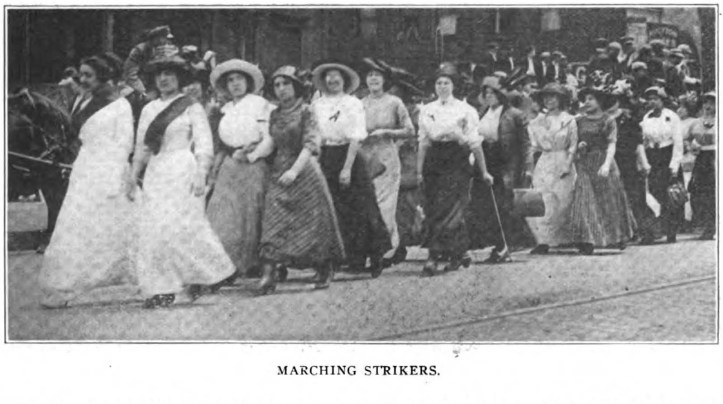
How Cleveland became an unexpected stronghold of the International Ladies Garment Workers, with its base mostly among immigrant workers in New York and Chicago, the union put down deep roots in the largely American-born women workers in the Ohio city after a successful 1911 strike.
‘The Cleveland Cloakmakers’ Union’ by L. Finkelstein from Justice (I.L.G.W.U.). Vol. 2 No. 9. February 27, 1920.
When we examine the powerful well-organized Cloakmakers’ Union in Cleveland, it is difficult to realize that it is reality and not a beautiful dream. Everything that has recently occurred in Cleveland, the negotiations between the Union and the Manufacturers’ Association, and what is taking place now, appears to be so fantastic as if it were a dream. But the healthy enthusiasm of the members indicate that it is an impressive reality.
After all the attempts of our International to organize Cleveland, including the great cloakmakers’ strike of 1911, there has developed a belief that the Cleveland cloakmakers “will never be organized,” that the cloak center in Cleveland, next in importance to New York, will forever remain a scab center. The phrase, “the Cleveland cloakmakers can never be organized” was frequently repeated. Not only was this the belief of the rank and file, but of many of the officials of our locals. Many theories have sprung up to enforce this belief. It was said that the Cleveland cloak manufacturers were “too rich”; that the cloakmakers were property owners; that the section system of work made organization work impossible; that the girls were made up of stuff which is not organizable.
This cloak center was solemnly said to be destined to remain under the dominion of scabs.
But our International was firmly determined to ignore all the pessimistic theories regarding the Cleveland cloak trade and proceed to organize the workers. Fortunately Brother M. Perlstein, possessing indomitable energy, great ability and an inexhaustible fund of patience, has undertaken the tremendous job of organizing the Cleveland cloakmakers.
As it was to be expected the work did not proceed very smoothly. The situation appeared to be gloomy, and some “practical men” have predicted inevitable failure and have warned against the “waste of time and money” for such futile purposes. But the leaders of the International remained firm. The determination to have Cleveland organized under all conditions has swept aside all the dismal predictions, all the “practical” advice. There was only one solution that the International decided to follow. It was: Cleveland must be organized. And not only are the Cleveland cloakmakers well organized today, but their organization marks one of the most splendid achievements in the annals of American labor movement.
In his report to the last quarterly meeting of the General Executive Board, Secretary Baroff says the following in speaking of Cleveland:
“I am very happy to report to you that the Cleveland situation which has been one of the most vexatious spots for the past nine years, has been brought to splendid end, and Cleveland is now on the map of the International as one of the Union strongholds.”
One can readily agree with Brother Baroff that the situation is highly encouraging. Were it not so well organized there would still be sufficient cause for gratification, taking in consideration the many hardships and obstacles in the way of organization.
But I have somewhat strayed from the subject of this article. I was to write on the actual achievements of the Cleveland cloakmakers, but I could not simply, in a matter-of-fact way, enumerate the various activities of the Union. I could not repress the surge of feelings when writing on this subject. What are these achievements!
There are many things that could be said about the Cleveland Cloakmakers’ Union. There are 4000 good standing, enthusiastic members. What is particularly gratifying is that 2000 of the membership are women, most of them gentile American girls to whom the Union has become a part of their life. The Union has opened up new horizons for these girls, has revealed to them the meaning and power of solidarity, has instilled new life into them. They now feel stronger, freer, nobler. They are united and consequently they are not subject to the wild caprice of the boss, foremen, or manager. They are constantly aware that the Union protects them. They fully realize that their conditions have undergone a startling change since the advent of the Union, that the relations between the employer and the worker have been transformed. This calls forth their enthusiasm, confidence and devotion to the Union.
Is this not remarkable? The American girls of the Cleveland cloak shops were once feared. It was said that they were the insurmountable obstacles in the way of building a union in Cleveland. Now these same girls are among the best members of the organization! The Union has founded for these girls’ musical clubs, dancing classes; it arranges lectures, discussions, concerts where the girls come with their parents and they are all having a good time. In a word, the workers are in constant touch with the Union, during their work as well as during their leisure.
The extent to which the Cloakmakers’ Union is entering into all phases of the life of its members may be seen from its undertaking to organize an Auxiliary Society of the girls’ mothers. They are paying the very moderate sum of five cents a week to the Society and they are entitled to certain benefits in case of need. The mothers are very well, satisfied with the undertaking, at the same time they are directly bound to the organization of their daughters. This will unquestionably be of mutual benefit to the mothers and daughters. It is one of the most singular achievements which will make the Union still more beloved by its members.
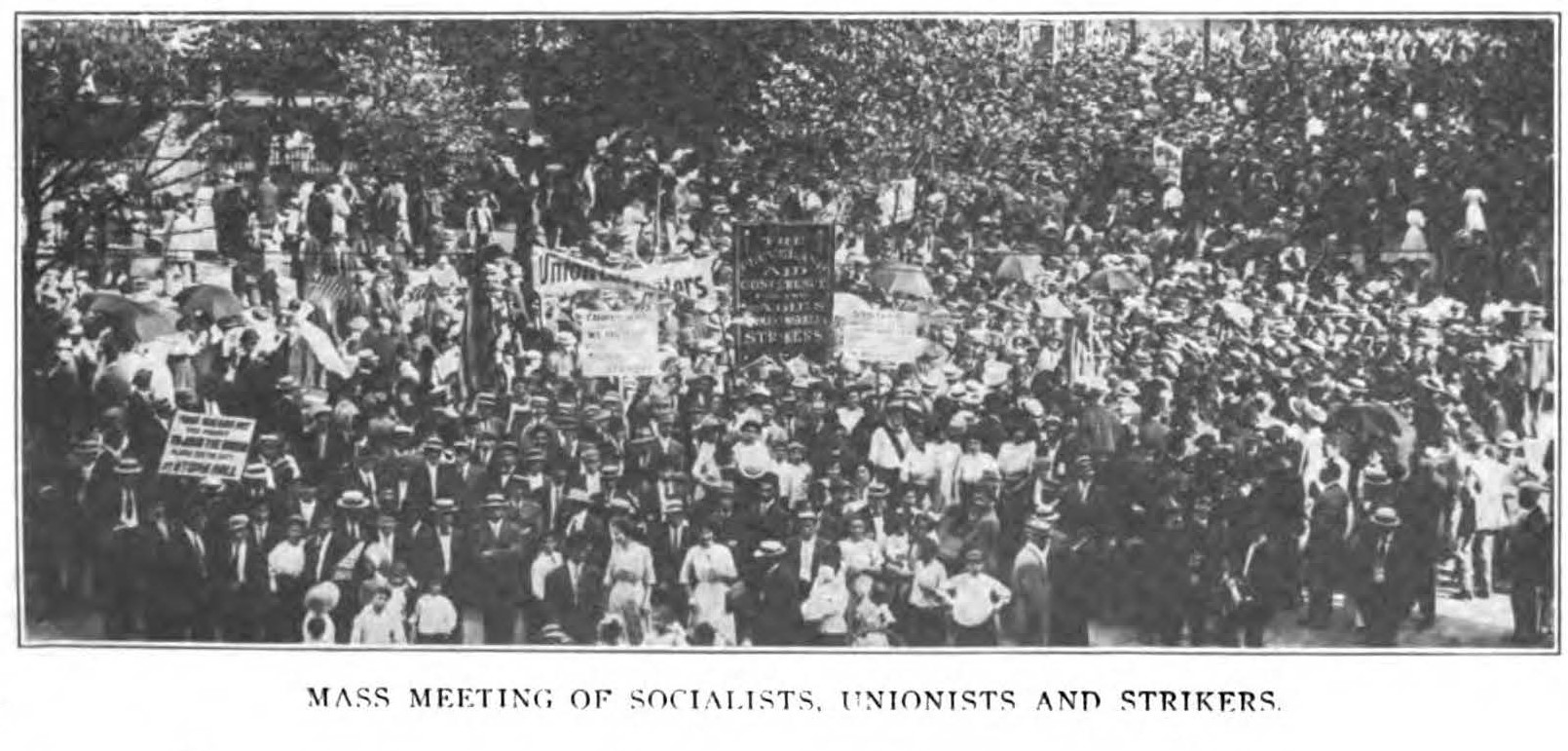
Is this not a convincing demonstration that the Cleveland Cloakmakers’ Unions widening its scope of activity? The founding of the Auxiliary for the mothers sufficiently shows how thoroughly the leaders have grasped the situation. How many foolish mothers are there to be found who still bar their daughters from belonging to union? How many are there who out of pride would not permit their children to belong to a labor organization! This undertaking therefore is a splendid ‘move’ of the Union which will go a long way in breaking the wall of ignorance and prejudice.
The Cloakmakers’ Union in Cleveland has existed for the last several years. But the manufacturers have not recognized it, have ignored its activities, have used all means against its growth. But their measures were of no avail. The Union made steady progress–until it forced recognition. All cloak manufacturers now admit that there is a Cloakmakers’ Union in Cleveland, and they deal with it officially. The Union and the manufacturers signed an agreement. There are shop chairmen and price committees in the shops. The manufacturers have also agreed to introduce week, work in the entire trade.
The weekly newspaper of the International Ladies Garment Workers Union, Justice began in 1909 would sometimes be published in Yiddish, Spanish, Italian, and English, ran until 1995. As one of the most important unions in U.S. labor history, the paper is important. But as the I.L.G.W.U. also had a large left wing membership, and sometimes leadership, with nearly all the Socialist and Communist formations represented, the newspaper, especially in its earlier years, is also an important left paper with editors often coming straight from the ranks radical organizations. Given that the union had a large female membership, and was multi-lingual and multi-racial, the paper also addressed concerns not often raised in other parts of the labor movement, particularly in the American Federation of Labor.
PDF of full issue: https://www.marxists.org/history/usa/pubs/justice/1920/v02n09-feb-27-1920-justice.pdf

