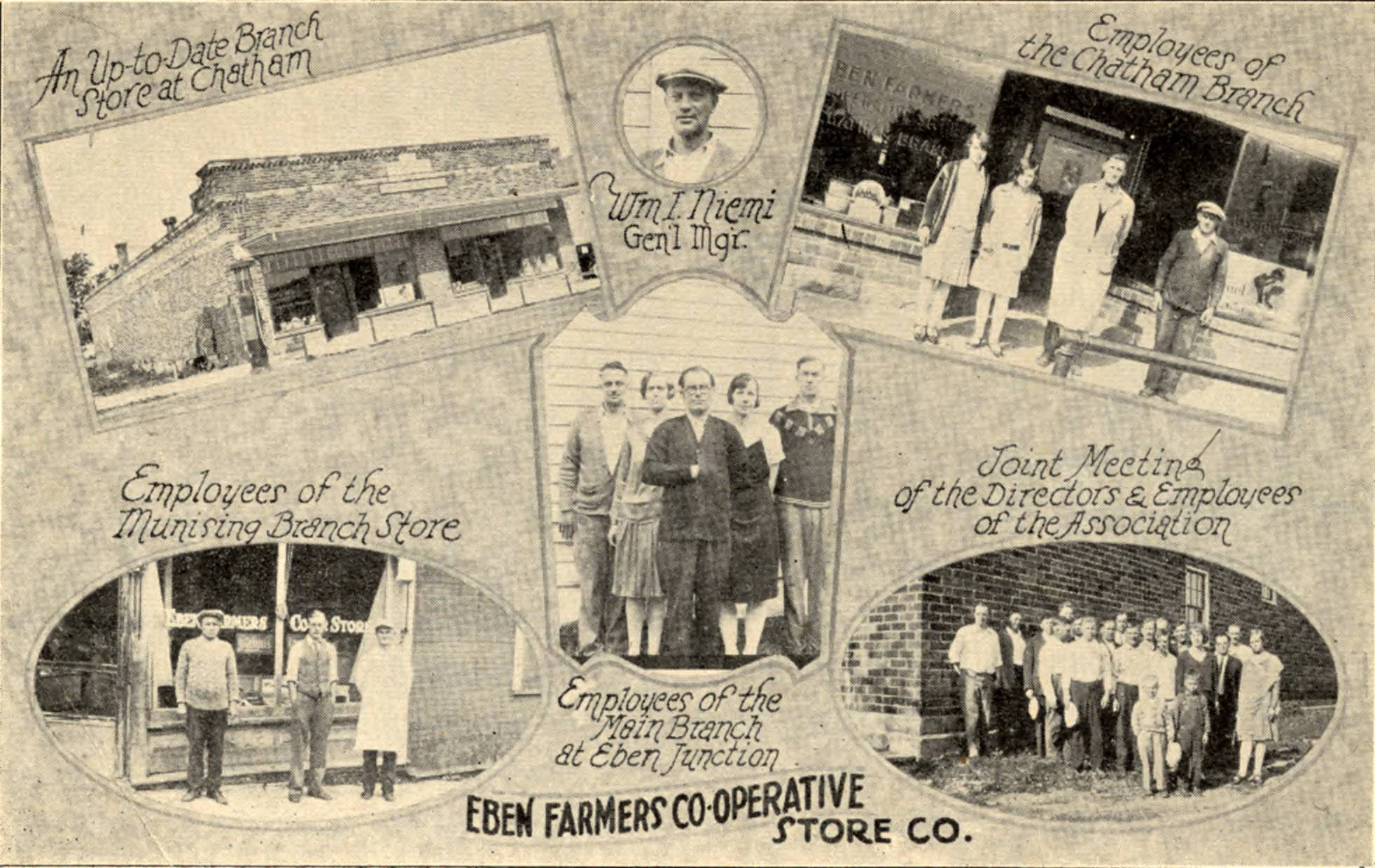
Producer and consumer co-operatives were real mass movements internationally in the 1920s and 30s, with wide swathes of the population outside of the labor movement involving themselves. In the mid-1920s, under the New Economic Policy, co-operatives played a central role, especially in the distribution of goods, in the Soviet Union and the Comintern enthusiastically, but critically, embraced the movement, it being, along with unions and party work, one of the main areas of concentration for a number of years.
‘What does the Co-operative Society Mean to the Housewife?’ by Clara Zetkin from International Press Correspondence. Vol. 5 No. 54. July 2, 1925.
Might we not expect every mother of a family to reply to this question with a paean of praise regarding the economic advantages and the ideal social significance of the co-operative societies? Those who cherish this opinion forget that in countries where the large property owners rule over and exploit the small owners and the penniless, the interests of various classes of women in the social conditions and institutions vary greatly and are even entirely opposed, the decisive question is: whether the women belong to the possessing and dominating class, and keep house from a well filled purse, without themselves performing any useful work for society at large, or whether they belong to the class who have to contrive to make both ends meet on the wages or salary of their husbands, or on their own wages or salary.
The purchase of food, linen, shoes, clothing, coal, etc., through the co-operative society, means a saving of money. It means a saving even when the prices are the same as those of the private shops. It is a well-known fact that the co-operatives supply goods of good quality, and that the weights and measures are accurate; these points in themselves render the goods cheaper. And how important all this is for the mother of a family, spending sleepless nights and care-racked days over the vain attempt to stretch her housekeeping money beyond its utmost limits, and turning every penny over ten times before she spends it. Often much time is saved by buying at the co-operative store. The housewife organised in the co-operative society is well aware of where she buys to the best advantage, and every co-operative society strives to open as many branches as passible, in order that the members need not go long distances. The proletarian housewife is spared the necessity of visiting distant market places and shops, an advantage valuable indeed to the worried and overworked housewife who grudges herself every moment of rest, and whose working day none the less often enough stretches far into the night!
The material advantages of the co-operative society will be of special benefit to the housewife in times of social distress and struggle. The co-operative society does not take advantage of scarcity goods and economic emergencies for the purpose of gaining speculative profits. Under certain conditions it can temporarily keep bread and other urgent necessities of life below the high prices ruling at the moment, and it can grant credit in cases of unemployment, without any concealed pocketing of interest and compound interest. It can lend material support to striking or locked-out workers and political fighters, out of its profits and surpluses; it can contribute to the war funds of these fighters, can provide food, clothing, etc., from its stores, for the children of those thus struggling with the bourgeois class enemy and with blackest misery and poverty: it can lend them strong moral support, agitate for them, etc.
Summed up in a few words: The co-operative society can be an extremely powerful instrument and auxiliary for the workers, employees, officials, etc., in their class struggles against the exploiting usurious capitalists and their State. It is a matter of vital interests to housewives that the co-operative society does play this role, actually and energetically. Every victory won by the exploited over the exploiters effects an alleviation of the crushing cares and burdens imposed upon the women of the proletariat and the lower middle class.
But the awakening and thinking woman of today is not content with a mere alleviation of her lot. She seeks emancipation. She longs to develop and to act as a complete human being, she demands that the whole social world, with all its duties and rights, is opened out to her as her sphere. The co-operative society performs invaluable service here for the housewife. It has already proved a political and social school for hundreds of thousands of women, and it could be the source of such education, in the highest sense of the term, for millions. Its educative and enlightening influence forms a striking contract to the influence exercised by the individual household of today, with its complete absorption of woman’s time and energy.
The household of today has ceased to be a sphere of multifarious productive activity; it no longer furthers the development of capabilities. It overburdens women with monotonous occupations, scarcely ever brightened by any new idea. It absorbs the whole mentality and activity of the housewife in a never-ending recurrence of humdrum trifles, confines her within a narrow circle, and isolates her from the human beings and events beyond the four walls of one household. The household of today cripples and stifles the receptivity, the thought, and action of woman. The good housewife’s capacity for thinking and feeling with others, her whole social consciousness, degenerates into an egoistic care for her own family. She fails to recognise a duty of solidarity towards anyone outside of her own intimate circle. She remains unaware that her personal fate is indivisibly bound up with that of her class.
The co-operative society is a bridge over which many hesitating and timid housewives may find the path from their own narrow homes into the outer world, into social solidarity. It is a link joining the economics of the individual household to the economics, the life, and the strivings of society as a whole. Its literature, its meetings, its propaganda, give the housewife the enlightenment enabling her to understand the daily object lessons of overflowing shops with the contrasting emptiness of the pantry and wardrobe at home. Many women who have never read a political article have learnt through their co-operative society that not the failure of crops has raised the price of bread, but the imposition of a high import duty on cheap foreign grain for the benefit of the large landowners.
In this manner they learn to recognise the connections between economics and politics, the decisive influence exercised by the class antagonisms between the bourgeoisie and the proletariat, between the big bourgeoisie and the petty bourgeoisie, upon the social position and standard of life of the individual. They become conscious of the strength and power which unity brings even among the weak and exploited, for they see that the co-operative society, in its capacity as a large buyer, can obtain better goods at cheaper prices than the small owner of a private shop.
The intimidated and anxious housewife learns even more than all this from the life of the co-operative. She learns that a business enterprise need not necessarily be synonymous with profit, with an advantage gained by a few at the expense of many, and that the welfare of all is more than the profits of the few. She is given the right to co-operate with others in the defence of her opinions, demands, and interests, and to exercise an influence in the control and management of the business. Once this right is given her, the courage to exercise it and the sense of duty compelling her to exercise it awaken of themselves. The enlarged economic, political and social horizon given by the co-operative society activity, furthers the development of class consciousness, of realisation of fraternal solidarity among the exploited and oppressed. The active and consistent woman member of a co-operative society is bound to become a revolutionary fighter against capitalist profit economy and its bourgeois state, or she is untrue to herself and to the ideal of the co-operative. The housewife may begin her co-operative activity for the sake of gaining some advantage for her own little household. But she must end it by joining the struggle against the bourgeois order, by fighting for the seizure of state power as the means of revolutionising economics and society.
The housewife can thus find in the co-operative society that which fills her life with all that is highest and best. The will to fight, the irresistible impetus to fight, for her emancipation; and at the same time the mental and social equipment for the fight. But it is quite another question whether the co-operative society actually does offer the housewife all it should offer, in truth and deed, for her material and mental equipment as a servant of the revolutionary proletarian class struggle. This depends on the spirit permeating and actuating the co-operative society. Is the ruling spirit merely one of despicable, bourgeois, individualist profit and dividend-hunting in favour of a limited group of persons, a spirit of reformist and capital subservient “neutrality”, smothering all will to revolution in a cheap syrup, or is it a spirit of revolutionary proletarian class war, conscious of its mission as bearer of the true ideal of co-operation? For true co-operation can only be realised when the proletarian revolution has deprived the exploiting bourgeoisie of its position as ruler over state and economics, and when the co-operative society has been converted into an apparatus of social development and distribution, serving the transition to and the carrying out of communism.
The housewife should not resignedly accept the spirit which happens to prevail in her co-operative society. She must realise that this spirit is hers, hers and that of her sisters and brothers. The co-operative society is what its members make it. The housewife, as a convinced co-operative worker, is bound in honour to combat, continuously and systematically, the open and concealed anti-revolutionary bourgeois spirit finding its way into the co-operatives, and to spread the co-operative ideals and the propaganda for co-operative organisations among ever increasing numbers of men and women ready to fight, class consciously and determinedly, against capitalism. All efforts must be united to haul down the lying rainbow flag now floating over the international co-operative movement, the symbol chosen by those who continue to talk rubbish about smoothing away the antagonism between the nations, and about eternal peace among the peoples, without uttering a syllable about the fundamental causes of the hostility between the nations, or about the actual roots of predatory imperialist wars the irreconcilable class antagonism between possessors and non-possessors. The flag borne by this kind of co-operative society is as deceptive as the wisdom which it represents.
These ladies and gentlemen boast of the influence exercised by 50 million co-operative society members in 31 different countries. They preserve silence regarding the fact that they, as leaders, not only neglected to mobilise these 50 millions against the last great massacre of the peoples, but have done something much worse and more unpardonable: they have driven these millions into the camp of the bourgeoisie which is lusting for power and money. These ladies and gentlemen forget that in the bible legend the rainbow did not appear as a celestial sign of peace until the flood had exterminated every living creature. The sign of socialist peace cannot appear until the proletarian revolution has wiped out class antagonisms. This sign of peace will not, however be the co-operative rainbow flag, symbol of sentimental pacifist drivel and allied bourgeois and reformist reaction. The true sign of peace can only be the glowing red of the banner borne by the Communist International, leading the revolutionary proletarian fighters today to battle, tomorrow to victory. It is around this banner that the housewives must gather in the co-operative societies.
International Press Correspondence, widely known as”Inprecor” was published by the Executive Committee of the Communist International (ECCI) regularly in German and English, occasionally in many other languages, beginning in 1921 and lasting in English until 1938. Inprecor’s role was to supply translated articles to the English-speaking press of the International from the Comintern’s different sections, as well as news and statements from the ECCI. Many ‘Daily Worker’ and ‘Communist’ articles originated in Inprecor, and it also published articles by American comrades for use in other countries. It was published at least weekly, and often thrice weekly.
PDF of full issue: https://www.marxists.org/history/international/comintern/inprecor/1925/v05n54-jul-02-1925-inprecor.pdf

