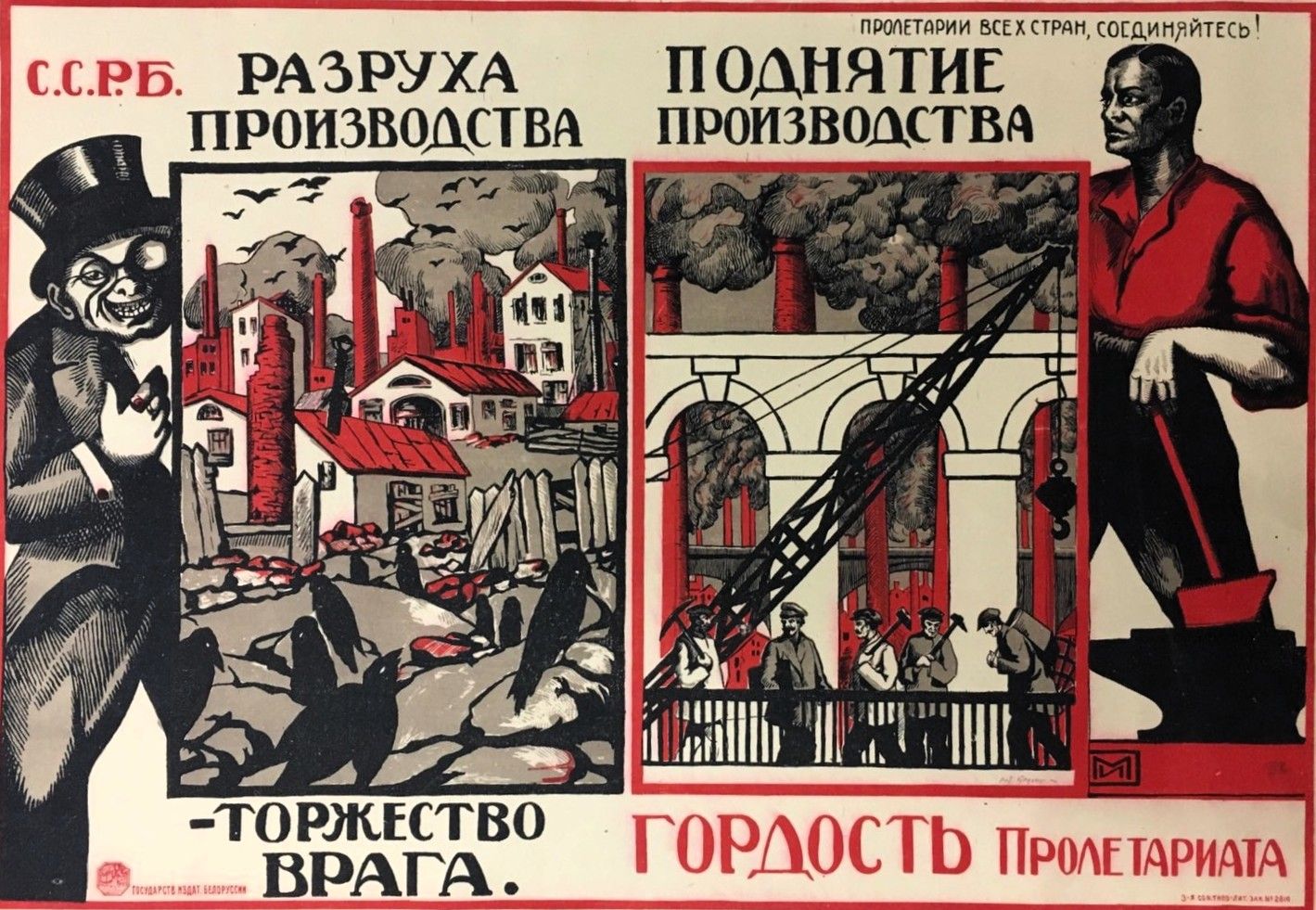
A snapshot of Soviet industry under War Communism by one of its architects. Larin–a Menshevik at first–had a long, rich, and difficult revolutionary career, arrest, prison, internal and external exile. One of the leading Mensheviks to align with the Bolsheviks in 1917. An original member of the Supreme Soviet of the National Economy, he would spend much of his Soviet career in that field. He also did not fit into any of the blocks emerging in the factional disputes of the 1920s, leaving him increasingly isolated at the decade’s end. From a Crimean Jewish background, Larin took an interest in Jewish affairs, headed the Society for Settling Toiling Jews on the Land and advocated for Jewish agricultural communes in the Crimea and was sharply opposed to the Birobidzhan creating an autonomous Jewish region and removing Jews far from their traditional communities. He would perish of natural causes in 1932.
‘Economic Reconstruction in Soviet Russia at the End of February, 1919’ by Yuri Larin from Soviet Russia (New York). Vol. 1 No. 3. June 21, 1919.
Member of the Supreme Council of National Economy
The half year that has just terminated was the first period of economic reconstruction in Russia. The resources of the country, considerably depleted by the war, do not as yet offer us any possibility of attaining a high standard of living, but important forward steps have been taken in the matter of the preliminary work of organization for economic reconstruction.
In industrial life, there has been almost accomplished the transition from mere regulation and supervision, to real government control over factories and plants, the nationalization of which had hitherto existed only on paper, or which bad been under the control of dictatorial workers’ committees not in full agreement among themselves. There is now present in all the main branches a government “Central Administration,” which manages all the enterprises of a certain industry as a single unit. Such Central Administrations are those of the textile, machine-construction, paper, rubber, honey-raising, cement, coal, sawmill, peat, salt, match, tobacco, shoe and leather, baking, starch, alcohol, sugar, and many other industries.
Owing to the necessary length of the process of organizing and listing the resources in raw materials and fuel, and to other necessary preliminary arrangements, a real working program was not established in these industries until 1919; these programs are now in full harmony and mutual adjustment.
The Supreme Council of National Economy, in organizing the little and big industries, afforded an opportunity for the abolition of private trading in factory products (decree of November 21, 1918). This made possible the establishment of a system of government centers throughout the country, which took the place of the former private stores.
On the basis of the new government organization of supplies there is carried out the principle of compulsory consumers’ organizations. Beginning with February, the distribution of the products will take place along class lines, i.e., workers engaged in the manufacture of textile fabrics, matches, sugar, petroleum, vegetable fats, shoes, etc., receive higher assignments that townspeople, and the latter get more than the peasants (owing to unusual conditions in agricultural districts, which often render the lot of the rural population very favorable.)
With the progress of the organization of the national economy, a decrease in the value of money goes hand in hand, at least in so far as its necessity as a medium of exchange is concerned. This is evidenced by the fact that for the second seven-month period of the Soviet regime (June-December, 1918), the amount of paper money in circulation was a little less than in the first seven-month period (November, 1919-May, 1918), in fact this amount remained at the lower level even in January, 1919, (about three milliards), in spite of the fact that prices had nearly tripled since the opening of the Revolution.
The decree of February 20th extends and systematizes our achievements: it provides for the transfer of all factory products to the appropriate national institutions (locomotives are assigned to the Commissariat for Means of Communication; guns to the Commissariat of War; textile fabrics to the Commissariat of Supply, etc.) without compensation, without even a fee for bank transfer.
It also establishes a mixed government budget of money and barter, under which system money is assigned to the factories (such as in cash or by opening credits in the national banks) only for such purposes (such as salaries) as could not be carried out by direct exchange through other institutions, for instance, by barter without recourse to the medium of money (thus even banking establishments will be supplied with fuel, raw materials, machinery). From July 1, 1919, on, it abolishes railroad freight charges for the transportation of cargoes; postal charges for forwarding letters by mail have also (since January) been abolished. The fact that social services must be rendered to the population without charge is now being realized, among other such free services being the abolition of house-rent in connection with the enforcement of municipalization of houses in cities, etc.
The gradual realization of order in the economic life of the country permits us to work more intensively in 1919 than in the preceding year toward the expansion of our forces of production. The establishment of power by the workers involved from the very first a fundamental change in the nature of the directions in which those portions of the national energy that arc represented in the national budget, are being expended. Both 1917 and 1916 have budgets of about 28,000,000,000 rubles—about the same amount for each year. But in the first (or “bourgeois”) year, two-thirds of that amount went to the Army, and the remaining items received the remaining third of the budget, while in the second (or “socialistic”) year, although the war was in progress throughout this year, only one-third went to the Army and the remaining two0thirds to the other items in the budget.
Some of the great construction works planned is 1918 can now be carried out, owing to the cutting down of military expenses; such are: the irrigation of 1,500,000 acres in Turkestan, the canal to connect the Volga and the Don, the Volga-Embe Railroad, the new naphtha region on the northeastern shores of the Caspian Sea, which promises to become a second Baku, and other similar constructions.
The increased authority of the dictatorship of the working class during the second half of 1918 afforded an opportunity for creating a socialistic rural economy. This was taken advantage of, chiefly by organising the great agricultural enterprises, which were under the direct management of the Soviet Government, and cultivated by hired laborers. By the end of 1918 the total area of these Soviet establishments was about 800,000 dessyatins (more than 2,000,000 acres), of which about 500,000 dessyatins were in Great Russia, and about 300,000 in the Government of Minsk. In the second place, in order to facilitate the “urbanization of the rural population,” i.e. its adaptation to the interests of the industrial population of the cities, the big estates were transferred to individual factories and to subdivisions of them.
The latter process was especially encouraged by the decree of the People’s Commissariat of February 15, 1919.
All these provisions give to peasants with small, individual holdings, as well as to group operations, a new, large, state system of Socialist agriculture (on the confiscated lands of the former landholders, whose land has not yet been completely divided among the peasants). In the future this will tend to decrease the economic dependence of the city population on the peasantry. The peasants will therefore have constantly before their eyes a great agricultural establishment, which will convince them by other demonstration of the advantages of a rational, collective economy, and will thus attract and persuade them to join in this mode of operation.
As is clear from the above statements, the new organization of Russian economic life is approaching that stage in its development when it will be able to solve the problem of naturalizing the earning capacity (i.e., returning to the workmen, in the way of exchange, all the necessities of life, such as rent, manufactured products, foodstuffs, etc., without involving any money transactions). In a country which is predominantly agricultural, such as Russia, this arrangement will have a great class significance.
For the present, the earnings are fixed at six hundred to three thousand rubles monthly, by the decree of February 17th, which limits include all the categories in the various branches of activities beginning with the young day laborer and ending with the highly skilled engineer.
Soviet Russia began in the summer of 1919, published by the Bureau of Information of Soviet Russia and replaced The Weekly Bulletin of the Bureau of Information of Soviet Russia. In lieu of an Embassy the Russian Soviet Government Bureau was the official voice of the Soviets in the US. Soviet Russia was published as the official organ of the RSGB until February 1922 when Soviet Russia became to the official organ of The Friends of Soviet Russia, becoming Soviet Russia Pictorial in 1923. There is no better US-published source for information on the Soviet state at this time, and includes official statements, articles by prominent Bolsheviks, data on the Soviet economy, weekly reports on the wars for survival the Soviets were engaged in, as well as efforts to in the US to lift the blockade and begin trade with the emerging Soviet Union.
PDF of full issue: https://www.marxists.org/history/usa/pubs/srp/v1-soviet-russia-June-Dec-1919.pdf

