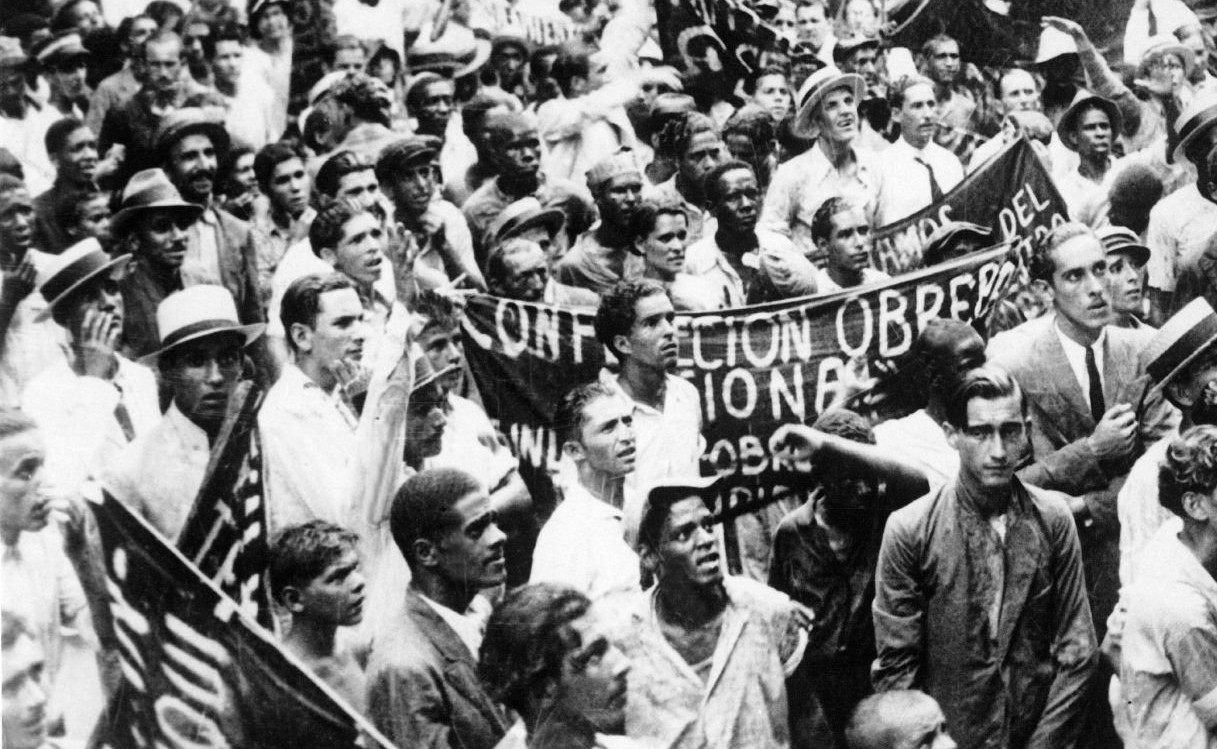
As the Iron Heel descended on Cuba after the incomplete Revolution in 1933 and Batista’s rise to power after September’s coup, the Communist Party, among the most influential Communist Parties in any country, was made illegal with many members exiled, imprisoned, or murdered. Publishing their newspaper, “Bandera Roja,” in those circumstances was an arduous and dangerous undertaking. An interview with its editor.
‘Underground Journalism’ by John Ramos from New Masses. Vol. 12 No. 13. September 25, 1934.
An interview with the Editor of the “Bandera Roja” Central Organ of the Illegal Communist Party of Cuba.
THE DETAILS of the meeting were arranged: a member of the Central Committee of the illegal Communist Party of Cuba, the editor of the illegal newspaper, Bandera Roja, is ready to be interviewed. I was looking forward to the meeting with considerable interest. We have never seen him, his name is unknown, and the only thing we know is that he came from far away; hiding, living a hunted life–yet he is the representative of an indestructible power which smashes dictatorships, conquers cities, leads hundreds of thousands, makes history.
At first somewhat haltingly, the conversation got under way with the aid of a Spanish interpreter. And since he is the editor of the Central Party organ, we started with the problem of publishing an underground newspaper.
“Is the entire revolutionary press illegal? Or is it like in Canada where the Party is forced underground but the press is legal?”
“Both the Party and the press are forced underground. Every paper is put out by illegal means.”
“How many newspapers are there altogether?”
“More than twenty, including the Trade Union papers.”
“Is the revolutionary press spreading?”
“Naturally.”
And here he gave us details. People used to legal circumstances cannot imagine how round about the way of the printed word may be. Under illegal conditions, the press takes a more prominent place. The movement needs it more than ever The Party’s possibilities of personal contact are reduced. It is the illegal press which brings the Party’s messages before the masses with the greatest frankness. We see this not only in Cuba, but also in Germany, where, while they cannot address large masses by the word of the mouth, they reach hundreds of thousands through the printed word of the press. But the bourgeoisie also recognizes values and this is the explanation of the great circumspectness, of the great sacrifices. Both sides are careful, both sides are resolved. One false move and the achievement of years of work collapses…The police also must carefully consider its steps. If they have succeeded in smuggling in a stool pigeon, an arrest arouses suspicion and for the sakes of a small haul they lose the threads… and then they must begin all over again…
The Stool Pigeon Merodio. At one time the Cuban police worked for three years before they succeeded in smuggling in one of their stool pigeons. He was Rey Merodio, a smuggler. At least, that is how he introduced himself among his intimate acquaintances. He was often among the workers, he donated small sums here and there, and he was one of those who regularly purchased illegal literature. The fact that he was a smuggler?– who would have held that against him? What if he outwits Machado, if he smuggles in goods duty free…after all, one must live and it doesn’t harm the workers…
And Merodio, the sympathetic, unobstrusive, quiet Merodio waited…waited persistently for his chance…
One of the comrades had an idea. They had a discussion and agreed. Because if Merodio is a sympathizer, and is smuggling anyhow, why couldn’t he do it for the Party?
And Merodio nodded, for isn’t it his revolutionary duty? And Merodio made his word good…
For three years he smuggled illegal literature for the Communist Party of Cuba. Now from Spain, then from France, but the treasure arrived with deadly precision. The Party was satisfied. Merodio was biding his time. But the police were getting impatient. He is among them for three years and yet he isn’t trusted? Pondering. A move. The police sacrifice two pawns. Two other provocateurs. Two of those who worked in the mass organizations. Merodio unmasks them. Merodio’s reputation grows by leaps and bounds. Merodio gets into the illegal press work…
And the police do clever work. Such an expensive investment must bring good returns. For three years, the Machado dictatorship was smuggling literature…this was a valuable service…and it must be well paid.
Merodio worked diligently. No use for small hauls…to get into the Central!…Yes, when all the addresses are known, the whole press apparatus,–then to swoop down! And Merodio was advancing in the press apparatus.
The Arrests. “How did you discover his identity?” I asked.
“Well, Merodio came to obtain the addresses of two presses. Here some premature arrests were made. But the suspicion against Merodio was aroused mostly by confidential information. There were some among city employes who secretly felt with us. One of these sympathizers came across Merodio’s name in certain documents. And when Merodio got wind of it, he skipped…”
“And that was the end of it?”
“Not quite. The name of a stool pigeon doesn’t remain unknown. The workers learned it too, and they wanted to take care of him. I heard that he was fired upon three times….”
“So the workers got rid of him.”
“The attempts were not completely successful, and Machado helped him out of the country in time. I want to add that only during the downfall of the Machado dictatorship did we learn all the details of the Merodio case. At the time of the riots we succeeded in making visits to the police station. You know, there are quite a few documents there. And after such a visit one doesn’t leave empty handed” he added smilingly.
Innocent Packages. I further inquired about the printing of the illegal papers. (I need not add, that the details published in this report are of a general character and I am authorized to reiterate them.)
“How is the work divided?”
“Well, we have weekly and monthly papers, not dailies. The editorial staff is in one place, the compositor somewhere else, and the printing is done in a third place. In a fourth place they are packed and shipped out to reliable places.”
“What are the chief difficulties in getting out the papers?”
“In the printing and in the distribution, naturally. Also the night work, fatiguing speed, hurry. The worse thing is that we always have to be on the move. This entails great difficulties. We are reduced to private apartments and cellars. The greatest difficulty is that if once we had an apartment, the second time we rarely get it, and I might say that the third time never get it again.”
“And at what rate is the press growing?”
“In spite of the hardships, we are making rapid headway. At one time we put out eight, ten page mimiographed sheets. The circulation did not exceed 10,000. And today? It exceeds 100,000.”
“And the arrests?”
“Of course there are arrests. That means a great loss of blood, because for work of this nature we can only use the most trustworthy. Two weeks ago they arrested a group.” “Is its trial over already? How much did they get?”
The Cuban comrade smiled.
“Mendieta says Cuba is a democratic country. Up till recent times, even during the Machado dictatorship, capital punishment was barred by law. Things of this sort were taken care of by the “Porra” [Machado’s private organization of secret murderers]. And now? Oh, there are no trials. They took them to the Cabana Fort–incommunicado. We do not know what happened to them…
“And the movement in general?”
“Soviet Cuba is our aim.”
Here the Cuban comrade gave a detailed description of the economic and political situation. In the overthrow of the Machado dictatorship, the Party had a leading role. The Cuban workers had a thorough revolutionary schooling under the leadership of the Party. They brought about the resignation of one president after another. They fought on the barricades, often the workers occupied cities, here and there they formed Soviets. In spite of the fact that with the exception of one month it was always illegal, the Party, which under the leadership of the since murdered Mella, was formed with a membership of 60 to 80 in 1925, today has a membership of 5,000. The membership of the revolutionary trade unions has reached more than 200,000.
In this small country with a population of three million, the influence of the Communist Party is tremendous. The present Mendieta government cannot stem the revolutionary upsurge either. The problems remain unsolved; the only way out is Soviet Cuba! And this solution lives in the heart of the masses…
“One final question,” I interposed. “What are the probabilities regarding the American intervention? Will the Soviet government be able to repel an attack?”
“We had a long schooling. The Nicaraguan narrower struggle cannot be compared with our mass movement and yet it proved to be a hard nut. Yankee imperialism cannot run a country with bayonets if we smash their local servants, the local bourgeoisie. The masses are schooled and are still learning. If we retreat here and there, and now and then we have to resort to guerilla warfare, with the Cuban masses behind us and with the help of the American proletariat,–help which we must have–we can still make an intervention a bad business proposition. And in the end the imperialists are not bad business men. Oh no! They have learned one thing, a business with a loss is no business at all, don’t you see?”
And with this the interview came to an end. We parted silently.
I had never seen him before and likely I shall never see him again. I don’t even know his name or where he went or where he is. Perhaps he is sailing towards the Cuban shores or perhaps he is already on Cuban soil as one of the generals of the tailing masses of Cubans…Who knows? At any rate, he left an interesting and colorful experience behind him. Much more interesting and colorful than the cold printed letter can convey.
The New Masses was the continuation of Workers Monthly which began publishing in 1924 as a merger of the ‘Liberator’, the Trade Union Educational League magazine ‘Labor Herald’, and Friends of Soviet Russia’s monthly ‘Soviet Russia Pictorial’ as an explicitly Communist Party publication, but drawing in a wide range of contributors and sympathizers. In 1927 Workers Monthly ceased and The New Masses began. A major left cultural magazine of the late 1920s and early 1940s, the early editors of The New Masses included Hugo Gellert, John F. Sloan, Max Eastman, Mike Gold, and Joseph Freeman. Writers included William Carlos Williams, Theodore Dreiser, John Dos Passos, Upton Sinclair, Richard Wright, Ralph Ellison, Dorothy Parker, Dorothy Day, John Breecher, Langston Hughes, Eugene O’Neill, Rex Stout and Ernest Hemingway. Artists included Hugo Gellert, Stuart Davis, Boardman Robinson, Wanda Gag, William Gropper and Otto Soglow. Over time, the New Masses became narrower politically and the articles more commentary than comment. However, particularly in it first years, New Masses was the epitome of the era’s finest revolutionary cultural and artistic traditions.
PDF of full issue: https://www.marxists.org/history/usa/pubs/new-masses/1934/v12n13-sep-25-1934-NM.pdf

