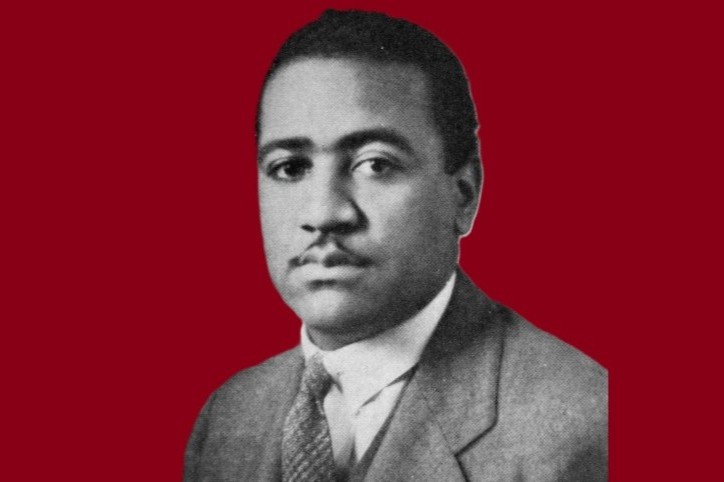
Introducing a larger audience to Ben Davis Jr. as he became editor of the Negro Liberator, newspaper of the League of Struggle for Negro Rights. Davis was an important Black leader of the Communist Party who began as the attorney for Angelo Herndon and would be elected Communist alderman from Harlem in 1943. Convicted under the Smith Act in 1949, he would eventually spend over three years in prison. Closely associated with Foster’s leadership after the war, Davis finished his memoirs, Communist Councilman from Harlem, before his 1964 death, again under indictment.
‘Ben Davis, A Fighting Southern Lawyer’ by Don West from The Daily Worker. Vol. 11 No. 150. June 23, 1934.
THE white rulers of the south regard a Negro as a lower type of humanity. For centuries the black man has bowed his shoulders to bear the load of southern oppression. He has been trodden under foot, lynched, chain-ganged.
The Civil War was over. Still the Negro was forced to bow to his mister with “Cap. boss, yes sir.” Certain so-called Negro leader. Like those of the N.A.A.C.P., told the Negro masses that was the best way to get along with the white rulers! Stay in their place. Be nice to the white boss. Bear a constant burden of fear and grief, but don’t offer to fight back. So the Negro masses stayed under the white rulers’ thumb. They were made to think the poor white workers were their enemy rather than the landlord and boss class.
But always there have been those courageous men among the Negro masses who dared face the anger and violence of the white lynchers. Even before the Civil War there were slave uprisings led by such heroic men. And when these leaders rise from the Negro people they always find a following of workers ready to learn what to do and do it. Among those we recall are such names as Nat Turner, Gabriel Denmark Vesey, and Angelo Herndon—leaders of the Negro masses.
***
BEN DAVIS Jr., native Negro leader of Georgia, follows in line with those valiant men who have dared fight for Negro rights against the terror of a lynching white ruling class system. Davis has always known what it means to be a Negro in Georgia. His early life was a constant reminder of that fact. His father was one time a real fighter for Negro rights. Young Ben Davis Jr. must, have felt keenly the hate of the white man at such times as when his father’s home was riddled with bullets, when his life was threatened.
Having early tasted the hatred of the white rulers against a Negro who dared fight for the rights of Negroes, Ben Jr. was not cowed or daunted in his courage. He was a southern Negro, but never did he have that subservient Uncle Tom approach to the white man. Early in his school life in Atlanta he saw how the so-called Negro leaders were cowed and afraid to struggle. Because of his militant leadership in college in organizing the students for struggles against certain injustices, he found himself “out of harmony” with the administration, and was expelled. Twice this spirited young Negro leader was forced by the cowardly college officials to leave school.
I have heard Ben tell how he always chaffed under the open and brutal forms of race prejudice every where in the south. All the schools he attended in the south, were of course, “Jim Crow” institutions. In the north where he went to Harvard and Amherst, he felt the more subtle forms of white chauvinism found there. He was not satisfied. Although he had been an outstanding student, a foot ball player of unusual ability, he was still treated as one belonging to an inferior race.
***
AFTER finishing his law course in Harvard, young Davis returned to the south to take up law practice in Atlanta, Georgia. That in itself is an index of the courage of the man. A Negro lawyer In Atlanta has about as much chance for success as the proverbial snow ball in hell. A struggling young Atlanta lawyer. Ben Davis Jr. became interested in the Herndon case. Herndon was a Negro, a fighting young Negro. That was something to attract such a one as young Davis. But he knew nothing of the Communist Party, the I.L.D. or their position on the Negro question. He was simply interested in a young Negro who had dared, as Herndon did, to face a lynch mob and defy the white rulers of Georgia!
When a representative of the I.L.D. Interviewed Ben Davis Jr. and explained the position of the organization. he was glad to raise the question of Negro rights to sit on jury. He volunteered his services in the case, along with John Geer, another young Atlanta Negro lawyer. When the Herndon case came to court Ben Davis Jr. fought it with the fearlessness of one who knows what justice is and is willing to die fighting for it. Negro workers who heard this fiery young Negro speaking in a white boss court with the same vigorous courage that he has always shown, marvelled at it. White workers were astonished, Ben never compromised an inch with the white court. He demanded that the court and the lawyers refer to Angelo Herndon as “defendant” instead of “darky” or “n***r” Young Davis was dynamite in that southern lynch court.
In studying the records in the Herndon case. Davis became familiar with the literature for which Herndon was convicted. He read The Communist Position on the Negro Question, Race Hatred on Trial, Self Determination for the Black Belt, and other literature which Herndon had been arrested for having. And in court he put up a fearless fight, for these principles which he had studied and began to support. It was no easy thing to do. His life was constantly threatened. He was met in the hall of the building where the I.L.D. office was by Ku Klux representatives, and his life threatened. (In that same building the Interracial Commission had its office, and never a time has it been molested. Once when W.L. Patterson was speaking in Atlanta, one of the heads said he would not go to the meeting because the police might not be there to protect him. Later he called up the police to make sure they would be there. Then he went along too.).
Since the time of the first Herndon trial. Ben Davis Jr. has become known as the outstanding Negro leader of the south. Coming to see the correctness of the I.L.D, and the L.S.N.R, he threw his whole energy Into the fight, for Negro rights. He assisted in the Scottsboro ease. He became the regular lawyer of the I.L.D. in Atlanta, volunteering his services.
As a leader in the League of Struggle for Negro Rights. Ben Davis Jr. is a real fighter. As the new editor of the “Negro Liberator,” voice of the oppressed Negro masses in America, he is certain to prove the same courageous, far-sighted person that we have known and loved in the south.
The Daily Worker began in 1924 and was published in New York City by the Communist Party US and its predecessor organizations. Among the most long-lasting and important left publications in US history, it had a circulation of 35,000 at its peak. The Daily Worker came from The Ohio Socialist, published by the Left Wing-dominated Socialist Party of Ohio in Cleveland from 1917 to November 1919, when it became became The Toiler, paper of the Communist Labor Party. In December 1921 the above-ground Workers Party of America merged the Toiler with the paper Workers Council to found The Worker, which became The Daily Worker beginning January 13, 1924.
Access to PDF of full issue: https://www.marxists.org/history/usa/pubs/dailyworker/1934/v11-n150-jun-23-1934-DW-LOC.pdf

