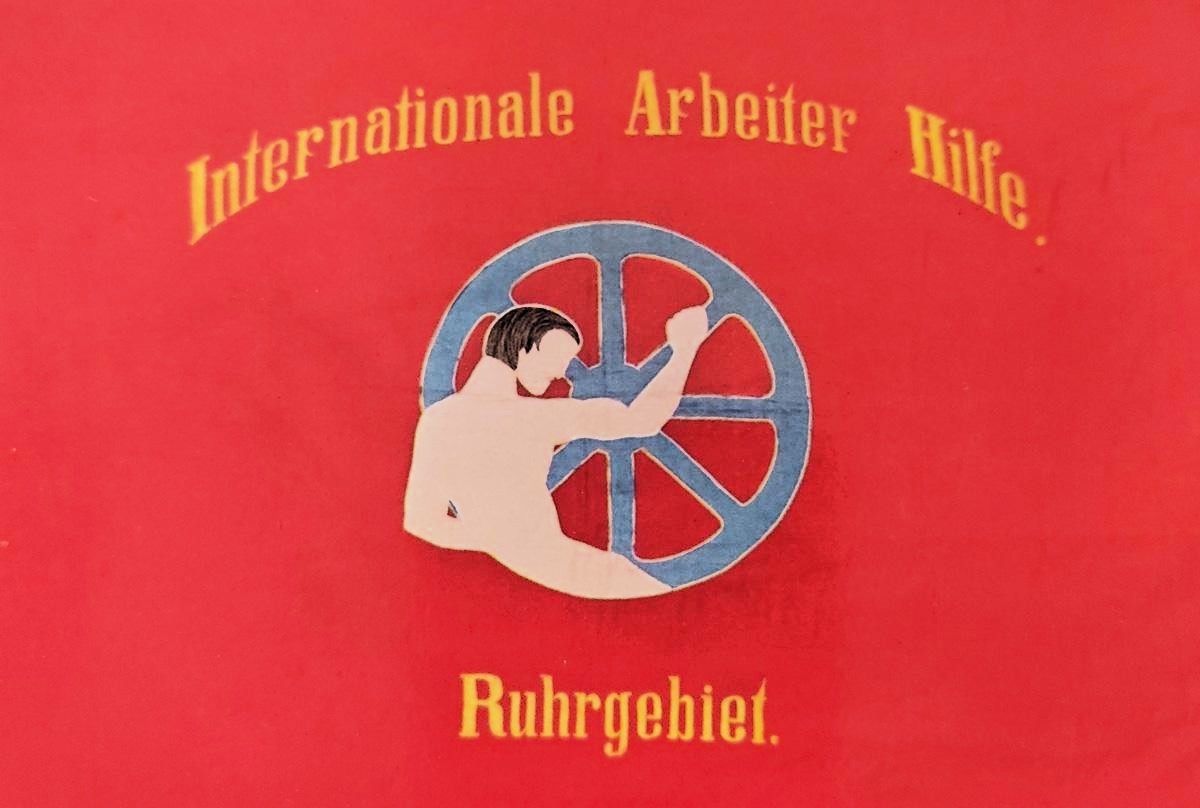
Formed in Berlin in 1921 by the indefatigable Willi Münzenberg from various, largely ad-hoc, solidarity groups that had sprung up to support famine-stricken Soviet Russia the W.I.R. (Mezhrabpom or Internationale Arbeiter-Hilfe-IAH) developed into the Communist International’s center for raising and distributing relief to workers on strike, as refugees, suffering from disasters, etc. With national sections, most importantly in Germany, but also in the U.S. and many other countries, the W.I.R. was often the organization behind youth camps and recreational facilities as well. Also down to Münzenberg, the W.I.R. became a place of pioneering use of film and images, with some remarkable artists involved, as it created information campaigns as part of collecting money and resources for those in need. In the U.S., the W.I.R. sponsored the Film and Photo League along with tents for the Gastonia strikers. Not to be confused with International Red Aid (MOPR), the Comintern’s class war prisoner support group, the W.I.R. (already severely weakened by the rise of fascism) being a specifically and separate workers’ organization, was dissolved by the Comintern with the inauguration of the Popular Front in September, 1935.
‘Five Years of Workers International Relief’ by Willi Münzenberg from International Press Correspondence. Vol. 6 No. 61. September 9, 1926.
In autumn of this year the Workers International Relief will have been in existence five years. On August 12th. 1921, the first proclamation was issued by the Foreign Committee for the organising of workers relief for Soviet Russia. On September 12th, 1921, the First International Conference of the W.I.R. was held in Berlin.
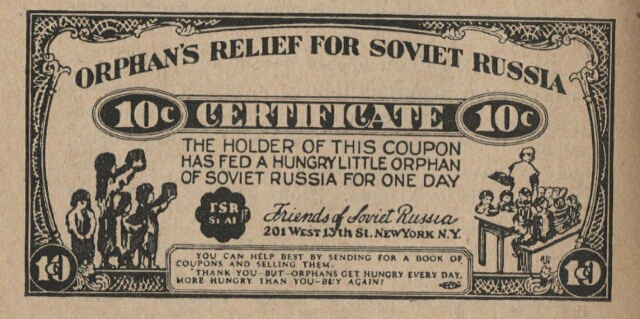
The founding of the Workers International Relief was undertaken in connection with the Russian famine in 1921.
In the summer of 1921 the results of the catastrophe in Soviet Russia threatened over 40 million people with starvation. Foreign Capitalist countries did little or nothing to help cope with the situation. On the contrary, several Capitalist countries made preparations to exploit Soviet Russia’s distressful position for purposes of a military attack upon the Soviet Republic. Soviet Russia was left alone to fight against the catastrophe which had befallen her through no fault of her own. The one help which could come from abroad was that of the world proletariat which was so zealous for the Soviet Republic. The proletarians hastened with their small means to the assistance of Russia. Proletarian Relief Committees were formed everywhere and linked together internationally by the Workers Internation Relief. The W.I.R. was not, therefore, built according to the speculative plans of individual persons, nor yet upon the basis of theories, it was born of the harsh force of circumstance.
The continued existence of the W.I.R. was, furthermore, an imperative necessity on account of the post-war privation which threatened the world proletariat.
The period of Capitalism’s decline is characterised by widespread economic catastrophes which are more ruthless and devastating than those which characterised the period of Capitalism’s commencement.
During the year 1920-21 hundreds of thousands of workers literally starved in Austria; in 1923-24 hundreds of thousands of people in Germany died of malnutrition or its concomitate typhoid, or committed suicide in their desperation. The continued aggravation of the economic stress and the steady decline in the standard of living compelled the workers in almost every country to resort to defensive strikes.
The existing labour organisations did not suffice to afford any help worth mentioning for the unfortunate, struggling millions.
The great idea which in recent years the Workers International Relief has sought to realise through the development of its organisation is that of an organisation unifying all toilers, without distinction of party or trade union attitude, during the present phase of extraordinary lights and mass privation, so that at any given moment all available economic and financial strength may be focused upon the danger point on the common front, an ambitious scheme which has been received enthusiastically by millions of workers of all continents and countries.
The relief works which have been carried out by the W.I.R. during the five years of its activity belong to the most brilliant and magnificent solidarity demonstrations and relief measures in the history of the labour movement. In the annals of the proletarian class fights there is no international action which compares in extent, duration, enthusiasm and efficiency with the great Russian relief work carried out by the W.I.R. during the years 1921 to 1923.
In those unhappy days the W.I.R. actually succeeded in rousing millions of workers and groups of artists and intellectuals who sympathised with the endeavour to make it their chief tasks for several months, and, as regards some of the groups, for years, to work to save Russia from starvation.
But also the other great international relief works of the W.I.R. we will recall only that in favour of the starving German workers in the year 1923-24, that in support of the Japanese workers and that for the benefit of the English miners began in the summer of 1926 were upheld by the workers of all nations and were contributed to by millions of workers of nearly every country.
During the five years of its existence, the W.I.R. has raised for the international works which it has undertaken, no less a sum than £1,250,000. This total does not include such amounts as were collected in individual countries for local or national tasks and expended there. At a low estimate, these amounts must represent a total of £250,000, to which can be added £500,000 for relief work in England, i.e., the W.I.R. by means of contributions of coppers gathered from individual workers has raised a minimum £2,000,000 and distributed this sum to the poorest of the poor, to those enduring the severest economic struggle, to the persecuted and to proletarians threatened with starvation.
The international economic crisis has not yet terminated. There is every indication that the privations of the broad masses of the workers will become even more acute and that new and greater economic fights are inevitable. This circumstance alone makes the W.I.R. indispensable. For years the W.I.R. was alone in its efforts to propagate the Leninist thought of the organisation of international solidarity as a weapon in class warfare. It has been attacked as a “Red Salvation Army” by the Communist Workers Party leaders and by the so-called left wing in Germany. It has also been set upon by the opportunist and social-chauvinist leaders of the Second International for interfering with “peaceable” trade union work. According to Social Democratic notions, the trade unions are the sole representatives of the workers even in times of distress and catastrophic misery, a conception which underwent necessary correction to some extent, at least during the summer of 1926. The Amsterdam Trade Union International finally came to the view that the available trade union funds and relief arrangements would not stand the strain of the big, recurrent fights. It was decided to create special funds to maintain such extensive economic fights.
The decision of the Amsterdamers has little significance in view of the fact that in supporting big strikes, such as that in Germany in 1923, the one in China in 1925 and the English strike of the current year, it is not only those organised in trade unions who are concerned, for all workers, as well as the peasants and petty bourgeois groups who sympathise with the workers, participate. These strikes also have in general a political significance for the whole of the proletariat.
The inevitable course of development will, without doubt, compel the Amsterdam people to a thorough rectification of their untenable attitude towards the W.I.R.
The foundation of the W.I.R. and, more especially its development into a mass movement with far-reaching organisations, was a matter of grave dispute throughout the Labour movement. The so-called “Left Wing” regarded the W.I.R. as superfluous. In those circles it is believed that it is possible to put an end to the Capitalist world by shouting at it.
The right-wing, circles of social-chauvinistic leaders of the Second International, who are so closely related to the bourgeoisie and who fear nothing quite so much as a close-knit united front of the proletariat, dread that a weakening of their prestige and a reinforcement of the unity movement which they like so little, might ensue as a consequence of the W.I.R. forming a common cause among Social Democratic, Communist and non-party workers. On this account they have circulated the fairy-tale that the W.I.R. is merely another manoeuvre on the part of the Communist International. The Executive of the Second International formulates anathema after anathema against the W.I.R. The Social Democratic Parties of Germany and Austria have made membership and participation in the W.I.R. punishable with expulsion. But all these measures have failed to check the W.I.R. in its development and triumph.
It started in 1921 as a few detached committees which were designed to fulfil a temporary need, but the W.I.R. now has a powerful organisation in most countries. Social Democrats, trade union members, Communists and non-party workers are members of the W.I.R. Millions sympathise with the institution. There are, furthermore, collectively affiliated to the W.I.R.: 8,000,000 Russian trade unionists, 600,000 trade unionists in Japan, the General Trade Union League in India, etc. There are sections of the W.I.R. working in all the countries of Europe, as well as in North and South America, the Argentine, Australia, South Africa, India, China and Japan.
More than 15,000,000 women and men are organised in the W.I.R., either individually or collectively. The W.I.R. is an indispensable organisation; its national organisations are indissolubly associated with the revolutionary labour movements of their respective countries. The W.I.R. is an international proletarian relief organisation, which does not desire to distribute alms, but wishes to work through the proletariat for the proletariat.
The Workers International Relief knows that it is only through a re-organisation of economy that social privation and economic misery can be eliminated. The W.I.R. will continue to use its provision-column in practical and effectual support of the struggling labour battalions until the day of deliverance.
After five years of activity, the W.I.R. looks with pride upon the tasks it has completed and the relief works it has carried out. It has helped to protect Russia and foster its development and to strengthen the defensive will of the German workers, and, by means of the China Alliance, it has built a bridge between the proletariat of the East and the proletariat of the West. The Workers International Relief which has inscribed upon its banners: “International Solidarity helps to Liberate the World!”, is thoroughly convinced of the soundness of the Leninist views. It is the ambition of the institution to demonstrate the truth of the expression:
“The international solidarity of the revolutionary proletariat is a fact, despite the dirty froth of opportunism and social-chauvinism.”
Animated by this thought, aflame with holy enthusiasm for the fulfilment of proletarian duties, the W.I.R. is preparing itself after five years of activity to use in the future in a still greater measure and still more effectually the feeling of international solidarity as a lever for the liberation of the international proletariat.
International Press Correspondence, widely known as”Inprecorr” was published by the Executive Committee of the Communist International (ECCI) regularly in German and English, occasionally in many other languages, beginning in 1921 and lasting in English until 1938. Inprecorr’s role was to supply translated articles to the English-speaking press of the International from the Comintern’s different sections, as well as news and statements from the ECCI. Many ‘Daily Worker’ and ‘Communist’ articles originated in Inprecorr, and it also published articles by American comrades for use in other countries. It was published at least weekly, and often thrice weekly.
PDF of full issue: https://www.marxists.org/history/international/comintern/inprecor/1926/v06n61-sep-09-1926-Inprecor.pdf

