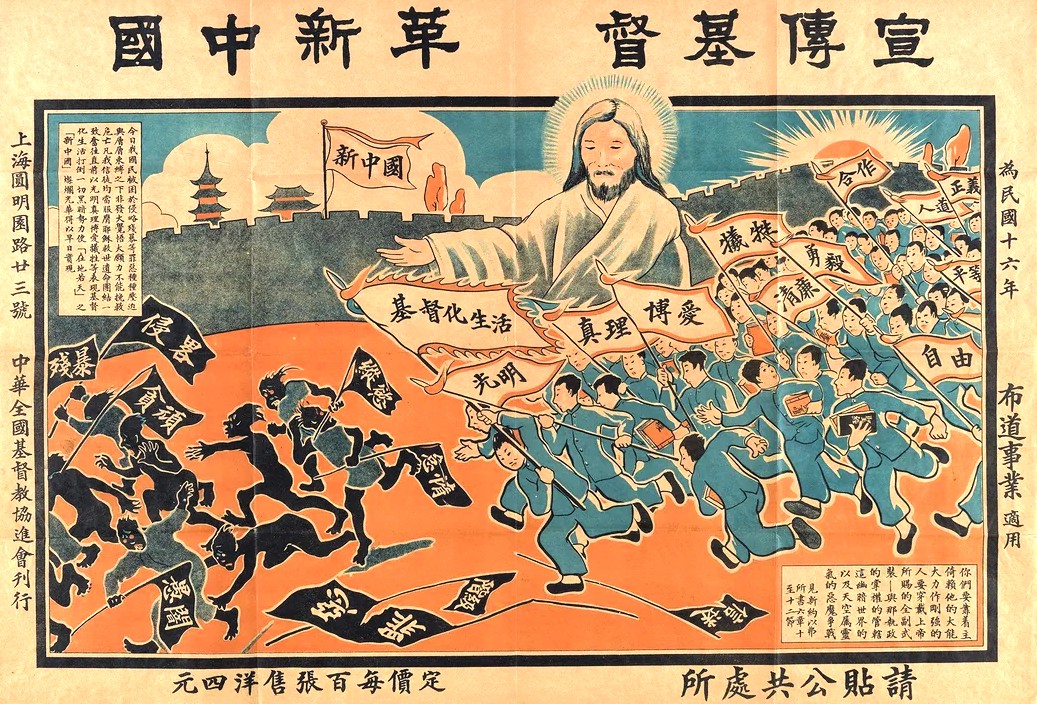
Tretyakov says the movements against Christian missionaries played a vanguard role in the development of a national anti-imperialist movement in the 1920s.
‘The Anti-Christian Movement in China’ by S. Tretyakov from International Press Correspondence. Vol. 5 No. 18. March 5, 1925.
The Christian press of Europe and America is disturbed. The active antichristian movement among the Chinese students is developing at a rate hitherto unknown.
In almost all universities anti-christian unions have been founded. In Nanking the students have publicly destroyed the bible. In Canton the anti-christian students at Christmas time arranged a Carnival and ragged the christian youth. It is natural that the missionaries have been roused by this question and that the majority of them have broken out into a terrible howl over “bolshevism”.
It is true that this is not the case with all the missionaries. There are some who perceive the connection between the anti-christian and the anti-foreign movement and are endeavouring in their sermons to distinguish the cause of the missionaries from the cause of imperialism, and even to proclaim that the fundamental task of the christian missionaries consists in “realising a higher type of nationalism”.
Even the most simple minded must see the trap which the catholic priests and the methodist doctors of divinity are laying by endeavouring to identify christianity with the most popular slogan of the nationalist movement in China, which in spite of the machinations of the missionaries bases itself upon the anti-foreign and anti-christian movement.
It is true that in Tientsin some weeks ago some naive missionaries attempted to be “honestly consistent” and to declare that religious propaganda must abandon all those privileges which have been assured to it by the imperialist penetration of China. These naive people however, were literally crushed by the whole of the remaining missionary fraternity. A flood of indignation has broken out among the missionaries regarding such an improper attitude towards the sacredness of the mailed fist, without which, as the missionaries generally admit, the holy cross cannot be firmly established on Chinese soil.
The anti-christian movement is an organic part of the anti-imperialist movement; in fact it is more than that. The anti-christian movement goes in advance of anti-imperialism and gives rise to the latter. It has struck deep social roots in China and has behind it a past of over half a century. It is immediately connected with the so-called Taiping movement (1850-1864) which in its nature constituted a mass revolt of the Chinese people against the Manchu dynasty.
It is not to be wondered at that with the growth of the national anti-imperialist movement the anti-christian movement also increases among the students. Thus, for example, the students of the university of Tchancha have put forward the following two demands:
1. The registration of the university by the government (that is, its subordination to the programme and the control of the Ministry for Public Education).
2. Abolition of obligatory attendance at church services.
The students have seen through the social nature of the missionaries, of this advance-guard of imperialism. They see how the missionaries, under the cloak of charity, are carrying on a persistent propaganda among the Chinese proletariat against those people who wish to educate this proletariat to self-consciousness and solidarity.
This is shown by a long article in the “North-China Daily News” reporting on the results of the activity of the missionary organisation of Shanghai, and which states, that this organisation is not only engaged in charity but in the fight against the strike movement.
What wonder then if the youth, who are building up a new China, so strongly hate these enemies of Chinese national and class-consciousness. Rather is it a wonder that the Chinese youth maintain such a sober and disciplined attitude in their protest demonstrations.
The missionaries are carrying on a furious and well-paid work, aiming at converting China into a “factory of slaves”. But they will not achieve their aim. The steadily growing anti-christian movement among the youth and among the masses is a guarantee for that.
International Press Correspondence, widely known as”Inprecorr” was published by the Executive Committee of the Communist International (ECCI) regularly in German and English, occasionally in many other languages, beginning in 1921 and lasting in English until 1938. Inprecorr’s role was to supply translated articles to the English-speaking press of the International from the Comintern’s different sections, as well as news and statements from the ECCI. Many ‘Daily Worker’ and ‘Communist’ articles originated in Inprecorr, and it also published articles by American comrades for use in other countries. It was published at least weekly, and often thrice weekly. Inprecorr is an invaluable English-language source on the history of the Communist International and its sections.
PDF of full issue: https://www.marxists.org/history/international/comintern/inprecor/1925/v05n18-mar-05-1925-inprecor.pdf
 Revolution's Newsstand