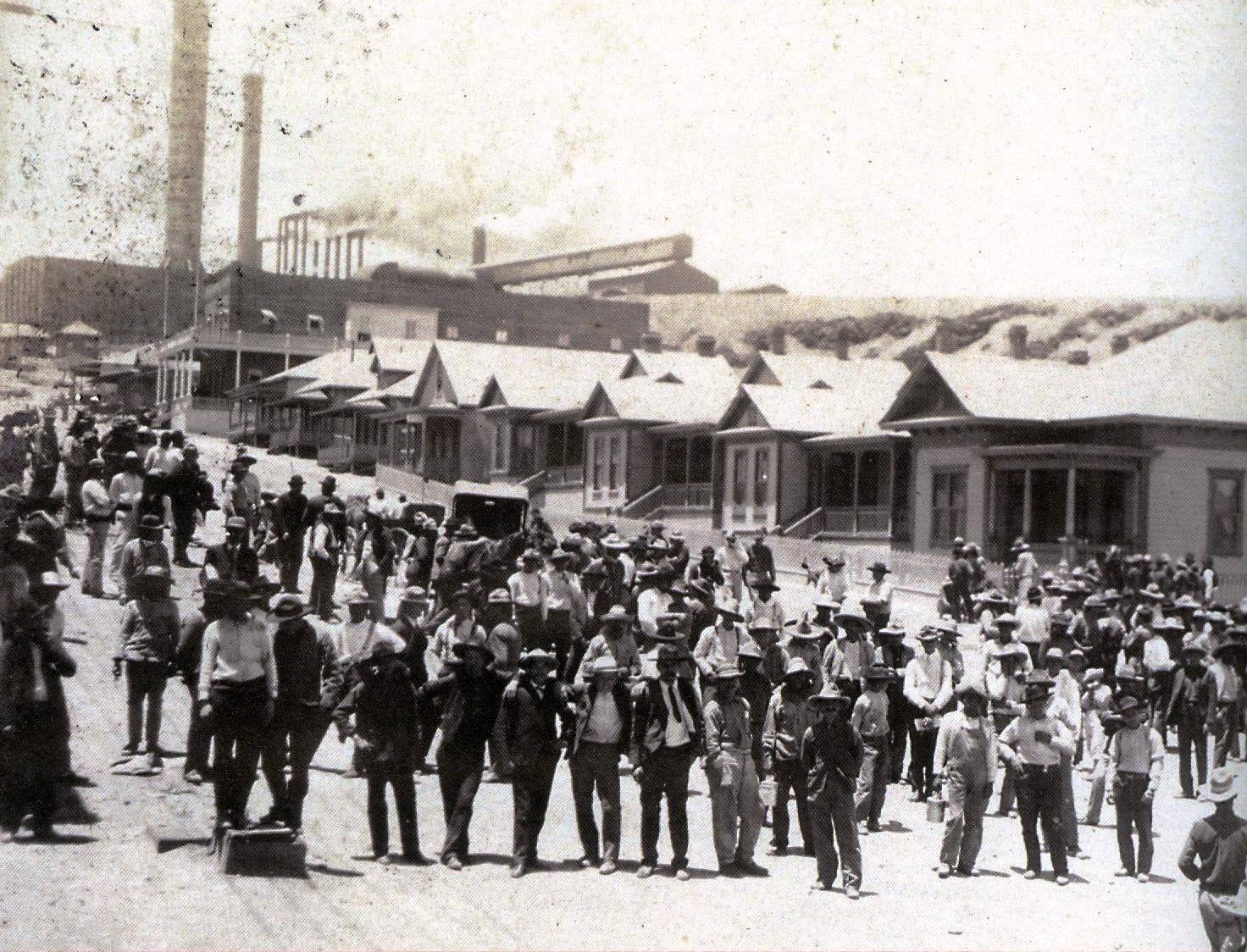
Imperialism, violence, race, and class along the Mexico-U.S. border as capitalists exploit the region’s copper belt. B.H. Williams, whose voice would be so central to the early I.W.W. as long-time editor of the wobbly press, here an S.L.P./I.W.W. organizer, reports from Tuscon on the events in Cananea, Sonora which saw over 30 deaths in June, 1906. The event would join with others in an increasing ferment to become the Mexican Revolution.
‘The So-Called Race War at Cananea’ by B.H. Williams from The Weekly People. Vol. 16 No. 13. June 23, 1906.
CLASS, NOT RACE, FEELING CAUSE OF RECENT CONFLICT IN CANANEA, MEXICO.
Natives Prevented by Governmental Requirements from Securing Wage Increase and by Law Making Organization a Treasonable Offense from Organizing, Rise in Vigorous Revolt–Incident Proves That W.F. of M., Backed by the I.W.W., Is Growing Ever Bigger and More Threatening to the Robber Class of the West.
Tucson, Arizona, June 8. The recent so-called “race war” in the big mining camp at Cananea, Mexico, forty-five miles south of the Arizona line, turns out to have been but another and significant incident in the CLASS WAR between the capitalist mine owners and their working-class victims, La Cananea is in a section of the great copper belt extending from Central Arizona southwesterly into the heart of Sonora, Mexico. Though still but partially developed, this is reputed to be the richest copper belt in the world. Jerome, Globe, Morenci and Bisbee, Arizona, and Cananea, Mexico, are the principal mining camps deriving their life and activity from the exploitation of this wonderful mountain of mineral. Douglas and Clifton, Arizona, are also large smelter towns, handling ore from the mines at Bisbee and Morenci, respectively. Cananea has a population of 25,000; and since, under a Mexican law, three-fifths of the men employed there must be Mexicans, that nationality predominates. More than 5,000 miners and smeltermen are employed in Cananea. American capitalists have secured complete control of the district–the principal company being known as the Greene Consolidated Mining Company–and have established “friendly relations” with the Diaz Federal Government and with the State authorities of Sonora. Great disparity in wages exists at Cananea. American miners receive an average of $3.50 in gold, while the Mexicans only get $3.00 per day, Mexican, the equivalent of $1.50 or less, in gold. A law of Sonora requires that before wages of Mexican workingmen may be raised a permit must be obtained from the governor of the State. Some time ago that governor, doubtless because of his “friendly relations” with the American capitalists, deliberately reduced the wages of the Cananea Mexican miners from $4.00 to $3.00 a day, Mexican money. This in itself was a, sufficient cause for discontent; but when one considers the cost of living, which is higher in Cananea than in the border towns of Arizona, where it averages more than $1.00 per day for board and lodging alone, one may readily imagine the miserable lot of the $1.50-a-day Mexican workers in that mining camp. Another law of Mexico makes it a treasonable offense to attempt the organization of a labor union in that country. As a consequence of such conditions, coupled with the agitation of Socialists and W.F. of M. men, discontent has long been brewing among the Mexicans of Cananea. That discontent came to a head, on the morning of June 1, when the Mexican miners decided to demand an increase of wages. Marching in a body, and without arms, to the home of Colonel Greene, superintendent of the Green Consolidated Mining Company, they presented their demands for an increase of wages to $5 a day, Mexican currency. Greene met them with a plausible speech in which he declared he would like to grant their demands, but could not do so without a permit from the governor of Sonora. This subterfuge did not satisfy the Mexicans and they all went out on strike, marching about town and trying to inaugurate a general strike. There is no evidence, even in the distorted capitalist reports of the affair that race feeling had anything to do with it, or that the Mexicans planned a general attack upon the American workingmen. On the other hand, there is reasonable certainty that the strikers expected their American brothers to go out with them; and only when disappointed in this did they show any hostility toward the whites. In the “riots” that followed the strike, Americans were the aggressors. At the lumber yard, whither the strikers went to induce some employes to quit work with them, some hot-head started the trouble by turning a hose on the Mexicans and when the manager of the yard, Geo. Metcalf, appeared with a gun and tried to check the mob, he and his nephew, Will Metcalf, were killed by the infuriated Mexicans. What followed this incident is told by a Cananea correspondent of the “Tucson Citizen,” under date of June 4. Says he:
“The mob, after firing the lumber yards, went to the plaza on which faces the residence of Colonel Greene and the Catholic Church. Colonel Greene came out and tried his level best to quiet it. The mob merely howled and a couple of its leaders began to fire their pistols. Some of the Mexican shooting was close enough to worry the Americans.
“Suddenly, from their side guns began to snap and snarl. Hot-heads started the shooting, but cool heads joined them. To be just to the Mexicans, the volume of the fire was from the American side. The bullets sought every corner of the square. The mob which had roared began to scream. It went back like the tide, then came forward again like a wave; then it broke and swept away–brave enough, even in its distress, to carry away its dead and wounded. A fairly conservative estimate places the number of Mexicans killed in the plaza at fifteen and the wounded at fifty. American loss, none.
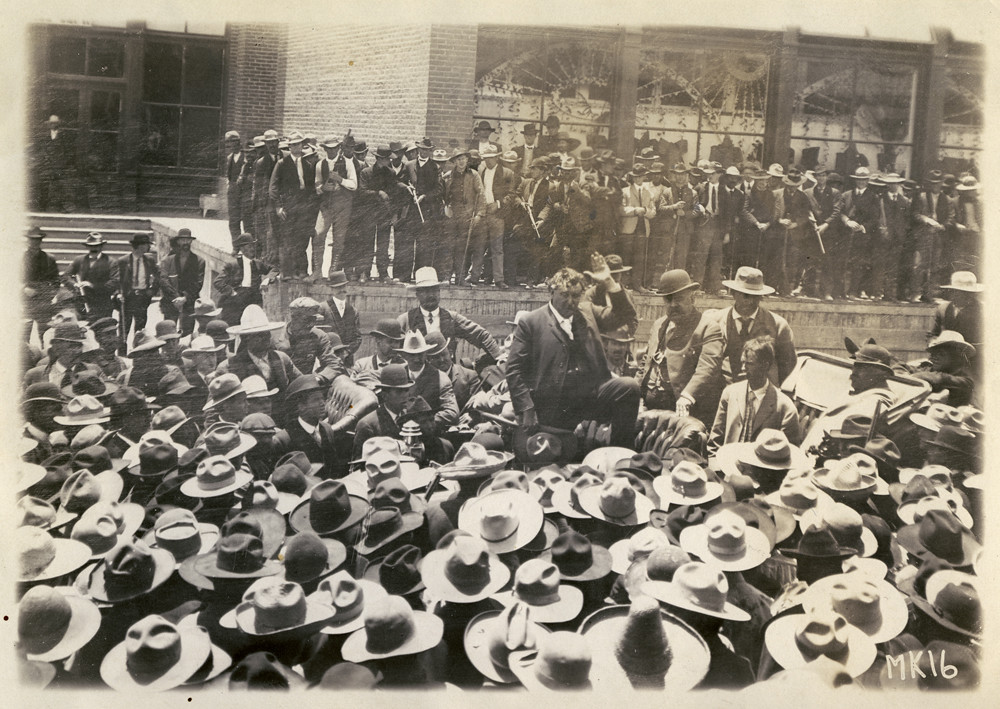
“Following the riot in the plaza there were other riots over town. Shootings occurred, at frequent intervals. Both sides took guns from wherever they could find them. Groups of Americans were frequently driven back before the Mexicans, but the shooting of the latter was very poor.”
Thus, it is evident that hot-headed tools of the American capitalists started the “race war” and are responsible for the “riots.” The subsequent coming to Cananea of the “Bisbee volunteers”–200 armed Americans from that camp–who were extolled by the capitalist papers of Bisbee as the “valiant 200,” “noble defenders of their country,” etc.–only added fuel to the flames, although the “volunteers” took no direct part in “quelling the riot.” A significant fact in this connection is that the Mexican governor of Sonoro—Ysabel–allowed Capt. Rynner’s rangers and the two hundred Bisbee men to cross the boundary and “assist” him to “suppress the insurrection.” The whole affair savors of direct collusion between the authorities of Mexico and the American capitalists.
As further evidence on the causes of the Cananea trouble, let me quote again, from the report of the “Tucson Citizen” correspondent of June 4;
“The friendly relations between the management of the great Greene properties in Sonora and the Federal Diaz administration and the Isabel government in Sonora made it easy for the Socialists and discontented elements to select the Cananea enterprises to strike at. This, it is reasonably certain, was at the bottom of the Cananea emente.”
Another correspondent, writing from Cananea to the “Tucson Daily Star,” June 5, makes this statement:
“In an interview with Ysabel in regard to the cause of the disturbances he stated with emphasis that in his opinion the Western Federation of Miners was entirely responsible for the riots. Agitators sent into Cananea by them had worked on the ignorant Mexicans and had inflamed their minds against the company to such an extent that they were ready to kill and destroy property of the company, believing in this way that they could secure what they termed their rights. The Governor particularly urged a denial of the report that the rioting was caused on account of race hatred of the Americans.
“The officials of the company rather convey the impression that the whole trouble is revolutionary and not against the company, while the Mexican authorities endeavor to convey the impression that the trouble is more in the nature of a strike for better wages and conditions. The positions assumed by both the company and the government are natural. The one is to strengthen Greene’s stock in the East by conveying the impression that there is no discontent among the employes against the management or existing conditions. The position of the government conveys to the outside world that there is no discontent in Mexico against the Diaz regime. But the truth is that there is decided discontent among the 4,000 Mexican miners at the wages that they are working, and it is also true that there is a strong feeling against both the administration of Governor Ysabel and the Diaz government whom they say could alter conditions and aid them in receiving what they should at the hands of the company.”
Thus, from the evidence sifted through the mass of contradictory capitalist reports, it appears that there was no “race war” in Cananea on June 1; that there has been and remains direct collusion “between the “powers that be” in Mexico and the American Mine Owners; that the mysterious laws against increase of wages and denying the right of labor to organize are designed to work admirably in the interest of the American capitalists; and, finally, that Socialist and Industrial Union agitation had had its magical effect in awakening intelligent discontent among the so-called “backward race” of Mexicans.
The officials of the Copper Queen Company, of Bisbee, avow that in case an organization of the miners is formed in that camp, they (the officials) will shut down the mines and replace the whites by Mexican miners. But in view of the awakening class spirit of the latter the benevolent Copper Queen Company may find itself leaping “out of the frying pan into the fire.”
From British Columbia to Sonora, the Nemesis of the W.F. of M. is rising ever bigger and more threatening before the robber class of the West. And behind and all around the W.F. of M. towers the young giant form of the Industrial Workers of the World, which is rapidly uniting all workers, regardless of race, color or previous condition of wage servitude, into one mighty army of emancipation. Let the good work go on.
B.H. Williams.
Tucson Ariz., June 8.
New York Labor News Company was the publishing house of the Socialist Labor Party and their paper The People. The People was the official paper of the Socialist Labor Party of America (SLP), established in New York City in 1891 as a weekly. The New York SLP, and The People, were dominated Daniel De Leon and his supporters, the dominant ideological leader of the SLP from the 1890s until the time of his death. The People became a daily in 1900. It’s first editor was the French socialist Lucien Sanial who was quickly replaced by De Leon who held the position until his death in 1914. Morris Hillquit and Henry Slobodin, future leaders of the Socialist Party of America were writers before their split from the SLP in 1899. For a while there were two SLPs and two Peoples, requiring a legal case to determine ownership. Eventual the anti-De Leonist produced what would become the New York Call and became the Social Democratic, later Socialist, Party. The De Leonist The People continued publishing until 2008.
PDF of full issue: https://www.marxists.org/history/usa/pubs/the-people-slp/060623-weeklypeople-v16n13.pdf
 Revolution's Newsstand